For eleven years, Earl Dobs had kept his tractor working on a remote Montana farm without bringing it back to the dealership once. Now, with 8,400 hours on the machine, he had hauled it four hours across the state to find out whether his confidence had been justified. The young technician examining it had expensive instruments, factory specifications, and a full day to look for everything Earl might have missed. Earl had brought something else: a worn notebook that had spent eleven seasons beside the driver’s seat.
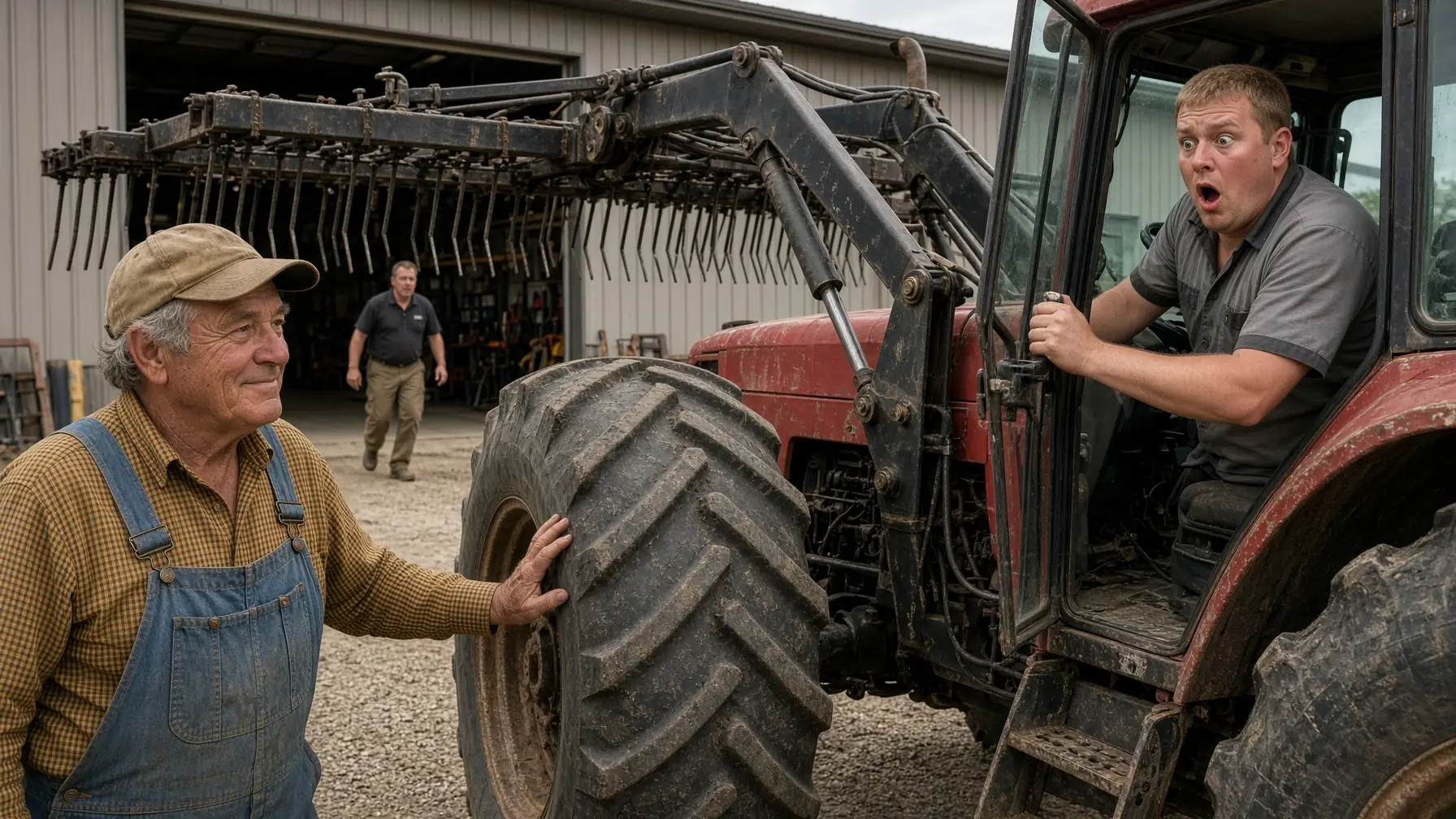
Brett looked from the service form to the red tractor standing beyond the office window. Then he looked back at Earl.
“Last dealer service?”
“It hasn’t been in.”
Brett’s pen stopped above the paper. “Since when?”
“Since I bought it.”
The technician checked the purchase year again. May sunlight fell across the counter, showing the pale scratches on Earl’s hands and the dust still caught along the seams of his cap.
“Eleven years?”
“That’s right.”
Brett glanced toward the transport trailer outside. He had been working at the dealership long enough to know that farmers sometimes used the phrase I do my own maintenance to describe very different things.
Some meant they followed the book closely. Some meant they changed oil when they remembered. Others meant they had learned to ignore a warning light until the machine refused to move.
“What brings it in now?”
“I’d like to know what condition it’s in before I decide whether to keep it.”
“Anything particular bothering you?”
“No.”
That answer seemed to interest Brett more than a list of symptoms would have. He set the pen down and leaned slightly forward.
“So you want a full inspection.”
“Engine, hydraulics, transmission, electrical. Whatever you think needs looking at.”
“It’ll take most of the day.”
“I brought a book.”
Brett smiled, but Earl was serious. At sixty-two, he had learned that being in a hurry did not make careful work happen faster.
He handed over the cab notebook, its cover faded and rounded at the corners. Brett opened it near the middle and found a dated entry about a slight hesitation under heavy load, followed by observations recorded on three different days.
“Is this your maintenance record?”
“Some of it. Receipts and scheduled work are in the folder. That one’s for things I noticed.”
Brett turned another page. There was an entry about coolant temperature, an entry about a belt, and a short description of an intermittent fault that had appeared, disappeared, and returned.
“You write down everything?”
“No. Just what I might forget.”
Earl left the notebook on the counter and walked into the waiting area. Behind him, Brett reopened the folder.
Through the dealership’s large front windows, Earl could see the trailer that had brought his tractor there. He had left home before daylight and driven the same roads he had traveled eleven years earlier, when the machine was new to him and the decision to buy it had kept him awake.
The distance had not changed. Two hundred fourteen miles still separated his machine shed from this service department.
What had changed was that he now knew exactly what those miles demanded.
In the spring of 2008, Earl had been fifty-one years old and twenty-six years into farming ground his grandfather had homesteaded. His father had expanded the operation, and Earl had spent his adult life trying to keep it useful, solvent, and ready for another season.
Just over four thousand acres lay under his management in the high plains of eastern Montana. To someone from a smaller farming region, that sounded enormous; to the men working around him, it was a farm that required real equipment and left very little room for careless decisions.
He grew wheat, corn, and soybeans, moving between crops and fields according to the needs of the land and the working season. The acreage did not become less demanding when machinery prices rose or a familiar business closed.
The local equipment dealer had shut its doors in 2003.
Earl remembered going there shortly before the end and finding fewer parts on the shelves than usual. A man behind the counter had apologized for something that would once have been kept in stock.
At the time, Earl had assumed the delay was temporary. Then the building emptied, and temporary became permanent.
For years, that dealer had been close enough that a problem could be discussed over the counter. A farmer could bring a damaged part, set it down, and explain what had happened while someone who knew the machine looked at it.