“Put that wrench down before you break something.”
Howard Larkin said it loudly enough for all four men beside the combine to hear. The sound of their laughter rose into the cold Illinois morning, thin and sharp against the idling engine. Leah stood beneath the long unloading auger with her wrench lowered at her side, trying to decide whether Howard had simply not understood her warning or understood it perfectly and wanted the other men to watch him humiliate her.
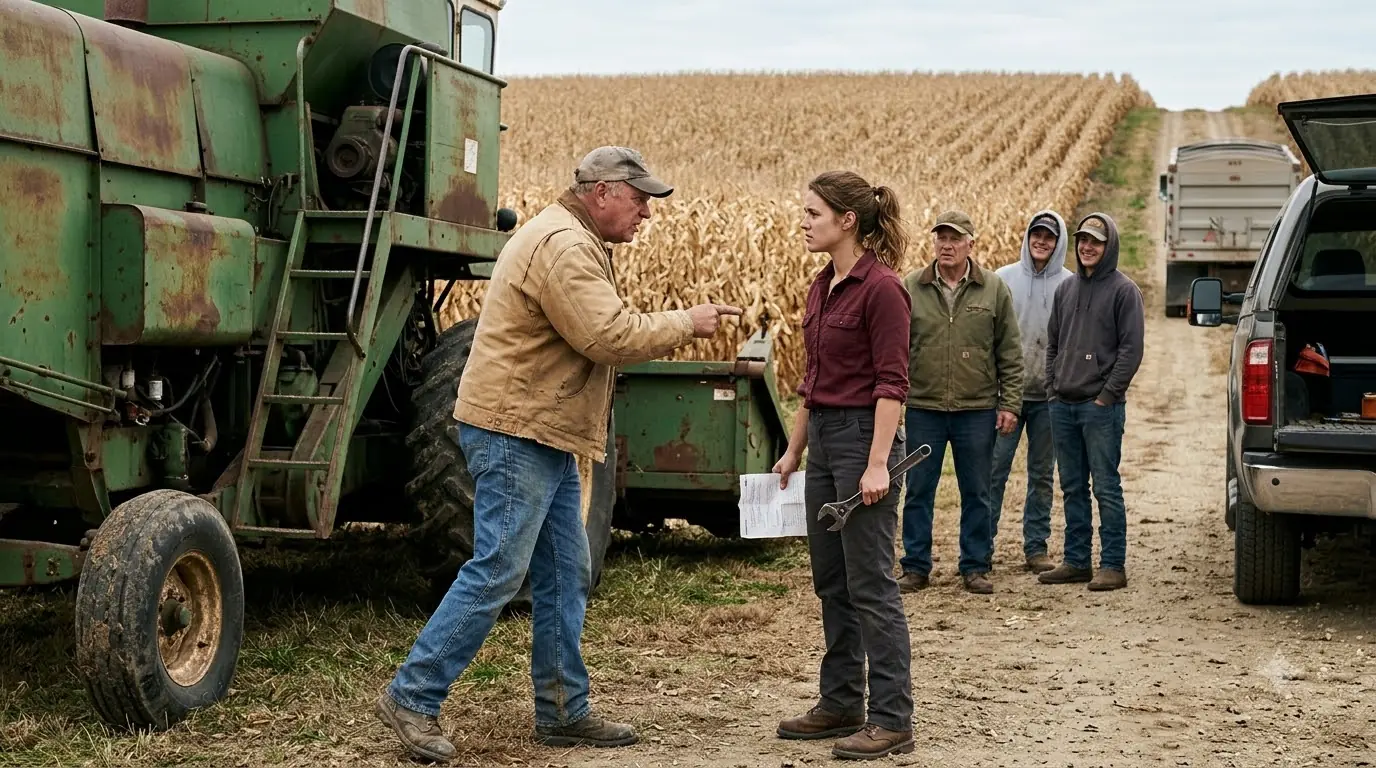
“Look at those skinny arms,” one of the younger workers said. “You couldn't lift that housing if you had to.”
Leah kept her eyes on Howard. “I don't need to lift it to hear a bearing coming apart.”
“Little girls get frightened by noises,” Howard answered. “Real mechanics fix machines.”
It was not the first insult she had heard in a farmyard. It was not even the cleverest. But it was the first time Howard had allowed the men to laugh while a potentially serious equipment fault went unexamined. She had worked on this machine for three seasons. She knew the difference between a harmless old-machine rattle and the low dragging note that came through the unloading drive whenever the grain tank was nearly full.
“Shut down the unloader until I can inspect it,” she said.
Howard's jaw worked beneath his gray stubble. “That's my combine. My harvest. I decide when it stops.”
“And if a worker gets hurt?”
His face hardened. There were men watching, and he seemed more concerned with their faces than with the machine. “I won't have a weak little girl ordering grown men around my farm.”
Leah felt heat climb her throat. She swallowed it before she spoke. “Then find somebody who'll tell you what you want to hear.”
Howard pointed toward the road. “You're fired. Get off my property.”
She placed the wrench carefully inside her toolbox. She did not throw it. She did not turn to the men and list all the work she had done while they treated her as a visitor who ought to be grateful for permission to get dirty. She picked up her clipboard, closed the service truck's rear compartment, and walked away while the engine continued its heavy, familiar idle behind her.
Sam Duggan, Howard's foreman for forty years, watched the truck disappear through the trees. He had forced a small smile when the other men laughed. Now that smile felt like something sour caught in his mouth. He looked at the unloading auger, then at the remaining corn stretching toward the tree line. One hundred eighty-six acres stood ready or nearly ready for harvest. Rain was coming, the elevator had reserved delivery windows, and Howard had just sent away the only mechanic who understood the particular history of that patched-together drive.
“Come on,” Howard shouted, climbing the ladder into the cab. “We've wasted enough daylight.”
Sam opened his mouth, then closed it. The combine rolled into the rows, its header swallowing dry stalks with a steady rustle. From a distance the farm looked peaceful, almost beautiful: pale gold corn beneath a washed-blue sky, red and brown leaves collecting in the ditches, a few dark birds wheeling above the fields. Sam had worked this ground for so long that he could read the rise of the western slope without looking at the map. He knew where water pooled after heavy rain and where the soil turned hard after a week without it.