She said it on a Saturday morning while I was down on one knee on the pine boards, drill in hand, sweat already soaking through my shirt.
She was leaning against the new railing, the last post I had just driven flush, holding that white ceramic mug with the little blue flowers, looking down at me with a quiet smile.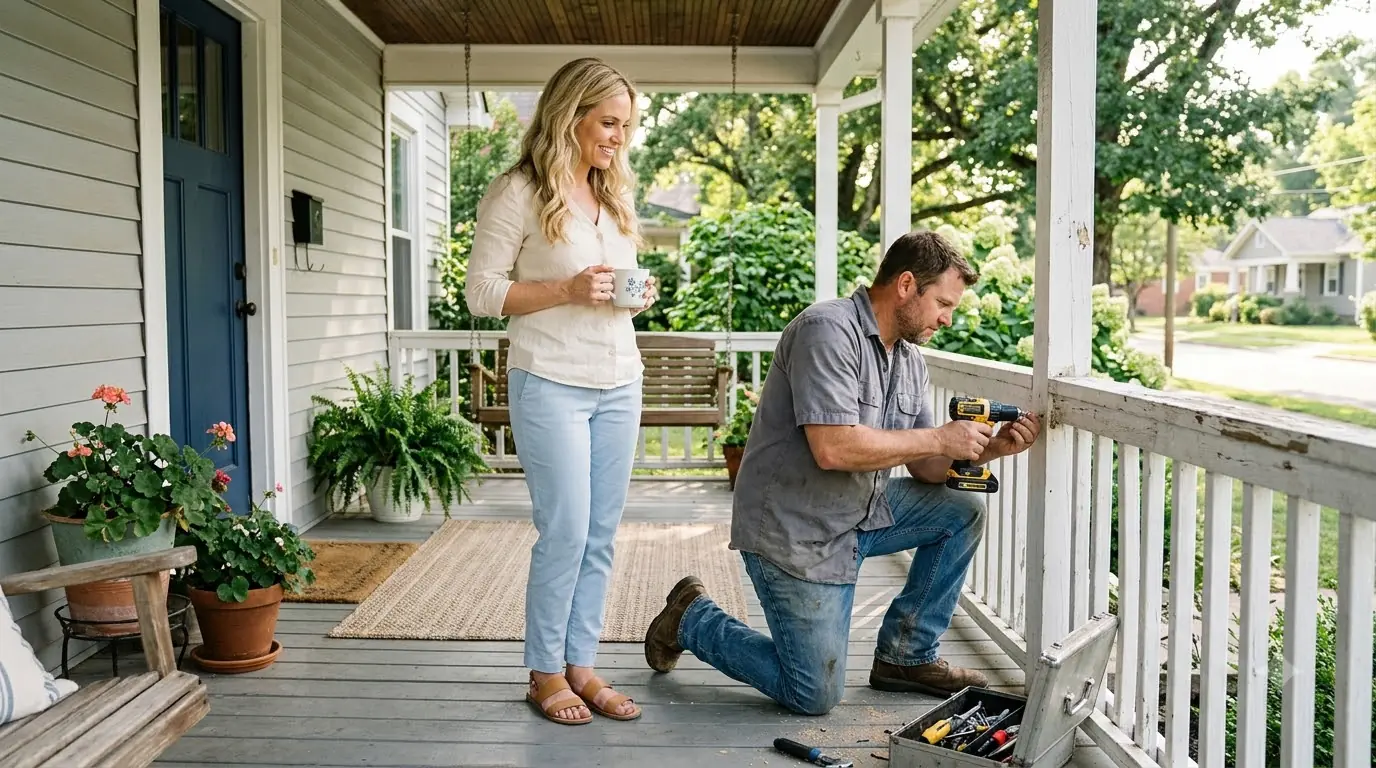
"I wish you were my husband."
I didn't answer right away. I looked up.
Morning light was pouring gold through her silver blonde hair, and something in my chest went very still. I had known Maggie Calloway long enough by then to know the difference between a joke and a door left slightly open.
That was not a joke.
My name is Daniel Hurst, 43 years old. I do residential carpentry out of Clarksville, Tennessee.
Nothing glamorous, nothing that earns you a feature in a magazine. I drive a 10-year-old pickup with sawdust in the cup holders and a dent in the rear bumper I stopped explaining years ago.
I keep my tools organized, my invoices paid on time, and my word when I give it. Most mornings I am up before 6:00, home before dark, and that rhythm has been the shape of my life for a long time now.
I love the smell of fresh-cut pine in the morning, that damp sweet sharpness before the sun fully climbs. I love the sound of a drill bit biting clean into solid timber, that brief resistance and then the give.
Most of all, I love the feeling when something crooked and uncertain becomes steady again under your hands. I have always been better at fixing things than talking about them.
That is probably the most important thing to understand before I go any further.
Sandra and I divorced 4 years ago. No children, no prolonged war.
Just a Tuesday evening when she set her wedding ring on the kitchen counter and said, "I'm not happy, Danny, and I don't think you are, either."
She was right on both counts. We had been two people living parallel lives inside the same house, saying the right things at dinner parties, feeling almost nothing real underneath any of it.
The split was clean, no lawyers, no ugly late night messages. We divided what was ours, signed what needed signing, shook hands on the front steps.
I mean that literally. We shook hands and went our separate ways.
I still think of Sandra without anger. That is the truest thing I know how to say about my marriage.
It ended without anger, and somehow that was the saddest part of all.
I bought the house on Sycamore Street the following spring. Single story, white siding, wide front porch with a ceiling fan someone had wired at a slight angle so it wobbles on the highest setting.
I never fixed it. It would take 8 minutes, and I liked having something left to do.
I told myself I was fine with that enough mornings in a row that it started to ring true the way repeated things eventually do, whether they actually are or not.
My neighbor to the left was Margaret Calloway. Everyone called her Maggie.
51 years old, widowed 3 years before I moved in. Her husband, Robert, had died of a sudden cardiac event.
No warning, no gradual decline, no chance for a last word. She had kissed him goodbye before her shift and come home that evening to a neighbor sitting on her front steps waiting to tell her.
She shared this one late September evening, both of us leaning on the fence line, her voice so level I could not tell whether she had made peace with it or simply carried it long enough that it no longer showed. I did not ask.
There are things you sense a person has earned the right to hold privately.
The first time I noticed the mug was through the low wooden fence between our yards. She stood on her porch every morning, sometimes in pajamas, hair loose, feet in the slip-on sandals she kept by the back door.
Both hands wrapped around that white ceramic mug with the small blue flowers. Just standing.
Just looking at her garden, the tomato cages and the raised beds and the bird feeder she kept stocked with sunflower seeds.
The old sycamores along the sidewalk filtered the early light down in long pale columns, and she would stand in the middle of all of it, very still, holding the cup like it was the one fixed point she was navigating from. I would pretend to check the downspout so I was not caught staring.
I told myself I was getting a feel for the neighborhood. I understand now why I kept looking.
I just was not ready to let myself understand it yet.
Sometimes a full 10 minutes would pass before she moved, before she stepped back inside, before the morning went on. I would hear the screen door close, and then there would be nothing but the birds at her feeder and the sound of a car pulling away down the street.
I told myself those mornings meant nothing.
The first step she asked me to fix was in April, a few weeks after the azaleas along her front walk had opened up pink and full. She came to my door on a Wednesday evening, still in her navy nursing scrubs from her shift at Tennova Healthcare, where she had worked as a charge nurse for going on 18 years.
She had the mug with her even then, carrying it after a full day of work, as if it simply traveled alongside her as a matter of course.
She smiled when I opened the door, the kind of smile that belongs to a person who has spent years handling everything alone and is choosing, just this once, to ask for help. "Danny, I know you're probably tired," she said, "but my front step has been making this awful creaking sound every time I come home, and I'm honestly half afraid it's going to give out on me one of these mornings."
Then she waited, not nervously, just patiently, the way she did almost everything without pushing, without filling the space she had opened up. I grabbed my tool bag and went right over.
Loose stringer bracket, a couple of screws working their way out through two winters of freeze and thaw, the kind of problem that sounds alarming and fixes in 20 minutes. When I packed up, she came out with two glasses of lemonade, apologizing that the ice tray wasn't done yet, and we sat on the bottom step together while the sun finished dropping behind the tree line.
I do not remember precisely what we talked about. I remember she laughed twice, not politely, but genuinely, the kind that surprises the person doing it and makes them look away for just a second.
I remember thinking on the walk back across the yard that I had not had a conversation that easy, that unguarded, in a very long time. Small things you notice when something is beginning, even when you have no idea yet that anything is.
Then there was the back fence in May. Three boards had gone soft over a wet winter and were pulling away from the post.
She texted on a Sunday morning, "Don't feel any obligation, but if you have an hour sometime this week." And I was there in 30 minutes.
She brought the mug out to the backyard and sat in her old green canvas lawn chair and watched me work. And we talked the entire time about the deer getting into her garden again, the novel she was halfway through, whether the oak at the back corner would ever shed enough light for the hostas to actually fill in the way she wanted, the smell of damp earth and split wood, and the trace of whatever was in her coffee layered into something pleasant and unhurried that I did not think to name.
I just knew the morning felt good. I left with sawdust on my arms and something quiet settled in my chest, and I did not examine it any closer than that.
Then the kitchen cabinet in June, a lower door swinging at a tilt because the hinge had stripped its mounting screws. She called instead of texting.
"I tried to fix it myself," she said, already laughing at herself before she finished. "I made it considerably worse."
I laughed out loud. "10 minutes," I said.
She had coffee poured when I arrived, two sugars, a little cream without asking, because by June she already knew. She had noticed without making any production of noticing, which I would only recognize later as something she did quietly about most things she cared about.
Every time she knocked, I went immediately. No hesitation, no second thought.
I carried my toolbox across the yard and fixed whatever needed fixing and we sat on the porch afterward and talked until the light shifted. Then I walked home and I told myself every single time that this was simply who I was, a carpenter, a neighbor who helped when asked.
That was the entire explanation and I was very comfortable with it. I was lying to myself.
I had become extremely fluent at it.
One evening near the end of June, I was sanding the last section of her new porch railing. The original wood had gone gray and splintery and she came out and stood quietly at the edge of the porch and watched me work.
Her watching never felt like being observed. It felt exactly like company, which is a different thing entirely.
After a while, she said softly, "Robert never knew how to use a hammer."
I looked up. She was smiling, not the sad kind, but the warm kind, the kind that reaches backward toward something it genuinely loved.
"He was talented at other things," she said. "He knew how to make me laugh every single morning."
"Whatever was happening, however the day had started. Every morning, without fail."
I turned back to the sandpaper. My hands slowed without my deciding they should.
I let them stay slow.
There was a morning in early July when I stepped out onto my front porch before 6:00 and she was already there on her side of the fence, mug in both hands, looking in my direction. When she saw me, she did not startle or look away.
She simply nodded once, slow and easy, as if she had already known I would come out. As if she had been waiting for exactly that without any urgency about the timing.
We talked across the fence for close to 40 minutes about nothing of any real consequence, the deer that kept finding her garden, a car alarm somewhere on the block that had been going off at 3:00 in the morning all week, whether the Henderson house at the corner was ever going to get a fresh coat of paint. Small, easy conversation that went nowhere and somehow left me feeling more settled than most conversations I had in any given week.
I went inside after and stood at my kitchen window for a long moment and thought, "I am looking forward to tomorrow morning." Not because anything needed fixing.
Not because there was a reason to go over.
Just because.
Then I thought, "That is a problem." Then I set the thought down because setting it down was still the easiest available option on this particular subject.
And I had gotten very good at choosing the easiest option when it came to this.
I want to be honest about something. I was not oblivious the way people are oblivious in films where the audience can see everything clearly and the character stands in the middle of it all and somehow sees nothing.
I could feel that something was shifting. I felt it the way you feel atmospheric pressure change before weather moves in.
Not an identifiable specific fact. Just a different weight in the air around me.
A change in how everything held itself.
I felt it every morning at the fence. Felt it in her kitchen over coffee.
Felt it on her porch in the evenings when we sat and watched Sycamore Street go from gold to dark. I felt it and I chose, consistently and deliberately, not to look at it directly because looking at it directly would have required admitting that I was no longer simply a helpful neighbor.
And that admission would have required others in turn, that the year I had spent calling my solitary life sufficient had been mostly something I told myself because I did not know what else to do with the quiet. That the quiet was not peace.
That underneath the steady rhythm of early mornings and honest work and the small reliable comforts I had organized my days around, I had been waiting without letting myself know I was waiting for something I could not name.
Maggie, I understand now, had done all of that reckoning long before I did. She had looked at what was developing between us without flinching away from it, decided something about it, and was then simply waiting with a patience I can only describe as extraordinary, of the kind that belongs to someone who has already done the hard work of being honest with herself and is now just waiting for someone else to finish catching up, to see whether I would find my own way there on my own terms and in my own time.
Sandra called on a Wednesday afternoon in late July. She needed to pick up a bedside lamp and three hardcover books she had been meaning to collect for over a month.
"Fine," I said. "Come Friday."
I hung up and did not think about it again for 2 days.
She arrived at 4:00 in the afternoon on a Friday, when the air was thick and still, and the heat sat heavy over the whole street, the kind of July afternoon where even the shade feels warm and the cicadas are going full volume in every tree. I was in Maggie's yard finishing the very last board on the porch railing, setting it carefully into position, checking the level one final time with the small level clipped to my tool belt, driving the last screws until the head sat flush and clean.
I heard a car door from the street and looked up over my shoulder, and Sandra was standing on the sidewalk with her hands in her jacket pockets, looking across the low fence between the yards. She looked at Maggie, who was standing on the porch steps with the mug in her hands.
She looked at the mug. She looked at me, crouched in the afternoon sun with sawdust on my forearms and the drill lying on the ground beside my knee.
She took all of it in over roughly 1 second, then she smiled in a way I recognized immediately and had not missed.
"Well," she said, "isn't this something?"
I set the drill down on the railing I had just finished. Sandra opened the gate and walked into Maggie's yard without being invited.
Maggie had gone still, not cold, not rigid, but precise. The way she went when she was carefully absorbing something and deciding what to do with it.
Sandra stopped a few feet from her and put on a voice I knew very well. Warm on the surface, measured underneath.
The voice she used when she was being deliberate about something and did not want that deliberateness to be visible.
"I'm so sorry to interrupt," she said to Maggie with a smile that almost reached her eyes. "I'm Sandra."
"Danny's ex-wife."
She gave that a moment to settle. "I just wanted to make sure you knew something about him because I genuinely think it matters."
"Danny is a very kind, very generous man. He loves helping people."
"He gets truly close to the people he helps. It's just how he's wired."
"It's just always been who he is."
A pause timed exactly right. "I just hate for you to read more into things than is really there."
"He always means well. He truly always does, even when things get complicated."
I stood up slowly from my crouch beside the railing. I did not say anything yet.
I watched Maggie.
Maggie looked at Sandra for a long and quiet moment. Then she looked at me.
Her face did not shift one degree in any direction. She looked back at Sandra, then reached out and set the mug down on the railing I had just built.
She set it down with deliberate care, the way you set something precious down when you want both hands completely free to think, and in the composed and final way she nodded when she was done with something.
"Thank you for letting me know," she said.
Her voice was so completely level, so unhurried, so entirely empty of anything I could read, that I felt something fall inside my chest. No anger in her face, no embarrassment, no visible crack anywhere on that surface, just the smooth, practiced stillness I had come to recognize as what she wore when something had reached her deeply enough that she was not going to let anyone see how deeply it had.
Sandra said it was wonderful to meet her, smiled one final time, walked around to my front door and came inside. She found the lamp and the books in about 6 minutes and came back out again.
On her way out, she gave me a long, measured look that I did not return.
I held the door until she was through it, then stood in the doorway and watched her car pull away from the curb and turn off Sycamore Street. I stood there for a moment in the late afternoon heat, then I walked around to Maggie's front door and knocked.
No answer.
I stood on the step, the one I had fixed back in April, the one that no longer made any sound under anyone's weight, and listened to the silence on the other side of the door. I knew she was in there.
Her car was in the driveway. The kitchen light was on.
I waited a moment longer than felt comfortable, longer than any reasonable person would wait before accepting that the silence was the answer. Then I walked back across the yard to my own house.
That evening I sat alone on my own porch for a long time and thought about the way Maggie had set the mug down on the railing. The care of that single motion, the quietness and precision of it.
I thought about how I could not find a single readable thing anywhere in her expression and how I was not sure whether that meant she was fine or whether it meant she was far from fine and was simply too practiced at composure to let me see which one it was.
I thought about Sandra's timing, the way she had arrived at exactly that moment, the way she had delivered each word with such careful and measured precision, and I thought about the fact that she had not said a single thing that was technically untrue. I am kind to my neighbors.
I do help people. I do get close to the people I spend time with.
Every single word she said pointed accurately at something real and managed to mean something entirely different at the same time. That was the part I could not set aside through the whole long evening.
Not a falsehood in what she had said, but the truth she had taken and turned into something sharp and deliberate and aimed directly at the one thing between Maggie and me that was still uncertain, still finding its footing, still too new and quiet to withstand that kind of pressure. Sandra had always been good at knowing exactly where the undefended places were.
Saturday morning I came out at my usual time. The porch next door was empty.
No mug on the railing, no figure standing in the early light with both hands wrapped around it. Just the white boards I had laid gleaming quietly in the sun and the still air of an unoccupied porch.
Sunday, the same. Monday, the same.
Three mornings. I counted them the way you count the days and absence makes itself persistently known.
Not loudly, not dramatically, but steadily, the way a particular kind of quiet gets louder the longer it goes on without anyone addressing it.
Three days of making coffee alone and carrying it to my own front porch and looking across the fence at nothing. Three days of telling myself she was fine.
She was busy. People got busy.
I had done nothing wrong. It was not significant.
It would pass on its own.
Three days of a quiet shaped differently from all the other quiet I had learned to live inside because this particular quiet had an outline I recognized clearly, the outline of a person who was no longer there.
On the morning of the fourth day, I stopped pretending I did not care. I had not moved the mug from my kitchen counter.
It had been sitting there since Friday evening.
I had carried it back from the railing without consciously deciding to, the way your hands do things your mind has not quite caught up with yet. For three days I had walked around it and passed it, set my own cup on the counter beside it each morning, picked mine up and left hers exactly where it was and not once stopped to ask myself why I had not simply returned it over the fence.
I was 30 seconds from her door. I had been over there dozens of times.
I had walked across that yard with a toolbox on my shoulder and a reason to knock and never given it a second thought. None of that was the explanation.
And I think I knew it.
I picked the mug up on the fourth morning, held it in both hands for a moment, the small blue flowers worn slightly pale at the handle from years of daily use, the comfortable familiar weight of something that has been held a long time by someone who needed it. Then I walked across the yard, stepped up onto the porch I had built, and knocked on the door.
She opened it. She did not look surprised to see me standing there.
She looked the way a person looks when they have been quietly waiting for a specific thing to happen and feel something ease inside when it finally does. Her eyes went to the mug in my hand right away, but she did not reach for it.
I held it out toward her. "Yours," I said, which was unnecessary.
She knew.
She took it, but stayed in the doorway, one hand on the doorframe, one hand around the mug. I was on the top step, roughly eye level with her, and I said what I had come across the yard specifically to say.
"I didn't know Sandra was going to show up and say any of that," I told her, "and I need you to understand that I have not been coming over here out of habit or because I like feeling useful or because being a good neighbor is simply what I do."
I stopped, found the rest of it. "I come over because I want to, every single time."
"That is the most honest thing I know how to say to you right now."
She looked at me for a long time, not weighing me, not deciding in that moment whether to trust me. I think she had already done all of that on her own sometime in the days before this.
She was looking at me the way you look at something you have been holding a place for, checking to confirm it has arrived.
Then she pulled the door open wider and stepped to one side.
"Do you want to come in?" she said.
"I just put a fresh pot on."
I stepped inside. That was the first time I had ever crossed that threshold.
We sat at her kitchen table for close to 3 hours. The kitchen was small and warm with afternoon light coming in low through the window above the sink, strong coffee on the table between us, and the kind of quiet in the room that does not need filling.
She told me about Robert, not the way a grieving person recounts loss for the benefit of someone new with the sharpest parts smoothed down for easier handling. The actual version.
The first year learning to sleep all the way across the bed, finding that cooking for one person felt absurd for months and months before it slowly began to feel normal, waking in the middle of the night and reaching for someone who was not there, lying perfectly still in the dark until her breathing evened out again and she could start the day over.
She told me what had surprised her most in the years since, how much she had found herself capable of carrying without breaking. How grief, when you stay with it instead of moving carefully around it, can clarify things about a person as much as it diminishes them.
She told me all of this steadily without performing composure and without collapsing into the absence of it, and I sat across the table and did not reach for a single comforting word to make any part of it easier than it actually was.
Then she asked, and I told her about Sandra. The real version, not the cleaned-up one I offered in polite company where nobody was really to blame and it just ran its natural course.
What had actually gone wrong and when, what I had done badly, what I had known for years and refused to name directly.
She listened the way almost no one ever manages to listen, without steering, without preparing her next sentence while I was still inside mine. When I finished, she sat with what I had said for a quiet moment before she said anything back, and that simple pause before the reply was exactly the right thing.
Before I stood up to leave, I asked the question I had been carrying across the table the whole afternoon. "That day on the porch," I said, "when you said you wished I were your husband, did you mean any part of that?"
She looked down at the mug, turned it once, slowly, in both hands, the way she did when she was choosing her words with care. "I was joking," she said.
Then she raised her eyes directly to mine. "But not entirely."
I walked home in the late afternoon light and stood in my own kitchen for a while without doing anything particular. The house looked exactly as it always had and somehow completely different.
July eased into August and we built a new kind of ordinary together without sitting down to discuss it or plan it out. Friday dinners appeared without anyone formally proposing them.
One of us would send a message around 5:00 asking what the other felt like eating and an hour later we would be in one of our kitchens with something warm on the stove and the whole evening open ahead of us, unhurried.
It became the fixed point of my week, the thing I was always quietly moving toward through the other six days without fully acknowledging that I was doing it.
In September she gave me a mug, plain white, no pattern, same size and weight as hers. She left it on the fence post one morning without any ceremony at all, said it was so I would have something that was actually mine to drink from when I came over instead of always borrowing her water glasses like I was sitting in a waiting room.
I carried it to her kitchen and placed it on the shelf right beside hers. She watched me set it there, did not say a single word about it, did not move it then or afterward.
October came in cool and amber bright, the sycamores along the street turning a gold that always managed to look slightly excessive and absolutely necessary at the same time. We started taking walks after Friday dinners, no route planned, no destination, just moving through the neighborhood side by side in the early dark while the air smelled of wood smoke and dry fallen leaves.
She had a habit of pointing out the things most people moved through a neighborhood without slowing down to notice. A maple on the corner gone an orange she described once as almost embarrassing.
A porch cat on Elm Street that observed us every single Friday with an air of magnificent total indifference, and the house on the next block whose front door wreath she told me had not been replaced in the 11 years she had lived on Sycamore.
I started noticing things during the week specifically to tell her about on those walks. Small things, things I would not otherwise have paused long enough to actually see.
I told myself it was just keeping up my end of the conversation.
I knew by then that it was not just keeping up my end of the conversation.
In November, we went to a film on a Saturday afternoon. A quiet drama neither of us knew much about going in, the kind that builds carefully for 90 minutes and then takes the floor out from under you in the last quarter hour.
The theater was nearly empty at that hour and we sat near the back the way she always preferred, away from the speakers, somewhere near the end in the dark. Without looking over at me, she reached across and took my hand.
No announcement, no pause to check my reaction first.
Just her hand finding mine in the dark, steady and certain, and settling there like it had always been the right place for it to be.
I did not turn to look at her. She did not look at me.
We sat that way through the end of the film and I remember very little about the last 10 minutes of what was on the screen because I was entirely occupied with something else.
What I felt was not the fast electric urgency of something new and uncertain. It was slower and deeper than that.
The feeling of something solid, something you trust your full weight against without worrying it will move.
January brought the first real snow of the season, not the thin decorative kind that melts before noon, but a proper overnight covering that turned Sycamore Street into something from a quieter and older century.
I was out before 7:00 with the shovel, clearing both driveways the way I had been doing since early December without being asked about it or giving it a second thought. When I finished, I leaned on the handle and looked up at the gray-white sky and caught my breath.
And Maggie was standing in her doorway in the heavy wool cardigan she wore on cold mornings, holding two mugs, one white, one with the blue flowers. She tilted her head toward the porch steps.
I left the shovel standing in the snow and climbed up.
We sat on the top step together with the cold pressing in from all sides and drank our coffee and watched the quiet white street, her shoulder warm against mine, not talking, not needing to. The steam from both cups rose in the same slow curl in the still morning air.
That was one of the most complete mornings I have ever had the good fortune to sit inside of.
In March, on a Friday evening after dinner, she looked up from across the kitchen table without any preamble and asked, "Are you happy, Danny?"
I sat with that before I answered because she never asked a real question and then accepted the comfortable version of the answer in place of the true one. She waited.
She was very good at waiting.
"Yeah," I said finally, "for the first time in a genuinely long time, actually."
"Yeah." She looked at me for just a moment with something in her face I did not quite have a name for, and then she nodded and looked back down at her coffee and did not add anything more to it.
She had asked because she wanted to know the true answer. She had gotten it and that was enough.
April came, one full year after that first creaking front step. I was back under her kitchen cabinet replacing a hinge that had stripped itself loose over the winter, a different cabinet from last time, same basic problem, the kind of thing old houses do to let you know they are still actively there and requiring attention.
She was standing at the counter with the mug in both hands and after a while said, in a tone working hard at sounding casual, "Do you think I loosened it on purpose?"
I slid out from under the cabinet and looked up at her. She met my eyes without wavering.
That quiet, steady amusement I had come to know as well as anything else about her.
"The first time," I said, reaching back under with the new screws, fitting the hinge carefully into position, "maybe. This time you don't need to."
She laughed, the real kind, the kind that still caught me off guard after all these months together and that I was always glad to have said the right thing to earn.
I packed my tools. She refilled both mugs.
We went out and sat on the April porch and watched Sycamore Street go from gold to purple to the first soft dark of a warm spring night and neither of us needed to say anything at all.
I don't know what love looks like when you're past 40 and you've already failed at it once. I didn't know until a woman knocked on my door with a ceramic mug and a broken step and I kept showing up without understanding what I was actually there for.
Sandra said I was kind to my neighbors. She wasn't wrong.
But she was wrong about why I kept going back. It wasn't kindness.
It was that I did not want to leave.
Kindness is something you extend to other people. What I felt in Maggie's yard, at her kitchen table, on her porch in January cold, that was something I needed just as much as she did, whether I was ready to name it or not.
This morning I sat on Maggie's porch, the one I built board by board over a summer I will not forget as long as I remember anything, and I looked at two mugs sitting side by side on the railing. One white, one with the blue flowers.
Neither one larger than the other. The steam rising from both in the same slow curl, in the same light, at the same unhurried pace.
Love, when it finds you the second time, does not announce itself. It comes quietly with a simple request and a cup of coffee, and it waits with far more patience than I deserved for you to stop pretending you cannot see it.