The officer had already decided what kind of woman my mother was before he bothered to look at her. He saw a cane, a grocery cart, and someone he expected to frighten into obedience. When he finally lifted his eyes to her face, his hand fell away—but by then, he had made a mistake that stepping backward could not undo.
The first thing I noticed was my mother’s cane scraping across the concrete.
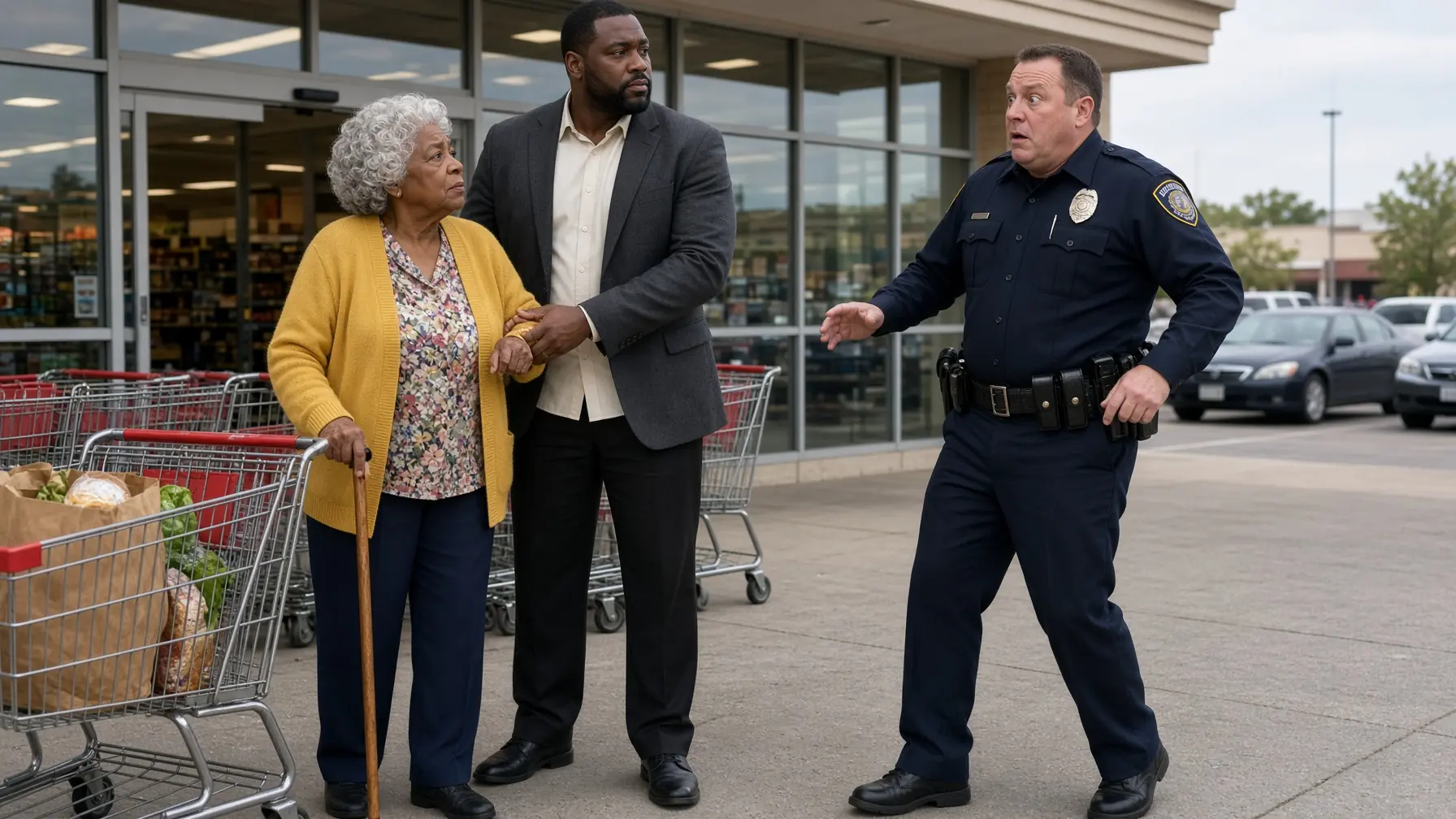
I had parked near the far end of the grocery store lot because she liked having room to open the passenger door all the way. At seventy-four, Ruth Carter could still do most things for herself, but getting out of a low car required patience, and she hated feeling rushed.
I was walking toward the entrance when I heard the scrape. Then I saw a stocky officer in a navy uniform pulling her away from her cart by the upper arm.
Her mustard cardigan had bunched beneath his fingers. One of her practical walking shoes slid forward, and the other failed to follow quickly enough.
“Move, ma’am, I’m done asking.”
My mother tried to plant her cane. Its rubber tip caught against the edge of a mat, leaving her weight balanced on a leg that sometimes gave way without warning.
I crossed the remaining distance before I had decided what to say. My hand went beneath her free elbow, and I felt how hard she was trembling.
“Take your hand off my mother.”
The officer turned toward me without releasing her.
Up close, I could see the clipped brown hair, the flushed skin above his collar, and the nameplate on his chest.
MILLER.
His eyes traveled over my charcoal blazer, my shoulders, and the hand supporting my mother. Then his chin rose.
“Back off, big guy, you’re next.”
His free hand moved toward his handcuffs.
For one terrible second, I wanted to knock his gripping hand away. The thought arrived whole and immediate, without regard for what would happen afterward.
My mother’s fingers tightened around my wrist.
That stopped me.
She had spent my childhood teaching me that being right did not always keep you safe. I had resented those lessons when I was young, believing she was asking me to accept things she should have taught me to fight.
At thirty-nine, standing outside a grocery store with a uniformed man threatening to arrest me for holding my mother upright, I understood the distinction she had been trying to make.
I kept my voice low.
“Look at her face before you make another mistake.”
Miller finally looked.
My mother raised her chin. Her silver curls had come loose around her temples, and her lips were pressed together, but her eyes stayed on his.
Something changed in him so quickly that I almost missed it.
His mouth opened a fraction. The confidence went out of his shoulders, and his hand fell away from her arm as though he had discovered something dangerous beneath his fingers.
He looked at me again.
Then he lowered his hand from the cuffs and stepped backward.
The automatic doors opened behind him. A woman carrying a bag of oranges stopped just inside, saw us, and stayed where she was.
My mother took a careful breath.
“Leon,” she said, “my cane.”
I bent, straightened it, and placed the handle securely in her palm. It took all my concentration to perform that simple task without dropping it.
When I looked up again, Miller was staring at her.
“Ma’am, I—”
“Am I free to leave?” she asked.
He swallowed.
“There’s been a misunderstanding.”
“That wasn’t my question.”
The woman with the oranges shifted her bag to one arm and lifted her phone.
Miller noticed.
“You don’t need to record this.”
“She does,” I said.
His jaw tightened, but he did not look at me.
My mother asked again, “Am I free to leave?”
“Yes.”
She reached for her cart. I moved it closer, keeping myself between her and the officer without touching him.
A paper grocery bag had tipped sideways. A carton of eggs rested against a sack of potatoes, and a small jar had rolled beneath the cart’s lower shelf.
Nothing about the scene looked exceptional. It was Tuesday afternoon. People needed milk, bread, dinner, and somewhere to return their carts.
That ordinary setting made what had happened harder to absorb.
My mother looked down at her arm.
Four pale pressure marks showed through the opening of her cardigan. They were already beginning to redden.
Miller followed her gaze.
“You were standing in an access area,” he said.
There it was.
He had found the first sentence he wanted everyone to remember.
I glanced at the entrance. The cart sat beside the other carts, near the place where shoppers regularly stopped to check receipts or search for car keys.
My mother had not been blocking the doorway.
“Then you could have asked her to move,” I said.
“I did.”
“No,” my mother said. “You told me to come with you.”
Miller’s eyes flicked toward the phone again.
A man in a grocery store vest came through the doors. He looked from Miller to my mother and then to me, measuring the situation before choosing an expression.
“Everything all right out here?”
“No,” my mother said.
The man’s smile faded.
Miller answered over her.
“We’ve resolved it.”
My mother turned toward the employee.
“Are you the manager?”
“Yes, ma’am.”
“Then I would like you to preserve whatever your cameras recorded.”
His eyes lifted toward a small camera above the entrance.
“We can look into that.”
“Please do it now.”
Miller took another step back.
I wanted to ask him what he had recognized. I wanted him to explain why her face had accomplished what her age, her cane, her unsteady footing, and her simple request had failed to accomplish.
But my mother was leaning more heavily against my arm.
Whatever answers I wanted could wait.
“Let’s get you seated,” I told her.
“I’m all right.”
“You’re shaking.”
“So are you.”
I looked down.
She was right.
We moved toward the car slowly. Behind us, Miller began speaking to the manager in a voice too low for me to hear.
The woman with the oranges followed us several paces.
“I got the end,” she said. “Not when he first grabbed her.”
I gave her my number.
My mother thanked her.
Then, before getting into the passenger seat, she looked back toward the entrance.
Miller was watching us.
He looked away first.
Inside the car, she placed her cane between her knees and folded both hands around its handle.
I stood beside the open door.
“Tell me what happened.”
“Let’s go home.”
“Mom.”
“Leon, I need to sit somewhere that doesn’t have people looking at me.”
That hurt more than if she had started crying.
My mother had always made herself visible. She spoke to cashiers by name, asked young mothers how old their babies were, and waved at people who might not remember meeting her.
Now she wanted to disappear.
I loaded the groceries, returned the cart, and retrieved the jar from beneath it. It was strawberry preserves, the inexpensive brand she insisted tasted better than the expensive ones.
When I got behind the wheel, she had turned her face toward the window.
For several seconds, neither of us spoke.
Then she said, “Don’t drive angry.”
I loosened my grip on the steering wheel.
“I’m trying.”
“I know.”
At home, she insisted we carry in the frozen food first.
That was how she handled fear. She found the next thing that needed doing and gave it her full attention.
I put the milk away while she stood at the kitchen counter, trying to separate two grocery bags that had become twisted together. Her fingers would not cooperate.
“Leave those,” I said.
“I can manage a paper bag.”
“I know you can.”
“Then stop looking at me like that.”
I stepped back.
She put both palms on the counter and lowered her head.
The kitchen was quiet except for the refrigerator motor. On the windowsill sat a small pot of basil she kept alive through stubbornness and constant turning toward the light.
Finally, she pulled out a chair.
I sat across from her.
“He came up while I was checking my receipt,” she said.
“What did he want?”
“At first, he asked whose cart it was.”
“Yours.”
“That’s what I told him.”
“And then?”
“He asked me to step away from it.”
She rubbed the edge of her cardigan between her thumb and forefinger.
“I thought maybe something had spilled. I asked what was wrong. He said I needed to come over by his car.”
“Did he say you were accused of anything?”
“No.”
“Did he ask your name?”
“No.”
“Did you tell him you needed your cane?”
“I told him I couldn’t walk that fast.”
I looked toward the doorway because I could not keep looking at her.
She waited until I faced her again.
“I wasn’t refusing to move, Leon. I was asking him to wait.”
“I know.”
“I need you to know that.”
“I do.”
Her voice dropped.
“He kept saying I was making it harder.”
I had heard my mother speak through pain before. I had heard her after surgery, after my father’s funeral, after the telephone calls that begin with someone asking whether you are sitting down.
This sounded different.
She was trying to prove that she had been reasonable.
To me.
In her own kitchen.
I moved my chair closer.
“You didn’t do anything that made him entitled to hurt you.”
She closed her eyes.
For a moment, I thought she might let herself cry.
Instead, she asked me to bring her purse.
Her brown wallet was inside. She opened it, took out the folded grocery receipt, and laid it on the table.
Then she took out a small spiral notebook.
Every grocery trip went into that notebook: the date, the total, the amount saved with coupons, and anything she needed to remember buying next time. My father used to tease her about it, and she used to tell him that money behaved better when someone was watching.
She copied the total with a hand that shook badly enough to make the numbers uneven.
I watched her stare at them.
Then she put down the pen.
“Maybe I’ll finish that later.”
I asked if she would let someone examine her arm.
“I don’t need an ambulance.”
“I didn’t say an ambulance.”
After a little arguing, she agreed to go to a nearby clinic.
By then, bruises had begun to form.
The clinician asked what had happened, and my mother answered plainly. I was grateful she did not soften it to make the room more comfortable.
An officer had gripped her arm and pulled her while she struggled to keep her balance.
The clinician documented the tenderness, checked her shoulder, and gave us instructions for what to watch for. There was no fracture, but the relief I felt was smaller than I expected.
A bone could be intact while something else had been broken.
On the way home, my mother fell asleep.
Her hands stayed folded in her lap.
I drove past our street once because I was not ready to wake her.
That evening, the woman with the oranges sent me her recording.
It began with my voice.
“Look at her face before you make another mistake.”
The video showed Miller turning toward my mother, releasing her, and backing away. His expression was clear.
So was her shaking hand.
The woman had written a short message beneath it.
I’ll give a statement if she wants me to.
I thanked her.
Then I watched the recording six times, searching the few seconds before his release as though they might reveal something I had not seen in person.
They did not.
What they showed was enough.
My mother found me at the kitchen table after dinner.
“Don’t keep playing it.”
“I’m trying to understand.”
“You won’t understand him by staring at his face.”
I set the phone down.
“Why did he recognize you?”
She stood beside the table, one hand resting against the chair.
“He did recognize me.”
“That’s not what I asked.”
“I know.”
There was no invitation in her voice to continue.
I could have pressed her. Before that afternoon, I probably would have.
Instead, I said, “All right.”
She sat down carefully.
“I don’t want you building this around whatever you think his expression means.”
“I saw him change.”
“So did I.”
“Then why shouldn’t it matter?”
“Because he had no right to put his hands on me before he changed.”
I let that settle.
She picked up the receipt from beside my phone.
“This matters. What he said matters. What he did matters. The rest is not a reason to treat me properly.”
I nodded.
We decided to submit a complaint the next morning.
Neither of us knew yet that Miller had already begun writing his own version.
The call came at eight forty.
A man identified himself as a lieutenant with the department and said he wanted to clarify an incident involving my mother.
I put him on speaker.
My mother sat at the table with a bowl of oatmeal she had not touched.
The lieutenant sounded polite, even sympathetic, until he began describing what had happened.
According to the preliminary account he had received, Sergeant Miller had been responding to a possible theft complaint. My mother had failed to comply with instructions during a brief investigative detention.
I felt my back stiffen.
“What theft?”
“That is one of the details we’re clarifying.”
“My mother asked why he wanted her to leave her cart. He never told her anything about theft.”
The lieutenant paused.
“Mr. Carter, I understand emotions are running high.”
My mother leaned toward the phone.
“Lieutenant, are you asking what happened, or are you explaining to us what you have already decided happened?”
A longer pause followed.
“I’m asking.”
“Then ask me.”
He did.
She described the encounter from the beginning. He interrupted once to ask whether she had physically resisted.
“I tried to remain standing,” she said.
When the call ended, her oatmeal was cold.
I warmed it while she sat silently.
Ten minutes later, she pushed the bowl away.
“I want a copy of what he wrote.”
We submitted the complaint in person.
The waiting area had blue plastic chairs, a scratched table, and a television with the sound turned off. My mother sat beneath it with her cane upright between her shoes.
I noticed people noticing me.
I was tall, broadly built, and wearing the charcoal blazer again because I had left home in a hurry. Twice, someone glanced from me to my mother and then toward the secure door.
For the first time that morning, I understood how easily the story could be shifted.
An aggressive son.
A confused elderly woman.
An officer trying to maintain control.
The clerk brought us forms.
My mother filled out her own.
When I offered to write because her arm hurt, she shook her head.
“You can help me remember. I’ll do the telling.”
She wrote slowly, pausing to flex her fingers.
At the section asking what outcome she sought, she stayed still for a long time.
Then she wrote three sentences.
She wanted an accurate record.
She wanted an explanation for the use of force.
She wanted the department to determine whether the officer had treated other people that way.
The clerk read that section twice.
An investigator met with us in a small room.
She asked my mother whether she wanted me present. My mother said yes, then made clear that she would answer for herself.
The investigator listened without interrupting.
We gave her the video, the clinic documentation, photographs of the bruising, and the grocery receipt. She asked for the names of anyone who might have seen the beginning.
“The manager was inside,” I said. “He came out afterward.”
“Did he witness the contact?”
“We don’t know.”
She wrote that down.
I asked about Miller’s body camera.
“We’ve requested all relevant recordings.”
“Was it on?”
“I can’t answer that yet.”
There was nothing theatrical about the meeting. No one rushed in, no one offered a dramatic apology, and no one promised that a single recording would resolve everything.
When we left, my mother looked exhausted.
But she was no longer trying to disappear.
At the car, she stopped me before I opened her door.
“Yesterday, when you came toward us—”
“I know. I moved too fast.”
“No.”
She took a breath.
“I knew you were angry. I could feel it in your arm. You still held me carefully.”
I looked away.
She squeezed my hand.
“I needed that.”
For the rest of the drive home, I kept both hands loose on the wheel.
The grocery store manager called that afternoon.
He asked how my mother was doing, expressed concern, and offered to refund her groceries.
She looked at me across the table.
Then she said, “Why?”
“Because of the unfortunate experience.”
“The food is fine.”
“Of course. We just want to do something.”
“Have you preserved the recording?”
His answer came too quickly.
“Our system has some limitations.”
“What limitations?”
“There are areas it doesn’t cover.”
“Does it cover where I was standing?”
“I’d have to check with our technician.”
“You told me yesterday you would look into it.”
“Yes, and we are.”
She ended the call without accepting the refund.
I went to the store that evening.
I told myself I was only going to ask about the camera. In reality, I needed to stand somewhere other than my mother’s kitchen with the anger I had been carrying.
The manager recognized me immediately.
He came around the service counter before I reached it.
“How is your mother?”
“You can ask her.”
“I did.”
“She asked you about the recording.”
His eyes moved toward the customers nearby.
“Could we speak over here?”
He led me toward a quiet section beside a display of canned soup.
I remained standing where the service counter was visible.
“Was there a theft complaint?” I asked.
“I’m not sure what the officer was referring to.”
“Did you call the police?”
“No.”
“Did anyone working here call?”
“I don’t believe so.”
“That’s a different answer.”
He folded his arms.
“I can’t account for every conversation my staff has.”
“Then find out.”
A cashier at the nearest register had stopped scanning.
She was a young woman with tired eyes and a name tag turned partly inward. When the manager looked in her direction, she immediately picked up the next item on the belt.
I noticed.
So did he.
“We’re cooperating,” he said.
“Then preserve the video.”
“Your mother was told we would look into it.”
“My mother should not have to ask three times.”
He lowered his voice.
“Please don’t make my employees uncomfortable.”
I looked at the cashier again.
She kept her eyes down.
For a moment, I wanted to argue until he gave me something definite. Then I thought about how I would look in someone else’s recording: a large man confronting a store manager near a register while customers watched.
I stepped away.
“Give your answer to the investigator,” I said. “In writing.”
Outside, the cart area looked exactly as it had the day before.
I stood beside it longer than I intended.
A shopping cart rattled past, pushed by an older man moving cautiously with both hands on the handle. No one stopped him.
I went home.
Two days later, we received the preliminary incident summary.
I read it once by myself before handing it to my mother.
Miller described her as uncooperative.
He stated that she had attempted to leave the area after being informed of an investigation into potentially unpaid merchandise.
He described his grip on her arm as assistance intended to prevent a fall.
My mother read that sentence aloud.
Then she set the pages down.
“He caused me to lose my balance.”
“I know.”
“He knows.”
I did not answer.
The account described me as an agitated male who approached rapidly and interfered with the detention.
That part did not surprise me.
The final paragraph did.
It stated that the merchandise issue had been resolved upon review of a receipt, after which all parties were permitted to depart.
My mother picked up her receipt from the table.
“He never looked at this.”
I remembered it folded beneath her notebook at home. I remembered her taking it from her wallet with shaking hands.
The recording from the woman with the oranges showed no receipt review.
But it began too late to prove there had not been one before I arrived.
That was the gap Miller had chosen.
For the first time, I understood why he had kept speaking after releasing her.
He had not simply been searching for an excuse. He had been laying down the beginning of a record.
We sent a written response.
My mother refused the word “misunderstanding.”
I removed it from a sentence I had drafted.
She refused the phrase “became upset.”
“I was upset,” she said. “That isn’t why he grabbed me.”
I changed that too.
By the time we finished, the response was shorter and stronger than my first attempt.
She signed it.
Then she asked me to put the papers away because she wanted to eat dinner without looking at them.
That night, she dropped a glass while reaching into the cupboard.
It did not shatter. It struck the counter, rolled, and fell into the sink.
I hurried toward her.
“I’m fine.”
She was holding her injured arm close to her body.
“Let me get it.”
“I said I’m fine.”
We stared at each other.
Then she began crying.
There was no warning, no gradual softening. One moment she was angry, and the next she was covering her mouth with her free hand.
I moved closer slowly.
“I’m sorry,” she said.
“Don’t.”
“I hate this.”
“I know.”
“I hate that you keep watching me. I hate that I’m waiting for something to hurt. I hate that I have to think about going to the grocery store.”
I pulled out a chair.
She sat.
When I reached for a towel to dry the counter, she caught my wrist.
“Just stay.”
So I did.
For a while, the glass remained in the sink, the cupboard stayed open, and dinner waited.
The next morning, the cashier called.
She had gotten my number from the woman who had recorded us. They knew each other from shopping at the store, and the cashier had asked whether the woman could pass along a request to speak.
“I’m the one who checked your mother out,” she said.
I moved into the hallway so my mother would not hear only half a conversation.
“I remember you.”
“I’m sorry I didn’t say something when you came in.”
“Were you there when the officer approached her?”
“Yes.”
My hand tightened around the phone.
“Did anyone accuse her of stealing?”
“No.”
“Are you certain?”
“I rang up every item in her cart. She paid. I watched her go outside.”
“Then what happened?”
The cashier took a breath.
“He was already near the entrance. Your mother stopped to put her change away and check her receipt. He said something to her, and she turned toward him.”
She paused.
“I couldn’t hear all of it through the doors. But she held up her cane. I remember that because I thought he would understand she needed a minute.”
“Did you see him grab her?”
“Yes.”
I closed my eyes.
“Would you tell the investigator?”
“That’s why I’m calling.”
She sounded frightened.
I asked whether the manager had told her not to speak.
“He said I shouldn’t involve myself in police business.”
“Those were his words?”
“Yes.”
“He can’t—”
I stopped.
I had been about to promise something I could not guarantee.
A person could be legally entitled to tell the truth and still fear losing shifts, income, or the goodwill of someone who controlled both.
“Your account matters,” I said instead. “I’ll give you the investigator’s number. You can speak to her directly.”
“Is your mother okay?”
I looked toward the kitchen.
She was trimming dead leaves from her basil.
“She’s working on it.”
The cashier gave a small, shaky laugh.
“She told me the other day that I looked like I hadn’t eaten lunch.”
“That sounds like her.”
“She bought a banana and left it on my register.”
I remembered the banana on the receipt, the one we had never unpacked.
After the call, I told my mother.
She listened, then said, “Make sure no one puts that girl’s name online.”
“We’re not putting anything online.”
“People still might.”
She was right.
The woman’s short recording had begun circulating locally after someone asked her what she had seen. She had shared it with a small group, and someone in that group had shared it again.
By afternoon, a stranger sent me a copy accompanied by a question about whether I wanted to tell our story publicly.
I declined for the moment.
My mother was becoming a face on people’s screens before she had decided what she wanted them to know.
Some comments were kind.
Others suggested that the officer must have had a reason.
A few insisted that the missing beginning would prove my mother had provoked him.
I did not show her those.
She found them anyway.
At breakfast the next day, she placed my phone facedown between us.
“Don’t spend your day answering people who weren’t there.”
“I wasn’t going to.”
“You were typing.”
I had been.
She pushed a plate toward me.
“Eat.”
The investigator called later that week.
The cashier had given a statement. The store had received a formal request to preserve and provide relevant footage.
Miller had also submitted a supplemental account.
That phrase made my stomach tighten.
“What changed?” I asked.
“I want to discuss it with both of you.”
We returned to the department.
This time, my mother wore a cardigan with looser sleeves. The bruises had deepened into purple and yellow.
The investigator laid a page on the table.
Miller now recalled that my mother had made a movement toward him that he interpreted as an attempt to push past.
He also recalled advising her that merchandise verification was necessary.
“He’s adding things,” I said.
The investigator did not disagree or agree.
She asked my mother to describe where her hands had been.
“One was on my cane. The other was holding the cart.”
“Did you release the cart?”
“When he pulled me.”
“Did you move toward him?”
“I lost my footing.”
The investigator asked whether my mother would demonstrate the grip using an empty chair as a reference, without anyone touching her.
My mother agreed.
She stood slowly and showed where Miller had been.
Watching her arrange her body around the memory made me feel sick.
The investigator noticed.
“Would you like a break?”
My mother answered before I could.
“Yes.”
In the hallway, she sat down.
I crouched beside her chair.
“We can finish another day.”
“No. I just needed to stop.”
A younger officer came through a nearby door carrying a folder.
He saw us and hesitated.
I recognized him vaguely from the parking lot outside the store. He had been near a patrol vehicle, farther away than Miller, and I had barely noticed him at the time.
He looked at my mother’s arm.
Then he looked at me.
“I hope you’re feeling better, ma’am,” he said.
My mother nodded.
“Thank you.”
He seemed about to say something else.
Instead, he went through the secure door.
I watched it close.
When we returned to the interview room, I mentioned him.
The investigator wrote down the description.
“Was he present at the store?” she asked.
“I think so.”
“Did you see him participate?”
“No.”
My mother looked toward the door.
“He was there,” she said.
“You saw him?”
“Before you arrived.”
Something in her voice made me turn.
“What did he do?”
She held her cane with both hands.
“He started walking toward us. Then Sergeant Miller told him to stay back.”
The investigator’s pen stopped briefly.
She asked my mother to describe exactly what she remembered.
My mother did.
The next few days were harder than the first.
At the beginning, anger had kept me moving. There had been forms to complete, calls to make, and photographs to take.
Then the pace slowed.
We waited for people with access to information we could not see.
My mother developed the habit of checking through the front window whenever a car stopped nearby. I noticed, but I did not mention it.
I began shopping alone.
The first time, I brought home the wrong bread.
She laughed when she saw it, and I felt absurdly grateful.
“The package looks almost identical,” I said.
“The bread doesn’t.”
“I’ll take it back.”
“We can eat it.”
The next week, I bought the right bread and forgot the preserves.
She wrote them at the top of the list.
I offered to bring her with me.
Her pen remained against the paper.
“Not today.”
“All right.”
She looked up.
“You don’t have to make that face.”
“What face?”
“The one where you pretend it doesn’t bother you.”
I pulled out the chair opposite her.
“It bothers me that he took something ordinary away from you.”
She capped the pen.
“I’m trying to get it back.”
“I know.”
“Let me decide how.”
That became the hardest part of helping her.
I could make calls. I could carry groceries. I could sit beside her during interviews.
I could not heal her by taking control of her life.
The manager called again.
This time, he said he had located footage showing my mother checking out.
“What about the entrance?” she asked.
“That camera angle is partially obstructed.”
“Partially?”
“There may be people moving through the shot.”
“Then provide it.”
“We’re sending what we have.”
My mother listened without speaking for a moment.
“Did you know I had paid?”
“Yes, ma’am.”
“When did you know?”
“We had no reason to believe you hadn’t.”
“Did you tell the officer that?”
The manager went quiet.
I watched my mother’s expression change.
Not into anger.
Into attention.
“Did you tell him?”
“I spoke with him after you left.”
“What did you say?”
“I told him we weren’t missing any merchandise.”
She thanked him and ended the call.
Then she wrote the conversation down.
That afternoon, she called the investigator herself.
I was in the living room, and I heard her asking to add another detail to her statement.
She did not ask me to take over.
A few days later, the department offered us a meeting with a senior supervisor.
The invitation described it as an opportunity to address concerns and discuss resolution.
My mother read the wording.
“Does that mean they’ve decided what happened?”
“We can ask.”
At the meeting, the supervisor expressed regret for her distress.
He said Miller had considerable experience, that the situation had developed quickly, and that officers sometimes had to make difficult judgments with limited information.
My mother listened.
Then she asked, “What information did he have?”
The supervisor glanced at the investigator beside him.
“The investigation is ongoing.”
“Then why are you explaining his judgment?”
“We want you to know we take this seriously.”
“I would know that if you asked how my arm was healing.”
He looked at her sleeve.
“How is it healing?”
“Slowly.”
The room became very still.
The supervisor offered to arrange a personal apology from Miller.
My mother shook her head.
“I want the facts established first.”
“An apology can be part of that process.”
“It can also be used to end a conversation.”
He leaned back.
I thought he might become impatient. Instead, he folded his hands and asked what she wanted to see happen.
She gave him the same answer she had written on the form.
An accurate record.
An explanation.
A review of whether this had happened to other people.
He said the department could not share all personnel matters.
My mother nodded.
“I understand there are things you cannot tell me. That does not make the things I can tell you less important.”
We left without an apology meeting.
In the parking lot, I asked whether she thought we had accomplished anything.
“She heard me,” my mother said, nodding toward the building.
“The investigator?”
“Yes.”
“What about him?”
“I’m not sure yet.”
Two mornings later, the investigator called.
Her tone had changed.
She asked us to come in and said we would be shown recordings relevant to the complaint.
“Did you get the store footage?” I asked.
“Yes.”
“What does it show?”
“I’d rather review it with you.”
My mother was standing beside the sink when I told her.
She dried her hands slowly.
Then she asked me to bring the cardigan with the loose sleeves.
The first recording showed the checkout.
My mother stood at the register, smiling at the cashier. She counted bills from her wallet and waited while the cashier put the groceries into paper bags.
The banana sat beside the payment terminal.
My mother pushed it toward the cashier.
The cashier laughed and shook her head.
My mother pushed it again.
Even in silence, I could hear the kind of conversation they had been having.
Then my mother took her receipt and left.
The second recording came from above the entrance.
The angle was imperfect. Customers moved through the frame, and one pillar obscured part of the walkway.
But my mother was visible.
So was Miller.
He approached while she was folding her receipt. She put it in her wallet, closed the wallet, and placed it inside her purse.
He spoke.
She turned toward him.
He pointed toward the parking lot.
My mother lifted her cane slightly and gestured toward her knee.
He stepped closer.
She put a hand on the cart.
Then he grabbed her.
There was no movement toward him.
No attempt to rush away.
No receipt inspection.
The investigator paused the recording.
My mother’s face was turned partly away from the camera. Miller’s fingers were buried in her cardigan.
I had seen the aftermath so many times that I thought I was prepared for the beginning.
I was not.
I felt my mouth go dry.
The investigator offered to stop.
My mother shook her head.
“Keep going.”
The recording resumed.
Her cane slipped. Miller pulled again.
Then I entered the frame.
The rest was familiar.
My hand beneath her elbow.
His hand moving toward the cuffs.
His head turning.
The sudden release.
The step backward.
My mother stared at the screen until the investigator stopped it.
For several seconds, no one spoke.
Finally, my mother said, “He didn’t help me.”
“No,” I said.
The investigator turned toward her.
“The recording does not support that portion of his account.”
It was a careful sentence.
At that moment, it was exactly what my mother needed.
She pressed a tissue beneath her eyes.
I thought we were finished.
Then the investigator opened another file.
“This next recording has audio.”
The image showed the grocery store entrance from farther away.
A patrol car hood occupied the lower edge of the frame.
I recognized the position.
The younger officer had been standing there.
The recording began before Miller reached my mother.
I leaned forward.
From somewhere close to the microphone, a voice said, “Is that the person?”
Miller answered, “That’s her.”
“Store says there’s no theft report.”
“I heard you.”
“Then what are we checking?”
Miller moved out of the frame.
“Stay with the car.”
The investigator paused.
My mother looked at her.
I felt an unexpected coldness spread through my chest.
He had known.
Before touching her, before pulling her, before I arrived, before he looked properly at her face, he had been told there was no theft report.
The investigator resumed the recording.
Miller crossed toward my mother.
The younger officer started after him.
“Sergeant—”
“Stay back.”
The camera moved, stopped, and tilted slightly.
We could hear Miller telling my mother to come toward the vehicle.
We could hear her asking why.
We could hear her say, “Please wait. I need to get my cane under me.”
Then came his answer.
“Move, ma’am, I’m done asking.”
My mother closed her eyes.
The recording continued through my arrival and the release.
But the investigator did not stop it there.
She let it run after we had moved toward the car.
Miller returned to the younger officer.
For a moment, neither spoke.
Then Miller said, “You’ll note she tried to leave.”
The younger officer answered quietly.
“I didn’t see that.”
“You were at the car.”
“I could see her.”
A pause.
Miller’s voice dropped.
“You need to understand what you’re writing.”
The younger officer said nothing.
Miller continued.
“Merchandise concern. Brief contact. Son intervened. Receipt cleared it.”
My mother’s tissue crumpled in her hand.
I stared at the screen.
The younger officer asked, “When did you check the receipt?”
The pause that followed seemed longer than everything before it.
Then Miller said, “I’ll handle the report.”
The investigator stopped the recording.
I sat back.
For weeks, I had imagined that proving the grip was unnecessary would be the hardest part.
I had not understood that someone had recorded the moment Miller tried to manufacture the justification.
“Where did this come from?” I asked.
“The other officer’s body camera.”
“Was it included from the beginning?”
“His original report referred to it.”
I looked at her.
“Original report?”
She took a page from the folder.
“The preliminary summary you received was based on Sergeant Miller’s account. The other officer submitted a separate account.”
My mother looked down at the page without reaching for it.
“He told the truth?”
“Yes.”
“Even after that conversation?”
“Yes.”
I remembered him in the hallway, looking at her bruises.
I remembered believing he had nothing useful to say because he had not said it to us.
The investigator explained that he had documented the absence of a theft complaint, my mother’s difficulty walking, the grip, and the instruction to remain back.
He had also stated that he never observed a receipt being examined.
Miller’s supplemental account had been written before he knew exactly what the other camera had captured.
I looked toward the screen again.
The most damaging witness had been standing beside his own patrol car.
Miller had ordered him to stay there.
My mother finally unfolded the tissue.
“May I have a minute?”
The investigator left us alone.
I moved my chair beside hers.
For a while, we sat looking at the paused image.
Then my mother said, “I started wondering if I had forgotten something.”
I turned toward her.
“What?”
“The way he kept writing it. Maybe I turned too quickly. Maybe I said something differently than I remembered.”
“Mom.”
“I know what happened.”
Her voice broke.
“But I kept having to say it against something that looked so official.”
I put my hand over hers.
She stared at our hands.
“I’m glad that young man wrote it down.”
“So am I.”
She took a breath and straightened.
When the investigator returned, my mother was ready to continue.
The department placed Miller on administrative leave while the review continued.
The store manager sent a written apology acknowledging that my mother had paid for her groceries and that no employee had requested a theft investigation involving her.
He also admitted that he had discouraged the cashier from becoming involved.
The cashier kept her job.
My mother asked about that before she asked about the manager’s apology.
The days did not suddenly become easy.
Evidence could settle what had happened without making my mother’s shoulder stop aching. It could expose a false report without removing the memory of being pulled off balance.
But something changed in the house.
She stopped checking every car.
She finished the entry in her grocery notebook.
One afternoon, she opened the cupboard and reached for a glass without looking toward me first.
I pretended not to notice.
A lawyer helped her understand her options, and she decided to pursue a formal claim. The decision was hers.
She wanted the medical costs covered.
She wanted the false account corrected wherever it had been filed.
And she wanted assurances supported by something more substantial than a promise made in a meeting.
When someone suggested that the brief duration of the encounter might limit its significance, she replied, “It took less time to frighten me than it has taken me to feel safe again.”
I wrote that sentence down after the call.
She told me not to turn it into a slogan.
Several weeks later, we met with department representatives again.
This time, no one began by discussing how difficult Miller’s job was.
The findings established that there had been no documented theft complaint involving my mother, that the physical contact had not been supported by the circumstances shown in the recordings, and that material portions of Miller’s account were contradicted by evidence.
His conduct toward the younger officer was part of a separate internal matter.
I asked whether he would return to patrol.
The representative said a final employment decision was pending.
My mother asked whether the inaccurate account would remain attached to her name.
The investigator slid a corrected document across the table.
My mother read every line.
Then she read it again.
Only after that did she ask for a copy.
On the way home, she held the envelope in her lap.
“Does it feel better?” I asked.
“Yes.”
She looked out the window.
“Not finished. Better.”
That afternoon, the younger officer called through the investigator to ask whether my mother would be willing to receive an apology for his not intervening sooner.
She agreed to meet him.
We chose a room at the department rather than our home.
He arrived without Miller.
He sat across from her, his hands resting flat on his knees.
“I should have moved sooner,” he said.
My mother studied him.
“You wrote what you saw.”
“Yes, ma’am.”
“Was that difficult?”
He hesitated.
“Yes.”
“Why?”
He looked toward the investigator, who remained by the door.
Then he answered my mother.
“Because I knew what he wanted me to write.”
She nodded.
I had expected her to comfort him. That would have been like her.
Instead, she said, “I am grateful you told the truth. I am also glad you understand that I needed help before the report.”
He lowered his eyes.
“I do.”
She let the silence remain long enough for him to hear her.
Then she thanked him.
When we left, I realized she had done something I had struggled to do throughout the ordeal.
She had allowed gratitude and disappointment to exist together.
The following Tuesday, she told me she wanted to go shopping.
I looked up from the list.
“Which store?”
“The one we always use.”
I tried not to react.
She noticed anyway.
“If I get there and decide to leave, we leave.”
“Of course.”
“And you let me push the cart.”
“All right.”
“And don’t walk around looking like you’re expecting someone to jump out of the cereal aisle.”
I laughed.
It was the first time she had made a joke about any of it.
We parked in our usual area.
She opened the passenger door fully, turned carefully, and stood with the cane planted before shifting her weight.
I waited beside her without reaching until she asked.
At the entrance, she paused.
The carts rattled as a worker pushed a line of them into place.
The automatic doors opened and closed.
My mother watched them for a moment.
Then she took a cart.
Inside, the cashier saw her and stopped what she was doing.
My mother raised a hand.
The cashier smiled.
Neither of them made a scene.
We bought bread, milk, eggs, potatoes, and strawberry preserves.
My mother checked the price of the preserves twice and complained that it had gone up.
I had never been happier to hear a complaint about groceries.
At the register, she took out her wallet.
Her hand shook a little.
The cashier waited.
My mother paid, folded the receipt, and put it away.
Then she looked at the basket beside the checkout.
“Have you eaten lunch?” she asked.
The cashier laughed.
“Yes, ma’am.”
“Proper lunch?”
“Yes.”
My mother narrowed her eyes.
I put a banana on the belt anyway.
Outside, she stopped near the carts to check her bags.
I felt my whole body tense.
She looked at me.
“I’m allowed to stand here, Leon.”
“I know.”
“Then stand with me.”
So I did.
She shifted the eggs away from the potatoes and moved the jar of preserves into a safer place.
No one pulled her away.
No one demanded she explain herself.
After a moment, we walked toward the car.
The final surprise came later, after Miller’s employment decision had been made and after the department confirmed he would not be returning to duty.
We were reviewing the last documents with the lawyer when my mother noticed a line in the younger officer’s original report.
She asked for the page.
I watched her read it.
The report had been submitted on the day of the incident.
Before our complaint.
Before the woman’s video spread.
Before Miller knew anyone would challenge him.
The younger officer had not merely recorded what happened.
He had formally requested that his supervisor review the use of force and the discrepancy concerning the supposed theft complaint.
“He reported him that day?” I asked.
The lawyer nodded.
My mother kept looking at the date.
For weeks, we had believed that every step forward had begun with us knocking on a closed door.
Someone had already knocked from the other side.
My mother asked whether we could send him a copy of the corrected findings.
The investigator arranged it.
She included a short note.
I did not read it before she sealed the envelope.
By then, I had learned that helping her did not entitle me to every private part of what she chose to say.
That evening, she placed her grocery notebook on the kitchen table.
The pages had filled nearly to the back, and I offered to buy her another one.
“There’s room yet,” she said.
She turned to the entry for the day Miller grabbed her.
The numbers she had written with a trembling hand still leaned unevenly across the line.
She did not cross them out.
Instead, beneath the grocery total, she added a note.
I looked at her.
“Do you want me to ask?”
“You’re going to ask whether I want you to ask?”
I smiled.
She turned the notebook so I could read it.
Paid in full. Came home with Leon.
I read it twice.
Then she closed the notebook and reached for the preserves.
“Open this for me.”
I took the jar.
“Your arm bothering you?”
“A little.”
The lid came free.
She spread a spoonful over a piece of toast, then pushed the other piece toward me.
For a long time, I had thought about that moment outside the grocery store—the instant Miller finally saw her face and stepped backward.
I still did not know everything that had passed through his mind.
But I no longer needed his explanation to understand what mattered.
My mother sat across from me in her own kitchen, eating toast, planning the next grocery trip, and deciding for herself when she was ready to stand.
This time, when she reached for something, I waited until she asked.