The rain hammered Jake Mitchell’s windshield with the kind of fury that made sensible men pull over, turn on their hazard lights, and wait for the sky to calm down.
Jake kept driving.
Thirty-eight years old, one failed marriage behind him, one eight-year-old daughter depending on him, and he still had not learned when to stop fighting losing battles.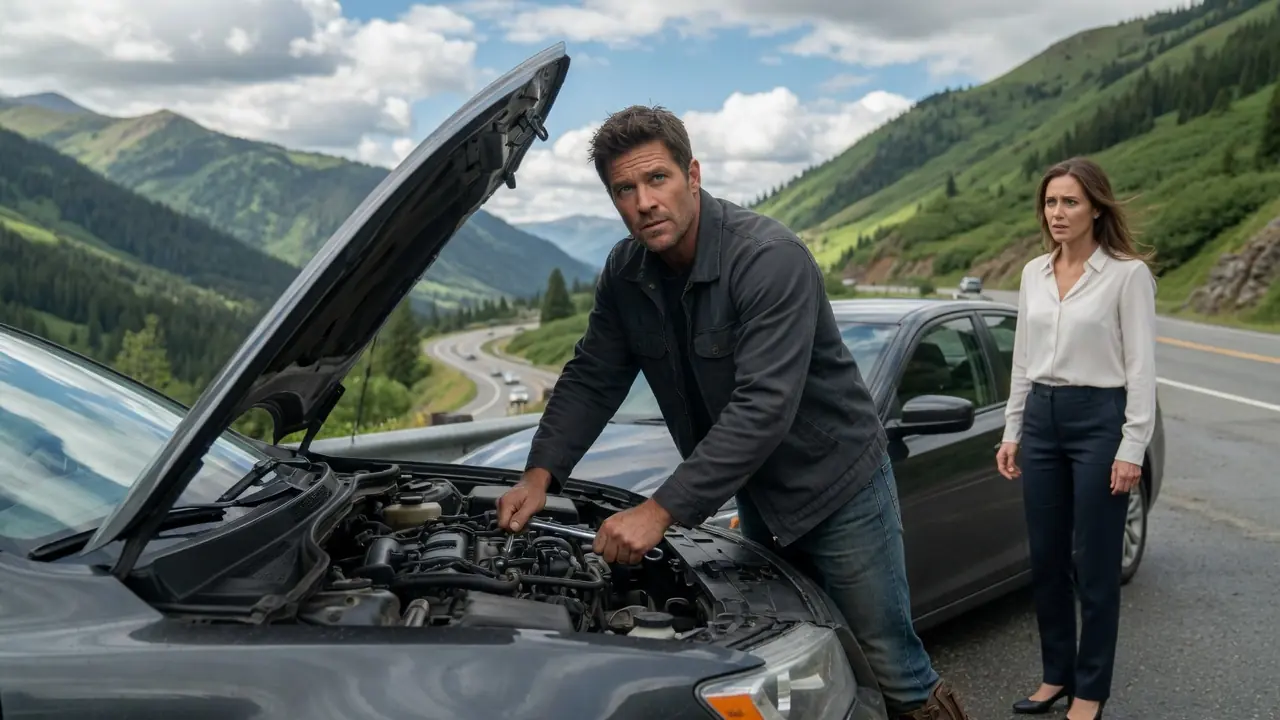
Not with weather.
Not with bills.
Not with ex-wives.
And definitely not with ghosts.
The wipers dragged hard across the glass, fighting sheets of water that seemed to fall sideways. Every passing truck sent a wave of spray over his windshield, turning the road into a blur of gray and white. The tires of his old pickup hissed against the wet highway, and the heater coughed unevenly against the cold dampness creeping into the cab.
Emma was safe at his mother’s house now.
That was what mattered.
His daughter had been dropped off after school, carrying a cardboard box full of volcano project supplies like it contained national secrets. Martha Mitchell had texted him a picture of Emma at the kitchen table, surrounded by baking soda, vinegar, red food coloring, clay, poster board, and three library books about plate tectonics.
Emma could explain magma chambers better than most adults, but she still needed her father to pick her up when the rain came down sideways and the school buses ran late.
Jake had done what he always did.
He left the construction site early, ignored the irritated look from the project manager, picked up his daughter, and drove her to the one place he trusted completely.
His mother’s kitchen.
Now he was heading back toward town to grab milk, plywood anchors, and a replacement drill bit he had forgotten twice already.
That was when the flashing lights cut through the rain.
A police cruiser sat crippled on the highway shoulder, hazard lights blinking their desperate rhythm into the storm. Its hood was up, yawning open like a broken jaw. Rain steamed off the engine. A figure in uniform stood hunched over the engine bay, soaked through, one hand holding a flashlight, the other braced against the frame.
Most drivers would pass.
Not their problem.
Not in weather like this.
Not on a highway where stopping meant getting drenched, delayed, and possibly clipped by someone driving too fast for conditions.
Jake’s foot touched the brake before his mind finished arguing.
His father’s voice rose from twenty years gone, clear as if the old man were sitting beside him with one hand on the dashboard.
“You see someone needs help, you help. Doesn’t matter who they are or what it costs you.”
Jake muttered under his breath.
“Yeah, Dad. I know.”
His tires crunched gravel as he pulled onto the shoulder twenty feet behind the cruiser. Rain slammed the roof of his truck so hard it sounded like thrown pebbles.
He reached behind the seat and grabbed the umbrella Emma had given him last Christmas.
It was bright yellow.
It had cartoon dinosaurs dancing across it.
He stared at it for half a second, then almost laughed.
Of all things to carry into a storm to rescue a cop, he was bringing dancing dinosaurs.
The rain attacked the moment he opened the door. Cold needles found every gap in his flannel shirt, ran down the back of his neck, soaked through his jeans before he reached the cruiser.
“Need some help, officer?”
The figure straightened.
Turned.
And the world did not stop.
That only happened in movies.
But something in Jake’s chest seized so hard that his next breath came shallow and painful. The umbrella trembled in his grip. Rain blurred the space between them, but not enough.
Not enough to soften those eyes.
Green.
Not blue.
Not hazel.
That specific shade of green he had spent ten years trying to forget. Spring grass after winter finally gave up. The color of hope before it learned how to hurt.
“Clare.”
The name escaped him as barely more than a whisper.
The wind tried to steal it.
She heard it anyway.
Her whole body went rigid.
“Jake Mitchell.”
Not a question.
A statement heavy with disbelief and something else he could not name.
The woman standing in front of him wore a police uniform that clung to her from the rain, her badge dull beneath the storm’s gray light. Her brown hair, longer than he remembered, hung in wet ropes past her shoulders. The sharp angles of her face had softened with age, but her eyes had not changed.
Those eyes had once watched him across a campus coffee shop while she stole fries off his plate.
Those eyes had once filled with tears when he got down on one knee in Riverside Park.
Those eyes had looked away from him three weeks before their wedding while she said she could not go through with it.
Clare Anderson.
The woman he had planned to marry.
The woman who had left him with a ring, a stack of canceled invitations, and a silence so deep it took years to climb out.
Professional instinct saved him before memory could drown him.
“What’s wrong with the vehicle?”
Clare blinked, as if she too had been pulled back from somewhere dangerous.
“Battery died. It cut out right in the middle of the highway.”
Her voice carried the same low timbre he remembered, but something harder lived inside it now. Years of giving orders, maybe. Years of standing in rooms where softness could be used against her.
Jake moved toward the engine.
“I’ve got jumper cables. Hold this.”
He pushed the dinosaur umbrella toward her.
For one strange second, Clare looked down at the cartoon dinosaurs with an expression close to confusion.
Then she took it.
He went back to his truck, rain soaking him completely now. Every step felt heavier than it should have. He grabbed the cables from the toolbox behind the seat and returned to the cruiser, refusing to look at her longer than necessary.
His hands knew what to do.
Red to positive.
Black to ground.
Check the connection.
Keep moving.
If his hands were busy, maybe the rest of him would not fall apart.
“So,” Jake said, clipping the cable in place, “you’re back in town.”
“Two years.”
He paused for half a second.
Two years.
She had been back for two years, breathing the same city air, walking streets he knew, buying groceries under the same weather, and he had not known.
“Last I heard, you were in California.”
“I was. San Jose first. Then Oakland. Moved back when Metro offered me detective.”
He said it without looking at her.
The cruiser’s hazard lights blinked red across the wet pavement.
“What about you?” she asked.
Jake connected the final clamp.
“Foreman at Morrison Construction. Divorced. Daughter named Emma. She’s eight.”
The facts came out flat, like information on a form.
He did not tell her that Emma loved dinosaurs and volcanoes.
He did not tell her that his ex-wife, Rebecca, had moved back into town six months ago and was trying to become a better mother after years of doing too little too late.
He did not tell Clare that his own life had been built carefully around a child’s schedule because schedules were safer than longing.
Clare’s voice softened.
“You have a daughter.”
“Yeah.”
The cruiser turned over on the first try.
The engine roared to life, indifferent to the emotional wreckage around it.
Jake removed the cables with sharp, precise movements. The rain kept falling. His shirt stuck to his skin. Water ran down his spine.
“Let it run for twenty minutes before you shut it off again,” he said. “Battery might still need replacement. Could be alternator if it dies again.”
Clare watched him.
“Jake.”
He coiled the cables.
“Detective.”
The word cut the air between them.
She flinched almost imperceptibly.
“I know I’m probably the last person you wanted to see.”
“The last person I wanted to see left ten years ago.”
The words came out colder than he intended.
But once spoken, they stood there.
He saw pain flicker across her face. Regret maybe. Or only surprise that he still had enough hurt left to sharpen into a blade.
“You’re just an officer who needed a jump,” he said. “Nothing more.”
Clare’s jaw tightened. For a moment, he thought she would retreat behind the badge completely.
Instead, she reached into her wallet and pulled out a business card. Rain dotted the surface as she flipped it over and wrote on the blank back with a pen that barely worked in the weather.
“If you ever need anything,” she said, “I owe you more than this.”
The card read:
Detective Clare Anderson
Metro Police Department
Her personal cell number was scrawled on the reverse.
Jake recognized the handwriting instantly.
The loops.
The slant.
The way her sevens crossed.
A decade collapsed into a single line of ink.
He pocketed the card without making a promise.
“Take care of yourself, Detective.”
Walking back to his truck felt like wading through concrete.
In the rearview mirror, Clare remained beside her cruiser, one hand pressed near her chest, the dinosaur umbrella tilted uselessly against the storm as she watched him drive away.
His phone buzzed before he had gone three miles.
A text from Emma, sent from his mother’s cell.
Did you remember milk? Grandma says we’re out.
The ordinary weight of his life returned all at once.
Milk.
Homework.
A volcano project.
Getting Emma to school on time.
Clare Anderson had no place in that world.
She had made that choice ten years earlier.
Martha Mitchell’s house smelled like cinnamon rolls when Jake stepped inside. Warmth wrapped around him the moment he crossed the threshold, followed by the familiar sound of Emma talking too fast.
“Daddy!”
She launched herself at him from the kitchen table with the full-body enthusiasm only an eight-year-old could manage.
“I got all my multiplication problems right. Even the hard ones. Grandma checked twice because she thought I cheated, but I didn’t.”
“I did not think you cheated,” Martha called from the kitchen. “I thought you wrote the numbers too neatly to be related to your father.”
Jake caught Emma and lifted her despite the protest of muscles that had spent the day hauling materials through mud.
“That’s my girl. Knew you could do it.”
Emma wrapped her arms around his neck, then pulled back and frowned.
“You’re soaked.”
“Rain does that.”
“You look sad.”
That landed harder than it should have.
Martha glanced over from the stove.
She had the kind of eyes that made lying pointless. She had raised Jake alone after his father died, working two jobs, stretching casseroles across three dinners, and somehow still knowing every secret he thought he had hidden.
“Something happened,” she said.
Jake set Emma down.
“Nothing happened.”
Martha poured coffee without asking if he wanted it.
“You have never been good at nothing.”
Emma climbed back into her chair, but her attention stayed on him.
“Did someone yell at you?”
“No.”
“Did you get in trouble?”
“No.”
“Did you meet someone?”
Martha paused with the coffee pot halfway lifted.
Jake sighed.
“Just an old friend.”
Emma’s eyes widened.
“An old friend who made you look like someone died?”
Martha gave her granddaughter a look.
“Emma Grace.”
“What? He does.”
Jake took the coffee from his mother and let the heat seep into his chilled fingers.
“Clare Anderson,” he said quietly.
Martha’s expression changed.
Not dramatically.
Mothers did not need drama when recognition was enough.
“The one who left before the wedding.”
Emma sat straighter.
“Wait. The lady who broke your heart?”
Jake almost choked on the coffee.
“Excuse me?”
Martha suddenly looked very interested in checking the cinnamon rolls.
Emma shrugged.
“Grandma said you had your heart broken once before Mommy.”
“I said sometimes grown-ups get hurt,” Martha corrected.
Emma looked at Jake with honest curiosity.
“Was Miss Clare the one?”
Jake placed his cup on the table carefully.
“Yes.”
The truth surprised even him.
Emma studied him like she was solving a puzzle.
“Is she mean?”
“No.”
“Then why did she break your heart?”
Martha turned from the stove.
“Sweetheart, grown-up things can be complicated.”
Emma considered that.
“Adults always say complicated when they don’t want to explain something.”
Jake could not help it.
He laughed once, short and tired.
“She was scared,” he said. “And sometimes scared people make choices that hurt other people.”
Emma’s face softened.
“Are you still mad?”
Jake looked toward the window. Rain streaked the glass, blurring the porch lights.
“I don’t know.”
That was the most honest answer he had.
Later, after Emma fell asleep in the truck on the ride home, after he carried her inside, took off her sneakers, tucked her under the quilt, and kissed her forehead, Jake stood alone in his kitchen and pulled Clare’s card from his wallet.
Detective Clare Anderson.
The woman he remembered had wanted to become a public defender once.
Then a federal agent.
Then a writer for exactly three weeks after reading a mystery novel she hated and insisting she could do better.
She had always been moving toward something.
Maybe that had been the problem.
Jake set the card on the counter.
He should throw it away.
There was no good reason to keep it.
No possible future where calling Clare Anderson led anywhere except pain.
He opened the trash can.
Held the card above it.
Then closed the lid without dropping it.
He slid the card back into his wallet, tucked behind his insurance card where he would not see it unless he looked.
Three days passed.
Life returned to its carefully arranged routine.
Wake at five.
Pack Emma’s lunch.
Make toast.
Make sure she had her library book.
Drop her at school.
Drive to the construction site.
Pretend the past had not stepped out of the rain in uniform.
Today, they were working on the elementary school renovation, replacing rotted window frames and updating wiring in a building that should have been repaired ten years earlier. The old brick structure smelled of dust, insulation, and childhood. Half the crew had memories in that building, including Jake, who had once been sent to the principal’s office for calling another kid “a wet sock with shoes.”
Joe Martinez, the crew leader, measured a window frame with the precision of a surgeon.
“You’ve been distracted all week,” Joe said without looking up.
Jake drove a screw into the frame harder than necessary.
“I’m fine.”
“People who are fine don’t measure the same board twice and still cut it wrong.”
“I didn’t cut it wrong.”
“You were about to.”
Joe straightened. At sixty-one, he had worked construction longer than Jake had been alive. His hands were scarred, his knees were bad, and his ability to detect emotional stupidity in younger men was unmatched.
“Woman trouble?”
“When isn’t it woman trouble?”
“Rebecca?”
“No.”
Joe’s eyebrows rose.
“Not Rebecca means worse than Rebecca.”
Jake sighed.
“Clare Anderson is back.”
Joe was silent for a moment.
“The fiancée?”
“Ex-fiancée.”
“That’s what I said.”
“She’s a detective now. Car broke down in the rain.”
Joe let out a low whistle.
“Past came back with flashing lights. That’s not subtle.”
“She wants to apologize.”
“And you said yes because you think apologies are magic and closure is real.”
Jake glared at him.
Joe clapped him on the shoulder.
“Listen to an old idiot who has been divorced twice. Closure is something people invented so they could keep reopening doors and call it healing. Sometimes the only closure you get is deciding not to keep bleeding.”
“That supposed to help?”
“No. It’s supposed to annoy you into thinking.”
Jake’s phone buzzed at lunch.
Unknown number.
He knew before he answered.
“Mitchell.”
“Jake, it’s Clare.”
His body reacted before his mind did.
Heart tightening.
Grip firming around the phone.
“What do you need, Detective?”
A small pause.
“I wanted to thank you properly. For helping with the cruiser. Dinner, coffee, whatever you’d be comfortable with.”
“I don’t need thanks.”
“I know.”
Rainwater dripped from the school roof near the trailer steps. Jake watched it fall into a muddy puddle.
“I also owe you an explanation,” Clare said.
His jaw tightened.
“That was ten years ago.”
“Is it?”
Her question was soft, but it cut.
“Because the way you looked at me in the rain was not the way someone looks at something finished.”
Jake closed his eyes.
She had no right to see him that clearly.
“What do you want from me?”
“One hour. You choose the place. You choose the terms. If you never want to speak to me again after that, I’ll respect it.”
Every instinct told him to refuse.
But there was a part of him, older than pride and quieter than anger, that still wanted to know why.
“Saturday,” he said. “Tony’s Italian on Fifth. Seven o’clock. One hour.”
“I’ll be there.”
The line went dead.
Jake stood behind the trailer with the phone in his hand, wondering what kind of man knowingly walked back toward the fire that had burned him.
That evening, Emma noticed immediately.
She climbed into the truck after school and narrowed her eyes.
“You’re doing the faraway face again.”
“I have a faraway face?”
“Yes. It looks like your body is driving but your brain is in a different state.”
“Which state?”
“Probably Ohio.”
Despite himself, Jake smiled.
“Good to know.”
At home, Emma spread math homework across the kitchen table while Jake started spaghetti. Thursday was pasta night. The routine had begun after the divorce, when Emma needed consistency and Jake needed meals he could cook without thinking.
The water had just begun to boil when Emma spoke again.
“Are you seeing Miss Clare?”
He nearly dropped the pasta box.
“What?”
“Grandma said grown-ups sometimes need conversations with people who hurt them. Are you having one of those?”
“Martha Mitchell,” he muttered, “is in trouble.”
Emma sat with her pencil hovering over a worksheet.
“Is she still scary to you?”
The question made him stop.
Not is she pretty?
Not do you love her?
Is she scary to you?
“No,” he said slowly. “The memory is.”
Emma nodded as if that made sense.
“When Trevor at school broke my pencil and laughed, I wasn’t scared of pencils after. I was scared he’d do it again.”
Jake turned off the stove and sat across from his daughter.
“You’re too smart for me.”
“I know.”
“I’m having dinner with her Saturday. She wants to apologize.”
Emma thought this over.
“Do you want her to?”
“I think I want to understand.”
“Okay.”
She returned to her homework.
Then, without looking up, she added, “If she makes you sad again, tell her to go away. You deserve to be happy, Daddy.”
He stared at her.
There were moments when parenthood made him feel impossibly strong.
Others made him feel like someone had placed his heart outside his body and taught it to talk.
Saturday arrived like a warning.
Jake spent the morning at Emma’s soccer game. She played defense with enthusiasm and very little strategy, mostly running where the ball had been rather than where it was going. Still, she managed to kick one clear downfield and celebrated like she had won the World Cup.
Rebecca arrived halfway through the game.
Jake saw her from across the field before Emma did. His ex-wife wore a fitted coat, dark sunglasses, and the uneasy expression she carried whenever she tried to participate in motherhood without fully knowing where to stand.
Rebecca had left two years earlier for Denver with a man she had called “stable” and “emotionally available,” two descriptions that had turned out to be optimistic. For almost eighteen months, she had been a weekend phone call, an occasional birthday gift, a mother more in theory than practice.
Then the relationship ended, and she moved back.
Now she wanted more time.
More influence.
More authority.
Jake wanted Emma to have a mother.
He did not yet trust Rebecca to understand what that required.
After the game, Emma ran to Rebecca for a hug, then back to Jake for orange slices, unable to decide which parent needed managing more.
Rebecca approached while Emma laughed with her teammates.
“She looks good.”
“She is good.”
“You’ve been practicing with her.”
“Every weekend.”
Rebecca’s smile tightened.
“She talks about you constantly.”
“She talks about volcanoes constantly. I’m second place at best.”
For a moment, Rebecca almost smiled for real.
Then her eyes sharpened.
“Emma mentioned someone named Clare.”
Jake’s stomach tightened.
“She overheard Mom talking.”
“Clare Anderson?”
He said nothing.
Rebecca took that as answer enough.
“The woman you were supposed to marry.”
“Rebecca.”
“Is she back in your life?”
“She’s a detective. I ran into her by accident.”
Rebecca’s laugh was brittle.
“With you, Jake, Clare Anderson is never just an accident.”
The words were unfair.
They were also not entirely wrong.
At seven that night, Jake walked into Tony’s Italian with his defenses already built.
The restaurant occupied an old brick house on Fifth Street, wrapped in ivy and warm light. Inside, the air smelled of garlic, wine, bread, and tomato sauce. Tony Ricci greeted Jake like family.
“Jake. Finally bringing a date?”
“No.”
Tony looked over his shoulder toward the door.
“That was too fast. Means yes.”
“It means mind your business.”
“My restaurant, my business.”
Tony led him to a corner table anyway.
Clare arrived at 6:55.
Of course she did.
She had always been five minutes early, constitutionally incapable of making people wait.
She wore jeans and a dark sweater, her hair loose around her shoulders. Without the uniform, without the badge, without the rain, she looked dangerously close to the woman Jake remembered.
Not the same.
Older.
More guarded.
But close enough to hurt.
She stopped when she saw him.
For one moment, neither of them moved.
Then she came to the table.
“You came.”
“I said I would.”
“I wasn’t sure.”
“I keep my word,” Jake said. “Even when I probably shouldn’t.”
She sat.
The waiter brought water and menus. Neither touched the menus.
Jake folded his hands on the table.
“You wanted to explain. So explain.”
Clare looked down at her water glass.
“I have rehearsed this conversation a thousand times.”
“That usually means the truth is simple and the excuses are complicated.”
She looked up.
A faint, pained smile crossed her mouth.
“You always did cut through nonsense.”
“Not always. I believed you when you said forever.”
The words hit.
He saw it.
She nodded once.
“You did.”
Silence stretched between them.
Then Clare took a breath.
“I was terrified.”
Jake leaned back.
“Of me?”
“No. Never of you.”
“That’s supposed to make it better?”
“No.”
She folded her hands tightly in her lap.
“My parents divorced when I was twelve. It was ugly in a quiet way. No huge scenes. No broken dishes. Just years of watching my mother become less of herself inside that marriage. When my father left, she didn’t know who she was without him.”
Jake remembered pieces of this.
Not enough.
At twenty-eight, he had been too eager to build a future to understand how someone else’s past could sabotage it.
“She used to say she gave him everything,” Clare continued. “Her choices. Her friends. Her work. Her name. I grew up swearing I would never disappear into someone else’s life. I had plans. Law school maybe. Federal work. My own apartment. My own money. My own name.”
“Then you met me.”
“Then I met you.”
Her eyes softened.
“And suddenly I wanted all the things I said I wasn’t ready for. A house. Kids. Sunday mornings. Grocery lists. Your stupid jokes. A life that felt so good I forgot to ask whether I had become brave enough for it.”
“You said yes when I proposed.”
“I meant yes when I said it.”
That made his chest ache.
“Then what changed?”
“I woke up three weeks before the wedding and realized everyone had plans for me. Dress fittings, seating charts, mortgage appointments, baby names your mother joked about but maybe didn’t joke about.”
Despite everything, Jake winced.
“Martha does that.”
“I loved her for it. And I panicked anyway.”
Clare’s voice shook now.
“I looked at myself in the mirror and all I could see was my mother. Not because of you. Because of fear. Because I didn’t know how to become a wife without disappearing, and instead of telling you that, I ran.”
The waiter returned.
They ordered food neither cared about.
When he left, Jake stared at his untouched water.
“You left a ring on my kitchen counter.”
“I know.”
“You left a note that said, ‘I’m sorry. I can’t do this.’”
Clare closed her eyes.
“I know.”
“I burned every letter you ever wrote me.”
Her eyes opened.
Pain moved through them.
“I deserved that.”
“No. You deserved a phone call from me screaming until my throat gave out. You deserved every question I never got to ask. You deserved to look me in the face when you destroyed me.”
“You’re right.”
The answer stunned him.
He had expected defense.
Explanation.
A softer version of blame.
Clare gave him none.
“I was a coward,” she said. “Not confused. Not noble. Not protecting you. A coward.”
Jake looked away first.
The anger in him had lived so long without apology that he did not know where to put it when apology finally arrived.
“What happened after?” he asked.
“I went to California. Joined the police academy because I thought a badge would make me strong. Spent years proving to everyone I didn’t need anyone. Made detective. Dated men who were safe because I didn’t love them enough to be afraid.”
Her laugh was bitter.
“Turns out not needing anyone can look a lot like not living.”
“Why come back?”
She met his eyes.
“Because I never stopped wondering if the life I ran from was the one I actually wanted.”
Jake’s fingers tightened around the edge of the table.
“Did you come back for me?”
Clare did not answer immediately.
That was answer enough.
“I accepted the Metro position because it was a good career move,” she said. “But I chose this city because of you.”
His breath left him slowly.
“I didn’t plan to show up at your door. I didn’t plan to interfere with your life. I knew you had a daughter. I knew you were divorced. I told myself I just wanted to be near the place where I had made the biggest mistake of my life and maybe learn to live with it.”
“You looked me up.”
“Yes.”
“For how long?”
She swallowed.
“Years.”
The admission should have angered him more.
Instead, it exhausted him.
“I got married,” he said.
“I know.”
“I had Emma.”
“I know.”
“My marriage failed.”
“I know.”
Jake looked at her.
“So you watched my life like a window you didn’t have to knock on.”
Clare’s face went pale.
“Yes.”
The honesty was brutal.
He appreciated it and hated it.
“I thought Rebecca would be good for me,” he said.
Clare said nothing.
“She was kind. Stable. Clear about what she wanted. I thought that was enough.”
He looked down at his hands.
“It wasn’t. And that was cruel to her. I cared about her, but I never loved her the way she deserved.”
Clare’s voice was soft.
“I’m sorry.”
“Don’t take all the blame. I made those choices.”
Their food arrived.
Chicken parmesan for her.
Lasagna for him.
They ate mechanically at first, then stopped pretending.
Jake pushed his plate aside.
“I have Emma now.”
“I know.”
“She comes first.”
“She should.”
“I won’t let her get attached to someone who might run.”
Clare absorbed that like a deserved sentence.
“I know.”
“Do you?”
“Yes.”
She leaned forward slightly.
“I’m not asking to meet her tomorrow. I’m not asking to step into your life like I belong there because we have history. I’m asking for the chance to show you, slowly, that I am not the same woman who left that ring on your counter.”
Jake studied her.
“How?”
“By staying.”
A simple answer.
A dangerous one.
“Staying is easy when nothing costs you.”
“No,” Clare said. “Leaving is easy. Staying is the work.”
The drive home that night felt longer than it was.
Jake did not call Clare afterward.
He did not text.
He sat in his truck outside his mother’s house, watching warm light in the kitchen window. Inside, Emma and Martha were probably baking something, because the window had fogged slightly.
He was about to go in when his phone buzzed.
Rebecca.
“We need to talk tomorrow. Emma told me about Clare.”
Jake leaned his head back against the seat.
Of course she had.
Eight-year-olds could keep secrets about surprise birthday cards and hidden cookies, but not about adults who made them curious.
The next morning, Rebecca confronted him at the soccer field.
“You let Emma meet Clare Anderson?”
“She met her briefly.”
“Briefly?”
Rebecca crossed her arms.
“Our daughter said Clare knows about volcanoes and helped explain chemical reactions.”
Jake frowned.
That had not happened.
Then he remembered Emma asking Martha about Clare, asking more questions, building stories from scraps.
“Emma is filling in gaps.”
“Because you created them.”
Rebecca’s voice cracked, and for once her anger looked less like control and more like fear.
“You don’t understand what it was like being married to a man still in love with someone else.”
Jake looked at her.
The words landed between them with old weight.
Rebecca continued, softer now.
“I always knew. You never said her name, but I knew. Every time you pulled away. Every time you looked sad for no reason. Every time I tried to love you enough and felt like I was competing with a ghost.”
“I’m sorry.”
“You’ve said that before.”
“I know.”
“Emma cannot become collateral damage in whatever unfinished thing you and Clare are doing.”
“She won’t.”
“You don’t know that.”
Rebecca wiped under one eye quickly, angry at the tear.
“I’m calling my lawyer. Not because I want to punish you. Because I need to protect her.”
Fear moved cold through Jake.
“Rebecca.”
“No. If Clare is back in your life, I need boundaries. I need to know Emma won’t be dragged into another adult mess.”
The threat was not empty.
For three days, Jake moved through life with a legal shadow over everything.
Work became a blur of measurements, invoices, deliveries, and crew problems. Emma sensed the stress and grew quieter, which frightened him more than questions would have.
Then the construction site was hit.
Copper wiring, power tools, and materials disappeared overnight from the elementary school renovation. Security cameras had been disabled. Whoever did it knew the site layout.
Clare was assigned as lead detective.
When she arrived at Jake’s house Thursday evening in a blazer and badge, he almost laughed at the unfairness of the universe.
“This isn’t a social call,” she said.
“I figured.”
She stepped inside, and he watched her detective’s eyes move over his house. Emma’s drawings on the fridge. Laundry folded but not put away. A half-finished volcano model on the kitchen table. A life held together by effort and routine.
Clare did not comment.
She laid crime scene photos across his kitchen table.
“Who had access codes?”
“Crew supervisors. Project manager. School maintenance lead. Electric subcontractor.”
“Anyone with financial problems?”
Jake hesitated.
“Danny Torres. Young guy on my crew. Gambling debts last year. I helped him out once.”
Clare wrote it down.
He hated seeing Danny’s name on her page.
“He’s a good kid.”
“Good people can make desperate choices.”
He knew that.
He hated that too.
The investigation moved quickly.
Joe Martinez admitted Danny had been acting strange. Danny came in the next morning before sunrise, pale, shaking, and hollow-eyed.
“I didn’t steal the tools,” he told Jake near the site trailer. “But I gave the codes to the people who did.”
Jake stared at him.
Danny was twenty-four, nervous, talented, always too eager to prove himself. Jake had trained him, defended him, loaned him money once without telling the crew.
“Why?”
Danny’s eyes filled.
“My bookie. Ricky Salazar. I owed him almost twenty grand. He said if I gave him the access code and camera positions, we’d be even.”
Jake looked away.
Not because he did not care.
Because if he looked too long at the fear on Danny’s face, he might forget the betrayal.
“You call Detective Anderson,” Jake said.
“I’m going to jail.”
“Maybe.”
Danny began to cry silently.
“I’m sorry.”
“I know.”
That did not fix anything.
Clare arrived twenty minutes later and took Danny’s statement with precise professionalism. No cruelty. No softness that would weaken the case. She treated him like a person and a suspect at the same time.
Jake respected that more than he wanted to.
By Monday, Salazar was arrested. Most of the stolen materials were recovered. Danny cooperated and received a reduced charge recommendation, though he lost his job immediately.
When the crew asked if Jake would try to keep him, Jake said no.
“He betrayed the site.”
Joe nodded.
“Hard call.”
“Right call.”
Those were not always the same thing.
That evening, Emma got suspended for pushing a boy at school.
The principal called just as Jake was leaving the site.
By the time he arrived, Emma sat in the office with red eyes and a stubborn set to her jaw. Across the room, a boy named Trevor held tissues to his nose and glared at her. Trevor’s mother demanded consequences loudly enough for everyone to hear.
In the principal’s office, Emma finally explained.
“He said kids with divorced parents don’t have real families,” she whispered. “He said I was broken.”
Jake closed his eyes.
Mrs. Patterson, Emma’s teacher, spoke gently.
“She has been anxious lately. Distracted. We think the custody conversations may be affecting her.”
Custody conversations.
Adult fear had reached the child he tried hardest to protect.
At home, Emma broke down over spaghetti.
“What if Mommy makes me live with her all the time?”
Jake pulled her into his arms.
“No one is taking you away from me.”
“What if a judge says?”
“Then I will stand in front of every judge in the state if I have to.”
She sobbed into his shirt.
“I don’t want everything to change.”
He held her tighter.
“I know.”
That night, after Emma slept, Jake sat on the porch with a beer he did not want.
His phone buzzed.
Clare.
He stared at her name.
Then answered.
“Hey.”
“I heard about Emma,” she said softly. “Is she okay?”
“No.”
The honesty surprised him.
“No. She’s scared. Rebecca’s scared. I’m scared. And all of this started the minute you came back.”
Silence.
Then Clare said, “I know.”
He rubbed a hand over his face.
“That wasn’t fair.”
“Maybe not. But it’s partly true.”
Her willingness to accept blame made him feel worse.
“I don’t know what to do,” he admitted.
“Then don’t decide everything tonight.”
“I’m tired of not deciding.”
Clare was quiet for a moment.
Then she said, “Would it help if I talked to Rebecca?”
“No.”
“Jake.”
“No, Clare. This is between me and Rebecca.”
“Emma is scared because Rebecca thinks I’m a threat. If I can make clear that I’m not trying to replace her or destabilize anything, maybe it helps.”
“You don’t owe us that.”
“I owe you truth. I owe Emma not becoming another adult who makes things harder because I’m afraid to do the uncomfortable thing.”
He did not answer.
So Clare did the uncomfortable thing anyway.
The next day, Rebecca called him.
“Detective Anderson contacted me.”
Jake closed his eyes.
“I didn’t ask her to.”
“I know. She made that clear.”
Rebecca sounded different.
Less angry.
More tired.
“She told me she isn’t trying to step into Emma’s life without boundaries. She said she understands I’m Emma’s mother and that if anything ever happens between you two, it has to move at Emma’s pace, not hers.”
Jake gripped the phone.
“She said that?”
“She also said you’re a good father.”
Rebecca’s voice wavered.
“And I already knew that, which is why I think I’ve been reacting from fear, not facts.”
Jake sat down.
“What are you saying?”
“I’m dropping the custody modification.”
His throat tightened.
“Rebecca.”
“I still want boundaries. I still want honesty. And if Clare becomes part of Emma’s life, I want to know before Emma does. But I’m not dragging our daughter through court because I’m angry that you might finally love someone properly.”
The sentence struck him clean through.
“Rebecca, I did love you.”
“Not the way I needed.”
He had no defense.
“I’m sorry.”
“I know,” she said. “I’m sorry too. For leaving the way I did. For coming back and expecting Emma to make room for me on my schedule. I’m trying.”
“I know.”
“Then let’s both keep trying.”
After the call ended, Jake sat in his truck outside the site for a long time.
That night, he asked Martha to stay with Emma after bedtime.
At exactly nine, Clare came to his house.
No uniform.
No badge visible.
Just Clare in jeans, a sweater, and the face of a woman trying not to hope too much.
They sat on the porch under a clear October sky.
For a long time, neither spoke.
Then Jake said, “Rebecca dropped the custody threat.”
Clare exhaled slowly.
“I’m glad.”
“She said you called.”
“I did.”
“You had no right.”
“I know.”
He looked at her.
“You still did it.”
“Yes.”
“Why?”
“Because ten years ago, when things got hard, I protected myself by leaving. I am trying to become the kind of person who protects people by staying.”
The words settled between them.
Jake looked out toward the quiet street.
“I’m terrified of this.”
“So am I.”
“I don’t trust you enough.”
“I know.”
“That doesn’t disappear because you apologized.”
“I know.”
“If we do this, Emma comes first.”
“Always.”
“You don’t get to rush into her life because you feel guilty or lonely.”
“I won’t.”
“You don’t get to disappear when fear hits.”
Clare’s voice shook.
“I won’t.”
He turned toward her.
“I need more than words.”
She nodded.
“Then I’ll give you time.”
That was the answer he needed.
Not passion.
Not promises.
Time.
Jake reached for her hand.
Her fingers trembled when they closed around his.
“I don’t know what this becomes,” he said.
“Neither do I.”
“I don’t know if I can forgive everything.”
“I don’t need everything tonight.”
His chest tightened.
“Why did you have to come back?”
Clare’s eyes filled.
“Because I never stopped loving you. And because love that only lives in regret is cowardice.”
The kiss that followed was not like the first ones from ten years ago.
It was slower.
Older.
Full of fear.
Full of history.
Full of the knowledge that love alone had failed them once.
When they pulled apart, Clare rested her forehead against his.
“No more running,” she whispered.
Jake closed his eyes.
“No more running.”
They did not announce anything to Emma the next day.
They did not rush.
Clare did not suddenly appear at dinner or sit in the stands at soccer games like she had always belonged. For weeks, she remained a name Emma heard occasionally, a detective who had helped with the site theft case, a person her father spoke about carefully.
Then one Saturday afternoon, after Rebecca and Jake had both agreed, Clare came to the park while Emma tested her volcano model on a picnic table.
Emma studied Clare for a long time.
“You’re the lady from the rain.”
Clare smiled.
“I am.”
“You broke my dad’s heart.”
Jake nearly choked.
Clare knelt so she was closer to Emma’s height.
“Yes,” she said. “I did.”
Emma looked suspicious.
“Are you going to do it again?”
Clare’s face softened.
“I’m going to try very hard not to.”
“That’s not a promise.”
“No,” Clare said. “It’s the truth. Promises are easy. Trying every day is harder.”
Emma considered this.
Then handed Clare a small bottle of vinegar.
“Hold this. If you spill it, the volcano won’t erupt right.”
Clare took it with the seriousness of a sworn oath.
Jake watched them from the edge of the picnic table and felt something in him loosen.
Not heal completely.
Not yet.
Healing was slower than that.
But loosen.
Months passed.
Clare stayed.
Not perfectly. No one stayed perfectly. She had late cases, difficult days, moments where fear made her quieter than she meant to be. Jake had his own walls, his own habit of pulling back before anyone could leave him first.
But now they named those things.
They did not let silence make decisions for them.
Rebecca remained cautious, but she and Jake became better co-parents than they had ever been spouses. Emma learned that families could be complicated without being broken. Martha pretended not to be invested and failed every time Clare came to dinner with flowers.
Danny Torres completed community service and entered a gambling recovery program. Jake did not rehire him, but six months later, he wrote a reference letter for a training program that helped young men rebuild after criminal charges.
“You still think he deserves a chance?” Clare asked when she saw the letter.
Jake sealed the envelope.
“I think a chance and a free pass are not the same thing.”
Clare smiled.
“That sounds like something your father would say.”
“Probably.”
The following spring, Emma presented her volcano project at school.
The model erupted beautifully. Red foam ran down carefully painted slopes while Emma explained subduction zones, pressure buildup, and chemical reactions with absolute confidence.
Jake stood in the back of the classroom beside Rebecca.
Clare stood near the door, by invitation, hands folded in front of her.
Emma finished her presentation and looked toward all three adults.
Her mother.
Her father.
The woman who had come back from the past and was slowly learning how to belong in the present.
Emma smiled.
Not because everything was simple.
Because it was honest.
Afterward, outside the school, Rebecca approached Clare.
For a moment, Jake tensed.
Rebecca extended her hand.
“Thank you for showing up carefully.”
Clare shook it.
“Thank you for letting me.”
It was not friendship.
Not yet.
But it was respect.
Sometimes that was the bridge love needed first.
That night, Jake and Clare sat on his porch while Emma slept inside and Martha washed dishes in the kitchen despite being told several times not to.
The air smelled like wet grass and spring.
Clare leaned her shoulder lightly against his.
“Do you ever think about that night in the rain?”
Jake looked toward the driveway.
“The cruiser?”
“Yes.”
“Every day.”
She turned to him.
“Do you wish you had kept driving?”
He thought about it.
Really thought about it.
The storm.
The hazard lights.
The dinosaur umbrella.
The face he had not wanted to see and somehow needed to.
“No,” he said.
Clare’s eyes shone.
“Even with all the mess?”
“Especially with all the mess.”
He took her hand.
“For ten years, I thought the story ended when you left. Then I thought it ended when I survived it. Then I thought it ended when I built a life without you.”
“And now?”
Jake looked through the window at Emma’s volcano poster leaning against the wall, at Martha moving through the kitchen, at Clare’s hand in his, warm and real.
“Now I think some stories don’t end where we think they do. Sometimes they wait until we’re finally brave enough to tell the truth.”
Clare rested her head on his shoulder.
“No more running,” she said again.
Jake looked out at the quiet street, the same street that had held his grief, his routines, his fear, and now, impossibly, this second beginning.
“No more running.”
This time, when he said it, it did not feel like a wish.
It felt like a choice.
The rain had brought her back to him.
But staying, that would be theirs to build.