Nathaniel Carter read the letter from the territorial supply company while standing beside the barn because bad news had never improved when he sat down to receive it. The company was ending Black River Ranch’s credit immediately, which meant no more feed or supplies could be purchased on promises about next season. Two ranch hands had already quit after hearing rumors that the place might not survive winter, his cattle herd was barely a third of what it had once been, and the smokehouse had been useless for three years. When Nathaniel looked across the frozen Montana ground that afternoon, he understood that his ranch was not facing one problem but a collection of small failures that had finally become large enough to bury him.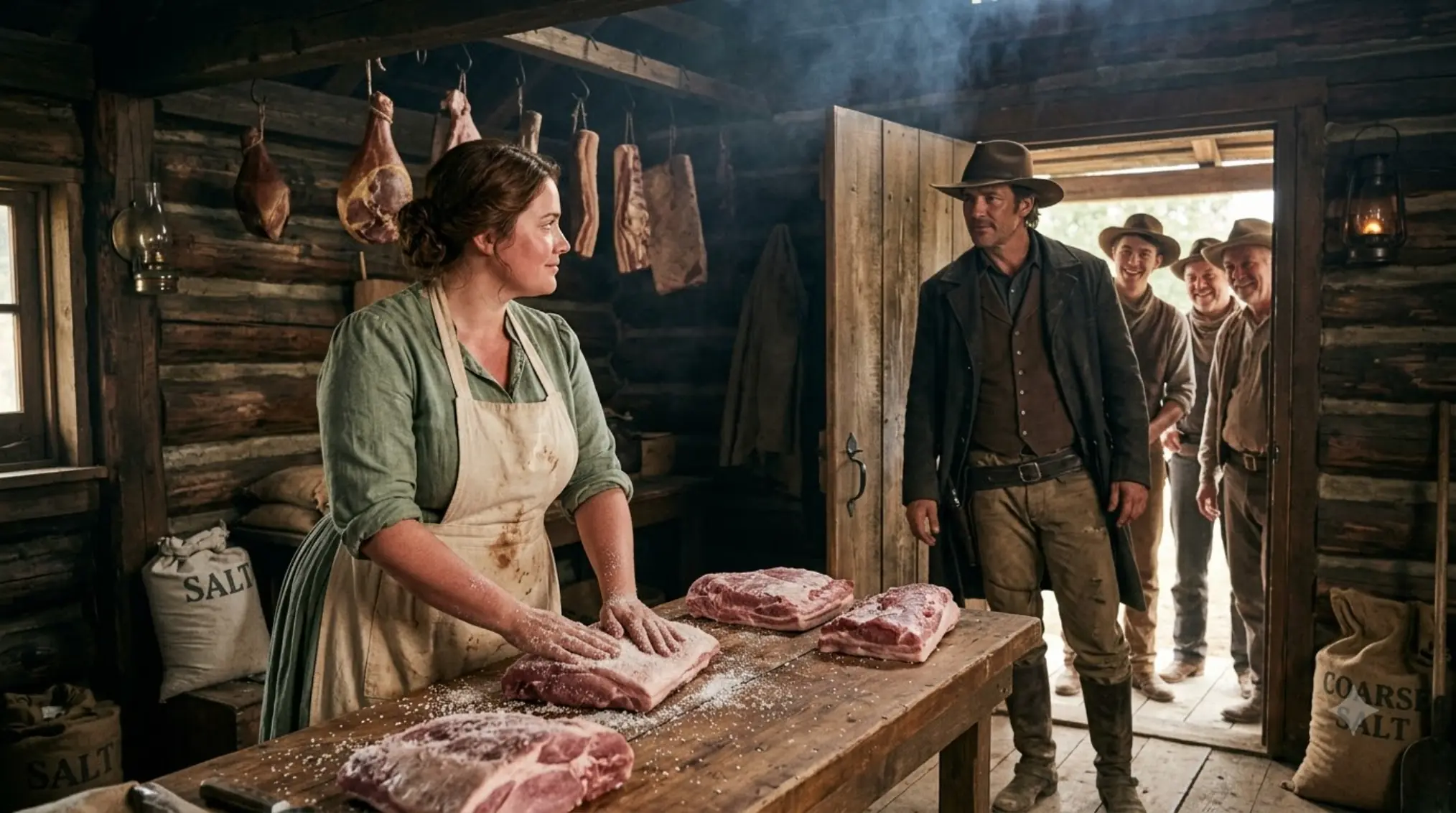
The worst of them was food. Twelve people still depended on Black River through winter, and the stores in the cellar could not carry them until spring unless the hogs slaughtered that season were properly cured. The smokehouse had once been operated by an older ranch hand named Gus, a patient man who apparently possessed more knowledge than anyone had realized until he died and took most of it with him. Nathaniel had always assumed there would be time to learn later, but later had arrived wearing snow clouds and carrying unpaid bills.
That night he gathered Dale Puit, Tobias, Clement, and young Roy around the kitchen table. He told them the truth without polishing it: Black River was short on provisions, the smokehouse was dead, and he intended to hire someone who knew meat curing before the first serious winter storm arrived. Clement asked the practical question everyone was thinking—where could a man find somebody with that kind of knowledge this late in the year? Nathaniel answered that he did not know, but not knowing was no longer a reason to delay.
The following morning he rode into town and pinned a notice to the board outside the general store. It contained no emotional appeal, just a few blunt lines asking for someone experienced with smokehouse work and meat preservation. Nathaniel expected to wait several days, perhaps longer, and assumed that when someone finally answered, it would be a gray-bearded man who had spent forty years around slaughter sheds and winter fires. Instead, twenty minutes later he stepped outside and found a woman sitting beneath his notice, reading it as though she had already decided how much of his problem could be repaired.
Her name was Elellanar Whitaker. She was thirty-two, full-figured and strong, with chestnut-brown hair braided over one shoulder, a mended coat, and a face so composed that the men standing near the hitching posts seemed disappointed they could not embarrass her into looking uncomfortable. Nathaniel noticed their expressions before he noticed his own hesitation, and that realization would shame him later. Elellanar folded the notice, handed it back, and said simply, “I can run your smokehouse.”
Nathaniel asked if she had done the work before. Elellanar told him her father had operated a smokehouse in Indiana for twenty-two years and that she had worked beside him from childhood, learning brine ratios, hardwood selection, airflow, meat inspection, and temperature control without relying on instruments. She spoke without exaggerating and without pleading for the job. Then she looked at Nathaniel and told him the first hard cold front was perhaps three weeks away, which meant he did not have time to keep searching for somebody who looked more like the person he expected to hire.
That was enough. Nathaniel told her to come to Black River the following morning and inspect the smokehouse. He still did not say yes directly, but Elellanar understood the answer and arrived before sunrise. By the time Nathaniel reached the old building at six-thirty, she was already standing outside with her hands on her hips, studying it with the concentration of a doctor deciding whether a sick patient could survive.
The building was worse than Nathaniel wanted to admit. One side of the firebox had rusted through, two hanging rods had partially collapsed, the vents were warped, and years of old smoke had left residue across the walls. Elellanar inspected everything without criticizing the neglect or making Nathaniel defend it. After nearly twenty minutes she finally said, “The bones are good.”
That phrase stayed with him. Elellanar explained that she could temporarily patch the firebox with scrap iron, rehang the rods herself, and compensate for the warped vents until better metal became available. What she required immediately was coarse salt, dry hardwood—preferably hickory—and permission to control the work without half the ranch standing in the doorway telling her how Gus used to do things. Nathaniel almost smiled when she said it.
Then Dale Puit appeared. Dale was twenty-four, strong, confident, and still young enough to mistake familiarity with cattle for universal expertise. He looked at Elellanar, then at Nathaniel, and asked whether she was really the person hired to operate the smokehouse. When Nathaniel confirmed it, Dale muttered that he had expected somebody who looked capable of handling the work.
Elellanar slowly turned toward him. She did not shout or insult him, which somehow made Dale look more foolish. “By next Thursday,” she said calmly, “there will be properly cured pork hanging in this building, and then you can decide whether what a person can do is more interesting than what you expected them to look like.” Dale opened his mouth, found no useful answer, and walked away.
The first two fifty-pound sacks of coarse salt arrived that afternoon. Dale dropped them near the door with enough carelessness to communicate exactly what he still thought, but Elellanar carried both inside herself rather than asking him to return. Tobias helped unload the hickory, and unlike Dale, he asked why she stacked it with narrow spaces between the split pieces. Elellanar explained that dry wood produced clean smoke while damp wood created bitterness and creosote that could ruin the fat.
By the next morning the abandoned firebox was burning again. Elellanar had repaired the damaged section using scrap iron from behind the barn and adjusted the draft through the warped vent with a small curved tool she carried in her bag. The smoke rising above Black River was thin and steady rather than heavy and black. Nathaniel noticed it from the main house and stood watching longer than he intended.
The pork came from four hogs slaughtered two days earlier. Elellanar inspected every carcass before cutting, pressing the muscle and checking how each animal had been bled and cooled. She told Nathaniel the slaughter had been done properly and asked who handled it. When he said Tobias, she told him to pass along the compliment because people should be told when they do something correctly.
Nathaniel actually went and found Tobias. The ranch hand looked almost embarrassed by the praise, then stood slightly straighter for the rest of the afternoon. That small reaction made Nathaniel realize how rarely he had spoken to his men except when correcting problems or giving instructions. Elellanar had been on the ranch for less than two days and had already noticed something Nathaniel had overlooked for years.
Her work became a ritual. She arrived before dawn, inspected the fire, turned and salted the meat, checked the draw, and rarely left the smokehouse except to eat. She slept in the small back room that had once belonged to Gus and spent eighteen-hour days restoring a process everyone else had assumed was lost. Dale continued circling the building as if waiting to discover evidence that she had failed.
On the second morning he asked why her fire looked different from Gus’s. Elellanar replied that Gus had apparently burned green wood, creating heavy smoke and creosote, while she used properly dried hardwood and controlled airflow. Dale said he was only checking. Elellanar answered, “Come back Thursday.”
Thursday afternoon arrived with Tobias, Clement, and Roy standing outside the smokehouse while Elellanar carried the first finished pork belly to the table. The smell reached them before she set it down—clean hickory, salt, rendered fat, and none of the bitterness that old smoke sometimes left behind. Clement, a man famous for considering enthusiasm a weakness, pressed one finger against the surface and examined the color. “That’s proper,” he said.
Elellanar nodded as though “proper” were exactly the word she expected. Tobias grinned, Roy stared openly, and even Clement laughed when she said meat did not care about people’s opinions. Dale did not come to witness the moment. Nathaniel heard about it later and immediately walked to the smokehouse.
He found Elellanar feeding another small piece of hickory into the fire. Nathaniel told her Clement had used the word proper, which he had not used about anything since their new well was dug two years earlier. She merely said it was a good word because it meant what it said. Nathaniel stood near the doorway and realized he had come there without any practical question to ask.
That became a habit. He started visiting the smokehouse in the mornings and sometimes at dusk, initially pretending he was checking progress. Before long both of them understood he was checking something else. Elellanar never embarrassed him by naming it.
One evening he told her that he had not asked enough questions when hiring her. Elellanar answered that he had asked enough for the emergency he was facing, but Nathaniel insisted desperation was not an excuse for judging someone too quickly. She studied him for a moment before saying, “What happened is done. The important question is what happens from here.”
Nathaniel repeated those words later that night while sitting alone in the farmhouse. What happens from here? Black River had spent three years looking backward—at lost cattle, lost credit, lost workers, a dead smokehouse, and Nathaniel’s wife Margaret, who had died four years earlier and left a silence inside the house nobody knew how to fill.
Several days later Elellanar asked what Margaret had been like. Nathaniel surprised himself by answering honestly. He described a practical woman who loved what Black River might someday become while patiently accepting what it was. Elellanar said loving potential while remaining patient with reality was difficult. When Nathaniel asked whether her father had taught her that too, she smiled and said that lesson was her own.
It was the first real smile he had seen from her. Nathaniel remembered it.
The second batch of pork was better than the first. The third was already curing when the early cold arrived with thirty-degree temperature drops and ice forming overnight. Nathaniel rushed to the smokehouse before dawn, terrified the sudden weather had destroyed everything. Elellanar was already there, feeding small pieces of hickory into the fire.
“I caught the temperature drop at three,” she told him. “Everything’s fine.”
Nathaniel realized she had been awake almost the entire night. Instead of asking for another report, he told her to sit down and went to the main house for coffee. When he returned with two cups, he found Elellanar sitting on the old stool beside the firebox doing absolutely nothing. It was the first time he had seen her rest since she arrived.
They drank in silence for a while. Nathaniel eventually asked whether she ever became tired of the smokehouse. Elellanar looked at the fire and said, “The fire is the honest part. People are harder.”
She explained that throughout her life people had studied her body and decided what she was capable of before she spoke. They saw a large woman and finished the story before allowing her to participate in it. She had eventually learned that arguments rarely changed those people, but completed work sometimes did. “I can’t control what they see first,” she said. “I can control what they have to acknowledge afterward.”
Nathaniel looked at his hands. “I almost didn’t hire you.”
“I know.”
“I’m not proud of it.”
“You hired me.”
Nathaniel wanted to tell her desperation had helped him overcome prejudice rather than virtue, but the honesty of that thought seemed unnecessary because her eyes already told him she understood. She cared more about what he became after recognizing the mistake. Nathaniel began to understand that forgiveness from Elellanar was not forgetfulness; it was simply a refusal to spend tomorrow carrying yesterday’s stupidity.
The ranch changed around her. Dale stopped criticizing and began quietly stacking wood the way Elellanar had shown Tobias. Roy started asking questions. Clement started talking about next spring instead of whether Black River would survive winter.
Nathaniel changed too. When merchant Thomas Aldridge cornered him in town and began commenting on Elellanar’s appearance, Nathaniel did not politely change the subject. He told Aldridge that the woman he was describing had restored a smokehouse in twenty-four hours, cured the ranch’s winter meat without losing a batch, repaired equipment herself, and knew more about preservation than anyone Nathaniel had ever hired. Whatever Aldridge planned to say about her body, Nathaniel told him, had nothing to do with the work being done at Black River.
Aldridge walked away irritated.
A week later his retaliation arrived wearing a territorial seal.
A deputy marshal delivered notice that Aldridge had filed a legal challenge against Black River Ranch’s eastern pasture. Nathaniel’s father had registered the land in 1861 using a creek as one boundary marker, but the creek had shifted after floods. Aldridge claimed the modern watercourse proved almost forty percent of Black River’s best land did not legally belong to Nathaniel.
Nathaniel brought the old deed to the smokehouse.
Elellanar read it three times. She immediately saw the weakness Aldridge intended to exploit, but she also asked the question that saved them: was anyone still alive who remembered where the original boundary had been understood to lie? Nathaniel remembered Art Pigford, an elderly former neighbor whose family’s fence had once bordered Black River.
Nathaniel and Roy rode for two days through worsening cold to find Art. The seventy-three-year-old rancher not only remembered the boundary but admitted he had wondered when Aldridge would try to use the moved creek against the Carter family. More importantly, Art possessed old letters between his father and Nathaniel’s father stating that the ridge and cottonwood line—not the shifting creek—were intended as the permanent markers.
Art agreed to testify.
Meanwhile Tobias rode to retrieve the original survey records. When he returned, the notes contained the sentence everyone had been hoping for: the creek was subject to seasonal movement and the ridge and cottonwoods should define the boundary if the watercourse relocated. Aldridge had built an expensive case around a technicality the original surveyor had anticipated more than sixty years earlier.
Three days before the hearing, Elellanar completed the final curing batch.
She walked into the yard while Nathaniel crossed from the barn and told him Black River now had enough properly preserved meat to carry twelve people until early April. Nathaniel stood in the snow and felt months of tension finally break somewhere inside him. The woman he had nearly dismissed outside a general store had just accomplished the task everyone else believed impossible.
“Thank you,” he said.
“You gave me the chance.”
“You made something of it.”
“That’s what people usually do when someone finally gives them a real chance.”
Nathaniel stepped closer. “After the hearing, I want to talk to you.”
Elellanar studied his face.