A metallic clang exploded beneath the steel plow, and the old red machine lurched hard enough to throw him against the steering wheel. The engine coughed under the sudden load. The tires dug into Virginia clay, then stopped. For a moment the entire pasture seemed to vibrate around him, from the dry grass at the fence to the loose boards on the old barn beyond the hill.
Ethan shut off the engine. A metallic ringing lingered in his ears. He climbed down, muddy boots landing in the freshly opened furrow, and stared at the place where his plow had struck something that had not moved.
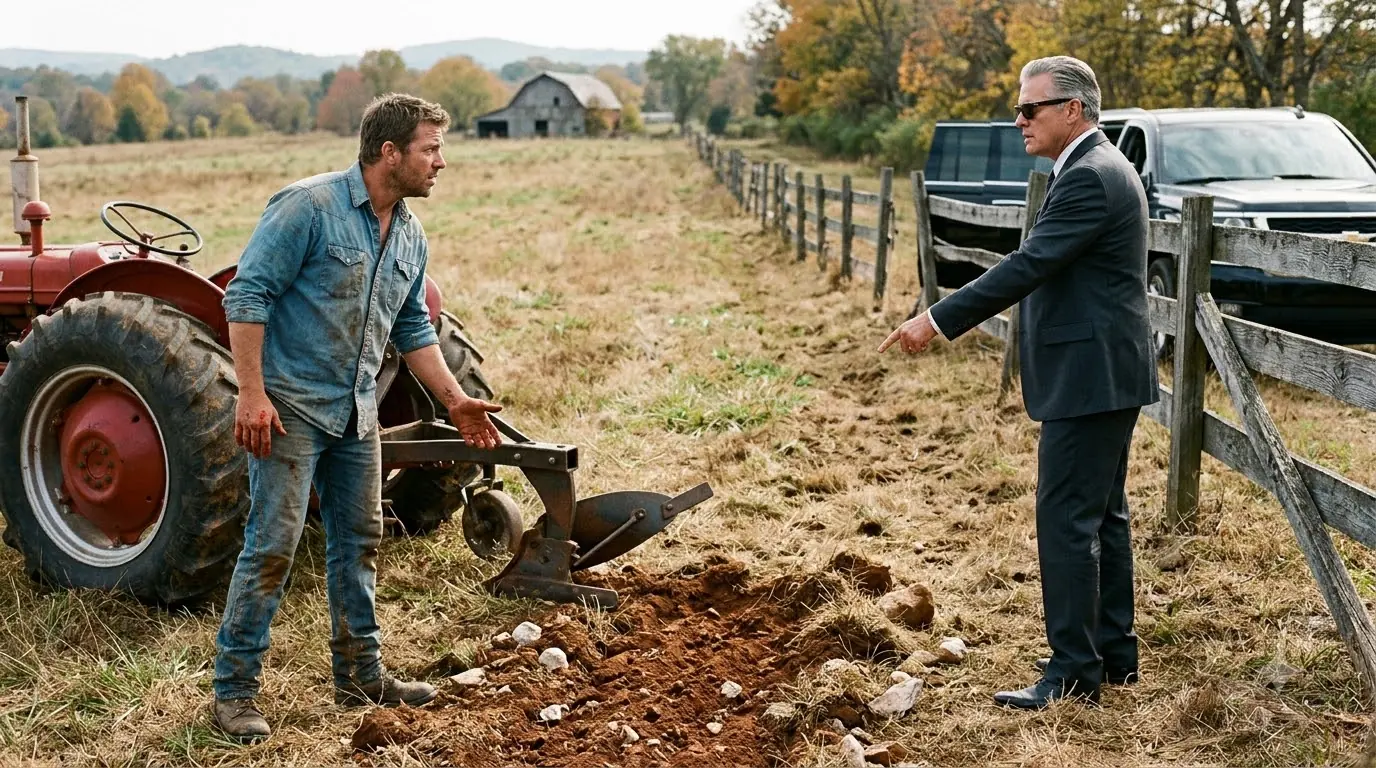
“What the hell was that?” he muttered.
He was thirty-eight years old, strong from years of farm work, with short brown hair and a face weathered by wind and sun. His faded blue denim shirt was dark with sweat beneath the arms. He had hit limestone before, and he knew the sickening resistance of a plowshare catching a buried root. This had felt different. The impact was too clean, too hard, too abrupt. Whatever the plow had met was still concealed beneath the red soil.
He crouched, brushing loose dirt from the point of contact with his glove, careful not to force the damaged steel deeper. A small amount of reddish clay crumbled away. Nothing identifiable appeared. He shifted back to examine the plow's angle instead of digging blindly. His father had taught him that an expensive surprise in a field was rarely improved by making a second, larger mistake.
That was when he heard the vehicle.
A black luxury SUV approached along the gravel lane bordering the pasture. It traveled too fast for the uneven track and stopped just outside the wooden fence, its polished body looking almost unnatural against the cracked clay and the shabby barn. The driver's door opened. A tall man in a charcoal suit stepped out, his slick gray hair undisturbed by the breeze. Dark sunglasses concealed his eyes. His polished shoes found the driest ground beside the fence as though he had inspected it beforehand.
The stranger looked toward the stalled tractor, then toward the disturbed patch of earth.
“Name your price,” he called. “I'm buying this land!”
Ethan slowly stood. “You haven't even told me your name.”
“Richard Harlan.” The man's voice was controlled, but his fingers tightened around the fence rail. “We can settle the details today.”
Ethan looked from the expensive vehicle to the man who had arrived at the exact moment his plow stopped. Richard had not asked whether anyone was hurt or whether the tractor was damaged. He had not asked what Ethan had struck. He had looked straight at the furrow, as though the location itself mattered.
Ethan's surprise hardened into suspicion.
“How do you know what's down there?” he asked.
Richard's confident expression tightened.
For one breath, neither man spoke.
The question had begun taking shape months before that autumn morning.
Ethan had purchased the eighteen-acre pasture because it was the only land in the county he could afford without surrendering the rest of his working life to a lender. The listing called it neglected grazing ground. The agent called it a challenge. Two neighbors called it a graveyard for equipment, and one of them advised him to save his money for a better opportunity. Ethan signed the purchase documents anyway, knowing that the acreage offered no easy income and that his savings would barely cover the first season of improvements.
He had grown up on farms where every field carried a personality of its own. He knew the difference between fertile bottomland and ground that punished machinery. What he did not know was why this particular property had remained unused for so long when it lay within reach of serviceable roads and productive neighboring land. The old barn was salvageable. The boundary fences needed repairs but had not collapsed completely. Water crossed a shallow depression at the lower edge after heavy rain, though no permanent stream ran through it. The field itself was the problem: a mix of hard red clay, shallow limestone, and dry grass, with patches where even weeds seemed reluctant to grow.
The first time Ethan walked the land alone, he carried a notebook and a cheap measuring wheel. He wore the same denim shirt he would wear on the morning of the impact, though it was less faded then. He paced the fence and marked places where posts leaned. He tested the barn doors, checked the roof for leaks, and traced the uneven terrain to see where rainfall might collect. He was planning a modest pasture improvement, nothing grand enough to impress the neighboring landowners. His hope was to restore enough grass to support a small operation and make the property pay a little of its own way.
He found a strange shallow ridge crossing the central pasture from northwest to southeast. It could have been old erosion, soil dumped during an abandoned improvement, or the remnant of a track that had disappeared under grass. It did not rise high enough to warrant a line on an ordinary map. But it interrupted the otherwise natural slope. Ethan noted its direction and moved on.
At the time, he had no reason to consider it important.
The house he rented in town was small, and he kept his tools in a shed behind it until he could make the farm secure. He drove out before sunrise on his days off and returned after dark with his boots covered in clay. In the evenings he calculated fence costs on the kitchen table and looked at seed prices he could not justify buying before the roughest patches were prepared. His friends told him he worked as though the land were a promise to someone. Ethan laughed at that. The truth was less romantic. He had spent years fixing other people's equipment and watching other people's property increase in value while his own plans waited for a decent opening. The eighteen acres were a risk, but they belonged to him.
He had not expected people to be so interested in his modest purchase.
The first inquiry arrived less than a week after the deed was recorded. A man who introduced himself as an intermediary called to ask whether Ethan would consider reselling. Ethan assumed a neighboring farmer wanted to enlarge a field, and he asked what sort of price the caller had in mind. The answer was generous enough to make him sit down. It would have returned his initial costs and given him a small profit before he had repaired a single fence.
But the caller did not name a buyer.
Ethan said no. The man thanked him and promised not to waste his time. Two days later another inquiry arrived, this one through an attorney's office. It offered a substantially higher sum, again without disclosing who ultimately wanted the property. Ethan asked whether the interest concerned road access, timber rights, or some plan for neighboring acreage. The woman on the telephone said she was not authorized to discuss the intended use.
That was the first detail that stayed with him.
He understood wanting land. He did not understand wanting land so urgently that a buyer would offer more than the market appeared to support while refusing to explain why. He reread his closing papers, checked the boundaries, and asked the title company whether there were disputed easements or unresolved claims. Nothing obvious appeared. The recorded documents described an ordinary eighteen-acre tract. The legal description was dull, the taxes current, and the title work showed no explanation for the mystery.
Ethan refused the second offer too.
When he mentioned the calls to an older farmer who lived across the county road, the man shrugged. “Maybe somebody thinks the highway is coming this way.”
“Is it?” Ethan asked.
“Not that I've heard.”
“Then why pay for it?”
“People with money don't always need a reason they share with us.”
That answer might have satisfied someone else. Ethan had spent too long troubleshooting machinery to accept it. When a component failed, there was a reason somewhere, whether or not the first inspection found it. The better question was which evidence could actually change his understanding. He wrote down the dates of both offers and left the page in his farm notebook. It was not paranoia, he told himself. It was recordkeeping.
Summer brought enough heat to harden the clay like brick. Ethan spent weekends patching fence, clearing brush around the barn, and removing loose stones from the highest strip of pasture. The work was slow, and every removed stone seemed to reveal two others. He hired no crew. He could not afford one, and he trusted his own pace. When the tractor needed an oil seal, he replaced it himself. When the barn door jammed, he reset its hinges rather than buying new hardware. Small economies were not glamorous, but they were the only reason the project remained possible.
During one hot afternoon, he noticed fresh tire marks beside the far gate. He had left the gate locked after replacing its chain. The lock was still intact, but a vehicle had stopped there recently, and two sets of footprints led a short distance along the fence. Ethan followed them until the grass swallowed their shape. He found no damage and no sign of anyone crossing the boundary. Still, the visit bothered him. Most strangers looking at land for sale came through the front entrance. The property was not for sale, and the far gate overlooked the central pasture rather than the barn.
He asked the road crew whether they had stopped there. They had not. A neighboring ranch hand said delivery vehicles sometimes turned around on that track, which was plausible. Ethan made a note and decided not to turn an uncertain observation into a dramatic accusation. He installed a simple trail camera facing the gate, mainly to watch for trespassers and wandering livestock. For several weeks it recorded deer, a fox, and an occasional pickup passing on the road. It offered no clear answer.
Then he received a letter.
It came in a plain business envelope and contained a formal purchase proposal with no personal message. The amount exceeded the earlier offers. There was a requested response date, a promise of a quick closing, and language allowing the buyer time for limited inspection. Ethan read the document three times. The proposed inspection area covered the central pasture, not the barn or the access road. A map attached to the offer outlined a narrow rectangle across the rocky clay. He recognized the direction immediately. It followed much the same line as the shallow ridge he had marked on his first survey.
He laid his notebook beside the letter. The similarity might have been coincidence. The outline might have reflected soil access or simple engineering convenience. But the connection was now strong enough that he could not ignore it. Someone wanted a particular part of his land, and someone was prepared to buy the entire property to reach it.
He called the number on the proposal. A receptionist transferred him to an attorney, who said that her client wished to remain confidential during preliminary negotiations. Ethan asked if the interest related to minerals, utilities, or construction. She repeated that the client would discuss permitted uses only after an agreement was signed.
“Then we don't have an agreement,” Ethan said.
The attorney remained polite. “Our client is willing to accommodate reasonable concerns.”
“My concern is that he knows something about my land he won't tell me.”
There was a pause long enough for Ethan to hear a faint office sound in the background.
“The offer stands until the date on the letter,” she said.
He hung up without answering.
That evening he drove to the property while the sun went down behind the hills. He walked to the shallow ridge with the proposal map folded in his pocket. He studied the hard ground, the sparse grass, and the scattered limestone protruding like pale knuckles. Nothing about the place suggested immediate profit. No healthy timber stood there. There were no buildings to salvage. The clay was poor, and any agricultural improvement would require patience. Yet a stranger wanted it badly enough to make an offer that would have tempted Ethan at almost any other time in his life.
He knelt and picked up a small limestone fragment. It was ordinary, angular, chalky at the broken edge. He rubbed the dirt away and tossed it gently to one side. The ground did not volunteer answers merely because he had learned to distrust the offers.
On the drive home, he considered selling anyway. The profit could buy a better tractor, clear his remaining debts, or become a down payment on land with stronger soil. He could walk away before investing another year of labor in the pasture. That was the sensible argument, and he did not pretend it had no force. But his decision to buy the place had not been an accident. He wanted to see whether he could make something useful from ground other people dismissed. Selling under unexplained pressure would leave him with money and a question that might follow him for the rest of his life.
He kept the letter.
In late August, Ethan took the property map to a retired surveyor who had known his father. He asked whether the ridge corresponded with any obvious historic boundary or abandoned access route. The surveyor examined the map, then looked through public records available at the county office. He found old descriptions of adjoining tracts and changes in ownership but no clear record of the ridge as a road or boundary. The surveyor warned Ethan against treating old maps as precise pictures of everything that had ever happened on a piece of ground. Minor farm features often went unrecorded; others appeared in drawings only because a clerk needed a convenient line.
“Do you think something is buried there?” Ethan asked.
“Something could be buried anywhere,” the man replied. “That isn't a reason to start digging without knowing what you're doing.”
Ethan agreed. He had worked around buried cables and broken drainage lines enough to respect the danger of the unseen. The surveyor advised him to check utility information before major excavation and to separate the question of who wanted the land from the practical work of improving it. A buyer's secrecy was suspicious, but suspicion did not make every unusual stone a discovery.
Ethan thanked him. The advice was useful precisely because it resisted the easy story forming in his mind.
September brought cooler mornings. Ethan ordered inexpensive grass seed for the less rocky margins and planned to break up a limited strip of compacted ground with the old red tractor and steel plow he had inherited from a relative. He was not trying to overturn all eighteen acres. Much of the property was too rough for that, and some ground needed a different treatment entirely. His first objective was a test area on the upper pasture where he might improve drainage and establish a small stand of forage. He examined the implement for cracks, checked the hitch, and replaced a worn bolt. Then he walked the intended line to clear visible rocks.
He came back to the ridge several times.
The shallow rise cut across part of the route he intended to prepare. He could work around it, and perhaps that would have been wiser. But he wanted to understand whether the ridge held loose stones that could be removed or a continuous shelf of shallow rock best left alone. He used a hand probe in several accessible places without forcing it against hard resistance. The readings were inconsistent. One spot yielded after a few inches. Another stopped abruptly. The surface looked much the same in both places.
A few days before the impact, a black SUV passed slowly along the county road while Ethan repaired the barn's lower door. Its windows were dark. He barely glanced at it until it slowed beside the property, paused, and continued. The road was public, and he had no proof the driver was interested in him. But the vehicle returned the next afternoon, passing in the opposite direction just as he carried tools toward the tractor shed.
He wrote down the description without making more of it than the evidence allowed.
That night, a new voice called his mobile phone.
“Mr. Carter?”
“Speaking.”
“My name is Richard Harlan. I represent a private interest in your property.”
Ethan stopped cleaning a socket wrench. The name meant nothing to him, though the calm precision of the voice sounded familiar from men accustomed to buying solutions rather than discussing them.
“I've already declined the offers.”
“I understand. I would like to discuss another.”
“Why?”
“Because I believe we can reach an agreement beneficial to both parties.”
“That's why anyone buys anything. What's the land for?”
A brief pause followed.
“An investment.”
“In eighteen acres of rocky clay?”
“Land often has more than one value.”
Ethan leaned against the workbench. “What value do you see?”
“That is a subject we can address in person.”
“Then call when you're ready to address it.”
Richard's voice remained composed. “I would advise against major alterations to the central parcel while we are speaking.”
The warning landed harder than the offer.
Ethan straightened. “Why?”
“Because changing the land could complicate a transaction.”
“You've got no transaction.”
“Not yet.”
“If you're suggesting I stop working my own property, you'll need a better explanation than that.”
Richard allowed the silence to last a moment. “Think carefully about my proposal, Mr. Carter.”
The call ended.
Ethan stared at the phone long after the screen went dark. He was not frightened by the idea of selling land to a wealthy stranger. He was frightened by the man's assumption that he could direct what happened on land he did not own. Richard had not requested a meeting or made a clear argument. He had issued a warning disguised as business advice, and it concerned the exact part of the pasture mapped in the latest offer.
Ethan looked toward the window, though he could not see the farm from his rented house. He thought of the shallow ridge and the hard probe readings. He also thought of his father, who had taught him never to mistake stubbornness for judgment. The next move needed to be deliberate. He could refuse to sell without deliberately courting danger. He could continue working the farm while honoring ordinary precautions about buried infrastructure and rock. The problem was that he did not know which facts Richard possessed and which ones he was trying to conceal.
At sunrise, Ethan returned to the property and walked the central pasture again.
The old barn cast a long shadow over the gravel yard. The grass had turned golden with autumn dryness. Red clay clung to the soles of his boots where dew softened the surface. He stood above the ridge and surveyed the line of stones. He saw nothing that would justify Richard's urgency. If anything, the land looked poorer in the clear morning light than it had on the day he purchased it.
At the far fence, he noticed a short length of ribbon caught on a splintered post. It might have blown there from a neighboring property or been left by someone measuring the area. He removed it and placed it in his notebook pocket. Alone it meant little. Beside the map and the calls, it troubled him. Someone had been paying attention to this stretch of ground, perhaps more closely than he had.
He drove into town for supplies and stopped at the feed store. Two men discussing equipment repairs fell quiet when he entered. He paid for what he needed and asked casually whether anyone knew a Richard Harlan. One recognized the surname and believed the man owned or financed property somewhere in the region, but could not say which company or why he would care about Ethan's pasture. The other offered a familiar warning about wealthy buyers who wanted land before the owner understood its future value. Ethan listened without treating their uncertainty as proof.
Back at the farm, he inspected the tractor once more. The engine started on the second turn, with a smoky cough that settled into a familiar rhythm. He attached the plow and made a slow test pass on a safe, previously cleared margin. The ground broke unevenly but predictably. He stopped several times to remove loose rocks by hand. His plan was to work only the limited area he had surveyed and leave the most uncertain patches untouched until he knew more.
By midmorning the sun had cleared the trees, and the red clay had begun drying again. Ethan drove across the field with the cautious attention of a man who knew every unexpected vibration could signal a costly repair. He approached the edge of the shallow ridge and considered turning away. The line ahead looked almost ordinary. He had walked it, probed part of it, and removed visible stones. Yet the map from the purchase proposal came back to him with unnerving clarity: a narrow rectangle drawn across this very part of the property.
He brought the tractor to a stop.
For several minutes he sat with the engine idling and looked over the land. He was not about to plow simply because Richard had warned him not to. That would have been a poor reason to risk an old machine. He considered the soil, the intended depth, and the route he had planned. He adjusted his course slightly toward ground he believed more suitable and proceeded slowly, ready to disengage the implement at the first sign of unusual resistance.
The first few yards were uneventful.
The plow opened an uneven furrow through clay and grass roots. Small stones rolled to the side. The tractor complained at a hard patch, then recovered. Ethan kept his left hand steady on the wheel, listening to the engine and watching the furrow behind him in the mirror. Everything he heard belonged to the ordinary language of an old tractor working difficult ground.
Then the steel struck.
The impact did not feel like the plow had scratched a rock. It felt like something solid had stopped the implement outright. A tremendous metallic clang broke across the pasture, sharp enough to make Ethan flinch. The tractor jerked violently. For an instant his boots lost their position on the floorboard, and his shoulder struck the side of the seat. The machine stalled before he could do more than secure the controls.
Silence followed so abruptly it seemed unnatural.
A crow lifted from the old barn roof. Somewhere near the fence a loose board knocked in the breeze. Ethan remained seated, breathing hard, trying to understand whether the engine, the hitch, or the plow had taken the force. The tractor had stopped directly over the line he had spent weeks studying. He could not yet tell whether that coincidence had meaning, but he knew the next few minutes would decide whether he left the pasture with an expensive repair bill or a much more complicated problem.
He set the brake, shut everything down, and climbed carefully off the tractor.
From the ground, the damage appeared less dramatic than the impact had sounded. The plow was held at an odd angle, and the furrow ended in a churned patch of red earth. Soil had been pushed forward and then heaped against a shallow depression. Nothing recognizable protruded. Whatever lay beneath was completely hidden, protected by clay and loose dirt.
“What the hell was that?” Ethan said again, hearing how small his voice sounded in the open pasture.
He examined the accessible part of the implement first. A pin had shifted slightly, and fresh scrape marks appeared on a steel edge. He did not try to pull the tractor forward or reverse it out under power. The plow was under load, and repeating the impact could damage the machine or disturb something he had not identified. He stepped back, evaluated the situation, and then crouched beside the point of contact.
Loose clay brushed away beneath his glove.
He found a patch where the soil was packed unusually tight, with small fragments of limestone embedded near the top. He stopped when the surface resisted his hand. He was not prepared to excavate blindly. There could be an old drainage line, a buried structure, a slab of natural stone, or something no living neighbor remembered. He knew enough to respect the uncertainty. He could work out a safer plan after documenting the position and checking what lay beneath, but the first task was to understand the scene without changing it.
He stood and took out his phone to photograph the furrow.
The engine sound reached him before he raised the camera.
At first he assumed a neighbor was driving past on the county road. Then he heard tires crunching along the side lane, faster than anyone normally approached the old gate. A black luxury SUV appeared beyond the fence. Its windows reflected the gold of the pasture, concealing the driver. The vehicle braked suddenly beside the access track and came to rest facing the stalled tractor.
Ethan felt his chest tighten.
He had seen a vehicle like it before. Perhaps it was the same one that had passed the farm twice. He could not be sure. But there was nothing uncertain about the timing. It had arrived when the plow stopped, not when he first entered the field, not when he started work, and not when the engine had been running smoothly. The driver appeared to know that something significant had just happened.
The door opened.
Richard Harlan emerged in a charcoal business suit, polished shoes, and dark sunglasses. He looked about fifty-five, his gray hair slicked neatly back. He did not carry a coat despite the autumn breeze. His face had the practiced stillness of someone who expected negotiations to end on his terms.
He walked to the fence and looked past Ethan toward the disturbed earth.
Not at the tractor's engine. Not at the bent plow or the sharp scrape across the steel. At the exact place where the furrow ended.
Ethan slipped his phone into his pocket without sending any message. He was alone, but he was not helpless. The fence separated them. The stranger had not entered his land. For now, words were the only threat on the table.
“Mr. Carter,” Richard called.
Ethan did not move closer. “Mr. Harlan.”
Richard's head tilted slightly. “I tried to reach you.”
“You did. I answered.”
“I believe my earlier proposal deserves reconsideration.”
“I already told your attorney I'm not selling.”
Richard looked toward the soil again. His hand tightened on the upper rail. His next words came with a sudden urgency that made the polite opening seem like a mask dropped too soon.
“Name your price. I'm buying this land!”
The words hung in the cool air.
Ethan had imagined a rich buyer making another offer. He had not imagined a man arriving at a stalled tractor and demanding the entire property without first asking whether he was injured. He felt anger rise, but beneath it was an unfamiliar unease. Richard's offer was no longer just generous. It sounded desperate.
“You picked a strange time to negotiate,” Ethan said.
Richard stepped closer to the fence. “This can be done simply. You tell me what you want, and I'll arrange it.”
“What I want is to know why you're standing here.”
“I came to protect an opportunity.”
“Whose opportunity?”
Richard's jaw shifted. “Yours, if you have sense enough to take it.”
Ethan glanced at the furrow. “You don't even know what happened to my tractor.”
“I can cover any damage.”
“You haven't looked at it.”
“I'm not concerned about the tractor.”
The admission was so quick that Richard appeared to regret it. He straightened, placed one hand in his coat pocket, and recovered a measured tone.
“Mr. Carter, I'm offering you an exit from a difficult investment. You can leave this property with more money than it would earn in years. There is no need to make this adversarial.”
Ethan had learned to listen when someone explained an arrangement too smoothly. The most important part was often what they refused to mention. Richard had described money, paperwork, and convenience, but not the purpose. He had talked about opportunity without saying what opportunity he saw. And he had arrived at precisely the one location his earlier purchase map emphasized.
“What makes you think it's a difficult investment?” Ethan asked.
Richard gestured toward the rocky field. “Look around you.”
“I did. Before I bought it.”
“Then you know what it's worth.”
“I know what I paid. I know what it costs to work. You seem to know something else.”
Richard gave a small smile. “A successful investor recognizes value differently.”
“Then explain your valuation.”
“I'm not here to give a lecture.”
“You're here to buy a farm that wasn't listed for sale.”
Richard's silence confirmed nothing, but it changed the way Ethan heard the earlier calls. The anonymous offers. The rectangle on the map. The request that he avoid disturbing the central parcel. The vehicle passing the road. Each could have been innocent in isolation. Together they formed a pattern no longer easy to set aside.
Ethan stepped away from the furrow, making it clear that he was not inviting the stranger closer. Richard watched the movement closely. A gust lifted dust from the dry grass between them. The tractor stood silent, its red paint faded against the clay, an ordinary machine caught in an extraordinary moment.
“I want you to leave,” Ethan said.
Richard did not move. “Think before you reject this. I'm prepared to pay more than the tract's agricultural value.”
“Why?”
“Because I can.”
“That's not a reason.”
“It's an answer.”
Ethan shook his head. “No. It's a way of avoiding one.”
For the first time Richard showed open irritation. “You've worked this place for a few months. You don't know the ground the way you think you do.”
Ethan felt the sentence settle heavily. Richard had spoken as though he possessed experience with the property, not merely an opinion based on maps and market prices. Ethan studied him behind the dark sunglasses. The man's expression had changed, but he was no closer to revealing why he cared.
“How long have you known about this land?” Ethan asked.
“That isn't relevant.”
“It is to me.”
“Your decision should be financial.”
“Then give me the financial reason you want eighteen acres of rock and clay.”
Richard looked past him again, toward the disturbed soil. His attention seemed almost involuntary. Something about the exact position of the plow disturbed his carefully arranged calm. Ethan recognized the reaction because he had seen it in mechanics who heard a noise and instantly knew a failure was more serious than the customer understood.
He thought of the day he found the small ridge. He thought of the old surveyor warning him against digging blindly and of his father's voice telling him that a second mistake never repaired the first. There was a sensible next step after this encounter: document the site, keep it undisturbed, gather professional advice, and find out whether any buried feature was dangerous or legally significant. He would not allow a stranger to turn uncertainty into a hurried sale.
Richard tried once more.
“Mr. Carter, I can write a figure that changes your life.”
“You've had plenty of chances to write one.”
“This offer won't last.”
“Neither will this conversation.”
Richard took off his sunglasses. His eyes were gray and cold, but there was strain around them now. His composure appeared held together by effort, and Ethan wondered how far the man had traveled to reach the field in time. Did he have someone watching the property? Had an employee called after hearing the impact? Or had Richard simply arrived by coincidence? Each possibility raised a question that could not be solved by accepting his money.
Ethan felt the weight of his phone in his pocket. He could record the conversation if it continued, but he did not reach for it yet. Instead he memorized what Richard had said. The offer was not proof of what lay beneath the soil, but it was evidence of what Richard believed mattered. That distinction might become important later.
“Is it yours?” Ethan asked quietly.
Richard frowned. “What?”
“Whatever you think is buried there. Is it yours?”
A muscle tightened near Richard's mouth. “I have made no claim about anything buried.”
“Then why did you warn me not to work the central pasture?”
“Because changes to the site complicate a purchase.”
“You weren't buying it. You were trying.”
Richard's gaze shifted to the plow again. “You should stop digging.”
The words landed between them like another impact.
Ethan stood very still. Richard had issued the warning without asking what the tractor struck or whether Ethan intended to excavate. The man was no longer negotiating like a buyer uncertain of a property's potential. He was reacting like someone who already possessed a private understanding of the ground beneath the furrow.
Ethan looked down at the red clay. The buried obstruction remained completely hidden. No visible edge, marking, or recognizable shape offered a hint. Loose soil had settled back over the impact point. The secret, if there was one, had stayed where it was despite the force of the plow.
He lifted his gaze.
“You came here too fast,” Ethan said.
Richard said nothing.
“You looked at the ground before you looked at me.”
“Mr. Carter—”
“You offered to buy the land before you knew whether the plow was broken.”
Richard's face closed. “I advise you to accept a reasonable business arrangement.”
Ethan took one slow step toward the fence, leaving ample distance between them. He was no longer thinking about profit or resale value. He was thinking about who had approached him anonymously, who had drawn the map, and why a wealthy stranger looked frightened by a patch of disturbed earth in an otherwise worthless Virginia pasture.
The autumn wind moved through the dry grass. The old barn creaked softly behind him. The red tractor waited where the metallic impact had silenced it. The black SUV stood beyond the fence with its engine ticking as it cooled.
Richard Harlan held Ethan's eyes for an instant, then glanced again at the place where the furrow ended.
Ethan followed that glance. He saw only clay. He would not invent a shape to fill the mystery, and he would not brush deeper merely to satisfy the man watching him. Whatever the plow had struck remained beneath the surface, wholly concealed.
He turned back to Richard.
“How do you know what's down there?”
Richard's confident expression tightened. The blood seemed to drain from his face, and the hand holding his sunglasses went motionless beside the fence rail.
He opened his mouth.
Ethan waited.