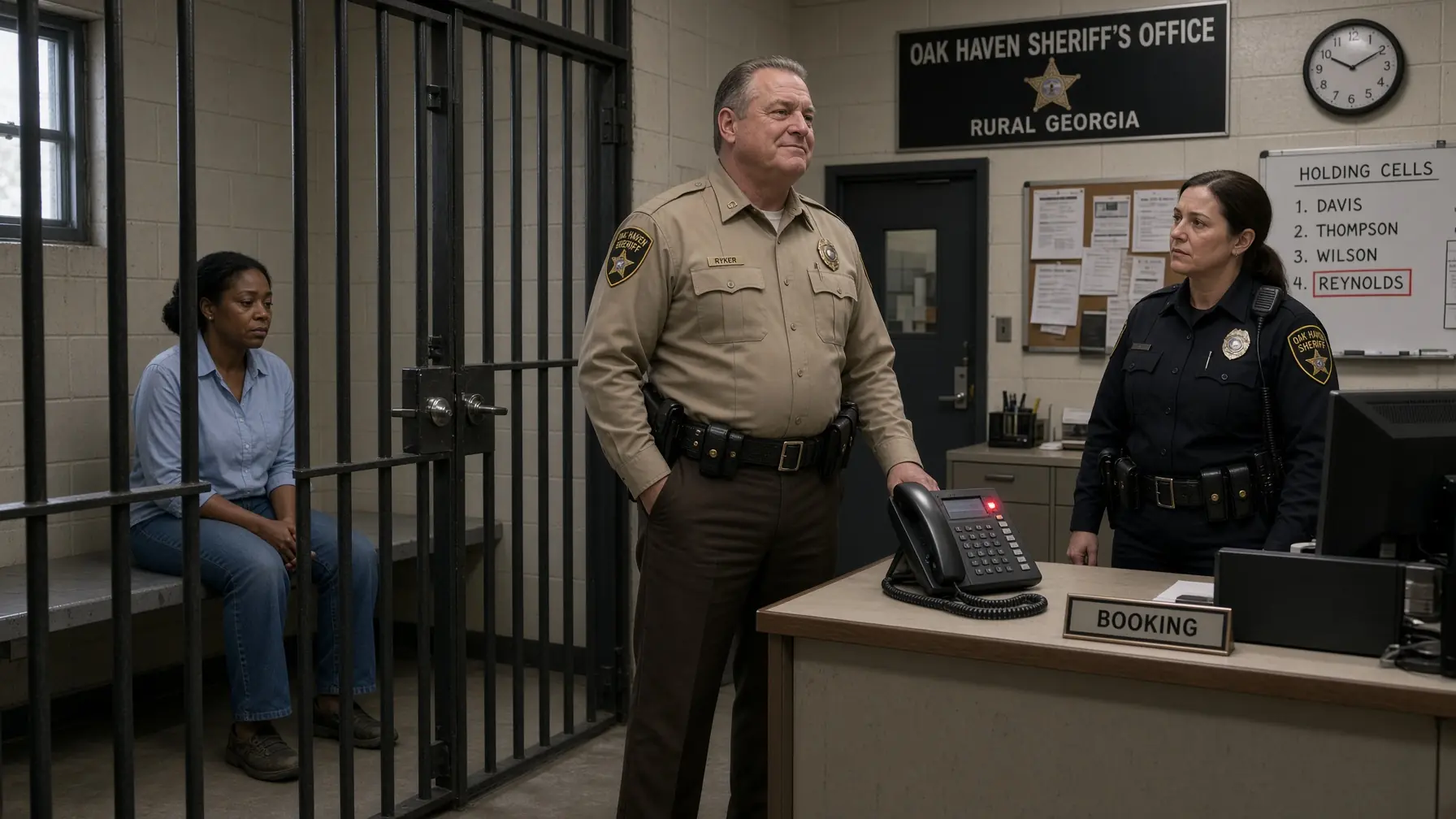
Sheriff Thomas Ryker smiled when the holding-cell door shut behind Sarah Reynolds. She had followed his instructions, kept her hands visible, and asked for an attorney, but he had decided that her calm voice amounted to attitude. Five minutes later, the front desk phone rang, and the dispatcher stopped treating the afternoon as ordinary. The caller wanted an explanation—and every camera inside the building had already recorded pieces of an answer Ryker would soon wish he could change.
At 3:31 that Friday afternoon, Sarah saw the patrol lights in her rearview mirror.
She was driving a rented sedan along Route 119, following the road through rural Georgia toward an aunt’s house outside Savannah. The afternoon had settled into the heavy heat that seemed to gather over pavement and remain there, even when the sky carried clouds.
She had been looking forward to the visit.
Not because her aunt had planned anything special.
There would be food, a familiar kitchen, and questions about whether she was sleeping enough. Her aunt would insist she looked tired, Sarah would deny it, and both would know the denial was a courtesy rather than a fact.
The previous seventy-two hours had left her exhausted.
She had spent them coordinating a sensitive Department of Defense logistics operation at the Pentagon, working through briefings, revisions, and problems that did not become simpler merely because somebody wanted an answer quickly.
Now she wore jeans and a white blouse.
No uniform.
No visible stars.
No security detail.
The rental car held an overnight bag, a bottle of water, and two phones: one personal, one secure government device she needed for a briefing scheduled at four.
She intended to stop somewhere quiet before joining it.
There was enough time.
Then Deputy Jared Miller accelerated behind her.
Sarah signaled, reduced speed, and pulled onto a wide section of shoulder. She placed the sedan in park, turned off the engine, and lowered the driver’s window.
Both hands rested high on the steering wheel when Miller approached.
“Afternoon.”
“Good afternoon, Deputy.”
“License and registration.”
“My license is in my wallet. The rental agreement is in the glove compartment.”
He glanced inside.
“Get them.”
She announced each movement before making it.
Wallet.
License.
Glove compartment.
Paperwork.
Miller watched, accepted the documents, and took a step away from the window.
“Know why I stopped you?”
“No.”
“You drifted across the center line.”
Sarah looked toward the road, then back at him.
“I don’t believe I crossed it.”
“You don’t believe?”
“I was watching the lane.”
He studied her license.
“Where are you headed?”
“To visit my aunt outside Savannah.”
“Coming from?”
“Work.”
“Where?”
“Washington.”
Miller looked at the rental agreement again.
She could see him sorting the information into a picture that made sense to him. Out-of-town driver, rented vehicle, unfamiliar name.
None of it required hostility.
She hoped the encounter would remain a conversation about a lane position they remembered differently.
“Have you been drinking?”
“No.”
“Taken anything?”
“No.”
He watched her face.
Sarah knew she looked tired.
She had seen herself in the rearview mirror before leaving the last place she stopped, and exhaustion had drawn faint lines beneath her eyes.
That did not make her intoxicated.
She answered without trying to hide the tiredness.
“I’ve had a long few days. I haven’t been drinking.”
Miller nodded once.
“Sit tight.”
He returned to the cruiser.
Sarah stayed still.
She glanced at the dashboard clock.
3:34.
Twenty-six minutes until the briefing.
She was not yet worried about missing it. She was concerned about letting the delay hurry her into a movement or answer that could complicate an ordinary stop.
She breathed slowly and watched the mirror.
Miller spoke into his radio.
She could not hear all of it.
She heard the rental plate repeated and part of her name.
She remembered both.
Remembering was not something she had begun doing because a police officer stopped her. It was a habit built through years of work in which a sequence could matter as much as an outcome.
Who said what.
When.
What information was available at the time.
She did not assume she would need the details.
She kept them anyway.
A second law-enforcement vehicle arrived at 3:38.
It pulled onto the shoulder behind Miller’s cruiser, and the man who stepped out moved with the confidence of someone who expected the others to wait.
Sheriff Thomas Ryker.