“You’re heavier than your letter described.”
Those were the first words Rhett Callahan spoke when Harper Whitmore stepped down from the train at Harlan Creek. She stood on the dusty platform holding one brown suitcase, a wooden wool-carding frame, and the marriage contract that had carried her across three American territories. Rhett did not remove his hat, offer his hand, or hide the disappointment crossing his weathered face.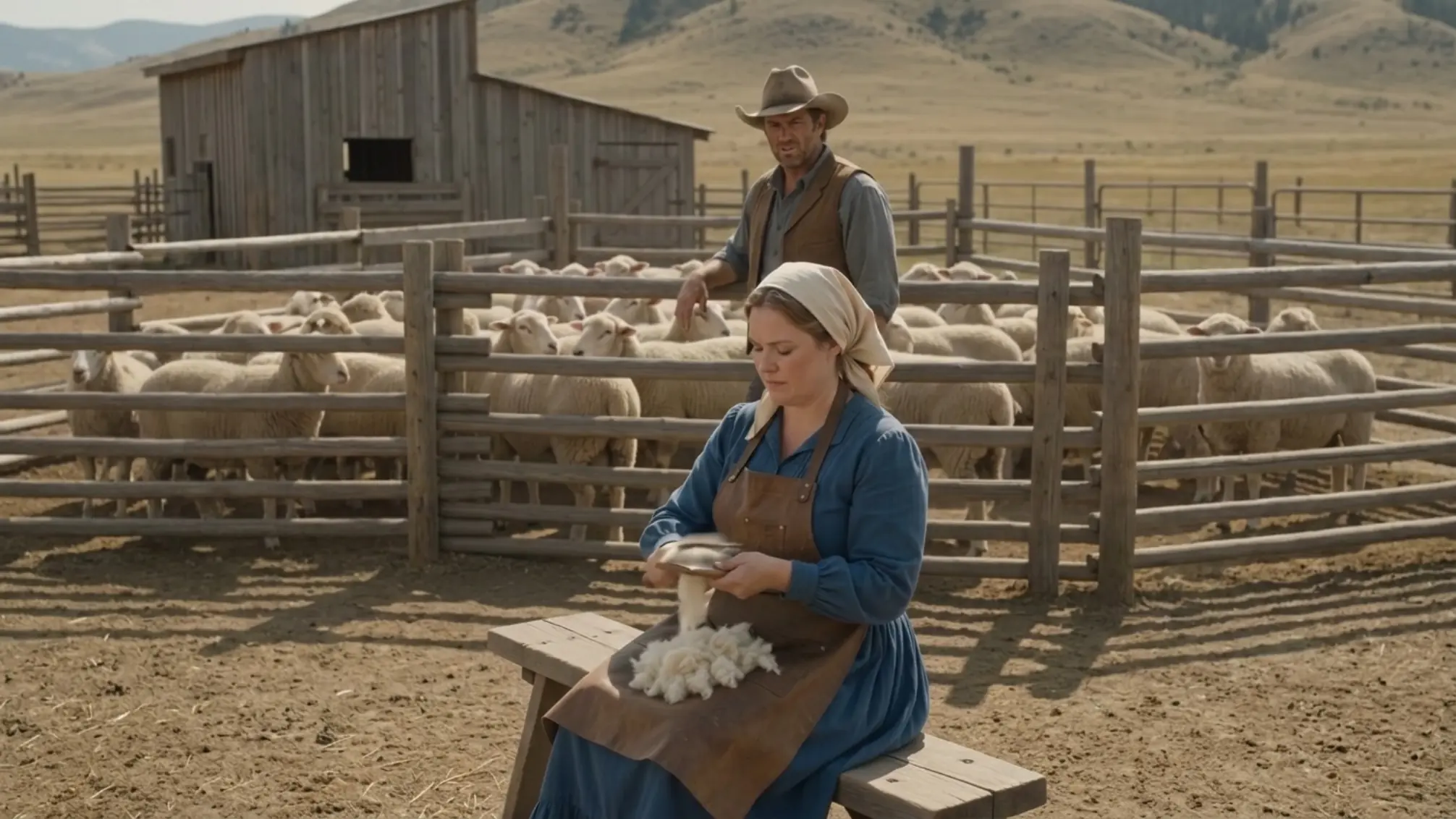
Harper’s cheeks burned beneath the Wyoming afternoon sun. She was thirty, beautiful in a quiet, full-figured way, with fair skin, soft hazel eyes, and dark-brown hair tucked beneath a cream headscarf. Her deep-blue traveling dress strained slightly at her waist after three days on the train, but her posture remained straight. She looked at the rugged rancher waiting beside the platform and decided she would not give him the satisfaction of seeing her break.
“And you’re ruder than your letter described,” she answered.
Rhett’s gray eyes narrowed.
Behind him, two ranch hands exchanged surprised looks. No woman in Harlan Creek spoke to Rhett Callahan that way, especially not a mail-order bride who had arrived because his ranch needed her labor more than he needed romance. He was thirty-eight, broad-shouldered and sun-browned, with dark wavy hair, a trimmed beard, and the hard expression of a man who had spent years losing things without admitting they hurt.
“The wagon’s outside,” he said.
Harper picked up her suitcase before he could reach for it. “Then lead the way.”
The Callahan ranch lay twelve miles beyond town, surrounded by pale grassland, rolling hills, and long fences that seemed to disappear into the horizon. Hundreds of sheep crowded the lower pens, their wool dirty and uneven, while the largest barn leaned slightly toward the east. A windmill creaked near the house, turning only when the prairie wind struck it from the right direction.
Harper saw the problems before Rhett stopped the wagon.
The sheep were restless. Several ewes stood apart from the flock, and one young animal dragged its back leg as it moved toward the water trough. Piles of unwashed fleece sat beneath a patched canvas beside the shearing shed, exposed to dust and moisture.
“You leave wool outside?” Harper asked.
“It was supposed to be collected last week.”
“By your buyer?”
“Emmett Crow. He’s handled our wool for sixteen years.”
Harper looked at the stained bundles. “Then your trusted buyer is ruining part of the harvest before he weighs it.”
Rhett’s jaw tightened. “You have been here less than a minute.”
“And the wool has been sitting there far longer.”
He climbed from the wagon without answering.
Their wedding took place that evening in the ranch house, witnessed by two ranch hands and a traveling preacher who accepted dinner instead of payment. There were no flowers, music, or promises of love. Rhett repeated the legal vows with the grave efficiency of someone completing a land transaction.
Harper did the same.
The marriage contract was practical. She would manage wool preparation, household accounts, food stores, and seasonal labor records. In return, she would receive a home, a share of the ranch’s annual profit, and legal protection as Rhett’s wife.
The final clause stated that either party could seek separation after one year.
Rhett showed her the room where she would sleep.
It had once belonged to his younger sister, who had married and moved east. The narrow bed was covered with a clean quilt, and a small wooden wardrobe stood beside the window. It was not the room of a beloved wife, but it was more care than Harper expected after the train platform.
“My room is across the hall,” Rhett said.
“I assumed this marriage did not include affection.”
His expression shifted almost imperceptibly. “You understood the advertisement.”
“I understood you needed someone skilled with wool.”
“That is what I need.”
Harper set her suitcase on the bed. “Then tomorrow, you’ll show me every fleece, every sheep, and every ledger.”
Rhett paused at the doorway. “The ledgers are my business.”
“They became mine when you signed the contract.”
For the second time that day, she watched him realize the woman he had summoned would not quietly follow instructions. He left without agreeing, but he did not refuse again.
Harper began work before sunrise.
She changed into a plain navy dress, tied on a brown leather apron, and carried her carding frame to the shearing shed. The ranch hands watched as she separated the wool into piles based on length, strength, color, contamination, and moisture damage.
By breakfast, she had rejected nearly one-third of the stored fleece.
Rhett found her kneeling beside a bundle marked for sale.
“That pile is worth forty dollars,” he said.
“No. It was worth forty dollars before rain reached it.”
“Crow takes everything.”
“Then he pays you the lowest possible grade for everything.”
“He pays the market rate.”
Harper lifted two handfuls of fleece. One was pale, soft, and evenly crimped. The other was tangled with grass, damp near the center, and beginning to smell sour.
“If he pays the same price for these, he is either a fool or a thief.”
Rhett’s expression hardened. “Be careful.”
“Which word bothered you?”
“Emmett helped my father build this ranch.”
“And that makes the wet wool dry?”
Rhett stared at her for several seconds, then walked away.
The ranch hands expected Harper to complain about the work. Instead, she spent twelve hours sorting, washing, drying, and carding wool. Her hands reddened, her shoulders ached, and loose fibers clung to her dress and hair, but by sunset she had produced six clean bundles finer than anything the men had seen leave the ranch in years.
One of the older ranch hands ran his palm across the prepared fleece.
“Soft as cloud,” he murmured.
“It was always this good,” Harper said. “No one separated it properly.”
Rhett stood near the doorway listening.
The following morning, Harper walked through the flock.
She examined mouths, hooves, eyes, and skin beneath the wool. Rhett followed with growing irritation, insisting his animals had already been inspected by a livestock agent three months earlier.
Harper stopped beside a ewe standing apart from the others.
The animal’s face appeared swollen. Saliva dampened its mouth, and small sores showed along its gums. Harper gently turned its head toward the light.
“How long has she been like this?”
Rhett looked uncomfortable. “A few days.”
“And the others?”
“What others?”
Harper pointed toward three more ewes near the far fence.
“Move them away from the flock. Now.”
Rhett frowned. “Why?”
“Bluetongue, or something close enough that we cannot gamble.”
The word changed him immediately.
Bluetongue could spread through biting insects, weaken sheep rapidly, and destroy an already struggling flock. Rhett called for the ranch hands and ordered the animals moved into an isolated pen.
The veterinarian arrived before evening.
Harper’s suspicion was correct.
Six sheep showed early symptoms, but the illness had not yet spread widely. The veterinarian explained that separating them quickly might save the flock and instructed Rhett to drain standing water where insects bred.
After he left, Rhett found Harper repairing a broken carding tool beneath the barn lantern.
“You saved us from losing half the flock,” he said.
“I noticed sick animals.”
“No one else did.”
“You were looking at the ranch as a whole. I was looking at individual sheep.”
He leaned against the workbench. “Where did you learn all this?”
“My mother managed a textile house in Vermont. My father raised Merinos until a winter storm took most of his flock. After he died, I worked for a wool merchant.”
“Why leave?”
Harper continued tightening the carder’s wooden frame. “The merchant’s son believed my skill belonged to him because he expected me to marry him.”
“You refused?”
“He called me lucky that any man wanted a woman my size.”
Rhett looked away.
Harper noticed.
“Your first words were kinder,” she said, “but not by much.”
“I was surprised.”
“No. You were disappointed.”
He did not deny it.
Harper set the tool down. “You requested a woman who could manage wool, recognize disease, keep accounts, and survive ranch work. You received exactly that woman. The disappointment came from something you failed to request honestly.”
Rhett’s face reddened beneath the lantern light.
“You are direct,” he said.
“I had to become direct. People hear a large woman more clearly after she stops asking permission to take up space.”
He left without defending himself.
The next week brought heavy work.
Harper reorganized the wool shed, repaired damaged drying racks, and ordered the ranch hands to stop mixing fleece from different sheep. She introduced a grading system using colored cords, allowing even inexperienced workers to identify quality before storage.
Production improved almost immediately.
Rhett said little, but he began appearing near the shed more often. Sometimes he carried tools she had not requested. Other times he stood beside the fence pretending to inspect sheep while watching her work.
Harper noticed but did not encourage him.
She had crossed half the country to build a stable life, not beg a stern rancher to find her beautiful.
The first real shift came during a storm.
A late-season wind swept across the prairie, tearing loose boards from the lambing barn and driving rain beneath the roof. Harper heard distressed bleating after midnight and found two pregnant ewes trapped behind a fallen partition.
Rhett reached the barn moments later.
Together, they lifted the heavy board while one of the ranch hands guided the animals free. Harper slipped in the mud and fell against Rhett’s chest, but he held her upright with both arms.
For a brief moment, neither moved.
Rain struck the roof. Lantern light trembled across his face, and Harper saw concern there before he covered it.
“You hurt?” he asked.
“No.”
His hands remained around her waist.
Harper looked down at them.
Rhett released her quickly.
They worked until dawn, securing the roof and moving the pregnant animals into the main barn. By morning, Harper’s dress was soaked, her hair had escaped its headscarf, and exhaustion made every step difficult.
Rhett prepared coffee.
He placed a cup beside her without speaking and draped his dry coat over her shoulders.
“You’ll need it,” he said when she looked at him.
“So will you.”
“I’m used to the cold.”
“And I’m not?”
His mouth moved slightly.
It was almost a smile.
Three days later, Emmett Crow arrived.
He rode into the yard wearing a polished black coat and a cream hat too clean for ranch work. At fifty-six, he carried himself with the confidence of a man accustomed to entering struggling properties and finding everyone eager for his approval.
His smile faded when he saw the organized wool bundles.
“What happened here?”
Harper stood beside the workbench. “The wool was graded.”
Crow looked at Rhett. “By her?”
“Harper manages the wool now.”
The trader examined one of the bundles and frowned. “Callahan wool has never been separated this way.”
“That does not mean it should not have been,” Harper said.
Crow ignored her.
“I came for the early pickup,” he told Rhett. “Prices are dropping. Best to move everything before the eastern mills cut their orders.”
Harper opened the ledger she had been studying.
“What price?”
Crow finally looked at her. “Market price.”
“Which market?”
His eyes narrowed. “The wool market.”
“Boston, Philadelphia, Denver, or the territorial exchange?”
The ranch hands stopped working.
Crow’s smile returned, though it no longer appeared friendly. “Rhett, your wife seems confused about how business is done here.”
“She asked you a question.”
Harper opened the ledger to a marked page.
“For six years, you recorded our highest-grade fleece as mixed low-grade wool. Yet transport receipts show those shipments weighed less when they left your warehouse than when they arrived.”
Crow’s expression became still.
Harper continued. “That means part of the shipment was removed, relabeled, and sold separately.”
“You have no idea what those numbers mean.”
“I worked in a wool house for eight years.”
Crow turned toward Rhett. “You’re letting a woman who arrived two weeks ago accuse me of theft?”
Rhett looked at Harper.
The uncertainty in his face hurt more than she expected.
Crow saw it too.
“I helped your father through two droughts,” the trader said. “I advanced money when banks would not. I found buyers when no one wanted Wyoming wool.”
“And you kept detailed records?” Harper asked.
“Better records than anything you have.”
“Then show them.”
Crow stepped close enough that Harper could smell tobacco on his coat.
“Be careful, woman.”
Rhett moved between them.
“You will not threaten my wife.”
The words surprised all three of them.
Crow’s expression darkened. “I came to collect wool under our standing agreement.”
“The agreement gives you first opportunity,” Harper said. “Not ownership.”
Crow looked toward the wagons he had brought.
“You refuse this pickup, I refuse the winter advance. You will not have enough money for feed.”
Rhett knew it was true.
The ranch depended on Crow’s advance every autumn. Without it, they could not purchase hay before the first heavy snow.
Harper closed the ledger.
“Give us three days.”
Crow laughed. “For what?”
“To compare your price with another buyer.”
“No buyer will reach this ranch before winter.”
“Then three days cost you nothing.”
Crow looked at Rhett. “Control your wife.”
Rhett’s hand moved toward the fence rail beside him.
“My wife is the only reason you still have a flock to purchase from.”
Crow’s smile vanished.
He mounted his horse and promised to return on Monday.
That night, Rhett and Harper sat across from each other at the kitchen table. The ledgers lay open between them, surrounded by receipts, shipment weights, and copies of contracts signed by Rhett’s father.
“If you are wrong, we lose Crow,” Rhett said.
“If I am right, Crow has already taken enough to buy this ranch twice.”
“We still need winter feed.”
Harper pushed a page toward him. “Your finest wool has been sold through a mill in Cheyenne. Their mark appears on three transport receipts.”
Rhett studied the small stamped symbol.
“You think they bought our wool?”
“I think Crow sold it to them under another name.”
“How do we reach them?”
“The telegraph office.”
Harlan Creek’s telegraph operator sent a message before sunrise.
Harper described the wool grade, shipment marks, dates, and quantities. She requested an immediate price comparison and asked whether the mill recognized Emmett Crow’s secondary trading company.
The reply came that afternoon.
The Cheyenne mill had purchased Callahan wool for years.
Not directly from Rhett.
From a company registered under Crow’s brother’s name.
The mill had paid nearly three times what Crow reported in the ranch ledgers.
Rhett read the telegram twice.
Then he walked outside and struck the barn wall with his fist.
Harper found him standing among scattered tools, breathing hard.
“My father trusted him,” Rhett said.
“I know.”
“He sat at our table. He attended my mother’s funeral.”
“Fraud is easier when trust opens the door.”
Rhett turned toward her. “You saw this in two weeks.”
“I knew what honest wool records looked like.”
“And I didn’t.”
“You knew sheep, land, weather, fences, and survival. He used the one part of the ranch you did not fully understand.”
Rhett’s anger softened into shame.
“I nearly chose his word over yours.”
“Yes.”
The honesty struck him.
“I’m sorry.”
Harper folded her arms. “For doubting me or for the train platform?”
“Both.”
“That is not enough.”
“What would be?”
She looked toward the sheep pens.
“Stand beside me when he returns.”
Monday morning arrived beneath a hard blue sky.
Crow entered the ranch yard with four wagons and six hired men. He expected fear, hurried acceptance, and wool stacked for loading.
Instead, he found every bundle locked inside the main barn.
Harper stood near the gate holding the ledger. Rhett stood beside her with two ranch hands and the county marshal.
Crow slowed his horse.
“What is this?”
Harper raised the Cheyenne telegram.
“Your buyer answered.”
Crow’s gaze moved to the marshal.
“You brought the law into a private business dispute?”
“The mill provided copies of payment records,” Rhett said. “So did the freight office.”
Crow climbed from his horse. “Those documents can be misunderstood.”
“Then explain them,” Harper said.
His voice became low. “You think because this fool married you, you own his ranch?”
Harper’s hands tightened around the ledger.
Before she could answer, Rhett stepped forward.
“She does not need to own this ranch to expose the man stealing from it.”
Crow pointed toward him. “You choose her over the man who kept your family alive?”
“No,” Rhett said. “I choose the woman who proved you were bleeding us dry.”
The hired men near the wagons began shifting uneasily.
Crow reached for the ledger, but Harper pulled it back.
The marshal placed one hand on his shoulder.
“Easy.”
Crow froze.
Copies of fraudulent receipts were recovered from his warehouse that afternoon. Investigators found altered weights, false company names, and hidden accounts extending across several ranches.
Crow had not merely cheated Rhett.
He had built his wealth by underpaying isolated ranchers who lacked access to distant markets.
The scandal reached Cheyenne within a week.
Several buyers arrived at the Callahan ranch, eager to secure the high-grade wool Crow had secretly sold at premium prices. Harper negotiated every contract herself.
The final agreement paid enough to purchase winter feed, repair the lambing barn, replace the broken windmill, and clear most of the ranch’s debt.
Rhett watched her sign the documents.
“You saved the ranch,” he said.
“I corrected the numbers.”
“You saved it.”
Harper looked at him. “Do you see me differently now?”
His answer came slowly.
“I see how little I saw before.”
That night, he prepared dinner.
The biscuits were hard, the stew had too much salt, and Harper ate every bite because she understood the apology hidden inside the effort.
Afterward, Rhett placed a small wooden box beside her hand.
Inside rested a silver brooch shaped like a sheep surrounded by prairie grass.
“It belonged to my mother,” he said. “She managed this ranch beside my father for twenty-seven years.”
Harper touched the brooch carefully.
“You want me to wear it?”
“I want you to know I no longer think of you as hired skill attached to a contract.”
“What do you think of me as?”
Rhett looked uncomfortable for the first time since Crow’s arrest.
“My wife.”
“Legally, I already was.”
“I know.”
Harper waited.
Rhett took a breath. “The first day you arrived, I looked at your body and decided it told me something about your strength. Every day since then, you proved how foolish that was.”
“That sounds like another apology.”
“It is also a confession.”
Her heart beat faster.
“What are you confessing?”
“That somewhere between the sick ewes, the storm, and watching you face Crow without lowering your eyes, I stopped wondering whether this marriage would survive the year.”
Harper held his gaze.
“And started wondering?”
“Whether you might stay after you no longer had to.”
The silence between them changed.
Harper closed the wooden box.
“You hurt me before I stepped into your wagon.”
“I know.”
“I will not pretend one brooch repairs that.”
“I would not ask you to.”
“And I will not become smaller so you can feel larger beside me.”
Rhett moved closer.
“I have spent my life surrounded by men who tried to make themselves large through land, money, and fear. You walked onto this ranch and filled every empty place without taking anything that was not yours.”
Harper’s eyes stung.
“That was almost beautiful,” she said.
“Almost?”
“You still need practice.”
He smiled.
This time, she smiled back.
Winter arrived early.
Snow covered the grasslands, but the flock entered the season healthy and well-fed. The repaired barn held against the wind, and the new windmill kept water moving even during the hardest freezes.
Harper managed the wool operation from a renovated room beside the main barn.
She hired three local women, paying them fair wages to wash, card, grade, and package fleece. Within two years, Callahan wool became known across the territory for quality and honest measurement.
Rhett added her name to the ranch deed.
Not because the law required it.
Because he believed partnership should appear in writing.
Their marriage changed slowly.
Affection arrived through small things: coffee waiting before dawn, Rhett repairing Harper’s favorite chair, Harper saving the softest fleece for the lining of his winter coat. He stopped standing behind her while she worked and began sitting beside her.
One evening during lambing season, Rhett entered the barn carrying a lantern.
Harper sat in the straw beside a ewe and two newborn lambs. Her blue dress was dusty, her apron stained, and loose hair framed her tired face.
Rhett looked at her as if she were the finest thing on the prairie.
“What?” she asked.
“I was thinking about the station.”
“That is dangerous.”
“I saw you step off that train, and I thought the letter had failed to describe you.”
“It did.”
He sat beside her.
“It failed to say you would save my flock, expose a thief, rebuild my ranch, and frighten every wool trader west of Cheyenne.”
Harper leaned against his shoulder.
“It also failed to describe you.”
“How?”
“It said you were practical.”
“I am.”
“It did not mention stubborn, suspicious, or painfully slow to understand a good thing standing in front of you.”
Rhett laughed.
Outside, the winter wind moved across the open land, but the barn remained secure.
Years later, travelers passing through Harlan Creek spoke of the Callahan ranch as prairie royalty. Its sheep produced some of the finest wool in the American West, its workers received honest wages, and its ledgers were studied by ranchers determined never to be cheated again.
They often credited Rhett Callahan for preserving his family’s land.
The people who knew the true story corrected them.
The ranch survived because a plus-size woman stepped off a train carrying wool tools, courage, and a mind sharper than anyone expected.
A rancher had married her for labor.
A thief had dismissed her as interference.
Both men believed they understood her before she spoke.
Only one became wise enough to admit he had been wrong.
And whenever Rhett introduced Harper to a new buyer, he never called her his wool worker or the woman who saved his ranch.
He placed one proud hand over hers and said:
“This is my wife. Nothing on this land prospered until she arrived.”