Miriam Holloway had been Mrs. Graham Ashcraft for less than three weeks when she carried the first full tray of smoked beef into the ranch dining shed and heard twenty-two grown men fall silent.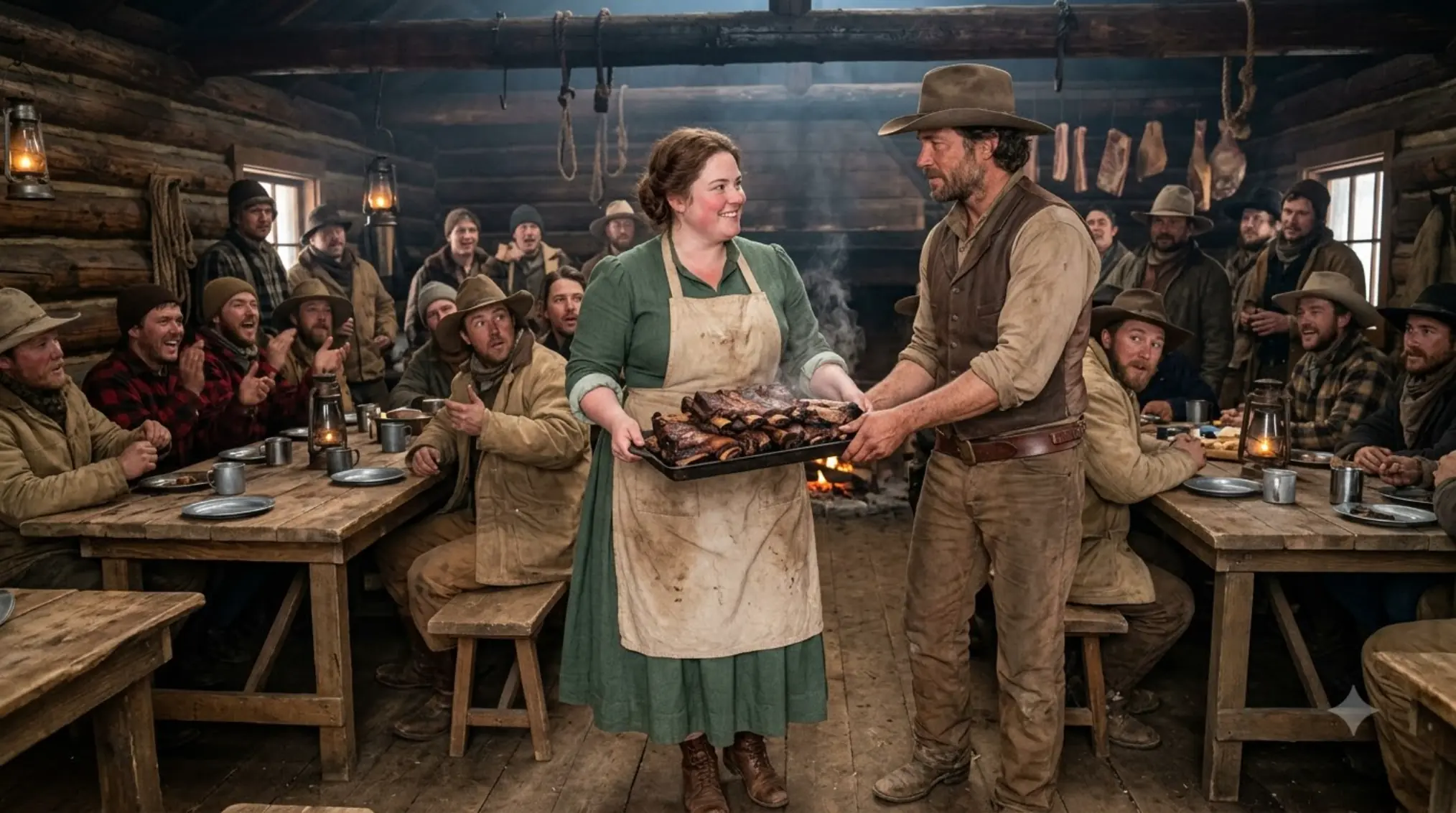
Not polite silence.
Hungry silence.
Every face turned toward the tray.
Dark, glossy ribs rested in rows beneath a thin layer of smoke, their edges caramelized from hours inside the rebuilt smokehouse. The smell filled the timber building before Miriam had taken three steps inside.
Someone at the far table whispered, “Good Lord.”
Another man immediately told him to shut up.
Miriam tried not to laugh.
Six weeks earlier, she had owned almost nothing.
Her father had died.
His provisioning business had been sold.
The house she thought she would inherit disappeared beneath debts she had not known existed.
By the end of summer, Miriam possessed one trunk, a few dresses, forty-seven dollars, and her father’s forty-year-old ledger containing recipes, accounts, preservation methods, salt ratios, smoking temperatures, and hundreds of handwritten observations accumulated across a lifetime of feeding people.
Then she saw Graham Ashcraft’s advertisement.
Montana Territory rancher seeking practical wife. Must understand food preservation and hard work. Romantic expectations unnecessary.
Miriam had stared at the notice for almost an hour.
Romantic expectations unnecessary.
At least the man was honest.
She answered.
Six days later, she climbed down from a wagon and discovered exactly why Graham needed someone practical.
Twenty-two ranch hands stood in the yard looking half-starved.
The grain shed roof sagged.
Two barns needed repair.
The bunkhouse chimney smoked badly.
Several cattle in the near pasture coughed.
And Graham Ashcraft himself looked as though he had not slept properly in four years.
He was thirty-nine, broad-shouldered, dark-haired, bearded, and probably handsome when worry was not carving lines into his face.
His first words to her were:
“You look sturdy enough.”
Miriam nearly climbed back into the wagon.
Instead she looked at him and said:
“You look desperate enough.”
That earned the smallest twitch at the corner of his mouth.
It was their first argument.
There would be many.
The smokehouse was the first thing Miriam noticed.
It sat behind the barn, half hidden beneath weeds and windblown debris.
The door leaned sideways.
One corner of the roof had collapsed.
The brick firebox was cracked.
Graham called it useless.
Miriam walked inside.
She touched the old brickwork.
Examined the ventilation shaft.
Studied the rotten racks.
Then she turned toward him.
“This isn't ruined.”
Graham stared at the hole in the roof.
“What would you call it?”
“Neglected.”
“Looks ruined from here.”
“That’s because you don't know what you're looking at.”
His eyebrows rose.
Miriam continued before he could object.
“Your foundation is sound. Firebox can be rebuilt. The roof needs maybe twelve boards. Replace the racks, repair the flue, clean everything properly, and I can have meat hanging in here inside three weeks.”
Graham gave a tired laugh.
“Three weeks?”
“Less if your men know carpentry.”
“They know everything except how to make money appear out of empty pockets.”
“Good.”
He frowned.
“What’s good about that?”
“Money isn't the first problem.”
Miriam pointed toward the bunkhouse.
“Those men are.”
His expression changed.
“You insulting my crew?”
“I’m telling you they're hungry.”
“I know.”
“No, Graham. You know food is short. That isn't the same as understanding what happens when twenty-two men decide there’s no reason to stay loyal to a dying ranch.”
He looked toward the bunkhouse.
Miriam softened slightly.
“Feed people first.”
“My father used to say that.”
“So did mine.”
For the first time, Graham looked at her as though she might be more than the stranger he had agreed to marry.
“Fine,” he said.
“What?”
“Fix it.”
Miriam nodded.
“I intend to.”
They married the following afternoon.
There was no ring.
No celebration worth mentioning.
Reverend Cole performed the ceremony in Graham’s front room while most of the ranch hands stood awkwardly near the walls wearing clean shirts they clearly hated.
Graham kissed Miriam only because the preacher waited until he did.
It was brief.
Careful.
Almost apologetic.
That night, instead of spending time discussing marriage, Miriam sat at the bunkhouse dining table beside the foreman, Cord Mercer.
Cord was fifty-seven, gray-bearded, powerful despite his age, and suspicious of almost everyone.
“Tell me about the ranch debt,” Miriam said.
Cord stopped eating.
“That’s Graham’s business.”
“I married Graham.”
“Yesterday.”
“And tomorrow I’ll still be married to him.”
Cord studied her.
Miriam continued.
“If this ranch collapses, pretending I don't understand why will not protect me.”
Cord finally put down his spoon.
“Bank note.”
“How much?”
He told her.
Miriam’s stomach tightened.
The number was worse than she expected.
“Deadline?”
“Eleven weeks.”
“What happens then?”
“Bank takes the ranch.”
“Simple foreclosure?”
Cord hesitated.
Miriam noticed.
“What?”
“There’s a man named Elias Ror.”
“Who?”
“Land buyer. Speculator. Vulture, if you're asking me.”
Cord leaned closer.
“He's bought three failing ranches already. Gets the debt cheap, waits for the owner to miss payment, takes the land, then sells the water rights.”
Miriam looked toward Graham across the room.
He was giving half his meat to a younger ranch hand named Pete.
“Does Graham know?”
“Enough.”
“Does he know Ror is waiting specifically for this ranch?”
Cord’s expression answered before he spoke.
“Yes.”
That night, Miriam found Graham on the porch.
“Elias Ror.”
Graham stopped.
“You've been asking questions.”
“I intend to keep doing that.”
He looked tired again.
“I didn't tell you because you just arrived.”
“You should have told me because I just arrived.”
“Miriam—”
“If I’m going to lose a ranch eleven weeks after marrying into it, I’d prefer advance notice.”
He looked away.
She stepped closer.
“You sent for a practical wife.”
“I remember.”
“Then allow me to be practical.”
She held out her hand.
“Tomorrow morning, you give me every account, every food bill, every contract, every debt paper, and every piece of correspondence connected to this ranch.”
“That is a lot to ask after two days.”
“Then think of it as an early marriage test.”
He looked at her.
“You’re serious.”
“Entirely.”
Graham sighed.
Then shook her hand.
“Partners?”
Miriam squeezed once.
“Partners.”
The ranch began changing the next morning.
Cord rebuilt the smokehouse firebox.
Pete and three other men constructed new oak racks.
Miriam repaired the roof herself until Graham climbed up beside her and told her to stop trying to prove she could fall off a roof without assistance.
They argued.
Then worked side by side.
Within ten days, the structure no longer looked abandoned.
Within sixteen, the firebox burned properly.
Within twenty, the first meat went onto the racks.
Miriam slept badly the night before tasting it.
She told nobody.
At dawn, half the ranch gathered outside the smokehouse.
Cord cut the first piece.
Chewed slowly.
Miriam watched his face.
Nothing.
“Cord?”
He chewed again.
“You planning to make us beg?”
His weathered expression finally broke.
“That’s damn fine meat.”
Pete grinned.
Someone behind him cheered.
Miriam laughed despite herself.
Graham stood several feet away.
He did not cheer.
He simply watched her.
Later, when everyone had left, he approached.
“You did it.”
“We did.”
“No.”
He looked toward the restored racks.
“You walked into something I abandoned and saw what it could become.”
Miriam met his eyes.
“You were busy trying not to lose everything else.”
“That supposed to excuse me?”
“No.”
She smiled slightly.
“But it explains you.”
That was the first time Graham touched her voluntarily.
Only her hand.
He squeezed it.
Then released it.
Miriam thought about that touch for the rest of the evening.
Success attracted attention.
Three days after their first full batch cured, Miriam discovered an unsigned note beneath the smokehouse door.
Ashcraft’s new wife thinks she’s clever. Some fires burn faster than meat cures.
Graham read it twice.
Then his face hardened.
“Ror.”
“Probably.”
“I’m riding to his property.”
“No.”
His head snapped toward her.
“No?”
“You ride there angry, he wins.”
“He threatens my wife—”
“And you answer by proving you're exactly the desperate fool he expects.”
Graham stepped closer.
“I am not letting him threaten you.”
“And I’m not letting you destroy yourself trying to protect me.”
Silence.
The words landed harder than Miriam intended.
Graham stared.
She lowered her voice.
“Protect the smokehouse.”
He breathed slowly.
“Watch rotations.”
“Yes.”
“Two men every night.”
“Good.”
“You're infuriating.”
“I’ve heard.”
He almost smiled.
Then looked at the note again.
“We’re finishing this.”
“Yes.”
“Together.”
Miriam nodded.
“Together.”
Their second batch doubled production.
Their third nearly doubled it again.
The ranch hands changed along with the numbers.
Men who once ate in silence began talking at supper.
Pete stopped giving away half his food because Miriam brought his fourteen-year-old sister Emma to live at the ranch once there was enough to feed another person.
Cord stopped talking about what would happen “when” the bank took the property.
He started discussing improvements they could make “next spring.”
Hope arrived quietly.
So did love.
Miriam realized it one night near the smokehouse fire.
Graham sat beside her on an overturned crate.
Neither spoke for several minutes.
Then he said:
“I didn't marry you expecting this.”
Miriam looked at him.
“The smokehouse?”
“You.”
She became still.
Graham stared into the low coals.
“When I wrote that advertisement, I needed help. That was all.”
“Very romantic.”
“I warned you.”
“You certainly did.”
He smiled.
Then became serious.
“I thought gratitude would be enough for a marriage like ours.”
Miriam’s pulse quickened.
“And?”
“It isn't.”
He looked at her.
“I wait for you to come inside at night.”
She said nothing.
“I look for you across the yard.”
His voice dropped.
“When something goes wrong, you're the first person I want beside me.”
Miriam felt warmth rise behind her eyes.
“Graham.”
“I don't expect you to say anything.”
“That would be unfortunate.”
He frowned slightly.
“Why?”
“Because I was going to tell you I feel the same.”
His expression changed completely.
Miriam laughed softly.
“You genuinely had no idea?”
“I suspected.”
“You did not.”
“No.”
“That’s better.”
Graham reached for her hand.
“May I?”
Miriam looked down at their hands.
Then back at him.
“Yes.”
His fingers closed around hers.
They remained beside the fire until the coals went dark.
Elias Ror escalated.
Someone broke into the grain shed.
Feed was destroyed.
Two smokehouse racks were slashed.
Then a young ranch hand was caught carrying money and instructions from Ror’s people.
The boy’s name was Silas Beckett.
Graham wanted him thrown off the property.
Miriam stopped him.
“Use him.”
Graham stared.
“For what?”
“Ror believes Beckett is still loyal.”
Understanding slowly reached Graham’s face.
“You want him feeding Ror false information.”
“Not false.”
Miriam smiled coldly.
“Outdated.”
Cord laughed when she explained.
“Remind me never to cross you.”
“You already said something similar.”
“I mean it more now.”
Through Beckett, Ror continued receiving reports that Ashcraft Ranch’s production remained small.
He did not learn about the second firebox.
He did not know their monthly output had quadrupled.
He certainly did not know Miriam had secured a meeting at the Billings provisions exchange.
That meeting became their chance.
Thaddeus Colton purchased provisions for northern railroad camps and remote settlements.
He was not impressed by promises.
That was precisely why Miriam liked him.
She placed four cured samples on his table.
Beside them went her production ledger.
Dates.
Weights.
Salt ratios.
Loss rates.
Batch consistency.
Colton examined everything.
“You kept all this?”
“Every pound.”
“Why?”
“Because memory is not evidence.”
He smiled.
Then tasted the meat.
Miriam accidentally stopped breathing.
Graham noticed.
She glared at him when he smiled.
Finally Colton swallowed.
“This is excellent.”
Miriam exhaled.
Then Elias Ror appeared.
He wore an expensive coat and a relaxed smile.
“Colton,” he said, “I trust the Ashcrafts mentioned the instability of their property.”
Colton looked toward Miriam.
She did not flinch.
“Our ranch carries debt.”
Ror smiled.
“Considerable debt.”
“And considerable production.”
Miriam slid the ledger toward Colton.
Ror continued.
“Production built on a ranch I expect will change ownership before spring.”
Colton looked sharply at him.
“You intend to take their ranch?”
Ror hesitated.
That hesitation cost him.
Miriam spoke calmly.
“Mr. Ror holds a contractual right connected to our bank note. He has spent months assuming we will fail.”
She gestured toward the meat.
“He has not adjusted his assumptions.”
Colton stared at Ror.
“Have you?”
Ror’s smile disappeared.
Colton turned back toward Miriam.
“Mrs. Ashcraft, let's discuss a contract.”
Ror left without another word.
Under the table, Graham found Miriam’s hand.
She squeezed his fingers.
They had won something.
Not everything.
But enough.
Colton’s agreement could save the ranch.
Then the grain shed burned.
Miriam and Graham returned from Billings and saw black smoke before reaching the property.
Every ranch hand formed a bucket line.
Flames tore through the building.
The barn caught briefly.
The smokehouse survived only because the wind pushed fire away from it.
Pete carried a calf from the burning barn.
Cord organized the men.
Miriam worked beside them until her arms shook.
Two hours later, the fire died.
The grain shed was gone.
Graham sat in the mud staring at the wreckage.
“They’ll never stop.”
Miriam sat beside him.
“No.”
“He nearly destroyed everything.”
“No.”
Graham looked toward her.
“He destroyed a shed.”
She pointed toward the surviving smokehouse.
“That's still standing.”
Then toward the men.
“They're still here.”
Then toward him.
“So are you.”
Graham looked down.
Miriam continued.
“If you call what happened tonight ‘everything,’ you're giving him more than he burned.”
He closed his eyes.
Then nodded.
“Sheriff?”
“Yes.”
They gathered every threatening note.
Beckett testified.
The sheriff opened an investigation.
It was not enough for immediate charges against Ror.
But it was enough to make people watch him.
And reputation mattered in Montana.
Buyers stopped trusting him.
Ranchers stopped meeting privately with him.
His greatest weapon had always been operating quietly.
Miriam had forced him into daylight.
Weeks later, the final attack came through paper instead of fire.
Ror exercised his right to buy Graham’s bank note.
The transfer would become final in three days.
If that happened, Ror could control the debt himself.
Silas, the wagon driver, brought the news.
Graham turned pale.
“We’re finished.”
Miriam immediately opened the ledger.
“No.”
“Miriam—”
“No.”
She calculated.
First contract payment.
Stored product.
Scheduled delivery.
Cash reserves.
Still short.
Then she stopped.
“Colton.”
“What?”
“Our second delivery isn't due for eight days.”
Understanding appeared.
“You want him to accept it early.”
“We load today.”
“Billings is two days.”
“Then we don't sleep.”
Graham stared at her.
“You're serious.”
“I have been serious since the day you called me sturdy.”
Despite everything, he laughed.
That afternoon the entire ranch loaded the wagon.
They drove through the night.
Then the next day.
Colton accepted the delivery early without hesitation.
“You've met every promise you've made,” he told Miriam. “I can move payment forward eight days.”
They returned toward the bank carrying enough cash to erase the debt.
The deadline was only hours away when Graham pushed open the bank doors.
Silverton counted the money twice.
Then stamped the note.
PAID IN FULL.
Graham stared at the paper.
Four years of fear ended in one stroke of ink.
Miriam touched his shoulder.
“Breathe.”
He laughed.
Then surprised everyone in the bank by pulling her into his arms.
Miriam laughed against his chest.
“I assume that means you’re pleased.”
“You impossible woman.”
“Careful.”
He pulled back.
“I love that impossible woman.”
The room disappeared around them.
Miriam looked at him.
“You mean that?”
“With everything I have.”
She smiled.
“Good.”
“Good?”
“Because I’d hate to have saved your ranch only to discover I married a man who still couldn't recognize a good investment.”
Graham laughed loudly.
Then kissed her.
Not the careful kiss from their wedding.
A real one.
When they returned home, the ranch hands were waiting.
Graham held up the canceled note.
Twenty-two men erupted.
Cord raised his hat.
Pete shouted.
Someone fired a pistol into the air until Miriam yelled that ammunition cost money.
That stopped the second shot.
That evening Graham stood at the head of the dining table.
“I have an announcement.”
Miriam immediately became suspicious.
He looked toward her.
“This ranch is debt-free.”
Cheers.
“But that's not the announcement.”
The room quieted.
Graham continued.
“Today I filed new ownership papers.”
Miriam stared.
“What papers?”
He smiled.
“Ashcraft Ranch now has two equal owners.”
Silence.
Then every face turned toward Miriam.
“Graham.”
“You rebuilt the operation.”
“I’m your wife.”
“You're my partner.”
He held her gaze.
“Those are not the same thing.”
Miriam’s throat tightened.
Graham continued.
“This ranch stands because you refused to let any of us call neglect ruin.”
Cord raised his cup.
“To Miriam Ashcraft.”
Pete immediately stood.
“To Mrs. Ashcraft.”
Twenty-two cups rose.
Miriam blinked away tears.
“Sit down before I make all of you wash dishes.”
Nobody sat.
They cheered louder.
Months passed.
The smokehouse expanded from one firebox to three.
Colton doubled the contract.
Pete brought Emma permanently to the ranch.
Cord trained younger men in masonry.
Miriam began receiving letters from struggling ranch families asking how Ashcraft had recovered so quickly.
She answered them.
One widow arrived personally.
Miriam walked her through every part of the smokehouse.
When the woman apologized for asking so many questions, Miriam shook her head.
“Knowledge isn't worth much if you lock it away.”
By summer, Ashcraft Ranch employed more people than before its crisis.
Nobody went hungry.
Nobody worked until collapse.
Accounts remained current.
And Elias Ror?
His plan collapsed more quietly than he deserved.
The sheriff never proved enough to convict him of the fire.
But suspicion followed him.
Ranchers stopped selling to him.
Banks stopped treating his offers as unquestionable.
Buyers became cautious.
Eventually he sold his regional holdings and left Montana.
Miriam did not celebrate.
She barely mentioned it.
She had learned that victory was not always watching an enemy fall.
Sometimes victory was simply becoming too strong for him to matter.
One warm evening, Miriam carried a tray of ribs into the expanded smokehouse dining area.
Twenty-two ranch hands and several newer workers crowded the tables.
Smoke drifted beneath the timber roof.
Men laughed.
Pete argued with Cord about seasoning.
Emma carried bread.
Miriam wore her sage-green dress and the beige apron that never stayed clean longer than ten minutes.
Graham stepped toward her.
“Give me that.”
“I can carry it.”
“I know.”
He took one side anyway.
Together they carried the tray.
Miriam smiled.
“You’re learning.”
“What?”
“To stop helping because you think I can't manage.”
“And start helping because heavy things are easier with two people.”
She looked at him.
“That took you long enough.”
Graham set the tray down.
Around them, men reached eagerly for food.
No hollow cheeks.
No silence.
No one counting biscuits.
Graham looked around the room.
Then back at Miriam.
“You rebuilt this place and fed twenty-two men when I couldn't even promise them another month.”
Miriam smiled.
“You gave me something worth saving.”
His expression softened.
“The ranch needed your hands.”
He lowered his voice.
“But I needed your heart.”
Miriam’s cheeks warmed.
Six months earlier, words like that would have embarrassed her.
Now she stepped closer.
“Then keep helping me carry the heavy things.”
Graham smiled.
“And?”
“And you may keep both.”
His eyebrows rose.
“May?”
Miriam laughed.
“Don't get arrogant.”
He took her hand.
Outside, three smokehouse chimneys released thin, steady columns into the Montana evening.
The ranch had survived debt.
Disease.
Sabotage.
Fire.
A predator waiting for failure.
But Miriam understood now that none of those things defined what Ashcraft had become.
The important transformation was simpler.
Twenty-two hungry men became twenty-two men with a future.
A desperate rancher became a husband capable of trusting another person's strength.
A woman who believed her father's death had ended the only meaningful work she would ever do discovered that everything he taught her had merely been waiting for another place to matter.
And a rotting smokehouse became the heart of an entire ranch.
Miriam looked toward Graham.
“You remember what you said when I climbed down from that wagon?”
He groaned.
“I was hoping eventually we'd forget.”
“You said I looked sturdy enough.”
“I apologized.”
“You did.”
“And you're still mentioning it.”
“I intend to mention it when we're eighty.”
Graham laughed.
Then he looked around at everything standing because she had remained exactly that.
Sturdy.
Patient.
Unwilling to accept ruin just because someone else had stopped imagining repair.
“Turns out I was right,” he said.
Miriam considered.
“Partly.”
“Partly?”
“I was sturdy enough.”
She squeezed his hand.
“But nobody saves something this big alone.”
Graham looked at the men.
Cord.
Pete.
Emma.
The smokehouses.
The barns.
Then at his wife.
“No.”
He lifted her hand and kissed her knuckles.
“They don't.”
Miriam rested her head briefly against his shoulder.
Inside, twenty-two ranch hands were already shouting for more ribs.
She laughed.
“Back to work, Mr. Ashcraft.”
“Yes, ma’am.”
They carried another tray together.
And that, more than the canceled debt, the rebuilt barns, or the contracts stacked inside their office, was what victory finally looked like.
Not one person rescuing everyone else.
A table full of people who no longer feared tomorrow.
A ranch strong enough to feed everyone who depended on it.
And two people walking beneath the same load, each taking half the weight.