Staff Sergeant Miller held the battered Zippo lighter beneath the fluorescent light and narrowed his eyes at the faded engraving.
“What kind of name is Rooster?” he laughed, the sound echoing from the tiled walls. “Did you wake the farmhouse every morning to milk the cows, old man?”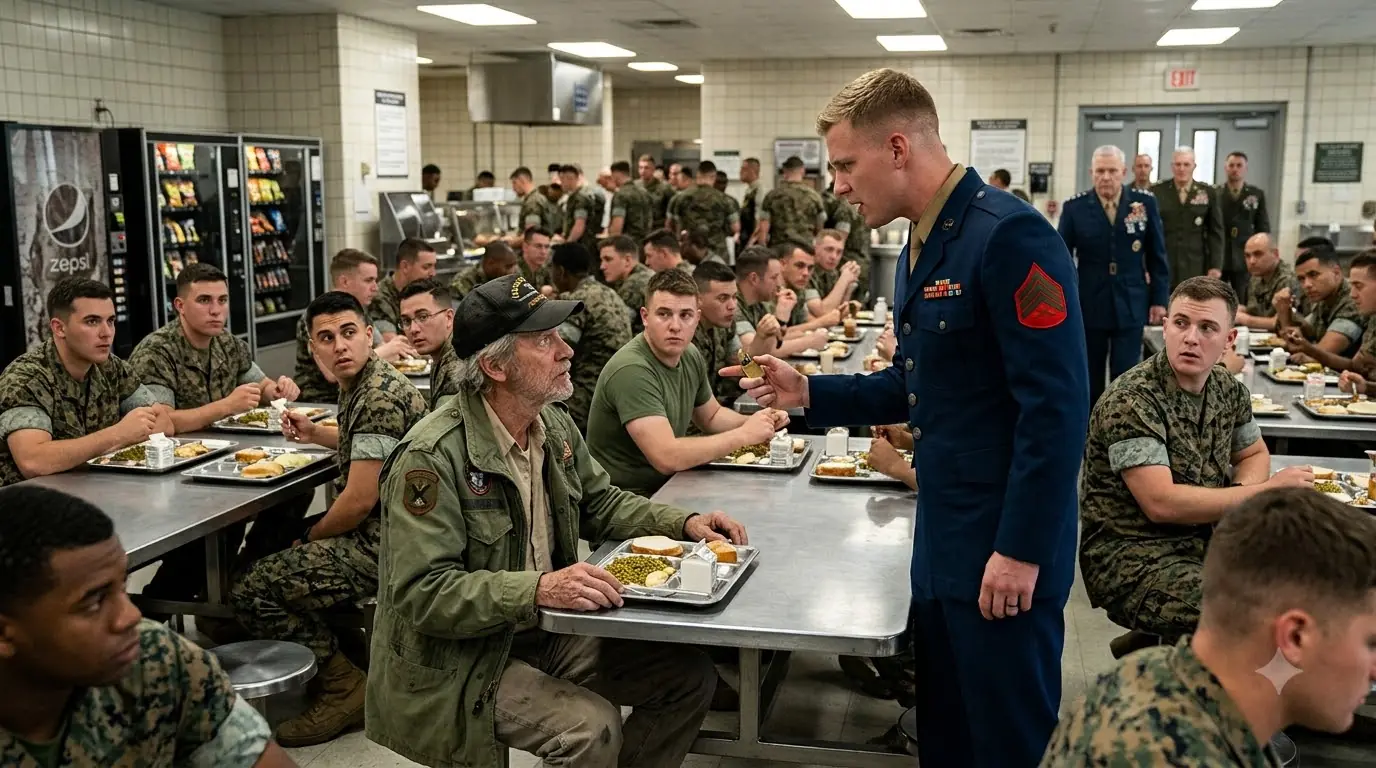
The question remained in the air.
Then the clatter of nearly two hundred forks against metal trays stopped.
The mess hall fell silent.
Miller’s laughter died in his throat as he noticed the sudden weight inside the room.
Harlon Vance did not look up from his tray of cold peas. He only reached forward with a trembling, grease-stained hand.
“It was not a name I chose, son,” Harlon whispered.
His rough voice cut through the silence.
“It was the sound the enemy heard right before the sky came down.”
The air inside the Camp Lejeune mess hall had been filled with the chaotic noise of the lunch rush.
Trays slammed against metal rails. Industrial dishwashers hummed behind the serving line, and nearly three hundred Marines in dress blues shouted over one another.
It was Commandant’s Day.
The room was a sea of midnight-blue uniforms, polished shoes, gold buttons, and youthful energy.
Sitting alone in the shadow of a vending machine, almost invisible beneath the noise, was Harlon Vance.
He looked like a mistake inside the perfectly ordered room.
Among the sharply pressed uniforms, Harlon wore a faded red-and-black flannel shirt. Its sleeves were frayed, and the fabric looked as though it had been purchased from a hardware store sometime in the previous decade.
His gray hair resembled tangled wire.
His hands were swollen by arthritis and permanently darkened by engine grease from the maintenance work he performed around the base.
They trembled slightly as he pushed cold peas around his metal tray.
“Is this some kind of joke?”
The voice was loud, but it barely cut through the surrounding noise.
Harlon stopped chewing.
He felt the vibration of heavy boots approaching his table.
Staff Sergeant Cade Miller stopped directly in front of him.
Miller was twenty-eight years old, physically immaculate, and carried himself with the confidence of a man who had never been forced to discover how fragile confidence could become.
He had noticed a civilian worker sitting among the Marines, and the sight offended his rigid sense of order.
“I asked you a question, old man,” Miller said.
He slammed one hand against the metal table.
Harlon’s tray jumped.
Milk splashed across the sleeve of his red flannel shirt.
“Who authorized you to eat here during a Protocol Level One event?”
Several young Marines glanced toward the table.
Most returned to their meals.
To them, it appeared to be an NCO reprimanding a civilian worker. It was uncomfortable, but not unusual enough to risk becoming involved.
Harlon slowly wiped the milk from his sleeve.
He did not stand.
“It is lunchtime, Sergeant,” he said quietly.
His voice was dry and rough.
“My contract says the maintenance staff eats at eleven thirty.”
He looked down at his tray.
“I am only trying to finish my peas.”
Miller’s face turned red.
“Your contract?”
He leaned closer and blocked the light above Harlon.
“You look like a complete disaster.”
Miller gestured around the hall.
“The Commandant will arrive in one hour, and I have a civilian in an old flannel shirt sitting here like he owns the place.”
His attention shifted to the table.
Beside Harlon’s tray rested an object that did not seem to belong among the disposable napkins and metal utensils.
It was a Zippo lighter.
The brass casing had been worn almost smooth. Its edges were dented, and one side looked as though it had once absorbed a hard impact.
Miller snatched it from the table.
“Give that back,” Harlon said.
His voice lowered.
Miller ignored him.
He turned the lighter over and examined the faint engraving scratched into the side.
Then he read the word loudly enough for the nearest tables to hear.
“Rooster.”
The effect was immediate.
A group of senior warrant officers at the closest table stopped eating.
Forks stopped moving.
Conversations ended.
Within several seconds, the enormous mess hall had become completely and unnervingly quiet.
Miller looked around in confusion.
He had expected laughter.
Instead, hundreds of eyes were fixed on him, or more precisely, on the battered lighter in his hand.
“That was your call sign?” Miller asked.
He attempted to recover his authority, but his voice sounded too loud inside the silence.
“Rooster?”
He smirked.
“What happened? Did you avoid service by hiding inside a chicken coop?”
Nobody laughed.
The silence felt thick enough to press against his chest.
It was the kind of silence normally reserved for a funeral.
“I am going to have you removed,” Miller said.
His confidence was beginning to crack beneath the attention of the room.
“I will have security escort you and your farm-animal lighter through the main gate.”
Harlon slowly extended his hand.
The tremor that had followed him since 1969 moved through his fingers.
He took the Zippo gently from Miller.
“You are right about one thing, Sergeant,” Harlon said.
His gravelly voice carried farther than it should have.
“I clean toilets.”
“I repair broken equipment, and I do not wear the uniform anymore.”
Harlon finally looked up.
His pale blue eyes were no longer dull.
They were burning.
“But you asked about the name.”
He ran his thumb across the flint wheel.
The lighter clicked.
A tall orange flame rose from the casing, carrying the smell of fuel and hot metal.
The moment the flame appeared, the fluorescent lights vanished from Harlon’s mind.
The scent of cleaning chemicals disappeared.
In their place came the smell of wet jungle vegetation, red soil, smoke, and fear.
The white tiled walls dissolved into the green darkness of the A Shau Valley.
Harlon was no longer inside North Carolina.
Rooster had returned to the ridge.
The memory began with the smell.
It was not cafeteria food or floor wax.
It was the heavy scent of soaked vegetation, mud, sweat, and the metallic trace of violence.
The air was so wet and heavy that breathing felt like swallowing water.
Rain did not fall gently.
It hammered the jungle.
The monsoon turned the ground into a deep mixture of red clay, leaves, and standing water.
Harlon blinked.
The mess hall disappeared completely.
He was twenty-four years old again.
His hands were not swollen with arthritis. They were locked around the grip of his rifle.
The red flannel shirt was gone.
He wore jungle fatigues that had been torn and soaked during three days of movement through the valley.
“Gunny, they are inside the perimeter!”
The voice cracked with fear.
“They are inside the perimeter!”
Harlon looked down.
Private Thomas Sterling crouched beside him inside the mud of a shell crater.
Sterling was nineteen years old and had grown up on a farm in Nebraska.
He had suffered a severe abdominal wound and was pressing both hands against it while holding the field radio handset near his ear.
“Keep pressure on it, Sterling,” Harlon ordered.
His voice struggled against the heavy gunfire cutting through the canopy.
“Do not look at the wound.”
“Look at me.”
Their six-man reconnaissance team had been sent deep into the A Shau Valley.
Intelligence reports described the area as a light enemy supply route.
The reports had been wrong.
The team had been inserted near a large enemy force.
Six Marines against hundreds of soldiers.
For three days, they had been forced farther up the slopes near Hill 937.
The enemy tightened the circle with each passing hour.
Now the team had nowhere left to retreat.
A mortar round struck nearby.
The ground lifted beneath them.
Mud, splintered bamboo, and fragments of earth rained over the crater.
Harlon shook the dirt from his face and checked his magazine.
Empty.
He replaced it with his final one.
“Gunny, air command says they cannot see us,” Sterling shouted.
He pressed the radio handset against his ear.
Tears moved through the mud on his face.
“The cloud ceiling is too low.”
“The rain is hiding everything.”
“They cannot make the strike without seeing the target.”
Harlon looked upward.
The sky was a solid ceiling of gray.
The monsoon shielded the soldiers advancing through the jungle.
Somewhere above the clouds, fighter aircraft circled while waiting for a visual reference.
They carried enough destructive force to stop the attack.
But they were blind.
“Tell them to strike the coordinates,” Harlon shouted.
He fired a controlled burst toward movement inside the trees.
Shapes moved through the rain.
The enemy was close.
“They will not do it,” Sterling said.
His voice broke.
“The strike is too close to us.”
“If they release without a visual reference, they could kill everyone here.”
Harlon looked at what remained of his team.
Jenkins lay motionless beside a fallen log.
Another Marine named Miller, unrelated to the staff sergeant who would mock Harlon decades later, was fading from a chest wound.
His eyes had already become distant.
Only Harlon and Sterling remained capable of speaking.
The enemy continued closing around them.
The gunfire became more rhythmic and confident.
The soldiers below knew the Marines were nearly out of ammunition.
They knew the rain had made air support ineffective.
They were moving in to finish the fight.
Harlon looked at Sterling.
The young Marine’s face had become pale beneath the mud.
If the enemy reached the crater, Sterling would not survive.
“Give me the handset,” Harlon said.
His voice became calm.
It was the calm of a man who had accepted that he might already be dead.
“Gunny…”
“I said give me the radio, Sterling.”
Harlon took the heavy handset.
He looked around the crater.
To the right, a jagged spine of stone rose from the jungle floor like a broken tooth.
It was completely exposed.
No trees.
No cover.
Only wet rock climbing into the gray mist.
If Harlon stayed inside the crater, they would die.
If he climbed the rock, every soldier in the valley would see him.
He did not hesitate.
“Stay down, kid,” Harlon ordered.
“Put your face against the mud, and do not look up until the heat is gone.”
Sterling reached for him.
“Where are you going?”
“I am going to wake the neighbors.”
Harlon stood.
The movement drew fire immediately.
Rounds cut through the leaves and struck the earth around him.
He climbed from the crater and ran toward the rock formation.
Mud pulled at his boots.
Vines caught his ankles.
The ground around his feet broke apart beneath incoming fire.
He reached the base of the rock and began climbing.
The decision was nearly impossible to survive.
He was leaving the limited protection of the jungle and moving into open air.
His body became a dark silhouette against the sky.
A round grazed his thigh while he climbed.
Harlon grunted and continued.
Higher up, cold wind struck his face.
He finally pulled himself onto a narrow granite ledge overlooking the valley.
From that height, he could see them.
Hundreds of soldiers moved through the tall grass and wet trees below.
They were converging on the crater where Sterling waited.
Harlon pressed the radio button.
Static filled his ear.
“Checkmate King Two, Checkmate King Two, this is Recon Team Dagger.”
A pilot’s voice answered through the noise.
“Dagger, this is King Two.”
“We remain unable to acquire the target.”
“We are preparing to withdraw.”
“Negative,” Harlon shouted.
“Do not withdraw.”
He stood fully upright on the ridge.
Every soldier in the valley could see him.
For a fraction of a second, the firing slowed, as though the enemy could not understand why an American Marine had chosen to stand in the open.
Then the entire hillside erupted.
Rounds struck the stone near Harlon’s boots.
Fragments broke from the ledge.
One shot struck his shoulder and spun him against the rock.
Pain moved through his arm, but he held the radio.
“I am deploying smoke on my position,” Harlon shouted.
He activated a violet smoke marker and raised it above his head.
Thick purple smoke rolled into the wind.
“I see smoke,” the pilot answered.
His voice sharpened.
“But the marker is directly on your position.”
“Confirm that your team is inside the danger zone.”
“Confirmed,” Harlon said.
“Make the strike.”
The enemy continued climbing toward him.
Their voices rose through the storm.
“The wind is carrying the smoke,” the pilot warned. “I need a clearer reference.”
Harlon looked toward the crater below.
He could not see Sterling, but he knew the young Marine was still there.
Waiting.
Bleeding.
Harlon closed his eyes for one second.
He remembered his mother’s porch in Alabama.
He remembered the young woman he had left behind in Mobile.
Then he opened his eyes and drew a breath of rain-filled air.
He needed to produce a sound that could cut through static, wind, and gunfire.
So he screamed.
It was not a cry for help.
It was not a sound of pain.
Harlon threw his head back and released a long, broken call into the radio.
“Crow!”
His voice rose and fell in a rough pattern.
“Listen for the crow!”
He shouted toward the aircraft above the clouds.
“I am Rooster.”
“I am the marker.”
“Follow my voice.”
High above the valley, the lead pilot heard him.
The strange call cut clearly through the static.
It sounded like a rooster announcing sunrise in the center of a storm.
“I have the man on the ridge,” the pilot said.
“I see him standing in the open.”
“Beginning the run.”
Harlon saw the clouds separate.
Two aircraft descended through the gray ceiling.
The thunder of their engines struck the valley like a physical force.
The soldiers below looked upward.
Harlon released the radio and glanced toward the crater.
“Keep your head down, Sterling,” he whispered.
Then the strike reached the jungle.
The world became light, heat, and pressure.
A wall of flame rose across the enemy’s approach and consumed the trees between the advancing force and the crater.
The roar swallowed the gunfire.
Heat struck Harlon’s face.
The pressure wave lifted him from the ledge and threw him backward.
He fell through the air and struck the muddy slope below.
He rolled through broken vegetation while dirt and fragments rained around him.
The air inside the valley became hot and difficult to breathe.
Harlon crawled.
He could barely see or hear.
His shoulder and leg burned with pain.
Still, he dragged himself toward the crater.
The heat behind him was overwhelming.
He reached forward and felt a hand.
Harlon wiped mud from his eyes.
Sterling remained inside the crater, terrified but protected by its depth.
The strike had created a burning barrier around their position without reaching the lowest part of the hole.
Harlon gripped Sterling’s hand.
The young Marine trembled as he stared toward the flames.
“Gunny,” Sterling whispered.
“You brought the sun down.”
Harlon tried to answer.
His throat was scorched from smoke and screaming.
He coughed and lowered his head.
Then he noticed something inside his hand.
The Zippo lighter.
He was holding it so tightly that its metal edge pressed into his palm.
He could not remember taking it from his pocket.
The fire around them crackled like thousands of dry branches breaking together.
“Rooster,” Sterling whispered.
His eyes held equal parts fear and wonder.
“I heard you on the radio.”
“You crowed.”
Harlon rested against the muddy wall of the crater.
The rush of adrenaline began fading, and the pain in his shoulder finally reached him.
Above the burning valley, the aircraft climbed back through the clouds.
Their engines disappeared into the storm.
Harlon was alive.
He did not understand how.
As he closed his eyes and listened to the distant fire, he understood something else.
The young man named Harlon Vance had died in some way on that ridge.
The person breathing beside Sterling had become something different.
A survivor.
A keeper of the flame.
Rooster.
The memory began fading.
The smell of smoke and wet jungle slowly retreated.
Industrial bleach returned.
The roar of the aircraft became the hum of the mess hall ventilation system.
Harlon blinked.
The white tiles came back.
He sat inside the chair beside the vending machine.
His hand remained clenched, but it no longer held a radio.
It held the Zippo.
The flame still burned.
A small, unwavering light inside the silent mess hall.
Harlon snapped the lighter shut.
Click.
The flame disappeared.
The ghosts of the A Shau Valley faded with it.
The silence inside the mess hall remained.
It pressed across the tables and smothered the normal lunchtime noise.
Staff Sergeant Miller was the first person to move.
He shook his head as though waking from a dream.
Confusion returned quickly to anger.
He felt embarrassed.
For several seconds, an elderly janitor with an old lighter had controlled the attention of his entire section.
“That is enough,” Miller said.
His voice was tight.
“You think you can intimidate me with a lighter?”
“You believe some old story gives you the right to sit at the Commandant’s table?”
Harlon did not answer.
He carefully returned the Zippo to his shirt pocket and pressed his hand against the fabric to ensure it was secure.
Then he picked up his fork.
“I am talking to you, Vance.”
Miller grabbed the back of Harlon’s chair.
“Stand up.”
“You are finished here.”
“I will escort you to the gate myself.”
“Stand by!”
The command came from the main doors at the far end of the hall.
The voice carried with enough force to overwhelm Miller’s shouting.
“Attention on deck!”
The response was immediate.
Three hundred chairs scraped across the floor at once.
Every Marine rose.
Spines straightened.
Chins lowered.
Boot heels struck the floor together with the sound of a single shot.
Miller froze.
He released Harlon’s chair as though the metal had become hot.
Then he turned and snapped to attention.
The color disappeared from his face.
The double doors opened.
Two military police officers in white helmets moved aside.
General Thomas “Hawk” Sterling entered.
He was a large man.
Even at seventy years old, his presence filled the room.
He wore a formal olive-green uniform carrying four silver stars on each collar.
His chest held rows of ribbons, medals, and badges representing a lifetime of service across several decades.
His eyes commanded the hall more than the decorations did.
They were steel gray, sharp, and searching.
Sterling moved down the center aisle with a group of colonels and sergeants major attempting to match his pace.
Staff Sergeant Miller stood rigidly beside the vending machines.
This was the Commandant’s visit.
Miller believed he needed to show that he controlled his section.
The general came directly toward him.
Miller lifted his chest.
“Good afternoon, General,” he called.
His voice cracked slightly.
“Staff Sergeant Miller, Third Battalion.”
He swallowed.
“Sir, I apologize for the disturbance. I was removing a civilian contractor who was violating protocol by occupying the…”
General Sterling did not look at him.
He did not slow down.
He walked past Miller as though the staff sergeant were part of the furniture.
Miller remained with his mouth open.
Sterling stopped three feet from the corner table.
The entourage behind him nearly collided when he halted.
Harlon had not risen.
He remained seated, looking down at his peas.
Nobody inside the room breathed.
A civilian worker was sitting while the Commandant stood in front of him.
It violated every instinct of military protocol.
“Harlon,” General Sterling said.
His voice had changed.
The booming command tone was gone.
The name came out softly and with a tremor.
Harlon slowly looked up.
He squinted at the four stars and then studied the general’s face.
He saw deep lines, gray hair, and an old scar along the jaw.
Beneath the age and authority, Harlon recognized the frightened nineteen-year-old lying in the mud.
“Hello, Tommy,” Harlon said.
A collective breath moved through the room.
Tommy.
The elderly janitor had called the Commandant of the Marine Corps Tommy.
Miller appeared ready to collapse.
He stepped forward before he could stop himself.
“General, this man is…”
“Silence,” Sterling said.
He did not shout.
He dropped the word with enough authority to end the sentence.
He still did not look at Miller.
The general’s eyes remained on Harlon.
Sterling stepped closer.
He studied the faded flannel shirt and grease-stained hands.
Then his attention settled on the pocket containing the Zippo.
“I searched for you,” Sterling said.
Emotion thickened his voice.
“After the evacuation, I spent ten years looking for you.”
“The record listed you as killed in action near Hill 937.”
“They recovered identification tags, but no body.”
“I left the tags behind,” Harlon said.
He gave a slight shrug.
“I did not want to be a Marine anymore.”
“Not after the fire.”
He looked toward the floor.
“I wanted a quiet life.”
“Quiet?”
Sterling almost smiled.
“You were never quiet, Gunny.”
“Not when it mattered.”
The general slowly raised his right hand.
Everyone inside the hall watched in disbelief.
The highest-ranking Marine in the service lifted his hand to the brim of his cover.
He gave Harlon a slow, precise salute.
It was not a quick professional acknowledgment.
It was held with absolute reverence, the kind of salute reserved for presidents, fallen comrades, and memories too important for words.
Harlon remained seated for a moment.
Then he pushed his chair back with visible effort.
He stood.
The elderly maintenance worker disappeared.
In his place stood the straight-backed posture of a Force Recon gunnery sergeant.
Harlon did not return the salute because he was no longer in uniform.
Instead, he reached into his pocket.
He removed the battered Zippo and held it between them.
“I heard Rooster crowing,” General Sterling whispered.
Tears began moving across his weathered face.
“I was lying in the mud waiting to die.”
“Then I heard you.”
“You called down the thunder.”
“I was doing the job, Tommy,” Harlon replied.
“You saved my life,” Sterling said.
His voice broke.
“You saved all of us.”
The general lowered his salute and extended his hand.
Harlon accepted it.
The handshake was not formal.
Their hands locked tightly.
They were two aging warriors anchoring each other inside a world that had continued moving while they carried the same night for more than fifty years.
“Staff Sergeant Miller,” Sterling said.
He finally turned his head.
Miller flinched.
Sweat covered his face.
“Yes, General.”
“You asked this man what kind of name Rooster was.”
Sterling’s voice became cold.
“Allow me to educate you.”
He placed one hand on Harlon’s shoulder.
“Rooster was the call sign of Gunnery Sergeant Harlon Vance.”
“Navy Cross recipient.”
“Recipient of three Purple Hearts.”
“The Marine who voluntarily exposed his position to a force large enough to destroy his entire team so that air support could find us in 1969.”
Miller looked toward Harlon.
The elderly man in the flannel shirt suddenly seemed larger than every decorated Marine inside the room.
“He is not a disgrace to this hall,” Sterling continued.
“He is one of the reasons this Corps still has traditions worth serving.”
The general’s eyes remained fixed on Miller.
“Do you understand?”
“Yes, General,” Miller answered.
His voice was barely audible.
“Good.”
Sterling faced Harlon again.
“Come with me, Gunny.”
“This hall is too loud.”
“I have a car outside, and I believe I owe you a drink.”
Harlon looked down at his tray.
The peas had gone cold long ago.
“I finish my shift at thirteen hundred,” he said.
Sterling laughed.
The deep sound broke the tension inside the room.
“Not anymore.”
He squeezed Harlon’s shoulder.
“You are officially retired, Rooster.”
“Effective immediately.”
The walk toward the exit became the longest distance Staff Sergeant Miller had ever watched two men travel.
General Sterling did not hurry.
He shortened his stride to match Harlon’s limp.
They moved down the center aisle like two leaders from different eras.
One wore the visible authority of stars, ribbons, and command.
The other carried the invisible weight of sacrifice beneath a faded flannel shirt.
“Make a path,” a corporal whispered.
The Marines moved aside.
Nobody needed to order them.
They stepped back with quiet respect.
Five minutes earlier, Harlon Vance had been treated as a stain on their perfect event.
Now they saw a living monument.
They looked at his damaged hands and imagined the hands that had pulled their Commandant through mud and fire.
They looked at his gray hair and saw the ash of a distant valley.
Miller remained beside the vending machine.
His heart pounded against his ribs.
He felt exposed.
Every ribbon on his uniform suddenly seemed heavy.
He had spent years polishing boots, memorizing regulations, and believing perfection could be found inside the crease of a trouser leg.
Harlon had shown him that discipline also lived in mud, pain, and the decision to hold a line that should have broken.
When the general and the janitor reached the doors, Sterling stopped.
He turned toward the room.
He did not look at Miller.
He looked at the hundreds of young Marines watching him.
They represented the future of the Corps.
“Marines,” General Sterling said.
His voice was calm, but it reached the farthest tables without amplification.
“You are trained to fight.”
“You are trained to win.”
He rested one hand on Harlon’s shoulder.
“But never forget that the uniform you wear is a receipt.”
Several Marines exchanged confused glances.
“It is proof of a debt paid by people like Harlon Vance,” Sterling continued.
“You stand tall because he once crawled.”
“You eat in peace because he went hungry in the rain.”
The general looked across the hall.
“Do not mistake silence for weakness.”
“The loudest thing inside this room was not your staff sergeant’s shouting.”
“It was this man’s memory.”
Sterling turned toward the door.
“Let us go home, Rooster.”
“After you, General,” Harlon said.
He closed one hand around the Zippo.
Sterling stepped aside and held the door open.
“No.”
The general smiled.
“Rank may have privileges, Gunny.”
“But valor leads the way.”
Harlon hesitated.
Then he nodded.
He stepped through the doors and into the bright North Carolina sunlight.
The smell of bleach and the stunned silence of the mess hall remained behind him.
The doors closed.
For several seconds, nobody moved.
The hum of the refrigerators became deafening.
Then Staff Sergeant Miller slowly walked toward Harlon’s table.
The tray of cold peas remained where Harlon had left it.
The milk carton stood beside the napkin used to wipe the spill.
Miller stared at the empty chair.
Its plastic seat was cracked.
It was the worst seat in the hall, hidden beside a noisy vending machine and normally left to workers nobody noticed.
Miller placed one hand against the back of the chair.
His fingers trembled.
“Sergeant?” a young private asked.
Miller did not answer immediately.
He picked up Harlon’s tray.
He did not order a junior Marine to carry it.
He lifted it himself and balanced the cold food with unexpected care.
“Clear this area,” Miller whispered.
“Say again, Sergeant?”
“I said clear the area.”
Miller’s voice cracked.
The Marines around him had never heard that emotion before.
“Nobody sits at this table.”
“Not today.”
“Not tomorrow.”
Miller carried the tray toward the scullery window with his head lowered.
He had learned the written regulations of the Marine Corps during training.
During the previous ten minutes, he had learned something about its soul.
The lesson burned more deeply than any public reprimand.
In the weeks that followed, the customs inside the Camp Lejeune mess hall changed.
No formal order came from the Commandant.
No memorandum circulated from headquarters.
It simply happened.
The corner table beside the vending machine remained empty.
Someone eventually placed a small brass plaque on the wall above it.
The plaque contained no name.
It listed no date or medal.
It carried only an engraved rooster and three words.
**HE CROWED FIRST.**
Every year, on the anniversary of the battle near Hill 937, someone placed a single Zippo lighter on the table with its lid open.
Every Marine who passed touched the table twice.
Once for the general.
Once for the janitor.
Harlon Vance never mopped another floor.
He spent his final years inside a modest house in Virginia.
General Thomas Sterling visited whenever his duties allowed.
Sometimes the four-star general arrived without a large escort.
The two men sat in rocking chairs on the porch, drinking bourbon as the sun disappeared and listening to crickets in the grass.
They rarely spoke about the valley.
They did not need to.
Both men knew the truth.
The world was filled with noise.
People shouted for attention, demanded respect, and repeated their own names until everyone around them listened.
The people who carried the greatest burdens were often quieter.
They walked among everyone else in faded shirts, with damaged hands and ordinary jobs.
They carried old fires inside their pockets.
Most days, nobody recognized them.
They did not ask to be recognized.
They only waited until the moment came when someone needed Rooster to crow one final time.