Garrett Voss waited until the Marsh family’s cattle trough was empty before offering to buy their land. Elias knew the offer was an insult, but the bank’s letters were becoming harder to ignore, and every morning began with another calculation about water. While the adults argued over what the farm was worth, his daughter carried a little notebook through the pasture, noticing things nobody thought to ask her about.
“Eighty thousand. Next month, less. Your cattle can’t drink history.”
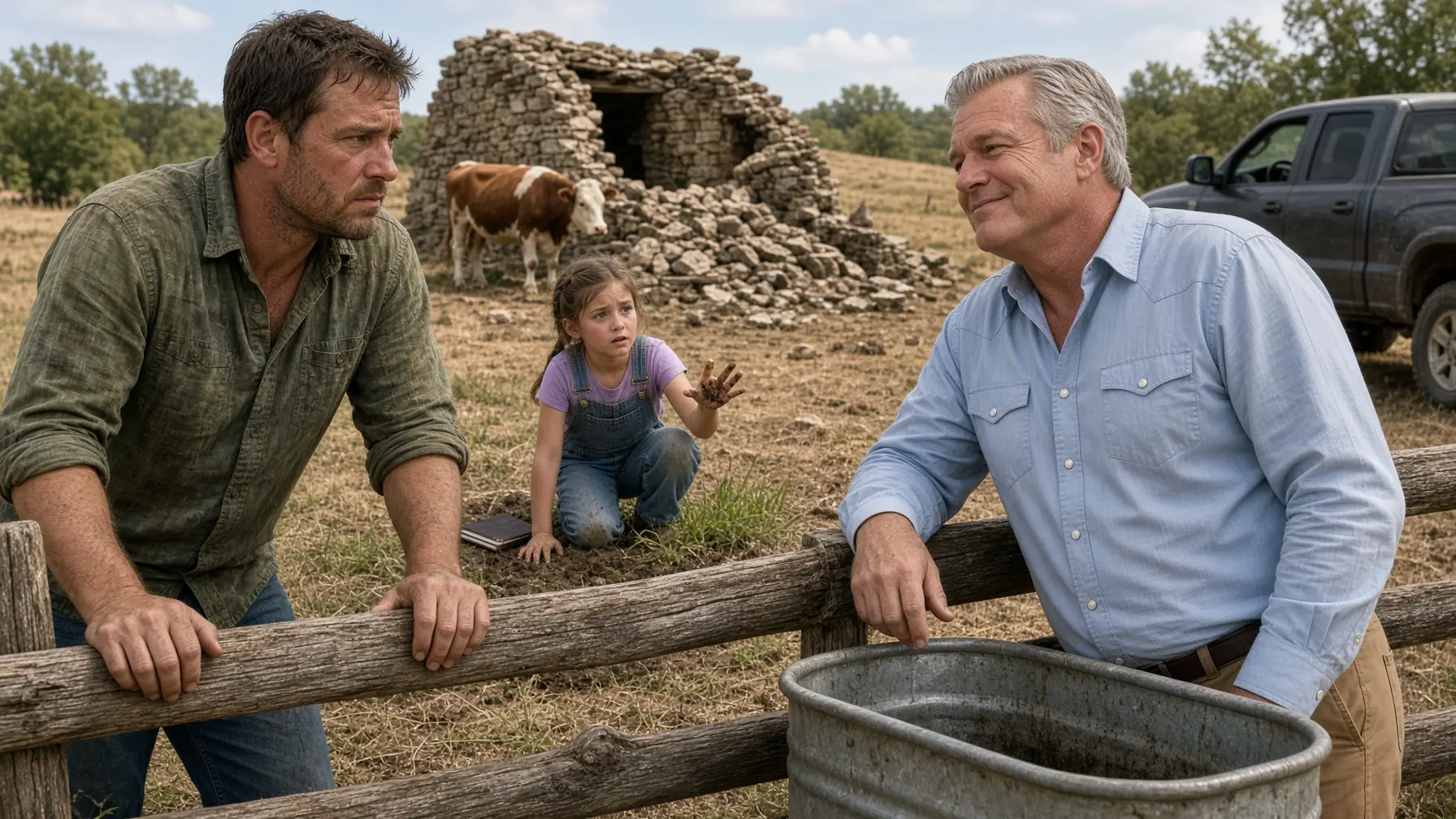
Garrett rested an elbow on the upper fence rail as though he had stopped to discuss the weather. His pale blue western shirt was clean, his gray hair neatly combed, and his polished brown boots stood on the dry side of the boundary.
Inside the fence, Elias Marsh tightened his grip on the wood.
He was thirty-nine, broad-shouldered, with short brown hair, rough stubble, and the weathered face of a man who had spent too many recent nights calculating instead of sleeping. Dust marked his rolled sleeves and settled along the creases of his worn jeans.
“You cut our water,” he said. “Now you want our land.”
Garrett straightened and brushed a faint smear of dust from his sleeve.
“Take the offer. Or let the bank take it.”
His pickup stood behind him, engine off, the windows dark enough to reflect the pasture rather than show what was inside. Beyond Elias, the hillside was brown in places that should still have been green.
The cattle trough near the fence was empty.
Farther uphill, the collapsed stone springhouse stood where it had stood for most of Elias’s life.
Ren crouched beside it with her notebook.
Elias could see his daughter’s lavender T-shirt between the grass and the fallen stones. Her loose brown braid had slipped over one shoulder, and she was concentrating with the seriousness she brought to small tasks.
He had told her to stay where he could see her.
She had.
He had not yet looked closely at what she was looking at.
His attention remained on Garrett.
It had been there too often lately.
The trouble had begun with an ordinary sound missing from an ordinary morning.
Elias opened the supply line beside the cattle trough and waited for the familiar rush.
Nothing came.
At first, he assumed the line had lost pressure or that a fitting needed attention. He checked what he could reach, walked the fence, and went back to the connection they had used for years.
The problem was not on his side.
A new lock secured the access gate on the adjoining property.
Beyond it, work had been done near the equipment that served the shared line.
Elias stood at the gate for a moment.
Then he called Garrett.
The rancher answered with a distracted voice, as though the conversation had interrupted something more important.
“The line’s off,” Elias said.
“I know.”
“When is it coming back?”
“We’re reviewing the arrangement.”
Elias looked through the gate.
“What arrangement?”
“The supply arrangement.”
“The one we’ve been paying for?”
Garrett exhaled.
“That doesn’t make everything permanent.”
Elias gripped the top of the gate.
“Then we discuss it before you shut it down.”
“There are issues with the old agreement.”
“What issues?”
“I’ll send you something.”
Elias waited.
“And what am I supposed to do about water this morning?”
Garrett’s answer came without hesitation.
“You’ll need to make other arrangements.”
For several seconds, Elias did not speak.
The ease of the sentence made it worse.
Water was not an item he could leave out of the week’s work and make up later. Every animal, every schedule, and every person on the farm depended on it.
“Garrett.”
“I said I’ll send something.”
The call ended.
Elias remained beside the locked gate.
He wanted to climb it.
He wanted to find someone on the other side and demand that the supply be restored before the discussion continued.
Instead, he looked back toward his own pasture.
The cattle were gathering near the trough.
He went to get the hauling tank.
That was the beginning of the new routine.
Each morning, before the farm could return to being a farm, Elias had to arrange water.
He borrowed equipment.
He made calls.
He drove farther than he wanted to drive and waited at places where other people’s schedules determined when he could fill and leave.
Nothing about hauling seemed complicated until he counted the hours.
Then the hours became fuel.
Fuel became money.
Money became decisions about everything else.
A repair could wait another week.
A fence section could be held temporarily.
He could do one job after dark.
He could skip the trip to town and combine it with the next one.
Soon, every task leaned against another task that had already been delayed.
His wife, Lena, noticed before he admitted it.
She found him at the kitchen table one evening with three sheets of figures spread around his supper.
The food was cold.
“You’re not eating.”
“I will.”