The officer told Valerie Covington that four thousand dollars and her car would make the little packet of powder disappear. He expected fear, bargaining, or a quick agreement from a woman standing alone beside the interstate. Instead, she offered him her wrists—and warned him to think carefully about the vehicle before deciding what to do next.
Officer Bradley Jenkins reached into his cargo pocket before leaning into the sedan.
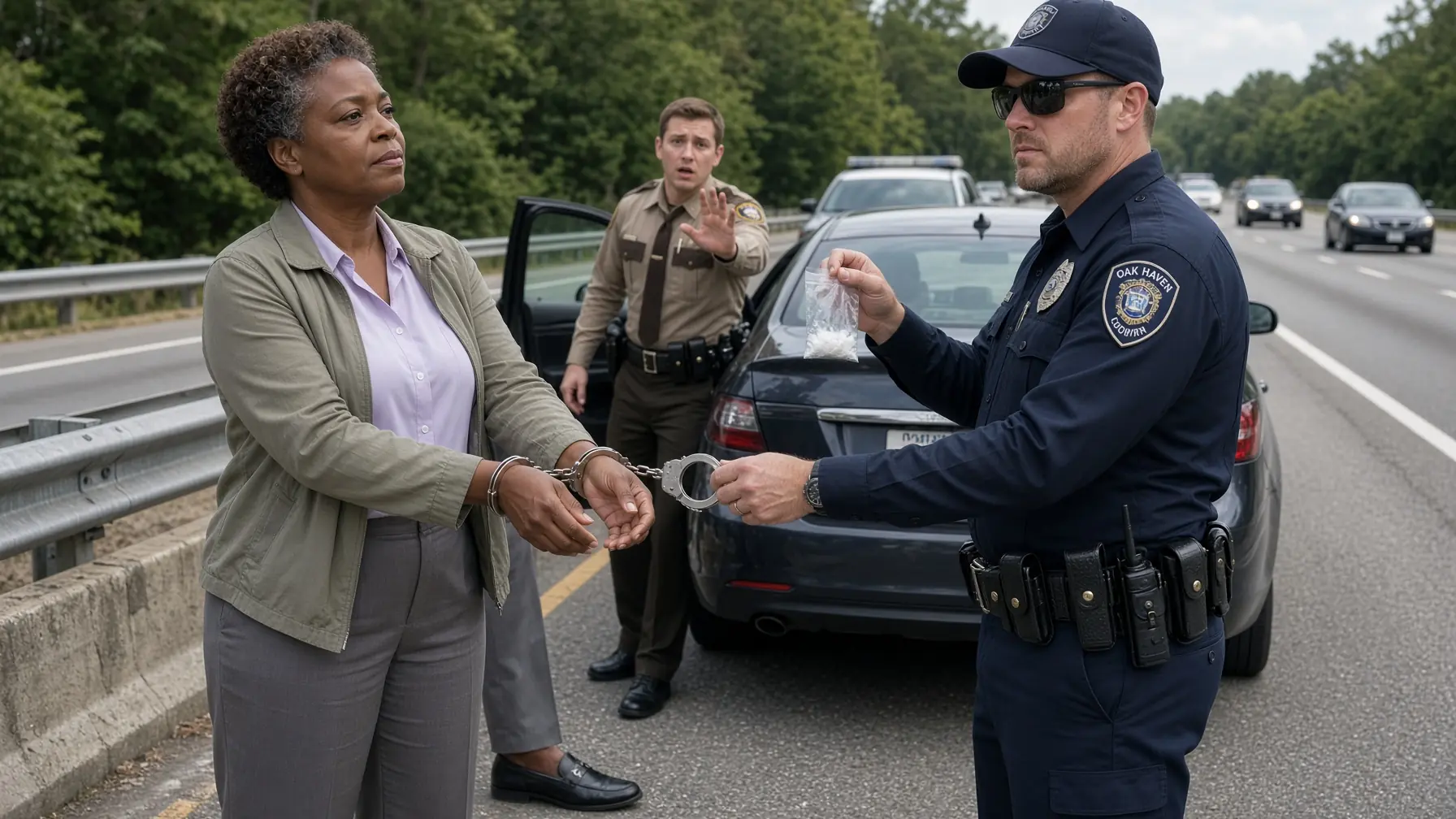
Deputy Greg Hayes saw the movement.
At first, he did not attach a meaning to it. Jenkins’s body blocked part of the doorway, and the traffic passing on Interstate 85 made every small gesture seem less important than staying clear of the road.
Then the closed hand disappeared beneath the driver’s seat.
Jenkins straightened.
He shifted his feet, bent into the charcoal sedan again, and came back out holding a tiny clear packet.
White powder gathered in one corner.
Hayes looked at the packet.
Then at Jenkins’s pocket.
Then at Valerie Covington, who stood beside the guardrail with both hands visible.
She had not moved.
The afternoon light caught the silver strands near her temples. Her olive jacket stirred in the highway wind, and the sleeve of her pale lilac blouse had pulled slightly above one wrist.
Jenkins turned toward her with a satisfied expression.
Not surprise.
Not concern.
Satisfaction.
Hayes felt something cold settle below his ribs.
He had seen that expression before.
He had spent weeks telling himself there were innocent reasons for it.
Forty minutes earlier, Valerie had been thinking about a grocery list.
It was on a folded piece of paper in her handbag, beside an envelope she intended to deliver after reaching Oak Haven. She had written the list before leaving because she knew that by evening she would remember the things she wanted and forget the things she needed.
Tea.
Bread.
The good oranges, if they had them.
A lightbulb for the hallway.
Nothing on the list justified taking the interstate, but she had other reasons to travel that afternoon. She expected the errands to fit around them.
At fifty-two, Valerie preferred plans with room inside them.
She disliked being hurried into decisions.
She disliked arriving late even more.
The charcoal sedan moved smoothly through the clear afternoon. Traffic was steady, the sky bright, and the air-conditioning was set low enough that she kept her lightweight jacket on.
A radio program played quietly.
Valerie turned it down when the subject changed to something she did not want occupying her mind.
She had already had a long morning.
Not a bad morning.
A long one.
Several conversations had required more patience than the people speaking seemed to realize. She had listened, asked a few questions, and postponed answering one request because she wanted to think before giving someone a convenient yes.
By the time she reached Interstate 85, she was ready for twenty uninterrupted minutes.
The blue lights appeared in her mirror.
Valerie noticed them immediately.
She looked at the speedometer.
Then at the lane beside her.
She had not been weaving.
She had not been using her phone.
The seat belt lay properly across her chest.
Still, there could be something she had missed.
She signaled, slowed, and moved toward the shoulder.
The available space was narrow beside the guardrail, but she found a stretch where the sedan could stand clear of the travel lane.
She stopped.
Put the car in park.
Turned off the radio.
Then she placed both hands on the wheel.
The first patrol car pulled in behind her.
A second stopped farther back.
Valerie watched through the mirror.
Two vehicles for one stop.
She could feel her pulse quicken.
It was not the first time she had been stopped.
It was the first time in years that the arrangement behind her had made her feel the beginning of something before anybody spoke.
She lowered the driver’s window.
The wind entered with the sound of passing trucks.
Jenkins approached from behind the sedan.
He was broad, forty-one, with closely cropped hair and sunglasses that prevented Valerie from seeing his eyes. His navy uniform was neat, and he rested one hand against the upper edge of the open window as though the space already belonged to him.
“License.”
Valerie kept her hands on the wheel.
“My wallet is in my handbag on the passenger seat.”
He glanced inside.
“Get it.”
She moved slowly.
The handbag was zipped.
She opened it, removed the wallet, and took out her license.
Jenkins accepted it.
He looked at the card.
Then at her.
Then at the card again.
“What brings you through here?”
“I’m headed into Oak Haven.”
“For what?”