Abilene, Kansas, 1878.
The letter Clem Hadley sent to the Frontier Matrimonial Registry in St. Louis was, by any measure, the most unusual piece of correspondence the agency had ever received.
Most men wrote about their acreage, their livestock, and their prospects. Clem wrote about those things too.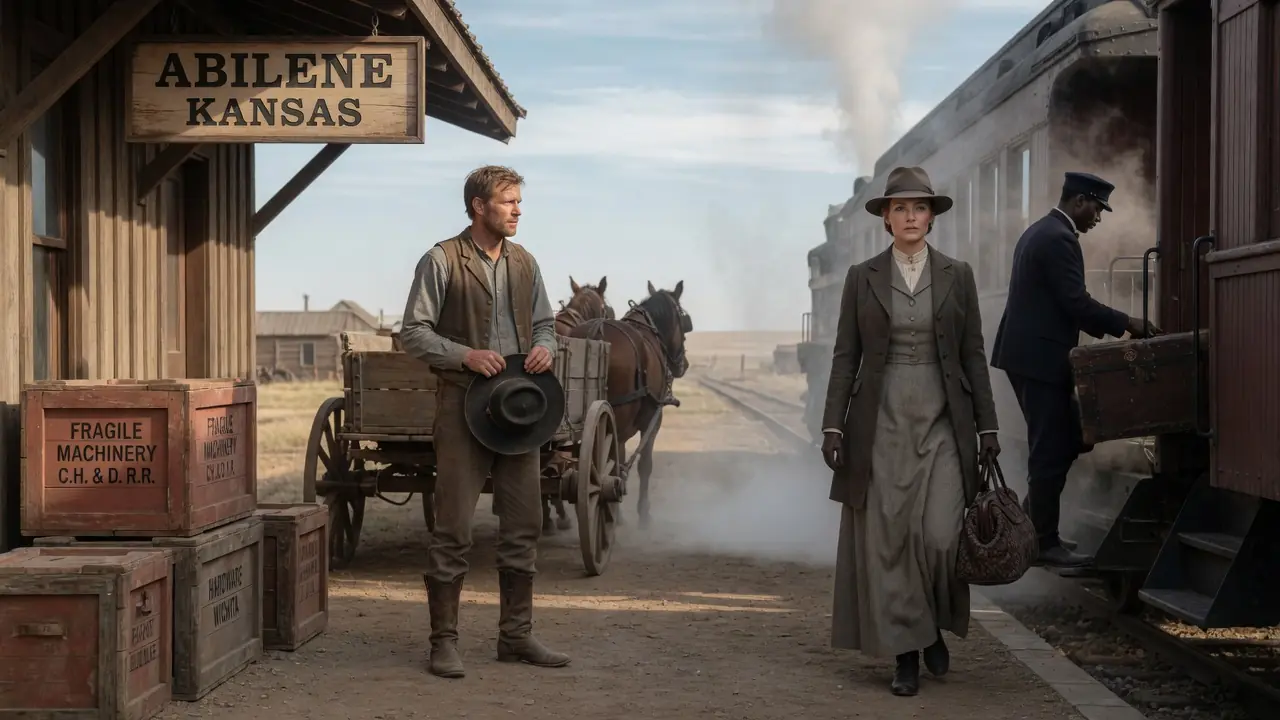
But at the bottom of the letter, in handwriting that suggested a man who had made up his mind and was not interested in arguing about it, he had added one specific requirement that made the agency’s proprietor, Mrs. Edna Foss, read the line twice, set the letter down, pick it up again, and read it a third time.
“Plain-looking preferred. Homely acceptable. Ugly welcome.”
He was not joking.
Clem Hadley was thirty-six years old, rangy as a fence post, sun-cracked from fourteen years of Kansas wind, and the owner of a respectable thirty-eight acres just south of Mud Creek that produced decent cattle and indifferent corn.
He had a cabin with a real floor, a smokehouse that mostly worked, and a cookstove that had never once betrayed him.
He was, by the standards of Dickinson County in 1878, a catch.
He knew it.
That was precisely the problem.
The last woman Clem had courted was a pretty one. Her name was Nettie Gage, and she had smiled at him across a church social in the spring of 1874. By September of that same year, she had smiled the exact same way at Douglas Farrow, who owned twice the acreage and a proper house with window glass.
Then she rode off toward Wichita on Douglas Farrow’s wagon without a backward glance.
Clem had done a lot of thinking after Nettie.
Quiet, flat, Kansas-plains thinking.
And he had arrived, the way a man arrives at a fence post he has been walking toward for a long time, at a conclusion.
Pretty meant trouble.
Pretty meant options.
Pretty meant that a woman could look at what she had, then look at what somebody else had, and start doing arithmetic.
Ugly, Clem had decided, was loyal.
Ugly was grateful.
It was, without question, the stupidest plan in Dickinson County.
He just did not know it yet.
Mrs. Edna Foss of the Frontier Matrimonial Registry did not have an ugly woman on her books.
She had plain women, practical women, and one woman from Cincinnati who described herself as no great beauty, but whose enclosed photograph suggested she was being modest to the point of dishonesty.
What Mrs. Foss did have was a woman named Adelaide Marsh.
Adelaide Marsh, thirty years old, of Independence, Missouri, had written to the agency describing herself in terms so unflattering that Mrs. Foss had initially assumed she was either deeply humble or deeply peculiar.
Adelaide’s letter said she was unremarkable in face, sturdy in frame, and plain as a Sunday sermon. It said she could cook, preserve, sew, mend, manage a household, and had once helped her father set a broken fence post in frozen ground, which she included as evidence of practical character.
It did not mention that Adelaide Marsh had auburn hair the color of a Missouri autumn, cheekbones a portrait painter would have wept over, and eyes so green and direct they had been stopping conversations in Independence since she was seventeen.
Adelaide knew what she looked like.
She had simply decided, after thirty years of watching men look at her face instead of listening to what she said, that her appearance was the least interesting thing about her.
And she was tired of it leading the conversation.
She wanted a husband who wanted a worker. Who wanted a partner. Who would value what she could do over what she happened to look like standing in the light.
When Mrs. Foss matched her with Clem Hadley’s letter, the man who had specifically, in writing, requested ugly, Adelaide Marsh read it twice, set it down, and laughed for the first time in six months.
She wrote back the same afternoon.
I believe I am exactly what you are looking for. I look forward to disappointing you.
Clem did not understand that last line.
He assumed it was humility.
He was wrong about that too.
The train from Independence pulled into Abilene on a Tuesday morning in March, and Clem Hadley was on the platform in his good shirt, which was just his regular shirt, washed.
He held his hat with both hands and told himself he was not nervous.
He was nervous.
He had a picture in his mind. Not a cruel picture, because Clem was not a cruel man, just a practical one. A sturdy woman. Capable looking. The kind of face that did not ask anything of you.
Someone who would step off that train, look at thirty-eight Kansas acres, and say, “Yes, this will do,” without any of the complicated arithmetic that pretty women did with their eyes.
The passengers came off in the usual order.
A family with luggage stacked like a general store. Two cattle buyers in good coats. A preacher.
Then Adelaide Marsh stepped onto the platform.
She was wearing a plain gray traveling dress, which was the plainest thing about her. She carried one trunk and a carpet bag, and she looked directly at Clem the moment her foot hit the platform.
Not searching.
Not uncertain.
Directly, as if she had already identified him from the window and was simply completing a transaction she had started in her mind.
Clem’s first thought was, That is not her.
His second thought was, The agency sent the wrong woman.
His third thought, slower and considerably more alarming, was, If that is her, she lied.
She walked straight to him.
“Mr. Hadley.”
“Miss Marsh.”
“You look disappointed.”
“I look surprised.”
“Is there a difference?”
He could not immediately think of one.
She looked at the wagon. She looked at the horse. She looked at the flat Kansas plain stretching out beyond the depot in every direction like God had ironed it.
“Your letter said the ranch was south of town.”
“About eight miles.”
“Then we should go. Standing here will not get the supper made.”
Then she walked to the wagon and climbed up without waiting for him, which was not what Clem Hadley had expected from any woman, pretty or otherwise.
The eight miles to Mud Creek were the quietest eight miles of Clem Hadley’s adult life, and Clem Hadley was not a talkative man.
It was not uncomfortable silence.
That was the strange part.
Adelaide Marsh sat beside him on the wagon bench and looked at the land.
Really looked at it.
The way a person takes stock of something they intend to understand.
She watched the color of the soil change near the creek bed. She noted where the cattle were grazing and where they were not. She looked at the sky the way a person looks at it when they have learned that Kansas sky is worth paying attention to.
After about four miles, she said, “How deep does your well run?”
“Forty feet. Good water.”
She nodded and said nothing for another mile.
Then she said, “That south pasture. Do you rotate it, or does it run cattle year-round?”
“Year-round, mostly.”
She made a small sound.
Not criticism exactly.
The sound a person makes when they have already thought about something and are filing away confirmation.
Clem looked at her sideways.
This was not the conversation he had prepared for.
He had prepared for questions about the house, the nearest town, whether there was a church.
He had not prepared for a woman who arrived in Kansas and immediately started interrogating his grazing rotation.
They reached the ranch.
The cabin was solid. Clem had made sure of that before she came. Real floor, real roof, cookstove standing upright with no baling wire holding it together.
He was privately proud of the cabin.
Adelaide stepped inside and made a full, slow turn, looking at everything. The stove. The pantry shelf. The single window. The two chairs at the table.
“It is a good cabin,” she said.
Clem felt something in his chest unclench just slightly.
Then she said, “I will need to rechink the north wall before real cold comes. And that pantry shelf is going to need a second tier before winter, or we will not have room for preserves.”
Clem opened his mouth.
Then closed it.
She was already rolling up her sleeves.
Here is what Clem Hadley had expected from a wife, ugly or otherwise: cooking, cleaning, mending, and the general management of a domestic situation that had been deteriorating quietly for years in the way that men’s domestic situations deteriorate when there is nobody to notice.
Here is what he got in the first week alone.
On Monday, Adelaide rechinked the north wall with a clay and straw mixture she made herself, having apparently memorized a technique from a publication called The Prairie Homesteader’s Companion, which she produced from her trunk like a surgeon producing an instrument.
On Tuesday, she reorganized the pantry and presented Clem with a written inventory of what he had, what he needed, and what he had apparently purchased in 1876 and forgotten entirely, including a tin of salt pork that she held up with two fingers and a look that required no commentary.
On Wednesday, she made biscuits.
They were extraordinary.
Clem ate four and did not say anything, because he was a man who had been eating his own cooking for six years, and his emotional response to a good biscuit was more than the situation seemed to call for.
On Thursday, she asked him to show her the cattle.
Not to look at them.
To explain them.
Which animals were producing. Which were not. What his breeding plan was. Whether he had considered the bloodline coming out of the Rocking H spread near Salina.
Clem stopped walking.
“How do you know about the Rocking H bloodline?”
Adelaide said, “I read. Is that a problem?”
It was not a problem.
It was, in fact, the most startling thing that had happened to Clem since the Nettie Gage situation, and for entirely different reasons.
He had asked for ugly because he wanted simple.
What had shown up was a woman who rechinked walls, cataloged pantries, made transcendent biscuits, and knew cattle bloodlines in two counties.
Simple was not the word.
By November, Abilene had opinions.
Small towns in Dickinson County in 1878 operated on a simple economy of information. Everyone knew everyone’s business, and the business of a bachelor rancher who had sent off for a mail-order bride was premium currency at the feed store, the barbershop, and every church social between Mud Creek and the Smoky Hill River.
What Abilene had expected was a plain, forgettable woman who would quiet Clem Hadley down and keep his cabin from smelling the way bachelor cabins smell.
What Abilene got was Adelaide Marsh.
She showed up to the first church social in October in a dress she had sewn herself, looked every person in the room directly in the eye when she spoke to them, and within forty minutes had gotten into a polite but utterly firm disagreement with Judge Roy Callum about whether the new road east of town should run along the ridge or the creek bed.
By the quiet consensus of everyone present, she had been correct.
Clem stood by the refreshment table watching this and feeling something he could not name right away.
It took him until the ride home to identify it.
Pride.
Which was a problem, because pride meant he was invested. And invested meant that the careful, sensible, ugly-wife practical solution plan he had constructed after Nettie Gage was doing what all carefully constructed plans do when they encounter a real human being.
It was falling apart.
Adelaide said on the ride home, “Your Judge Callum does not like being corrected by a woman.”
Clem said, “He does not like being corrected by anyone.”
“Was I wrong?”
“About the road? No. Creek bed floods in spring. You were right.”
She was quiet for a moment.
Then she said, “Good.”
Just that.
Good.
Like being right was the only part that mattered.
Clem looked straight ahead at the dark Kansas road and understood he was in serious trouble.
December in Kansas is not a gentle thing.
It comes off the Colorado plain with the manners of a debt collector, cold, flat, and completely indifferent to what you had planned.
The blizzard hit on a Thursday night.
Clem had seen it coming in the afternoon sky, that particular yellow-gray that meant business, and had spent the last hours of daylight moving cattle to the lower pasture, breaking ice on the water trough, and getting enough firewood inside to last three days.
Adelaide had spent those same hours tripling the food laid out, filling every available container with water from the well, and banking the stove with the particular expertise of a woman who had read about Kansas winters and taken the literature seriously.
They were as ready as ready got.
What they were not ready for was the sound at two in the morning of Clem’s best heifer bellowing from the barn.
Early labor in a blizzard.
Six weeks before she was supposed to.
Clem was up and dressed before he was fully awake. He did not say anything to Adelaide. It was his heifer, his barn, his problem. She was a woman from Independence, Missouri, and there was no reason on earth she should be outside in a Kansas blizzard at two in the morning.
He got to the door.
She was already there.
Coat on. Lantern lit. Scarf wrapped twice around her head.
“Adelaide.”
“You need a second pair of hands.”
“It is thirty below.”
“I can count, Clem.”
And she walked out into the blizzard.
He followed her, which, when he thought about it later, was the moment the whole thing reversed.
She had not followed him.
He had followed her.
The calf was breech.
Clem knew it the moment he saw the heifer’s distress, the particular frantic quality of an animal that was working as hard as it could and getting nowhere.
He had lost two calves to breech birth in six years of ranching, both times because he had no one to hold the lantern steady while he worked.
He looked at Adelaide.
She looked at him.
She held up the lantern.
She held it for fifty-three minutes.
He knew because he counted, the way a man counts when he is working by feel in the dark and the numbers are the only thing keeping him steady.
Fifty-three minutes in thirty-below cold, her arm extended, the flame absolutely still.
Her face went the color of candle wax.
She did not move.
She did not say a word.
The light did not waver once.
The calf came just before three in the morning, wet and shaking and alive.
Clem set it down beside the heifer.
Then he turned around.
Adelaide’s hand had locked around the lantern handle in a grip she could no longer release on her own. The muscles had simply decided they were done taking instruction.
He took the lantern.
He took both her hands in his and breathed on them, slow and steady, warming each finger back to life one at a time, the way you bring a fire up from almost nothing.
She said, “Your letter said you were looking for a plain wife.”
He said, “Your letter said you were plain.”
A silence.
The calf nuzzled the heifer. The blizzard screamed over the barn roof.
Adelaide said, “I was describing my character. I thought that was the relevant part.”
Clem was still holding her hands.
“You thought right.”
Neither of them moved to change that.
They were married by Reverend Dale Horton of the First Methodist Church of Abilene on a Saturday in February 1879, which was the earliest the ground was passable and the latest either of them felt like waiting.
The ceremony was brief.
Adelaide wore a dress she had made from cloth she ordered from the dry goods store.
Blue, because she said gray was for traveling, and she was done traveling.
Clem wore the good shirt.
He built her a proper bookshelf in March.
It was not a perfect bookshelf. The second shelf leaned slightly to the left, which Adelaide noted and Clem corrected on the third attempt.
She stacked it with the six books she had brought from Independence, and within a year she had written to Missouri for eleven more.
Clem read four of them.
He started with the cattle manual. He ended with a collection of essays by a man named Emerson, which he read twice without telling anyone and thought about for the better part of a winter.
Over the next twenty-two years, they turned thirty-eight acres into ninety-four.
They raised cattle, winter wheat, and three children, all of whom could argue before they could properly walk, which Adelaide accepted as evidence of good character and Clem accepted as consequence.
The north wall stayed chinked.
The pantry stayed organized.
The heifer from the blizzard, whom they named February for obvious reasons, lived eleven more years and produced the finest calves in Dickinson County.
Adelaide Marsh became the most respected woman in Abilene, which she acknowledged by saying, “I simply say what is accurate. People find that unusual.”
Clem told a man at the feed store one autumn, quietly, in the way Kansas men share the things that matter most, “I wrote to that agency asking for ugly. I have no idea what they sent me, but I will tell you something. Whatever it was, I got the better end of that bargain by a country mile.”
He had asked for ugly because he was afraid.
She had come because she was tired of being seen and not heard.
And what they built together, on thirty-eight acres, two honest lives, and one very cold night in a Kansas barn, was the kind of life neither one of them had thought to ask for.
Because some things are too good to know to ask for.