The first sign of trouble at Thornberry Manor was the sound of the iron gates unlocking.
Arabella Thornton froze in the reading room, the book open in her hands.
The October sun slanted through the tall windows, making soft gold patterns on the floor.
Normally, the gates stayed shut until noon. Normally, nothing changed here without warning, but today was not normal.
Mrs. Augusta Ashford, the woman Arabella served as companion, sat in her velvet chair across the room. At seventy-three, she looked as firm and sharp as the stones that made up the estate. Her dark eyes had the confidence of someone who had spent a lifetime giving orders no one dared ignore.
“Stop reading,” she said. “That novel has grown dull.”
Arabella closed it with quiet relief. The book was a dramatic mess. The heroine fainted every five pages, and the hero took even longer to notice it.
“Shall I ring for tea, ma’am?” Arabella asked.
“In a moment.” Mrs. Ashford tilted her head and studied her. “Tell me, child, what has changed in the house today?”
Arabella knew this was a test. Mrs. Ashford enjoyed testing her, not out of cruelty, but out of curiosity.
Arabella let her eyes move around the room, pulling details together. “The green guest room was open this morning,” she said. “Fresh flowers were put in the entry hall, even though we have none blooming outside, and Cook is preparing meals that take hours.”
Mrs. Ashford smiled, small but pleased. “Good. My grandson arrives this evening.”
Arabella’s breath caught. “Mr. Sebastian is coming today?”
“He was not expected until Christmas,” Mrs. Ashford said, “but I summoned him.”
Arabella pressed her fingers together to hide the way they trembled. She had met Sebastian Ashford three years ago on her first day at Thornberry Manor. He had walked past her without looking at her, which was understandable.
She was a companion with one trunk and no family.
He was the heir to the Ashford Shipping Empire, a man the newspapers called the Duke for his cold control and impossible standards.
Since that day, Arabella had lived quietly, trying to be useful without being seen. But today, everything felt exposed.
Mrs. Ashford continued, “I wrote to tell him I have chosen his bride. I will not wait any longer. He is thirty-one.”
Arabella kept her face calm, though her stomach twisted. Over the last month, many polished young women had visited Thornberry Manor. Most of them carried the confidence of people born to be admired. One of them, Georgiana Blackmore, had seemed a perfect match: beautiful, wealthy, certain of her own importance.
Arabella lowered her gaze. “That is good news, ma’am.”
“Is it?” Mrs. Ashford asked. “You do not look pleased.”
Mrs. Ashford huffed. “You lie well, but not well enough. Go ring for tea and change for dinner. Wear the blue dress. The gray makes you look miserable.”
Arabella obeyed, though a heavy feeling pressed on her chest. The blue dress was her nicest. Mrs. Ashford had given it to her last year, and Arabella had never known why.
The afternoon drifted by with familiar tasks: letters, tea, a slow walk through the garden. But Arabella’s mind refused to be still. She kept imagining Sebastian’s return, his cold gray eyes, his sharp control, and the quiet anger he carried like a shadow.
As the sun set, word came from the footmen at the gate.
“The Ashford carriages have arrived.”
The great hall filled with a nervous energy. Servants straightened their uniforms. Lamps glowed brighter. The front doors were opened wide. Mrs. Ashford stood tall, dressed in black silk and diamonds.
“He will be difficult,” she said, “but I always win.”
Then Sebastian Ashford entered.
He filled the doorway like a storm rolling in. He was broad-shouldered, with neat dark hair and sharp, cold gray eyes. He removed his gloves with clean, precise movements, the kind that told the world he liked control and never surrendered it.
“Grandmother,” he said, kissing her cheek.
“You came,” she replied.
“You summoned me,” he corrected. “I hope this matter is brief.”
“Not at all,” she said. “We will speak after dinner.”
“Why have you chosen a wife for me?” he demanded, already tense. “I am not livestock. I choose for myself.”
“And yet you have not,” she said. “One week. Spend one week with the woman I chose. If you still refuse, I will not push you again.”
Sebastian exhaled sharply but nodded. “Fine. Present her to me after dinner.”
Arabella felt something cold settle in her chest.
After dinner, a servant brought Arabella upstairs.
“Mrs. Ashford is waiting for you,” he said.
Arabella followed with unsteady steps. She entered the sitting room to find Mrs. Ashford in her chair and Sebastian standing at the window, tense as steel.
Mrs. Ashford spoke first. “Sit, Arabella.”
Arabella sat.
Sebastian turned, expecting some polished socialite, and stopped. His brow furrowed. Confusion, disbelief, then anger crossed his face.
“No,” he said. “Absolutely not.”
Mrs. Ashford lifted her chin. “Miss Arabella Thornton is the bride I chose for you.”
Arabella’s breath caught. The room seemed to shrink.
Sebastian stared at her. “She is your companion. A paid employee.” His voice sharpened. “This is absurd.”
“It is perfect,” Mrs. Ashford said.
Sebastian turned to Arabella. “How long have you known about this?”
Arabella swallowed. “I only learned tonight.”
“You expect me to believe that?”
“I asked for none of this,” she said, her voice breaking. “If I had known, I would have left. I never meant to be part of any plan.”
Something in her cracked open, and a tear slid down her cheek. She stood quickly, humiliated.
“Mrs. Ashford, I must resign.”
“You will not,” Mrs. Ashford said firmly. “You promised one week, Sebastian. She will stay for one week.”
Sebastian looked at Arabella, troubled, angry, unsure. Arabella looked away, fighting tears. Mrs. Ashford dismissed them, but the air remained charged.
Outside the room, Sebastian said quietly, “I apologize for how I spoke.”
His voice was stiff, controlled.
“But this marriage will not happen.”
“I agree,” Arabella said. “I want no part of it.”
They stood facing each other, strangers bound by a choice neither had made. And yet something in the air shifted between them. Something small, dangerous, and impossible to ignore.
Their one week had begun.
Morning came cold and pale over Thornberry Manor, washing the sky in quiet gray. Arabella rose before dawn, as she always did. The air in her small attic room was colder than usual, as if the entire house sensed the tension waiting below.
She washed her face, braided her light brown hair, and dressed in her usual simple gown. She needed the plainness today. It felt safe. It felt like a shield, but nothing felt steady.
Her thoughts refused to settle. She kept hearing Sebastian’s voice from the night before, sharp, disbelieving, almost offended that she had been chosen. She kept seeing the shock in his eyes. A shock that had felt like a slap, even though he had not meant it that way.
She had no desire to marry him. She had no hope of it. But being chosen and rejected in the same breath left a bruise she could not hide.
By the time she reached Mrs. Ashford’s rooms, she had pushed her emotions deep inside. The older woman watched Arabella enter with her usual piercing stare.
“You look pale,” Mrs. Ashford said.
“I slept little,” Arabella answered.
“You will sleep less if you keep worrying, child. I need your help with my letters.”
Arabella obeyed, grateful for routine. She wrote as Mrs. Ashford dictated, her handwriting neat, even when her heartbeat was not. But halfway through the letters, Mrs. Ashford spoke in a tone that allowed for no argument.
“You will take breakfast with my grandson.”
Arabella’s pen froze. “Ma’am, I do not think that is wise.”
“One week,” Mrs. Ashford said. “You promised me one week, and one week requires more than standing in separate rooms and pretending the other does not exist.”
Arabella bowed her head. “Yes, ma’am.”
She walked slowly to the breakfast room, wishing the hallways were longer, wishing she could delay, wishing she were invisible again.
Sebastian was already there, standing by the tall window. Sunlight struck the edges of his dark hair, making him look sharper, colder. When he turned, Arabella braced herself. But he did not look angry. He looked uncertain.
“Miss Thornton,” he said quietly. “My grandmother insists we eat together.”
“She insisted with me as well,” Arabella replied.
He hesitated, then pulled out her chair. She sat across from him at the long polished table, a wide distance stretching between them.
For the first few minutes, silence filled the room. The only sounds were the soft clink of silverware and the occasional bird outside. Then Sebastian spoke.
“I behaved poorly last night,” he said. “Whatever my feelings about the situation, my words to you were unfair.”
Arabella folded her hands. “I understand. You were surprised.”
“That doesn’t excuse it,” he said.
She lifted her eyes, and something shifted in his expression, like he was seeing her, really seeing her for the first time instead of glancing past her.
“You truly had no idea,” he said.
“No,” she answered. “If I had known, I would have asked Mrs. Ashford to choose someone else. I did not want this.”
Sebastian nodded slowly, as if absorbing the truth piece by piece.
“Neither did I,” he admitted, softer than she expected.
The honesty surprised her. She had always imagined him cold as stone. But today, the sharp edges around him seemed less solid, as if something inside him was unsettled, too.
They began to speak of lighter things: books, the weather, the garden outside. At first, their words were careful, like stepping stones laid across deep water. Then the stones grew closer, their steps steadier.
“You read often,” Sebastian said, nodding toward the shelves. “Do you enjoy fiction?”
“Yes,” Arabella said. “Although the one your grandmother chose yesterday may have cured me of that.”
To her shock, a faint smile touched his mouth.
“She has terrible taste,” he said.
The smile warmed the air. Arabella looked down quickly, unsure what to do with the flutter in her chest.
Over the next hours, the household pulled them into the same rooms again and again. Mrs. Ashford arranged it with practiced ease: shared tea, a short walk outside, a visit to the map room to discuss future plans for the grounds.
In each moment, Sebastian watched Arabella more closely than he meant to. He noticed how she listened with real attention, how she spoke only when she had something useful to say, and how she avoided the center of a room even when she was the most capable person in it.
And Arabella noticed things, too. How Sebastian’s coldness softened when he spoke about the workers on the estate. How he studied problems as if searching for the most fair answer. How he carried his burdens with a quiet weight that made her chest ache.
By the third day of the week, something had changed between them. It was not spoken. It lived in the quiet glance Sebastian gave her when she entered a room, and the warm, uncertain feeling Arabella tried to ignore whenever he stood close enough that she could feel the heat of him.
Mrs. Ashford’s eyes sparkled every time she saw them.
“Do not underestimate yourself,” she told Arabella as they walked through the garden. “You have more strength than any of the pretty girls paraded through this manor.”
Arabella shook her head. “He looks at me because he must. When the week ends, he will choose someone like Georgiana Blackmore.”
Mrs. Ashford’s voice sharpened. “Sebastian sees you. He may not know what that means yet, but he sees you.”
Arabella wanted to believe that, but doubt lived deep inside her.
Everything changed on the fourth day.
A storm rolled across the Hudson Valley, dark and heavy. Rain hammered the windows. Thunder shook the ground. A rider arrived at the manor doorstep, soaked and wild-eyed.
“Miss Thornton,” he gasped. “Mr. Ashford, the river. It’s flooding. The cottages are in danger. Families are trapped.”
Sebastian didn’t hesitate.
“Prepare horses,” he ordered. “Gather as many men as you can. We leave now.”
Arabella stepped forward. “I’m coming with you.”
“No,” he said sharply. “It’s too dangerous.”
“You need me,” she said calmly. “I know the families. I know where the ground is weakest. I know who will need help first.”
Sebastian’s jaw tightened as he weighed her words. Then he nodded.
“Stay close to me. Do exactly as I say.”
They rode out into the storm, water pounding down, wind whipping at their coats. The river had burst its banks, flooding the fields and rushing toward the cottages. People cried out for help. Horses struggled in the mud.
Arabella moved with fierce determination. She guided rescuers to each house, called out names, calmed frightened children, and refused to step back even when the cold water surged up to her waist.
Sebastian watched her with something like shock and something deeper, something that felt like his entire understanding of her had been rewritten.
By nightfall, every family was accounted for. No lives were lost. The storm grew too strong for them to return to the manor, so they sheltered in the groundskeeper’s cottage.
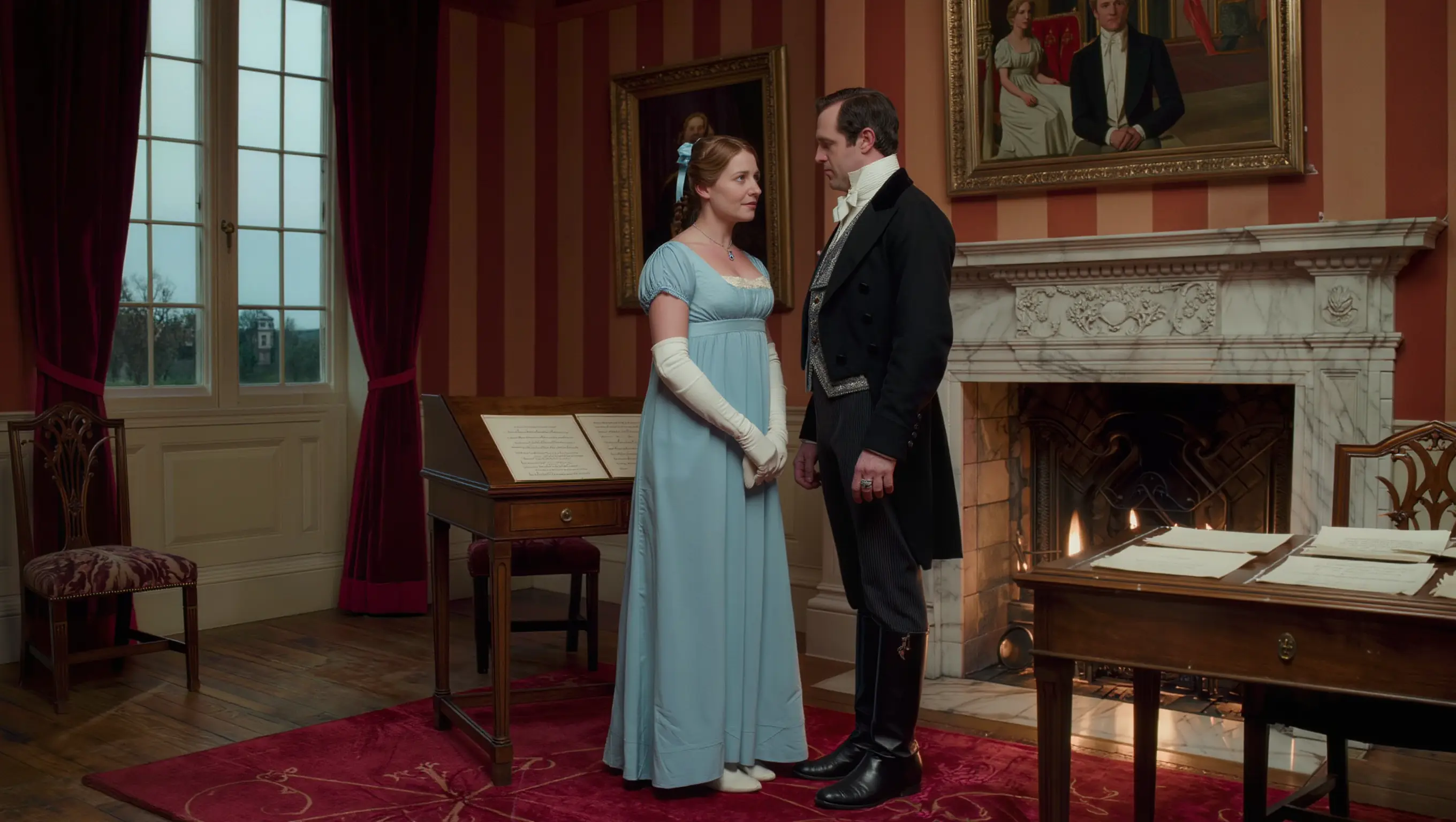
A fire burned low. Rain tapped against the roof in steady rhythm. Arabella sat near the fire, exhausted but steady. Sebastian watched her from across the room before speaking, his voice quieter than she had ever heard it.
“You were remarkable today.”
“I only did what needed to be done,” she said.
“That is not true,” Sebastian replied. “You did more than any of us.”
Arabella looked down, uncertain what to do with the warmth in his voice.
Sebastian stepped closer. “There is something I should tell you.”
His voice was rough, like the words had been waiting for too long.
“I thought I understood you. I didn’t. What I saw today, it changed something.”
Her heart beat faster.
“Sebastian.”
He hesitated, then said softly, “I don’t want this week to end.”
The truth in his voice melted something inside her, something she had fought to keep frozen. And yet, she feared hope more than anything.
“Sebastian,” she whispered, her voice trembling. “You cannot mean that.”
But he did. His eyes told her everything. He meant it more than she was ready to believe.
The storm passed by morning, leaving the world washed clean and silent.
Arabella awoke on the small cot in the groundskeeper’s cottage, her body aching from the rescue work, her hair still smelling of smoke from the dying fire. For one long moment, she forgot where she was. Then she saw Sebastian sitting near the window, his coat removed, his shirt sleeves rolled up, his eyes on her.
He looked like a man who had not slept at all.
“Good morning,” he said quietly.
Arabella pushed herself up. “I must have fallen asleep.”
“You did,” he said. “You needed it.”
His voice held something different, something warm and unguarded, a softness she had never heard from him before the storm. Arabella looked away, flustered.
“We should return to the manor. Mrs. Ashford will worry.”
“We will,” he said. “But first, we need to speak.”
Her pulse quickened. She kept her hands in her lap to steady them.
“About last night?”
“Yes.”
Sebastian stood and walked closer until he was only a few steps away.
“I meant what I said. I don’t want this week to end.”
Arabella swallowed hard. “Sebastian, you barely knew me before this.”
“Then I was a fool,” he said simply.
The words struck her with quiet force. She shook her head.
“You said yourself that you do not want a marriage chosen for you.”
“I don’t,” he said. “Not unless I choose it, too.”
Her breath caught. “And you think you would choose me?”
Sebastian nodded once. “I know I would.”
The truth in his voice felt dangerous. Beautiful. Impossible.
“Sebastian,” she said softly. “Do not mistake gratitude for affection.”
“This isn’t gratitude,” he said, and his voice broke with honesty. “I watched you risk your life for people you could have walked away from. I watched you lead grown men without raising your voice. I watched you stand in the storm with more courage than anyone I know.”
Arabella felt her heart press painfully against her ribs. She looked down, afraid to believe what she saw in his eyes.
“I have been blind for years,” he said. “My grandmother saw you. I did not.”
Arabella whispered, “I have cared for you for a long time.”
She stopped herself.
“But that does not mean marriage.”
Sebastian stepped closer and knelt in front of her, lowering himself until his eyes were level with hers.
“Then tell me you feel nothing now,” he said gently. “Tell me last night meant nothing to you.”
Arabella tried. She really did. But when she looked into his gray eyes, steady and open in a way she had never seen before, her voice broke.
“I cannot say that.”
Sebastian reached out slowly, giving her time to stop him. When she didn’t, he took her hand. Then he leaned forward and kissed her.
It was soft at first, as if he feared she might vanish. But then his hand slid to her cheek, and the kiss deepened, slow and certain, a promise sealed by everything they had endured together.
When they broke apart, Arabella’s heart felt new, awake, alive.
“We should go,” she whispered.
He nodded, though he lingered a moment longer, brushing his thumb over her cheek with a tenderness she had never known.
They rode back to Thornberry Manor through the quiet morning. The air was crisp, and the fields glimmered with water from the storm. Arabella felt every breath, every movement with sharpened awareness.
But as soon as the manor came into view, reality returned like a blade. A carriage stood waiting in the drive, white with silver trim, elegant enough to recognize, even from a distance.
Sebastian’s jaw clenched. “The Blackmores.”
Arabella stiffened. “Why are they here?”
Sebastian exhaled sharply. “My grandmother must have invited them weeks ago. Georgiana and her mother want our families tied together. They will not take this well.”
Inside the manor, the atmosphere shifted instantly. Lady Georgiana Blackmore was as perfect as ever. Golden hair in smooth curls, a flawless gown of silver silk, a smile so polished it looked carved.
She examined Arabella from head to toe in a single sweep, her smile tightening.
“Miss Thornton,” she said. “I did not expect to see you return from such an adventure.”
Arabella bowed her head. “The families needed help.”
“How brave,” Georgiana replied in a tone that felt like a needle. “But matters of the estate are usually left to those born to it.”
Arabella said nothing. Sebastian stepped between them with quiet authority.
“Arabella was essential yesterday,” he said. “I would not have managed without her.”
Lady Blackmore’s expression flickered, but she recovered quickly.
“You give her too much credit.”
“And you give her too little,” Sebastian replied.
Later that evening, while the Blackmores dined with Mrs. Ashford and Sebastian, Arabella stayed silent at the far end of the long table. She felt Georgiana’s eyes on her again and again, measuring, judging, dismissing.
After dinner, Georgiana approached Arabella near the drawing room fireplace.
“You must not confuse kindness with interest,” Georgiana said in a low voice. “Men like Sebastian do not marry companions.”
The words struck deep, sharper because they echoed everything Arabella feared.
Before Arabella could respond, Sebastian appeared at her side, his expression dark with anger.
“Georgiana,” he said quietly, “you will not speak to her like that again.”
Georgiana’s smile tightened. “I only meant to warn her.”
“To shame her,” he said. “I know exactly what you meant.”
Arabella stepped back, overwhelmed, but Sebastian caught her hand, pulling her toward him with a certainty that left no space for doubt.
He kissed her, not soft, not hesitant, a declaration.
Gasps filled the room. Mrs. Ashford smiled behind her napkin. Georgiana went pale.
Sebastian turned to everyone watching.
“I love her,” he said. “And I will marry her.”
The room erupted, Lady Blackmore in outrage, Georgiana in fury, the servants in open disbelief.
Mrs. Ashford rose slowly, lifting her cane.
“My grandson has spoken,” she said, “and the matter is settled.”
But the night was not done.
Before dawn, scandal erupted like a fire through the manor. A footman discovered a set of letters hidden in Georgiana Blackmore’s luggage, letters proving she had been secretly engaged to another man for months.
Lady Blackmore tried to hide the truth, but Mrs. Ashford read every letter aloud with calm satisfaction.
When the Blackmores fled the manor in humiliation, Sebastian found Arabella in the library. He dropped to one knee on the rug, the morning light warming the room around them.
“Arabella Thornton,” he said, “I ask you again, not because my grandmother chose you, but because I choose you. Because I love you. Will you marry me?”
Tears filled her eyes.
“Yes,” she whispered. “Yes.”
He rose and kissed her, pulling her into his arms. The world outside Thornberry Manor would fight this choice. Society would whisper, families would frown, but none of it mattered.
Sebastian chose her.