The gunshot shattered the cabin window before Caleb Hart’s trembling hand reached Clara Whitmore’s face. Glass burst across the wooden floor, the lamp flame jumped violently, and Clara felt Caleb’s entire body change beneath her. The vulnerable man who had been begging her to leave vanished in a single breath. In his place rose the cowboy every outlaw in Wyoming Territory had learned to fear.
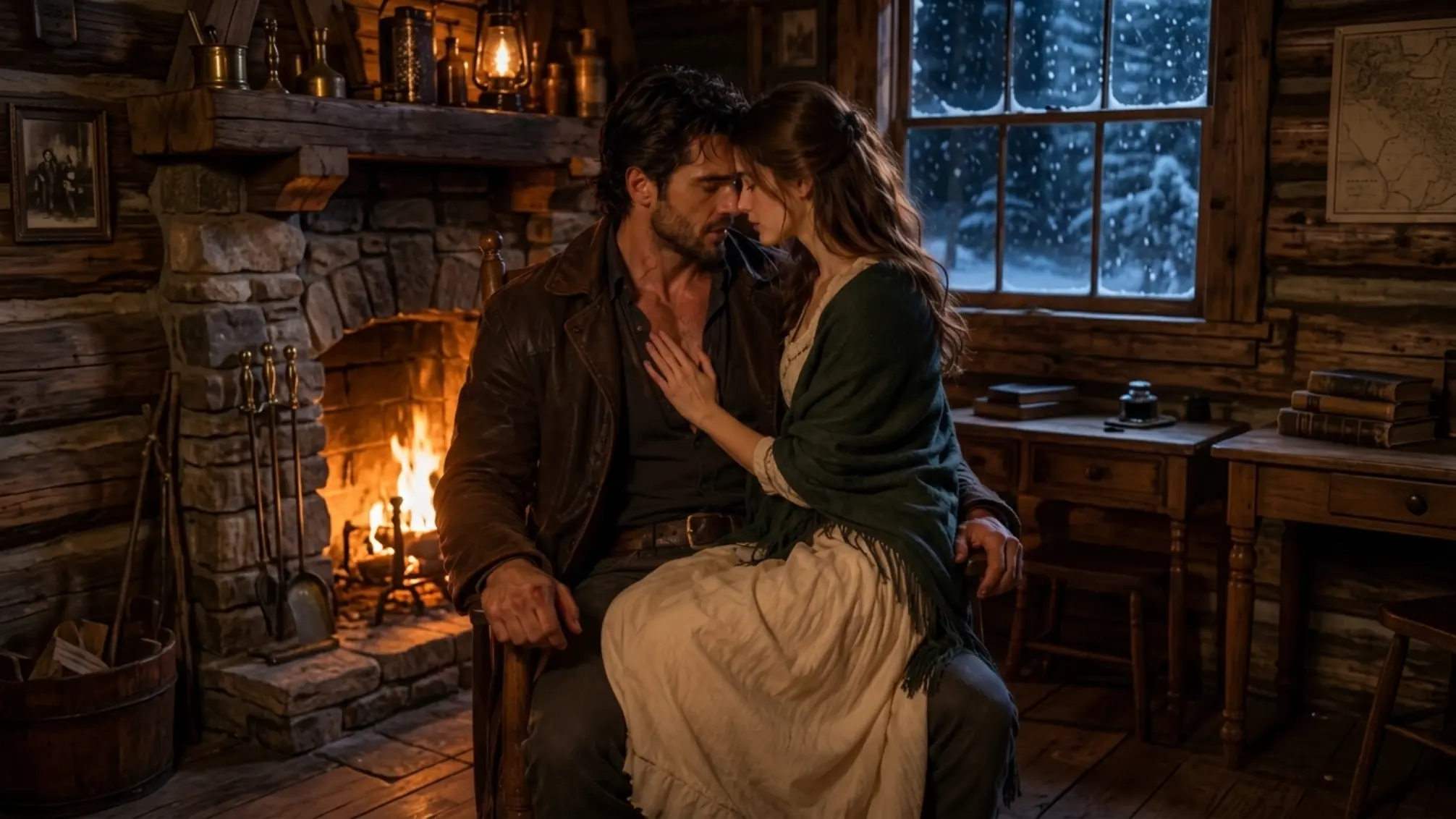
Caleb caught Clara around the waist and pulled her down behind the heavy chair as a second bullet tore through the wall. His broad body covered hers while splinters rained across his leather coat. He did not shout or panic. He listened to the storm, measuring the space between gunshots and the faint crunch of boots moving through the snow outside.
“Stay down,” he ordered.
Clara grabbed his sleeve before he could rise. “You’re not going out there alone.”
“This is exactly what I warned you about.”
“And this is exactly why I refused to leave.”
Another shot struck the stone fireplace and sent sparks across the room. Caleb looked toward the rifle hanging above the mantle, but reaching it meant crossing open space beneath the shattered window. His revolver sat in its holster near the cabin door, where he had left it after returning from town. Whoever waited outside knew precisely how the room was arranged.
That frightened Caleb more than the bullets.
Only a handful of people had ever entered his cabin. The sheriff had visited twice. An elderly ranch hand had delivered supplies during the previous winter. Clara had been there nearly every evening since the first snow.
And one other man had stood inside the room years earlier, before Caleb understood what kind of monster he truly was.
A voice rose beyond the door.
“Send the woman out, Hart.”
Caleb became completely still.
Clara heard the recognition in his silence. “Who is he?”
“A dead man who forgot to stay buried.”
The stranger laughed. The sound carried easily through the timber walls.
“You always did have a way with words, Caleb.”
Clara watched Caleb’s face harden. The scar across his throat stood pale against his skin, and something darker than fear entered his eyes.
“Gideon Vale,” he said.
Clara knew the name.
Everyone in Red Willow did.
Gideon Vale had once commanded the most violent rustler gang in northern Wyoming. His riders burned ranches, stole cattle, and killed anyone who refused to pay protection. Five years earlier, their reign ended when someone delivered detailed maps, names, and evidence to federal marshals.
The town believed an unknown informant had betrayed the gang.
Clara finally understood who that informant had been.
“You brought him down,” she whispered.
Caleb’s jaw tightened. “I helped him build it first.”
The admission did not surprise her as much as he expected. Caleb had carried too much guilt for a man whose only sins came from defending innocent people. Clara had always known there was a deeper history beneath the town’s stories.
Outside, Gideon called again. “You have one minute. Send her out, or I burn the cabin with both of you inside.”
Caleb reached beneath the chair and pulled free the short knife strapped to his boot. It was useless against a rifle, but he held it with the confidence of a man who had survived worse odds.
“You’re going through the back window,” he said.
“No.”
“You’ll cross the creek and follow the trees south.”
“I said no.”
“Clara, listen to me.”
“No, you listen.” She gripped the front of his shirt. “You’ve spent years deciding you don’t deserve love because of choices you made before you became the man I know. Now the past has found you, and you think dying alone will prove you were right.”
“This isn’t about proving anything.”
“It’s about fear.”
His eyes flashed. “Yes, I’m afraid.”
The honesty silenced her.
Caleb lowered his voice. “Not of him. I’m afraid I’ll watch you die because you refused to leave me.”
Clara pressed her forehead against his again, though bullets and shattered glass surrounded them. “Then don’t let me die. But don’t ask me to live knowing I abandoned you.”
For one brief moment, the storm, the gunman, and every dark year between them disappeared. Caleb looked at the woman who had crossed half the country to begin a new life and somehow chosen the one man everyone warned her against. He had expected fear to eventually drive her away.
Instead, fear had only revealed how fiercely she intended to stay.
The cabin door shook beneath a hard kick.
Caleb moved instantly. He pushed the chair toward the entrance and sent it crashing sideways as the door burst inward. Gideon fired through the opening, but the heavy chair deflected his aim. Caleb crossed the room before the outlaw could fire again.
The two men collided against the wall.
Gideon was nearly as tall as Caleb, wrapped in a black coat crusted with snow. A burn scar covered one side of his face, and hatred had hollowed his eyes. His rifle fell as Caleb drove a shoulder into his chest, but Gideon pulled a revolver from beneath his coat.
Clara saw the weapon first.
“Caleb!”
He twisted as the gun fired.
The bullet struck his left side.
Caleb staggered but did not fall. He seized Gideon’s wrist, slammed it against the wall, and struck him once across the jaw. The outlaw collapsed through the broken doorway into the snow.
Caleb followed him outside.
Clara ran to the fallen rifle and lifted it with shaking hands. The weapon felt impossibly heavy, but she carried it through the doorway while the two men fought beneath the storm.
Gideon drove a fist into Caleb’s wound. Caleb dropped to one knee, blood spreading beneath his shirt. The outlaw tore free the revolver and aimed it directly at his chest.
Clara raised the rifle.
“Put it down.”
Gideon turned toward her.
His smile returned when he saw the barrel trembling.
“You’ve never shot a man.”
“No.”
“Then don’t pretend you’re ready now.”
Caleb looked at her from the snow. “Clara, run.”
Gideon cocked the revolver.
Clara stepped between them.
The cowboy’s face changed with pure terror.
“Clara, move!”
She kept the rifle aimed at Gideon. “You wanted me outside. Here I am.”
Gideon laughed softly. “He told you what he was?”
“He told me enough.”
“He rode with us. Burned homes with us. Took money from widows and food from children. That scar on his throat came from a rancher defending his family.”
Caleb did not deny it.
Clara glanced at him. Pain twisted his face, but the shame inside his eyes hurt more than the bullet.
Gideon saw her hesitation.
“That’s right,” he said. “The gentle giant didn’t tell you all of it.”
Clara turned back toward the outlaw. “He also destroyed your gang.”
“He betrayed his brothers.”
“He stopped becoming one of you.”
Gideon’s expression hardened. “A man doesn’t change because a pretty woman wants to believe he can.”
“No,” Clara replied. “He changes because he chooses differently when it costs him something.”
The outlaw raised his revolver.
Caleb lunged forward.
The two guns fired almost together.
Clara felt the rifle kick against her shoulder. Gideon spun sideways and fell into the snow, his revolver discharging harmlessly toward the trees. Caleb reached Clara before she understood what had happened and pulled her against him.
“Are you hurt?”
“I’m fine.”
He searched her face, shoulders, and arms, refusing to believe her until he saw no blood. Then his strength failed. Caleb collapsed to one knee.
Clara dropped beside him.
The bullet had passed through his side, but blood soaked his shirt and coat. She pressed both hands against the wound, fighting panic as his face turned pale.
“You’re staying with me.”
He gave a faint, humorless smile. “You always were demanding.”
“Don’t joke.”
“I’m not sure I know what else to do.”
She tore fabric from the bottom of her dress and pressed it tightly beneath his coat. Gideon lay several yards away, unmoving but still breathing. Clara did not care whether he lived or died.
She cared only about Caleb.
Hoofbeats sounded through the storm.
Clara reached for the rifle again, but Caleb caught her wrist.
“Wait.”
Lanterns appeared between the trees, followed by the sheriff and four armed riders from town. They surrounded the clearing, dismounted, and stared at the ruined doorway, the wounded outlaw, and Clara kneeling in the snow with Caleb’s blood covering her hands.
Sheriff Thomas Bell ran toward them.
“We heard the shots.”
“Help him,” Clara demanded.
The sheriff opened Caleb’s coat and examined the wound. “Bullet passed through. He’s losing blood, but we can move him.”
Caleb attempted to stand.
His legs failed.
The men carried him inside while Clara remained beside him. The town doctor arrived twenty minutes later, summoned from Red Willow before the riders reached the cabin. He cleaned and stitched the wound beneath lamplight while Caleb drifted between consciousness and darkness.
Clara never released his hand.
Near dawn, the doctor finally covered Caleb with a blanket and washed the blood from his instruments.
“He’ll live.”
Clara closed her eyes.
The relief moved through her so violently that she nearly collapsed.
The doctor touched her shoulder. “He needs rest. Fever is likely, and the next two days matter.”
“I’m staying.”
“No one expected otherwise.”
Across the room, Gideon lay bound beneath the watch of two deputies. His wound was painful but not fatal. The bullet had torn through his shoulder, destroying his ability to raise his right arm.
When his eyes opened, he looked first at Caleb.
Then at Clara.
“You should’ve left him to die,” he muttered.
Clara stood slowly.
“You believed the worst thing about Caleb was what he once did.”
Gideon smiled through cracked lips. “Wasn’t it?”
“No. The worst thing was that men like you convinced him he could never become anything better.”
She leaned closer.
“You failed.”
The sheriff transported Gideon to town after sunrise.
Caleb remained unconscious for most of the day. When fever came that evening, Clara cooled his skin with damp cloths and forced small amounts of water between his lips. He spoke names she did not recognize and apologized to people long dead.
At midnight, he opened his eyes.
“Clara?”
“I’m here.”
His gaze moved around the cabin. “Gideon?”
“Alive. In jail.”
“You shot him.”
“He was about to kill you.”
Caleb looked toward the ceiling. “You could have died.”
“So could you.”
“That’s different.”
“Only to you.”
He tried to move but pain stopped him. Clara helped him settle against the pillows, then sat beside the bed.
“You heard what he said,” Caleb whispered.
“I did.”
“Some of it was true.”
“I know.”
He looked at her. “You don’t know all of it.”
“Then tell me.”
The story came slowly.
Caleb had been seventeen when Gideon found him starving beside a burned homestead. His father had died from illness, and debt collectors took the family ranch. Gideon offered food, a horse, and belonging to a boy who had none.
At first, Caleb guarded cattle.
Then he helped steal them.
By twenty, he was breaking fences, threatening ranchers, and collecting protection money. He told himself he never killed anyone who did not draw first, but violence followed every job.
The scar across his throat came from a farmer Caleb struck while Gideon’s men burned a barn. The farmer’s teenage son fought back with a broken blade.
Caleb survived.
The boy did not.
“I saw him fall,” Caleb said, his voice breaking. “He was trying to protect his father. I rode away anyway.”
Clara listened without interrupting.
“Three weeks later, Gideon ordered us to burn a widow’s home because she couldn’t pay. She had two little girls. I saw them hiding beneath the table.”
“What did you do?”
“I turned my gun on the men carrying the oil.”
That night, Caleb helped the family escape and began collecting evidence against Gideon’s gang. For nearly a year, he secretly recorded routes, names, stolen livestock brands, and contacts.
When federal marshals finally moved, Caleb testified.
Most of the gang died or went to prison.
Gideon escaped during transport and vanished.
Caleb received no public pardon because officials feared exposing him would invite retaliation. The town knew only that he had once ridden with dangerous men and later returned alone.
Rumor filled the missing years with every imaginable crime.
Caleb allowed it.
He believed hatred was the price he owed.
“I bought this land with money earned after Gideon,” he said. “Every winter, I take food to families we hurt. Every spring, I repair fences without saying who did it. But none of that brings the boy back.”
“No.”
His eyes closed.
“You should despise me.”
Clara reached for his scarred hand.
“I despise what you did.”
He opened his eyes.
She continued before he could pull away. “I will not pretend the past was harmless because I love you. That would make my love dishonest.”
Pain moved across his face.
“But I also know what you did afterward,” she said. “You risked your life to stop the gang. You protected those girls. You testified. You spent years repairing damage no one asked you to repair.”
“It wasn’t enough.”
“It will never feel like enough because guilt doesn’t know how to count.”
Caleb stared at her.
Clara lifted his hand and pressed it against her cheek.
“You are not asking me to love the man you were. You’re asking whether I can love the man who has spent every day choosing not to become him again.”
His fingers trembled against her skin.
“Can you?”
“I already do.”
Caleb’s eyes filled.
He turned his face away, ashamed even of the tears.
Clara leaned over and kissed his forehead.
He had endured gunfire without crying. He had survived a bullet and a knife. Yet tenderness broke him more completely than violence ever had.
For three days, Clara cared for him inside the cabin.
She changed bandages, prepared broth, and argued whenever he attempted to stand. On the fourth morning, Caleb managed to cross the room using the table for support.
“You’re impossible,” Clara said.
“I’m improving.”
“You almost reopened the wound.”
“That sounds like improvement with consequences.”
She guided him into the wooden chair beside the fireplace—the same chair where she had sat across his lap before the gunshot interrupted them.
Caleb noticed the memory at the same moment.
The cabin became quiet.
Clara stood before him, her hand resting lightly against his shoulder.
“You never answered me.”
“About what?”
“Whether you wanted me to stop.”
Caleb looked toward the shattered window, now covered with boards. “I thought the gunshot answered for me.”
“It interrupted.”
His mouth almost curved into a smile.
Clara lowered herself gently across his lap, careful not to touch the wound. Caleb’s hands remained uncertain at his sides.
She placed one palm over his heart again.
It beat just as fiercely as before.
“Still afraid?” she asked.
“More than ever.”
“Good.”
“Good?”
“It means this matters.”
Caleb finally lifted his hand and touched her face. His palm was rough, his knuckles scarred, but the movement carried extraordinary care.
“I love you,” he said.
The confession sounded painful, as though every word had to pass through years of self-hatred before reaching her.
Clara smiled through tears. “Say it again.”
“I love you.”
She kissed him.
It was not desperate or hurried. It carried no need to prove what might happen next. It was the quiet acceptance of two people who had already stood beside each other at the worst possible moment and chosen not to leave.
When they separated, Caleb rested his forehead against hers.
“You shot a wanted outlaw.”
“You make me sound reckless.”
“You climbed onto the lap of the most feared man in Wyoming.”
“That was reckless.”
He laughed, then winced from the pain in his side.
Clara immediately became serious. “You’re going back to bed.”
“Yes, ma’am.”
News of Gideon’s arrest spread quickly.
The federal marshal arrived one week later carrying documents that confirmed Caleb’s role in dismantling the Vale gang. Sheriff Bell read the statement aloud inside the Red Willow saloon after several townspeople demanded answers.
The room became silent.
For years, they had crossed the street to avoid Caleb. They blamed him for crimes committed by men he later helped stop. Some knew fragments of the truth but found fear more entertaining than fairness.
The widow Caleb had secretly helped stood near the back wall.
She stepped forward.
“He fed my children through three winters,” she announced. “Left flour, meat, and firewood without signing his name.”
An elderly rancher removed his hat. “He repaired my western fence after the flood.”
Another man spoke. Then another.
Acts Caleb believed invisible began appearing across the room.
By sunset, the town no longer knew which story to believe—the monster they had created or the man quietly repairing its wounds.
Clara knew both were incomplete.
Caleb had done terrible things.
He had also spent years making difficult choices after remorse would have been easier to perform than change.
When he finally rode into town again, conversations stopped.
Caleb’s body tightened instinctively, expecting fear or contempt.
Then the elderly rancher crossed the street and offered his hand.
Caleb hesitated before accepting it.
Others followed.
Not everyone forgave him. Some never would. Caleb did not demand it.
But the town finally allowed truth to stand beside rumor.
Gideon Vale received a life sentence after his surviving crimes were presented before a territorial court. Before transportation, he asked to speak with Caleb one final time.
Caleb refused.
He no longer needed Gideon’s hatred to measure his redemption.
Spring arrived slowly.
Snow retreated from the fields, streams broke free from ice, and green returned beneath the trees surrounding the cabin. Caleb replaced the shattered window and repaired the bullet holes but left one mark above the fireplace.
Clara asked why.
“To remember the night I almost sent away the best thing that ever happened to me.”
They married beneath the cottonwoods in May.
The entire town attended, including several people who once warned Clara to stay away from him. Sheriff Bell performed the ceremony, while the widow’s daughters scattered wildflowers along the ground.
Caleb wore a dark coat and looked more frightened than he had facing Gideon.
Clara reached for his hands.
“Still think you’re too dangerous to love?”
“Yes.”
She lifted an eyebrow.
He smiled.
“But I’m learning danger isn’t the only thing I carry.”
“What else?”
Caleb looked at her with the tenderness he once believed his hands could never hold.
“You.”
Years later, townspeople told the story differently depending on who was speaking.
Some said Clara saved Caleb from an outlaw.
Others said Caleb saved Clara from the bullet.
The truth was quieter.
Caleb had spent years believing love belonged only to gentle men with clean histories. He thought protecting Clara meant denying her the choice to stand beside him.
She proved him wrong.
She did not erase his past, excuse it, or pretend his darkness had never existed. She simply refused to believe darkness was the only truth inside him.
On the night he ordered her to leave, Caleb believed loving him would cost Clara everything.
Instead, she climbed onto his lap, placed her hand over his heart, and chose him before he learned how to choose himself.
Then the gunshot came.
And when the door finally opened, Clara did not run from the dangerous man everyone feared.
She stood beside the good man he had fought years to become.