“He looks barely old enough to bid.”
The comment came from somewhere behind Landon Pierce.
A few men laughed. Landon kept his eyes on the warehouse floor and loosened his grip on the auction paddle.
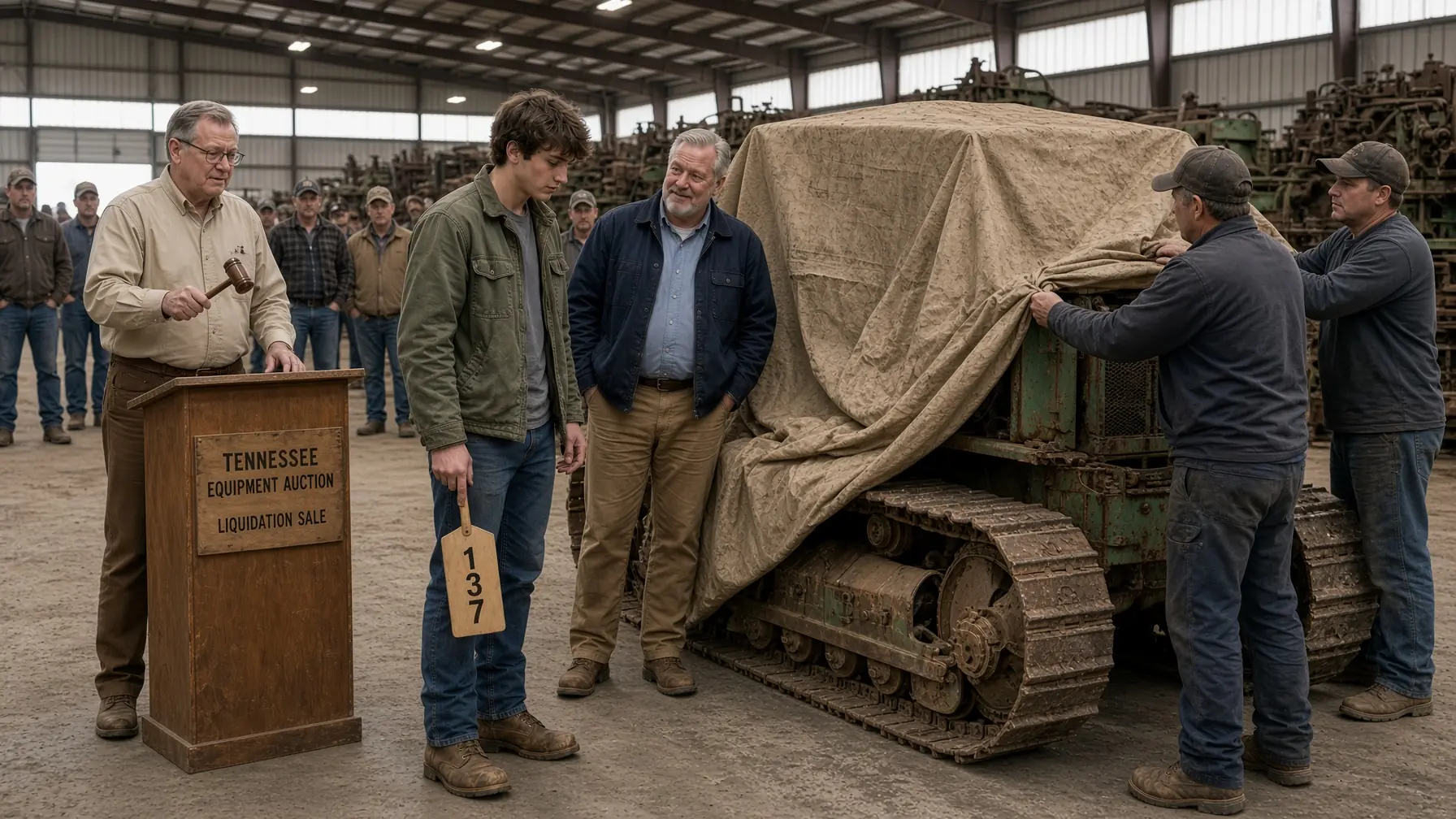
He was eighteen, standing among equipment dealers who could glance at a machine and estimate its resale value before he finished reading the auction sheet. His boots were stained with oil. His faded work jacket had a small tear near one pocket.
He had less than seven thousand dollars in the bank.
The garage his father had left behind carried $23,800 in debt.
Then two workers pulled the tarp off Lot 64.
The crawler tractor beneath it looked worse than the photograph.
Rust covered most of the surviving green paint. Cracked hydraulic lines hung against the frame. Part of a side panel was missing, and the tracks looked as though they had settled permanently into the concrete.
The auction sheet offered little comfort.
Prototype crawler tractor. Non-running. Condition unknown.
Landon walked a few steps closer.
He was not looking at the paint.
He crouched enough to see beneath the frame, then shifted sideways to examine the central transmission housing. The cover was still in place. He saw no torch marks, no evidence that someone had cut into the assembly to remove whatever remained useful.
That mattered.
It did not tell him the transmission was sound. It told him there might still be something inside worth understanding.
The auctioneer opened at $3,200.
Gordon Vale raised his hand.
Landon knew who he was. Most people around Millstone Ridge knew Gordon, or at least knew someone who had bought equipment through him. He dealt in machinery, salvage, and the practical difference between what an owner hoped a machine was worth and what someone would actually pay.
At that price, Gordon did not need the crawler to run.
There was steel, tracks, hydraulic hardware, and perhaps an engine block worth recovering.
Landon raised his paddle.
“Four thousand.”
Gordon turned.
His eyes moved from the paddle to Landon’s face.
Then his hand went up again.
“Forty-seven.”
Landon’s mouth felt dry.
“Fifty-three.”
Now the men nearest them were paying attention.
Gordon raised the bid to $5,900.
Landon looked at the closed housing again.
Two nights earlier, drawings had covered the kitchen table: old engineering notes, patent illustrations, incomplete technical descriptions. He had traced the same force path until the paper became gray beneath his pencil.
He could be wrong.
The thought was present and clear.
He was not bidding because he had forgotten it.
The auctioneer called for $6,200. Gordon remained willing to go higher.
Then he looked directly at Landon.
“Boy. You’re buying scrap.”
There was no particular cruelty in his voice.
That made it worse.
Gordon meant it as a fact.
Landon thought about his mother leaving for work before daylight. He thought about the parts bills waiting in the garage and customers who still asked for his father before remembering.
Then he raised his paddle.
“Six thousand five hundred.”
Gordon lowered his hand.
The auctioneer waited.
Landon could hear somebody shift behind him.
Going once.
He looked at the machine.
Twice.
His stomach tightened.
The hammer came down.
A few men applauded with exaggerated enthusiasm. Someone laughed. Gordon shook his head and started toward the next part of the warehouse.