Sheriff Thomas Ryker slipped two fingers through the chain between Sarah Reynolds’s handcuffs and pulled her toward him.
“Pretty little thing like you should’ve learned when to shut your mouth.”
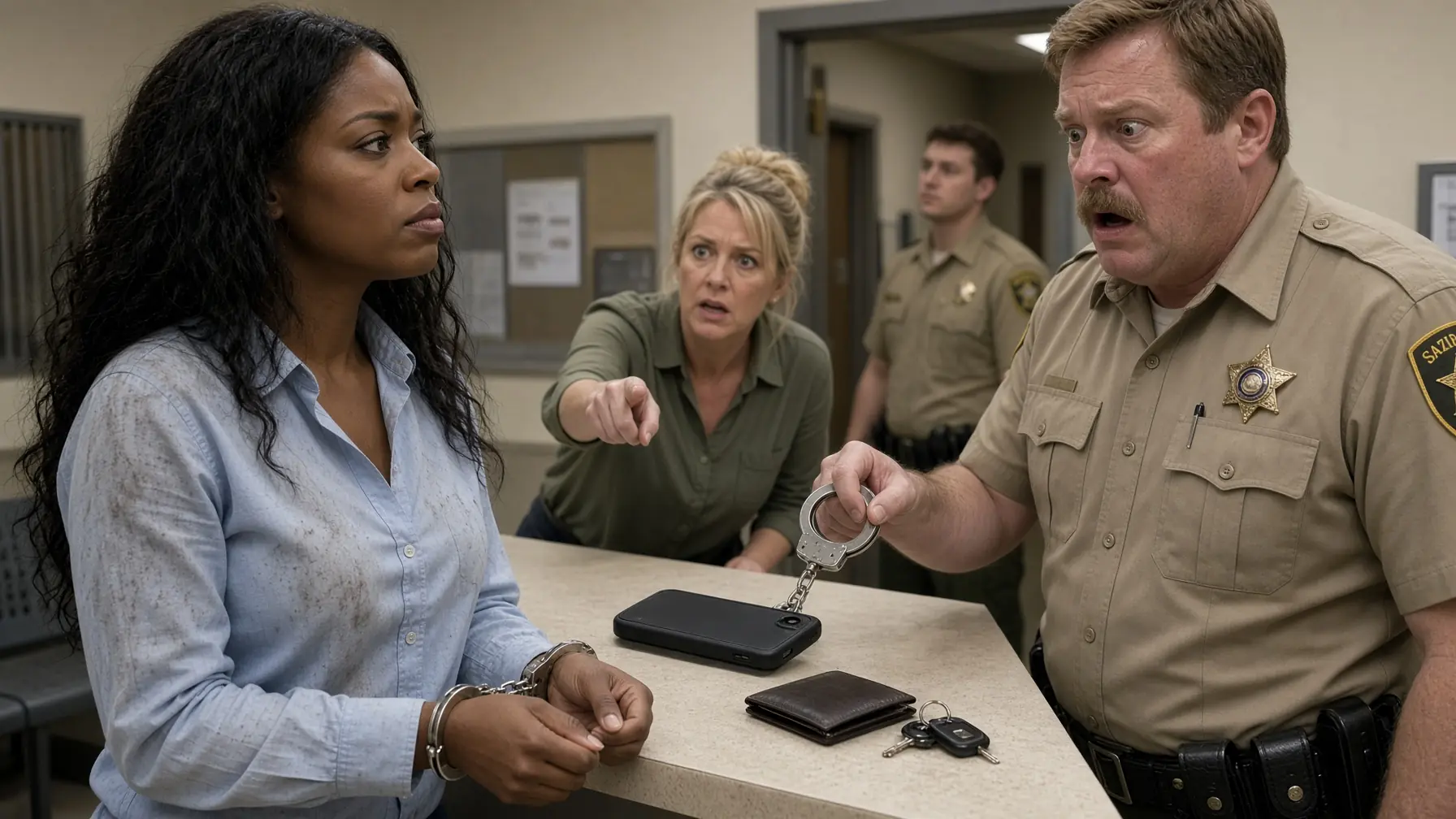
Sarah planted her feet. Across the booking counter, Brenda Lawson’s fingers stopped above the keyboard, but neither she nor the young deputy beside the hallway said a word.
“Take your hands off me,” Sarah said.
Ryker smiled and jerked the chain again. Sarah lost her footing, struck the counter’s edge with her upper body, and caught herself before her knees could give way.
“I can make ‘resisting’ mean whatever the hell I want in here.”
The overhead lights showed everything: his fingers in the chain, her struggle to straighten, the way Deputy Jared Miller turned his face toward an empty hallway. Sarah wondered how many people had stood beneath those lights waiting for someone else to acknowledge what was happening.
She lifted her eyes.
“I think you’ve gotten used to nobody making you pay for it.”
Ryker’s smile disappeared.
Before he could answer, the thick black phone beside her wallet vibrated against the counter. Brenda looked down, and the color left her face.
An hour earlier, Sarah had wanted coffee.
She stopped outside Pine Creek, Georgia, because her fuel gauge was low and the little convenience store beside the pumps had a handwritten sign promising fresh coffee. She had spent the morning driving through northern Georgia, answering messages only when parked and watching the time without treating every delay as an emergency.
She was thirty-five, with deep-brown skin and long black hair falling in loose waves over a fitted pale blue blouse. Dust from the roadside would later mark its collar and sleeves, but when she stepped out of the black SUV, her only concern was whether the store’s promise was believable.
She finished fueling and checked a route on her phone.
That was when the patrol car slowed.
Sarah noticed the deputy’s attention move from the SUV to her, then back to the SUV. He parked two spaces away, climbed out, and approached with the fixed purpose of somebody who had already decided the interaction would require compliance.
“Ma’am. License and registration.”
She lowered the phone.
“What’s the reason?”
“This your vehicle?”
“Yes.”
“Then show me the registration.”
Sarah looked toward the pump, the switched-off engine, and the receipt still between her fingers. She had not been pulled over; she was standing beside a parked vehicle on private business property.
“What traffic violation did you observe?”
“I didn’t say it was a traffic violation.”
“Then why are you asking for identification?”
The deputy’s nameplate read Miller. He looked young, although old enough to know that the question was not the same as a threat.
“Vehicles like this aren’t exactly common around here.”
Sarah almost smiled.
“That doesn’t explain why you need my documents.”
His cheeks reddened.
“Just give them to me.”
“Am I being detained?”
He glanced toward the store.
Two customers stood near the entrance, and a woman inside was watching through the glass. Sarah could see Miller noticing the audience and becoming less willing to admit that he had begun without an answer.
“I’m asking a simple question,” he said.
“So am I.”
He reached for his radio.
Sarah kept both hands visible.
She had learned that a person could be calm and still be described as argumentative, could ask for a reason and later find the question translated into hostility. Keeping her voice low would not prevent dishonesty, but it would give the recordings something clear to preserve.
Miller called his sheriff.
The wait lasted ten minutes.
During that time, Sarah considered simply handing over everything and ending the encounter. She had places to be, and the people she expected to meet would understand a delay less readily than she understood the deputy’s embarrassment.
Then she looked at the two customers pretending not to watch.
She thought about the difference between being able to leave an uncomfortable encounter and having the encounter end lawfully. The distinction mattered to her, but she also knew she was choosing to remain inside a situation whose risks were increasing.
“Deputy,” she said, “if you’re not detaining me, I would like to leave.”
“Wait for the sheriff.”
“Then please document that you’ve told me I can’t leave.”
He did not answer.
Thomas Ryker arrived already irritated.
He was forty-eight, broad through the shoulders, with weathered pale skin, sandy-brown hair, and a thick mustache. His gold star shone against the tan uniform as he stepped from his patrol SUV.
He spoke briefly to Miller, then approached Sarah.
“This vehicle yours?”
“Yes.”
“Prove it.”
She studied his face and decided she would provide the documents while making the limits of her cooperation clear. She told him where they were, moved slowly, and handed over her license, registration, and insurance.
Ryker examined them.
The SUV belonged to her. The registration and insurance were current, her license was valid, and the records check produced no warrant or stolen-vehicle report.
Miller looked toward his sheriff.
Sarah expected the papers to come back with a grudging instruction to move along. Instead, Ryker handed them over and said, “Open the trunk.”
“No.”