Steam curled toward the rafters of the timber cookhouse as Adeline Mercer lowered a long iron ladle into the bubbling cauldron. Chunks of beef, potatoes, carrots, onions, and wild herbs rolled through the rich broth, filling the room with a warmth the Double M Ranch had not known in months. Golden biscuits covered two blackened baking trays beside her, while three apple pies cooled beneath the western window. Behind her, eight hungry ranch hands stood shoulder to shoulder, hats held against their chests, waiting in a silence more respectful than any church service.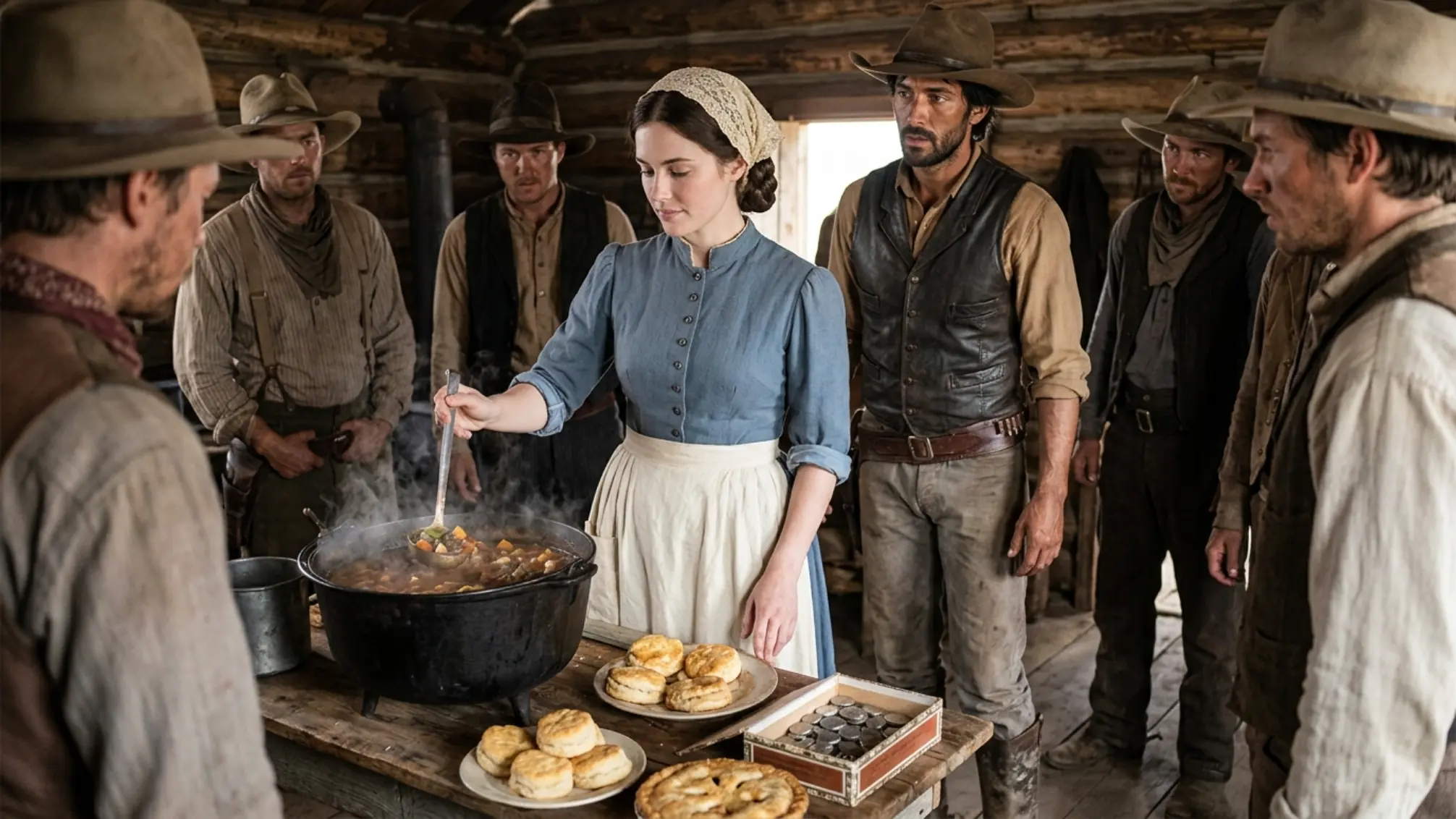
Adeline was twenty-four, fair-skinned and delicate-featured, with soft hazel eyes and dark-brown hair gathered into a braided bun beneath a cream lace covering. She wore a dusty-blue frontier dress with its sleeves rolled to her elbows, an ivory apron tied firmly around her narrow waist, and worn leather boots dusted with flour. Directly behind her stood her husband, Caleb Mercer, a thirty-one-year-old rancher with sun-bronzed skin, dark eyes, tousled black hair, and a short beard. His weathered hat sat low over an expression that had changed from disbelief to something dangerously close to hope.
Caleb’s fingers closed carefully around hers. The gesture was small, almost hidden by the steam and the men crowding around the table, but Adeline felt the tremor in his hand. He had spent the previous year pretending he could carry every burden alone: the failing cattle, the unpaid feed merchant, the damaged northern fence, and the mortgage notice locked inside his desk. Now the woman he had feared would become another responsibility was standing beside him as though his troubles had belonged to both of them from the moment she stepped off the train.
Only six weeks earlier, nearly everyone in Cheyenne had believed Caleb Mercer had made the greatest mistake of his life.
His decision to advertise for a wife had not been romantic. The Double M sat thirty miles from town, isolated by open grassland, bitter winds, and a road that became nearly impassable after heavy snow. Caleb had inherited the ranch from his father, along with its debts, deteriorating buildings, and twelve men who depended on him for wages. After years of returning each night to a silent house and an empty kitchen, he wrote a short advertisement asking for a practical woman willing to share an honest but difficult frontier life.
Adeline Whitmore answered from Pennsylvania.
Her letter was written in neat, graceful handwriting. She described herself as healthy, hardworking, familiar with household management, and willing to endure discomfort if treated with respect. She did not ask about Caleb’s acreage, income, or social standing. Her only questions concerned whether the house had enough sunlight for a kitchen garden and whether there were children nearby who needed teaching.
Caleb should have recognized strength in those questions.
Instead, when Adeline stepped from the train wearing a clean blue traveling dress and carrying one modest trunk, he saw how small she looked against the endless Wyoming sky. Her hands were smooth. Her speech was gentle. She thanked the porter and smiled at strangers with a softness that seemed entirely unsuited to a country where winter killed cattle and loneliness changed men.
The whispers began before Caleb had secured her trunk to the wagon.
Mrs. Talbot from the general store said the first blizzard would send Adeline back east. Two cattle buyers laughed that Caleb had ordered himself a porcelain doll when he needed a ranch cook. Even Ruth Bell, the kindly postmistress, privately asked whether the young woman understood what she had agreed to.
Adeline heard more than anyone realized.
She sat beside Caleb during the long wagon ride, gloved hands folded in her lap while the town disappeared behind them. Wind moved across the yellow grass, and mountains rose like a dark promise along the western horizon. Caleb tried several times to explain how difficult the ranch had become, but shame repeatedly stopped him before he reached the truth.
“You may find the house rougher than you expected,” he finally said.
“I expected a frontier house.”
“The winters are severe.”
“I brought wool.”
“The ranch keeps everyone busy.”
“I did not travel this far to remain idle.”
Her answers were calm, but they did not reassure him. Caleb assumed she simply did not understand. He would later remember that assumption with regret, because Adeline understood hardship better than he knew—she simply refused to greet it with fear.
Her father had owned a bakery in Lancaster County until a fire destroyed it. Adeline was seventeen when she watched her family lose their home, business, and savings in one night. Her mother fell ill the following winter, forcing Adeline to cook, clean, manage accounts, and prepare food for paying boarders while caring for two younger brothers.
She had learned that panic never kneaded dough, balanced a ledger, or kept sick people alive.
By the time the wagon reached the Double M, dusk had turned the ranch buildings into dark shapes against the plains. The bunkhouse roof sagged near the chimney. One barn door hung crooked, and several cattle stood near the corral with ribs visible beneath their hides. The main house had sturdy walls but peeling paint, cold rooms, and a kitchen that smelled of smoke, grease, and old onions.
Caleb watched Adeline absorb every detail.
“This is not what I wanted to bring you to,” he said.
She removed her gloves. “It is where you brought me.”
“You may still return with the stagecoach next week.”
Adeline turned toward him. “Do you want me to leave?”
“No.”
“Then stop offering.”
It was the first time she spoke to him with any firmness. Caleb stared at her, surprised, before a faint smile appeared beneath his beard. Adeline carried her own bag into the house.
Their wedding took place the following morning in the front room, witnessed by the ranch foreman and a circuit preacher passing through the county. Caleb’s hand shook as he placed the plain silver ring on her finger. He promised honesty, protection, and faithfulness, while privately wondering whether affection could ever grow between two strangers who had exchanged only four letters.
Adeline promised to remain beside him in abundance and scarcity.
Scarcity greeted her immediately.
The pantry contained dried beans, flour, salt pork, two onions, and a small jar of molasses. The ranch cook had left three weeks earlier after Caleb failed to pay him. Since then, the men had survived on burnt beans, hard biscuits, and meat cooked until it resembled saddle leather.
The first supper Adeline witnessed was nearly silent. The hands ate quickly, not from appetite but obligation. One older cowboy soaked his biscuit in coffee until it softened enough to chew. Another quietly slipped half his salt pork to the ranch dog beneath the table.
Adeline looked toward Caleb.
He did not meet her eyes.
The following morning, she opened every cabinet, counted every sack, and wrote an inventory on brown paper. She asked the foreman which vegetables grew nearby, whether anyone hunted, and what food could be purchased cheaply from neighboring farms. She requested permission to use an abandoned patch of ground behind the kitchen for a spring garden.
Caleb felt embarrassed by how little he could offer.
“I cannot buy fancy ingredients,” he said.
“I did not ask for any.”
“We may not have enough flour to last the month.”
“Then we will make it last.”
“You speak as if it is simple.”
Adeline looked at him over the pantry ledger. “No. I speak as if it is necessary.”
She started with broth.
Beef bones that had previously been discarded went into a large kettle with onions, dried herbs, and water. She traded two jars of molasses with a neighboring widow for carrots, potatoes, and cabbage. She rendered fat properly, saved drippings, softened beans overnight, and turned stale bread into thickening crumbs.
The first stew simmered for six hours.
Its scent reached the corrals by midafternoon.
Men began appearing at the cookhouse door under invented excuses. One needed water. Another claimed he was searching for a missing wrench. The foreman, Silas Boone, walked through twice before finally admitting he had come to ask when supper would be served.
Adeline placed bowls before them at sunset.
The bunkhouse fell silent after the first bite.
Silas finished two bowls, wiped the final broth with a biscuit, and looked at Adeline as if she had performed a miracle. “Ma’am, I haven’t tasted food like that since my mother died.”
Adeline smiled. “Then tomorrow you may tell me what she cooked.”
Within two weeks, the men changed.
They rose earlier without being called. Repairs that had remained unfinished for months were completed. Arguments became less frequent, and nobody disappeared into town after payday to avoid another miserable supper. Adeline packed food for riders working distant fences, prepared jars of hot coffee for night watch, and kept a plate warm whenever Caleb returned late.
Caleb watched the ranch become steadier around her.
Yet food alone could not erase the debt.
One evening, Adeline entered his office carrying a cup of coffee and found him asleep over the desk. Beneath his arm lay a notice from the Cheyenne Cattle Bank. Unless Caleb paid eight hundred dollars within sixty days, the bank would begin foreclosure proceedings.
Adeline read the amount twice.
Caleb woke and immediately covered the paper. “You should not have seen that.”
“I am your wife.”
“That does not mean you must carry my failures.”
“It means they are no longer yours alone.”
He stood abruptly. “This ranch was failing before you came.”
“And?”
“And I will not let it swallow your future.”
Adeline looked around the office at the old maps, worn account books, and photograph of Caleb’s parents standing beside the original cabin. “You believe leaving would save me. It would only teach me that your promises disappear when life becomes difficult.”
His anger vanished.
“I am afraid,” he admitted.
“So am I.”
“You do not look afraid.”
“I have discovered looking frightened rarely improves the situation.”
The next morning, Adeline accompanied Silas into town for supplies. Along the road, they passed a railroad grading camp spread across a wide stretch of valley nearly ten miles from the ranch. Hundreds of laborers worked with picks, shovels, wagons, and blasting equipment, carving a path through the Wyoming earth.
At noon, the workers gathered around rough cook fires. Their meals consisted mostly of thin beans, cold bread, and watery coffee. Adeline watched one man throw his bowl aside in disgust and purchase a bruised apple from a passing peddler for an outrageous price.
“How long will the camp remain?” she asked.
“Most of the year,” Silas said. “Maybe longer if winter catches them.”
“Are they paid regularly?”
“Every Saturday.”
Adeline looked back until the camp disappeared.
That night, she calculated flour, beef, vegetables, firewood, wagon distance, and potential meal prices. She wrote every number carefully and checked it twice. Caleb found her at the kitchen table after midnight with flour on her cheek and the bank notice beside her.
“What are you doing?”
“Finding eight hundred dollars.”
He read the plan.
“You want to sell food at the railroad camp?”
“Yes.”
“The road is rough.”
“We own a wagon.”
“You cannot feed hundreds of men.”
“I will begin with forty.”
“They may not buy anything.”
“Then the ranch hands will eat well for three days.”
Caleb sat across from her. “Adeline, you are already working from before sunrise until after supper.”
“So are you.”
“This is different.”
“Because I am your wife?”
“Because I care what happens to you.”
She reached across the table and touched his hand. “Then help me.”
Before dawn, Adeline packed two kettles of stew, four baskets of biscuits, and six cinnamon-apple pies into the ranch wagon. Caleb drove while Silas secured the containers against the rough road. The air was cold enough to sting their faces, and twice Caleb suggested turning back.
Adeline refused.
When they reached the grading camp, workers barely glanced at them. Then Caleb removed the first kettle lid. The smell of beef broth, herbs, and roasted vegetables traveled across the worksite.
Within minutes, a line formed.
Adeline charged twenty cents for a large bowl with two biscuits. Pie cost another nickel. The first worker ate beside the wagon, then immediately returned to purchase food for two companions.
By noon, every container was empty.
The cigar box held twenty-six dollars and seventy cents.
Caleb counted it three times.
The next morning, twice as many workers waited. Adeline increased the food without reducing quality. She hired the ranch hands’ wives to help bake, paid them fairly, and kept exact records of every ingredient and sale.
Within three weeks, the wagon earned more than the ranch’s cattle operation.
Bills disappeared one by one.
The feed merchant received full payment. The northern fence was rebuilt. Caleb purchased enough grain to restore weight to the weakest animals, and the men finally received every dollar of delayed wages.
Hope returned to the Double M, but so did laughter from town.
People who once mocked Adeline now arrived asking whether she had extra pies. Mrs. Talbot ordered six biscuits for a church supper and pretended she had never predicted the bride would flee before winter. Caleb said nothing, but Adeline noticed the satisfaction in his eyes whenever townspeople praised her food.
Their marriage changed quietly.
Caleb began returning earlier to help wash kettles. Adeline waited for him on the porch after long rides, often holding two cups of coffee. They spoke of childhoods, grief, and the lives they had imagined before necessity redirected them.
One evening, Caleb found her asleep at the kitchen table beside a stack of orders. He lifted her carefully and carried her toward the bedroom. Adeline woke against his chest.
“You will hurt your back.”
“I carry feed sacks heavier than you.”
“That is not romantic.”
“I have little experience.”
She smiled sleepily. “You are improving.”
He stopped beside the bedroom door.
“Adeline, I did not marry you because I loved you.”
“I know.”
“I thought I needed someone practical.”
“I know that too.”
His expression tightened. “But I wait all day to hear your voice now.”
Her smile faded into tenderness.
Caleb continued before courage failed him. “When I imagine losing this ranch, I feel afraid. When I imagine losing you, I cannot breathe.”
Adeline touched his cheek. “Then perhaps we have both received more than we requested.”
He kissed her gently, as if asking a question.
She answered by drawing him closer.
Their happiness lasted until the railroad representatives arrived.
A polished coach entered the grading camp one crisp October morning while nearly two hundred workers waited around Adeline’s wagon. Three men stepped down wearing dark coats, clean boots, and expressions that suggested the dust itself had offended them.
The senior official introduced himself as Mr. Cornelius Vane, regional operations director for the Continental Western Railroad. He examined the kettles, tables, workers, and cigar box without tasting a single bite.
“You have built an impressive enterprise,” he told Adeline.
“Thank you.”
“On railroad property.”
“The camp superintendent granted permission.”
“He lacked authority.”
Caleb stepped beside her. “What do you want?”
Vane ignored him.
“The company will assume control of food services beginning Monday,” he said. “Mrs. Mercer may remain as kitchen supervisor. We will purchase her recipes, equipment, and customer list for one hundred dollars.”
The workers stopped eating.
Adeline slowly lowered her ladle.
“My recipes are not for sale.”
Vane smiled. “You misunderstand. This is not truly a negotiation.”
Caleb moved forward, but Adeline caught his sleeve.
Vane continued. “Without company authorization, your wagon will be denied entry. If you resist, we will bring an action for trespass and recover profits earned on railroad land.”
“You invited no food seller here,” Adeline said. “You provided meals so poor that workers paid from their own wages to avoid them.”
“That is irrelevant.”
“Not to the men doing your work.”
Vane stepped closer. “You are a rancher’s wife with a cooking pot. Do not mistake temporary popularity for power.”
Adeline met his gaze.
Caleb felt her hand release his sleeve. For one terrible moment, he feared she would surrender to protect the ranch from legal costs.
Instead, she lifted her chin.
“You may own the rails,” she said, “but you do not own hungry men.”
Vane’s smile vanished.
Adeline turned toward the workers. “Tomorrow, our wagon will serve from the county road beyond the camp boundary. Any man may purchase food there during his legal meal break.”
A murmur of approval moved through the crowd.
Vane pointed at Caleb. “If that wagon obstructs company operations, I will have it seized.”
Caleb stepped between him and Adeline. “Touch my wife’s wagon and you will answer before the county judge.”
“You cannot afford a lawyer.”
“No,” Caleb said. “But five hundred railroad workers can afford witnesses.”
Vane left with a promise to return.
The following morning, Adeline positioned the wagon on public land beside the county road. The railroad shortened meal breaks to prevent workers from reaching it. In response, men refused to resume grading until their full break was restored.
By afternoon, construction had stopped.
The superintendent begged Vane to compromise. Every delayed hour cost the company more than Adeline earned in a month. Newspapers in Cheyenne heard about the dispute, and a reporter published a story describing how Continental Western attempted to seize a ranch woman’s food business after failing to feed its own laborers.
Public anger spread.
The county judge reviewed Adeline’s permits and confirmed she had violated no law. The railroad could control its land, but not the county road or workers’ personal purchases during lawful breaks.
Three days later, Vane returned without the polished coach.
He carried a written contract.
Continental Western offered Adeline exclusive rights to provide meals at three grading camps for one year. The company would supply transportation, storage space, and guaranteed daily payment. Adeline retained ownership of all recipes, equipment, and profits from additional sales.
Caleb read the document carefully.
“This could save the ranch permanently,” he whispered.
Adeline looked at Vane. “One more condition.”
His jaw tightened. “What?”
“Every camp worker receives one hot meal daily whether he has money in his pocket or not. The company pays.”
Vane looked toward the idle grading crews.
“Agreed.”
By the first snowfall, the Double M’s mortgage had been paid in full.
Adeline hired six local women, including two widows and a rancher’s daughter supporting younger siblings. A new cookhouse rose beside the original one, and the food business became known across the county as Mercer’s Frontier Table.
The cattle recovered.
The ranch hands stayed.
On a cold December evening, Caleb led Adeline outside after supper. Snow covered the plains, and lantern light glowed from every window of the ranch house and bunkhouse. The buildings no longer looked like failing shadows beneath the mountains.
Caleb handed her a folded paper.
It was the original marriage advertisement.
“I found it in my desk,” he said. “I wrote that I wanted a practical wife of sound character.”
Adeline laughed. “A remarkably passionate request.”
“I was an idiot.”
“You were lonely.”
“I thought I was asking someone to join my life.” He stepped closer. “I did not understand you would teach me how to live it.”
She looked toward the warm cookhouse, where men laughed over the final biscuits of the evening.
“You gave me a home.”
“You saved it.”
“We saved it.”
Caleb took her hands. “Then let me say this correctly. I love you, Adeline Mercer. Not because you paid the debts, fed the men, or proved this entire county wrong. I love you because when you saw me drowning, you did not shame me for sinking. You stepped into the water beside me.”
Tears brightened her hazel eyes.
“I love you too,” she whispered. “Even though you once believed I could not boil water.”
“I never said that.”
“You thought it loudly.”
Caleb laughed and drew her against him.
Behind them stood the ranch everyone had expected to fail. Before them stretched a future neither had dared imagine when a quiet bride stepped from a train beneath the Wyoming sky.
Adeline had arrived with one trunk, a gentle voice, and no fortune beyond what she knew how to create with her hands. She had not conquered the frontier through force, wealth, or inherited power.
She had offered hungry people a place at her table.
And in feeding them, she gave an entire ranch something no bank could lend and no railroad could seize.
She gave it hope.