The Single Dad stared at the folded paper beside his empty plate while twelve ranch hands watched from both sides of the scarred wooden table. Steam rose from platters crowded with crisp bacon, scrambled eggs, and biscuits made from nearly every remaining sack of flour in the pantry. His beautiful new wife stood at the head of the table in a burgundy frontier dress and cream apron, her chin lifted even as the entire bunkhouse waited for him to condemn her. Outside, Wyoming wind battered the walls of the ranch he had inherited, mortgaged, and nearly lost.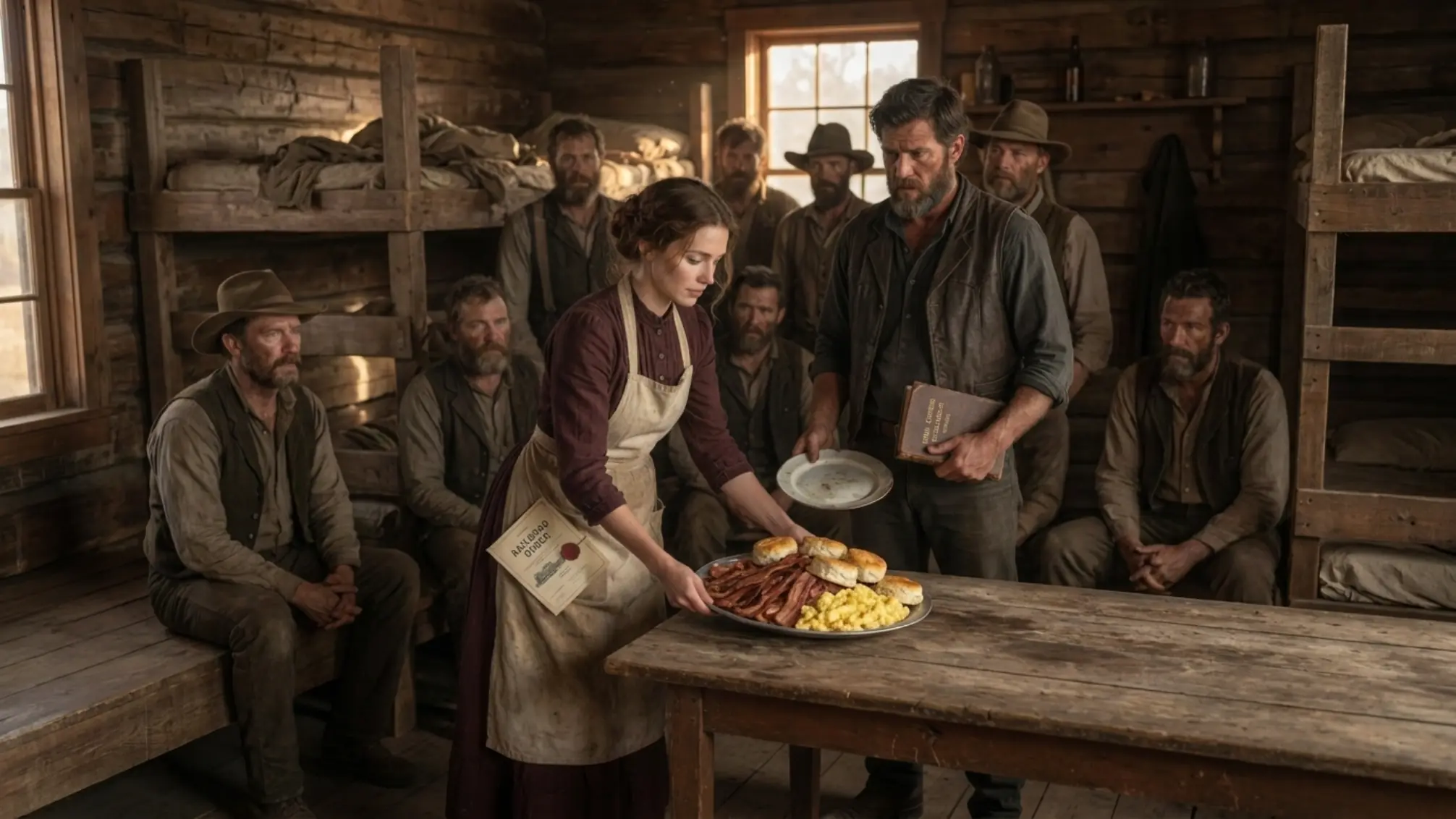
The Single Dad was a handsome forty-year-old American ranch owner with a tall powerful build, dark hair, a full beard, and the tired blue eyes of a man who had spent two years pretending fear was discipline. His first wife had died during a winter illness, leaving him to raise their eight-year-old son while managing twelve ranch hands and a herd too thin to cover the spring bank payment. He had answered a marriage advertisement because the ranch needed a cook, his son needed care, and the house had become too quiet. Love had not been part of the arrangement.
The Woman had arrived three weeks earlier from Nebraska with one trunk, a marriage contract, and the kind of calm confidence that made suspicious men uncomfortable. She was a beautiful twenty-nine-year-old American woman with clear fair skin, expressive hazel eyes, and chestnut hair usually pinned into a loose bun. Her letters had promised that she could manage a household, keep accounts, and prepare simple meals. They had not explained that she had spent six years helping her widowed mother operate a boardinghouse beside a busy freight depot.
Her first supper at the ranch had almost ended the marriage before it began.
The stove smoked badly, the beans scorched, and the biscuits came out hard enough to crack against a tin plate. One ranch hand joked that the Single Dad had ordered a wife and received a threat to human teeth. The others laughed, including the Single Dad’s young son, who tried to hide his smile behind a cup. The Woman had apologized, studied the unfamiliar cast-iron stove, and quietly asked why the chimney had not been cleaned in years.
The Single Dad had taken the failed meal as proof that desperation had made him foolish. He had expected a practical frontier wife who would restore order to his home, not an elegant woman who inspected ledgers and asked why half the pantry shelves leaned toward the floor. Yet the next morning, the stove drew cleanly after she removed a nest of soot and ash from the pipe. Her biscuits rose, the coffee tasted fresh, and the eggs arrived hot enough to silence every man at the table.
He did not apologize for doubting her.
Instead, he told himself one successful breakfast proved little.
The Woman said nothing about his silence. She spent the next week cooking, cleaning, and watching the rhythms of the ranch. She noticed that the hands ate quickly because they expected food to run out, that the Single Dad’s son slipped biscuits into his pockets for later, and that the ranch owner counted every slice of salt pork before placing it on the table. She also noticed an unpaid ledger hidden beneath a pile of feed receipts.
The figures were worse than the sagging barn and empty pantry suggested. The ranch owed the bank more money than the cattle could earn at current prices. Two winters of losses had consumed nearly every reserve, and the spring payment was six weeks away. If the Single Dad failed to pay, the bank would take the house, the herd, and the land his son was supposed to inherit.
The Woman found another entry near the back of the ledger.
A railroad grading camp had opened eleven miles north of the ranch. Nearly fifty men worked there from before sunrise until dark, but the company had not hired a permanent cook. The Single Dad had written that the foreman paid high prices for whatever food traveling merchants brought through, then crossed out the note and added two words.
Too far.
The Woman read those words three times.
Eleven miles was too far for a tired rancher focused on cattle, but it was not too far for a food wagon carrying hot meals to men with money in their pockets. She calculated the cost of beef, flour, coffee, dried apples, firewood, and wagon fuel. Even after wages and supplies, a single successful delivery could earn more than the ranch made selling one steer.
She presented the idea to the Single Dad after supper.
He rejected it before she finished.
“I married for a wife and a cook,” he said. “Not a merchant.”
“A cook prepares food,” she answered. “A merchant makes certain someone pays for it.”
“My men already think this marriage was a mistake.”
“Then let them think it while they eat.”
His face hardened. Pride had become the last piece of property he believed no bank could seize. “I will not have my wife driving into a camp full of railroad men and selling plates from a wagon.”
The Woman looked toward his son, asleep beside the stove with a schoolbook open across his chest. “Would you rather explain to him why the bank owns his home?”
The question ended the conversation, but it did not produce permission.
For two days, she waited. She continued feeding the ranch hands and measuring everything that disappeared from the pantry. She discovered that flour spoiled because sacks were stored against damp walls, coffee arrived stale because no one negotiated freight costs, and cuts of beef suitable for stew were discarded or fed to dogs. The ranch was not merely poor; it was bleeding through a hundred small wounds no one had time to notice.
On the third night, she found the Single Dad alone at the table with the bank notice in his hands.
His son had asked that afternoon whether they would still live at the ranch by Christmas. The Single Dad had lied and said yes. Now he sat beneath the lamp looking like a man ashamed that love had not made his answer true.
“Give me one wagon,” the Woman said. “One day, one camp, and enough food for forty plates.”
“If it fails, the men lose two days of supplies.”
“If we do nothing, they lose the ranch.”
He closed his eyes. “And if those railroad men treat you badly?”
“Then I return home knowing they refused my food. I will not return wondering whether fear cost your son his future.”
The Single Dad looked at her for a long time before nodding. He assigned the youngest ranch hand to drive the wagon and warned him not to leave her alone. He also made the Woman promise that she would return before nightfall, whether she sold one plate or forty.
She rose before dawn on Thursday.
By sunrise, the wagon held kettles of beef stew, baskets of biscuits, pans of fried potatoes, and small apple pies wrapped in cloth. The Woman had repaired an old iron stove and secured it inside the wagon so the food remained hot during the journey. She wrote each cost in a notebook, then placed an empty cigar box beside the driver to hold payments.
The railroad camp appeared across the prairie shortly before noon. Men moved through dirt and smoke, grading the earth for a line that would eventually cross the territory. The American Railroad Foreman approached with suspicion, his coat dusty and his expression hardened by merchants who charged high prices for poor supplies. He asked whether the ranch had sent charity.
The Woman smiled. “No. I brought lunch.”
“We have beans.”
“You have men who are tired of beans.”
He looked inside the wagon, and the smell of beef, onions, coffee, and fresh biscuits did what persuasion could not. Still, he refused to commit company money without proof. The Woman placed a free plate in his hands and told him to finish it before deciding.
He ate standing beside the wagon.
When he finished, he asked the price.
The Woman named a figure lower than traveling merchants charged but high enough to protect her profit. The Railroad Foreman negotiated a reduced rate if the company paid for forty meals at once. She countered with a slightly higher price that included coffee and a pie every Friday.
They shook hands.
The grading crew emptied both kettles in less than an hour.
Some men purchased second plates with their own coins. Others paid in advance for the next delivery. One exhausted worker stared at his biscuit and quietly said it tasted like something his mother used to make in Ohio.
The Woman did not return with leftover food.
She returned with an empty wagon, an overflowing cigar box, and a written order signed by the Railroad Foreman.
That was the contract she placed beside the Single Dad during the crowded ranch breakfast.
He unfolded it slowly. The paper guaranteed forty lunches three days a week for one month, with the possibility of daily service if the meals improved productivity. The first payment was due in advance.
The ranch hands stopped eating.
The Single Dad counted the deposit twice. It equaled nearly three weeks of ordinary ranch income. His son leaned over the table and asked whether it meant the bank would let them keep the house.
“Not yet,” the Woman said. “But it means we can fight.”
The Single Dad lifted his eyes to her. For the first time since she arrived, he did not see a stranger hired to occupy his late wife’s kitchen. He saw the person who had found opportunity inside the same ledger that had shown him only defeat.
The railroad orders grew quickly.
The Woman delivered three lunches the following week, then five. She added breakfast after the Foreman reported that men began work faster when they knew hot food waited nearby. She hired an American Widow from town to bake pies and asked an aging ranch hand with a damaged back to help manage the stove instead of riding cattle.
The bunkhouse kitchen became a small production center. Flour sacks were raised from the damp floor. Beef scraps became stew, old apples became pies, and stale coffee was roasted again before brewing. Nothing disappeared without being counted.
The Single Dad helped modify a second wagon.
At first, he called it temporary work. Then he began asking what she needed before she requested it. He built shelves, reinforced the stove, and designed a rack that kept kettles steady over rough ground. His son painted a sign across the wagon in uneven white letters.
HARTLEY RANCH MEALS.
The ranch hands who had mocked the Woman now competed to load her supplies.
One afternoon, the man who had joked about her first biscuits removed his hat and apologized. His American sister was a widow with two children and no reliable income. He asked whether the Woman might need another baker.
“Send for her,” the Woman said. “A kitchen that earns money should feed more than customers.”
Within two months, the ranch employed three widows, two older ranch hands, and the young driver. The railroad crews worked farther west, and the meal wagons followed. Foremen began scheduling breaks around their arrival.
The numbers in the ledger changed from red to black.
The Single Dad paid his ranch hands on time for the first time in nearly two years. He repaired the barn roof and purchased medicine for an injured horse without borrowing money. More importantly, he stopped hiding bank notices from his son.
Each evening, the Woman and the Single Dad sat together at the long table. He reviewed cattle expenses while she calculated food contracts. Their marriage slowly became something neither agreement had promised.
He learned that she had once dreamed of opening her own boardinghouse. Her mother’s illness had consumed their savings, and after the funeral she had answered the marriage advertisement because she possessed skills but no property. The ranch had not rescued her from helplessness. It had given her a place where her ability could finally become visible.
She learned that the Single Dad’s coldness came from grief rather than contempt. His first wife had been kind and gentle, and he still carried guilt for surviving the winter that took her. He feared loving another woman would betray the dead, while trusting her with the ranch might endanger the living.
One evening, he stood in the kitchen doorway while she revised a delivery schedule.
“I thought I needed someone who could cook,” he said.
“You did.”
“I did not understand that a kitchen could become the strongest part of the ranch.”
“Most men only notice a kitchen when the food is late.”
He smiled. “I noticed you.”
It was not a declaration of love, but it was the first time his voice held something beyond obligation.
Their progress soon attracted the wrong kind of attention.
A wealthy American Railroad Contracts Manager arrived in a polished black carriage. He wore an expensive coat untouched by prairie dust and examined the ranch as though he had already purchased it. He praised the food operation, then informed the Woman that she had been selling on railroad property without a permanent corporate contract.
He offered to buy the wagons, recipes, equipment, and supply agreements for a fraction of their monthly profit.
The Woman refused.
His smile cooled. “You misunderstand your position. The railroad owns the camps. One order from me, and no foreman may purchase another plate.”
“Your men work better because we feed them.”
“Which is why the company wants control.”
“You want profit without building the operation.”
“I want obedience from someone using our property.”
The Single Dad stepped forward, but the Woman raised one hand. She did not need him to fight the negotiation for her.
The Contracts Manager gave her three days to accept. If she refused, the company would ban both meal wagons from every camp on the line.
The order came the next morning.
The Railroad Foreman rode to the ranch personally. He apologized, but his job depended on following company rules. The crews were furious, yet none of them could purchase food during company hours.
The Woman now had two wagons loaded with meals, several employees expecting wages, and no customers.
The Contracts Manager returned with a second offer. This one included more money but required her to sign a permanent agreement promising never to operate another food business near any railroad. He wanted not only her wagons but her future.
The Single Dad considered accepting.
The money would pay the bank and protect the ranch. It would also end the risk that had consumed their lives for months.
The Woman read the contract and placed it on the stove.
“If we take this, we save the land but surrender the business that made saving it possible.”
“We could return to cattle.”
“To the same cattle that nearly lost everything?”
“What choice do we have?”
She looked toward his son, who was helping one of the widows package biscuits no railroad worker was allowed to buy. “A choice no one has shown us yet.”
That night, she studied old newspapers used to wrap supplies. One article described a competing American railroad company building a southern route forty miles away. Its crews were racing to complete enough track to secure federal land rights before winter.
Those workers would be hungry too.
The Woman wrote a proposal outlining food costs, improved productivity, reduced illness, and the number of additional working hours recorded after the first railroad camp began receiving hot meals. She did not describe herself as a cook. She described Hartley Ranch Meals as a mobile workforce provisioning company.
The young driver carried the proposal south before dawn.
The Contracts Manager arrived on the third day expecting surrender.
The road behind him remained empty. No messenger had returned from the competing railroad. The ranch pantry held food that would soon spoil, and the employees waited without knowing whether wages still existed.
“Sign,” the Contracts Manager said. “You have already lost.”
The Single Dad stood beside the Woman on the porch. Months earlier, he would have taken the safe offer, delayed ruin, and called fear responsibility. Now he looked at his wife and asked one question.
“What does your judgment say?”
“That signing saves us for a season and destroys what could save us for years.”
He nodded. “Then we do not sign.”
The Contracts Manager stared at him. “You would gamble your son’s home on her pride?”
The Single Dad’s expression hardened. “I am trusting my partner’s work.”
The Woman refused the offer.
The Contracts Manager withdrew every payment and promised to make certain no railroad company hired her. His carriage disappeared down the road, leaving dust and silence behind.
An hour passed.
Then two.
The Woman sat on the porch steps, wondering whether her proposal had reached anyone with enough authority to answer. For the first time, the Single Dad saw fear break through her confidence.
He sat beside her.
“If this fails,” she whispered, “I have endangered everyone who trusted me.”
“You gave them work when no one else would.”
“That will not feed them next month.”
“No. But whatever happens, you taught this ranch to build instead of merely survive.”
He took her hand.
“I spent two years believing the safest future was one I did not hope for. You made my son believe this land could still belong to him. I will not regret that because one powerful man tried to frighten us.”
A horse appeared on the southern rise.
The young driver raced toward the ranch waving a yellow telegram. He nearly fell from the saddle before placing it in the Woman’s hands.
The competing railroad accepted her proposal.
Its provisioning director wanted six meal wagons, not two. The contract guaranteed double the previous rate, paid a portion of expansion costs in advance, and granted Hartley Ranch Meals exclusive catering rights as the line moved west.
The ranch yard erupted.
The Single Dad laughed for the first time his employees could remember. His son threw both arms around the Woman’s waist and called her “Ma” without stopping to ask permission.
She knelt and held him while tears filled her eyes.
The new Railroad Provisioning Director arrived the following Monday. She was a sharp, beautiful American widow who had spent years arguing that healthy crews laid track faster and suffered fewer injuries. She examined the Woman’s ledgers, routes, staffing plans, and supply contracts.
“You are not selling meals,” the Director said. “You are selling time.”
“Hot food keeps men working.”
“And working men complete rail lines.”
They negotiated for four hours.
The Single Dad sat beside his wife, answering questions about cattle supply, wagon construction, and the ranch’s ability to expand. He did not interrupt her or explain her ideas in simpler words for the visitor. He treated her like the business partner she had become.
When the contract was ready, the Woman signed first.
Then she passed the pen to him.
“Both names,” she said.
He signed beneath hers.
The competing railroad’s crews soon outpaced the company that had banned her wagons. When executives investigated the difference, they discovered that their Contracts Manager had deliberately destroyed a profitable arrangement to force a private buyout. He had planned to purchase the food operation cheaply through a relative’s company, then resell the services to the railroad at several times the price.
He was dismissed before autumn.
The old railroad later requested a new contract with Hartley Ranch Meals. The Woman agreed only after it accepted transparent pricing, direct agreements with local suppliers, and protection for independent businesses from coercive buyouts.
She did not seek revenge.
She demanded better terms.
By the first snow, the ranch bank debt was paid in full. The cattle herd had been rebuilt, the barn repaired, and a new well dug beside the kitchen. Six meal wagons traveled different routes each morning, carrying food prepared by widows, older workers, and ranch families who previously had no steady income.
The Single Dad’s son no longer hid biscuits in his pockets.
One winter evening, every employee gathered around the long bunkhouse table. The ranch hand who had mocked the Woman’s first meal stood and raised his tin cup.
“To the wife we thought couldn’t cook,” he said, “who now feeds every man on this ranch and half the railroad besides.”
Laughter filled the room.
The Single Dad stood next.
He looked at the beautiful woman who had entered his home under a practical marriage contract and transformed every part of it. She had repaired the pantry, challenged his fear, protected his son’s inheritance, and given struggling families work.
“I asked for a cook,” he said. “I received a wife, a partner, and the smartest person ever to read my ledger.”
The Woman raised an eyebrow. “You forgot stubborn.”
“I married that part too.”
The men laughed again, but the Single Dad did not look away from her.
Later, when the others had gone, the Woman found him beside the stove. He held the original marriage contract in one hand and the paid bank receipt in the other.
“This paper brought you here,” he said, lifting the contract. “But it never promised you would stay.”
“No.”
“I want you to stay because this is your ranch too. Not because I needed a cook. Not because my son needed a mother. Because I love the future we build when we stand together.”
The Woman stepped closer.
“I stayed long before you learned how to say that.”
He kissed her beside the stove where her first biscuits had nearly broken a ranch hand’s tooth.
Outside, snow settled across repaired roofs, full barns, and wagons waiting for morning. Inside, the ledger showed profit in every column, and the kitchen fed a household larger than either of them had imagined.
The Single Dad once believed his new wife could not cook.
He had mistaken one ruined supper for the limit of her ability, just as the railroad had mistaken a woman with an apron for someone easy to control.
She did far more than feed his ranch.
She taught everyone on it that survival was not the same as a future—and then she built them one.