The leather case had not cleared my pocket when Officer Brennan seized my arm.
That is the detail I return to, even now, whenever I try to put the afternoon in its proper order. Not the pain in my shoulder, although there was pain. Not the terrible sound of a stranger shouting about a weapon in a crowded airport. Not even the tile rushing toward my face. I return to the distance between the case and the edge of my jacket. Less than an inch. A small distance, almost nothing, and yet enough to separate what he had told me to do from the story he was about to tell everyone else.
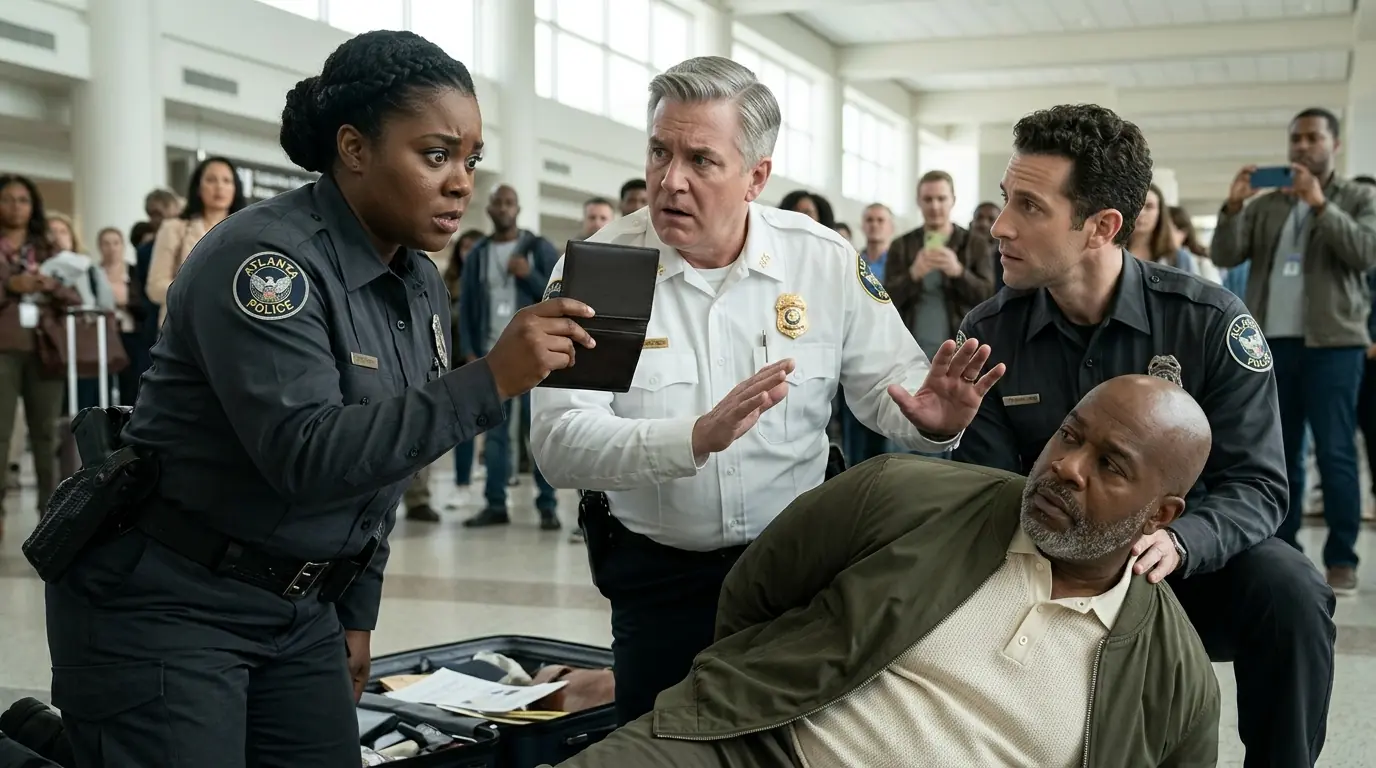
“Gun! Get down!”
For one suspended instant the words seemed to belong to a different encounter. I knew what my hand held. I knew why it was there. I knew that an officer had asked me to take it out, slowly, and that I had described the movement before making it. I had not drawn a weapon. I had not threatened anyone. But the people who turned toward that shout could not know any of those things. They heard one urgent word from a uniformed man, and the word changed the meaning of everything they saw.
My open carry-on stood beside a pillar. Conference papers lay scattered over the polished floor. A woman moved backward with both hands lifted, not in surrender exactly, but in the instinctive way people protect the space around their bodies when they think violence is coming. Somewhere nearby, a child began crying. Then Brennan pulled me off balance, and my thoughts became a collection of separate objects: the strap biting into my shoulder, a suitcase wheel turning in my peripheral vision, the white square of a fallen handout, the terrible knowledge that I was going down.
An hour earlier, I had been thinking about coffee.
That was all. Coffee, a place to sit, and whether my flight would leave on time. I had spent enough years traveling to know that the ordinary discomforts of an airport could consume an afternoon if you allowed them to. Nothing about my plans required confrontation. Nothing about the day suggested that three police officers would soon surround me beneath the bright lights of a concourse, or that I would have to measure my own breathing while a man put his weight on my back.
At fifty-four, I had learned to be careful with predictions. I had also learned that some of the worst moments begin without warning, while a person is occupied with the sort of task nobody ever remembers afterward. My task was to put a folded paper into a suitcase. I could have done it in ten seconds if the handle had not jammed. I could have kept walking if I had decided the paper was not worth saving. I could have stood on the other side of the pillar. All those alternatives would later assemble themselves in my mind, pretending to be explanations.
None of them would explain what Brennan chose to do.
Before the conference, I had almost canceled the trip. There had been a difficult week at home, not a catastrophe, but a succession of small obligations that demanded more attention than I seemed to have available. A household repair had taken two visits. A relative needed help sorting paperwork. Someone close to me had