Grant Mercer laid the contract over Noah’s field map as though the map no longer mattered.
The corner covered three weeks of handwritten notes. Beneath the signature line, a blue pencil mark disappeared—the boundary Noah had redrawn after walking that section of the farm in rain, convinced the measurements he had inherited no longer matched what the ground was telling him.
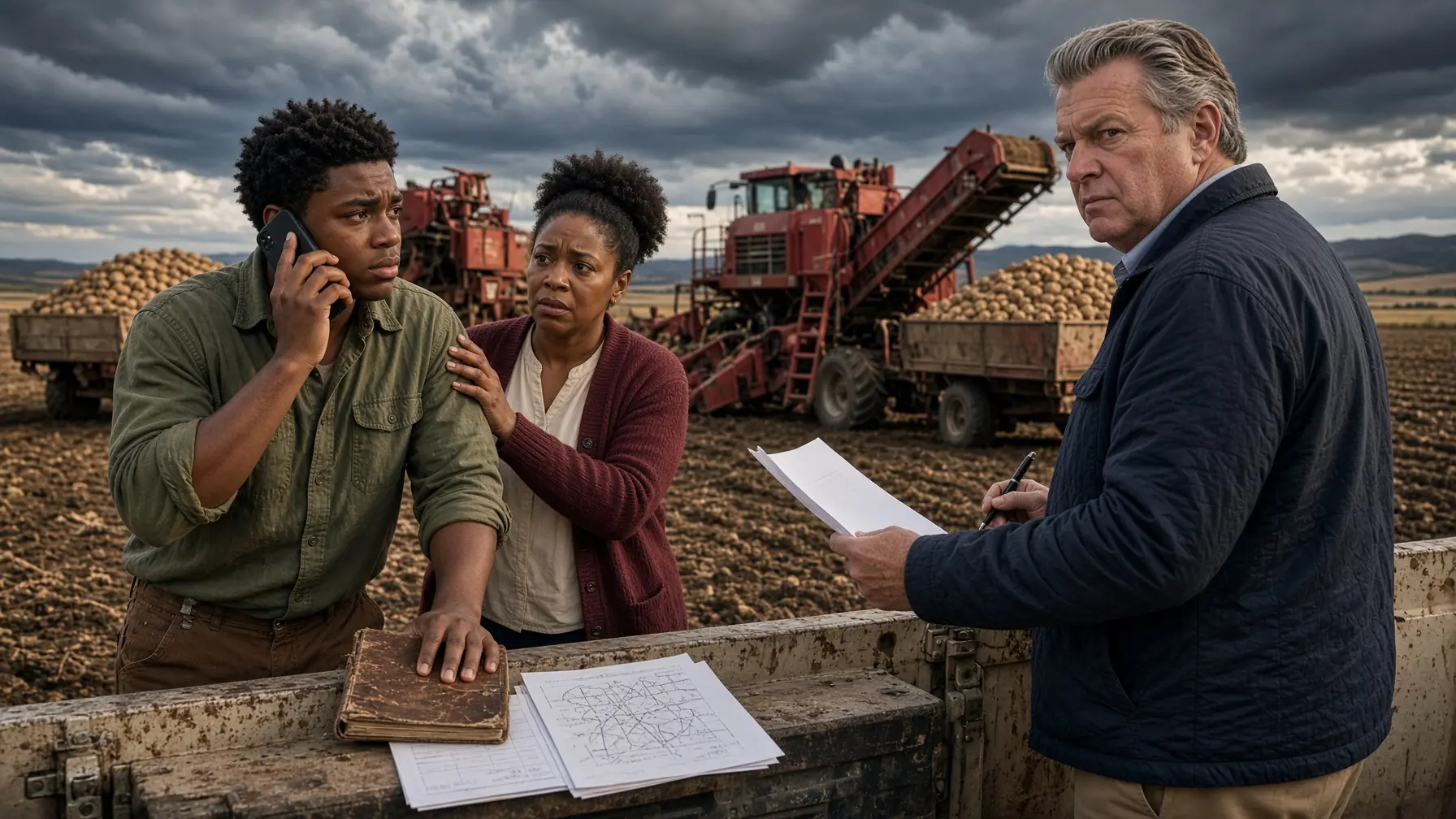
“Your buyers are gone,” Grant said. “Sign it, credit my program, and your mother keeps her home.”
Noah looked toward the equipment shed.
His mother stood in the doorway with one hand pressed against the timber frame. She was trying to look composed, but the fingers of her other hand trembled against her burgundy cardigan.
Behind the truck, two enormous red potato harvesters stood idle.
Loaded trailers waited nearby.
There was work everywhere, proof everywhere, and no one willing to take what they had grown.
Noah tightened his grip on his father’s notebook.
He was nineteen years old.
For the first time that season, he wished someone else could make the decision.
That morning, he had believed the hardest part would be beating the storm.
He had climbed down from the tractor before sunrise, stretched his stiff shoulders, and looked toward the eastern edge of the farm. The sky beyond Blackfoot was still clear, though the forecast showed weather gathering later in the day.
They had time if nothing went wrong.
That was how every harvest calculation began.
If the machinery held.
If the trucks arrived.
If the crew stayed ahead of the delays.
If the forecast did not move.
Noah had stopped saying the last part aloud because his father used to say it, and hearing the words in his own voice still unsettled him.
He checked his phone.
A delivery confirmation sat at the top of the screen.
He opened it, read it again, and slipped the phone into his shirt pocket.
Then he walked toward the shed.
His boots were already muddy.
The faded olive work shirt he wore had been clean two days earlier. Now the rolled sleeves were stiff at the edges, and there was a dark smear beneath one elbow where he had leaned against machinery while checking something that should have taken five minutes and had taken forty.
His mother was waiting with a food container.
“Breakfast.”
“I ate.”
“What?”
He looked at her.
She waited.
“A piece of toast.”
“When?”
Noah took the container.
Ruth nodded, satisfied with the result rather than the explanation.
At forty-six, she had become very good at identifying which arguments were worth having before dawn. She wore her natural curls tightly gathered, and there was flour on the cuff of her cream blouse from whatever she had been making in the kitchen.
“Your father used to think coffee counted,” she said.
Noah looked down at the container.
Inside were eggs, potatoes, and two pieces of bread.
“He also thought standing up made it faster.”
“He was wrong about plenty of things.”
She said it gently.
Noah smiled.
Then she touched his arm, and the smile became something more difficult.
“Eat before you get back in.”
“I will.”
She watched until he opened the lid.
Only then did she return to the house.