“Consider this your roadside fee.”
Officer Derek Mercer said it with a smile.
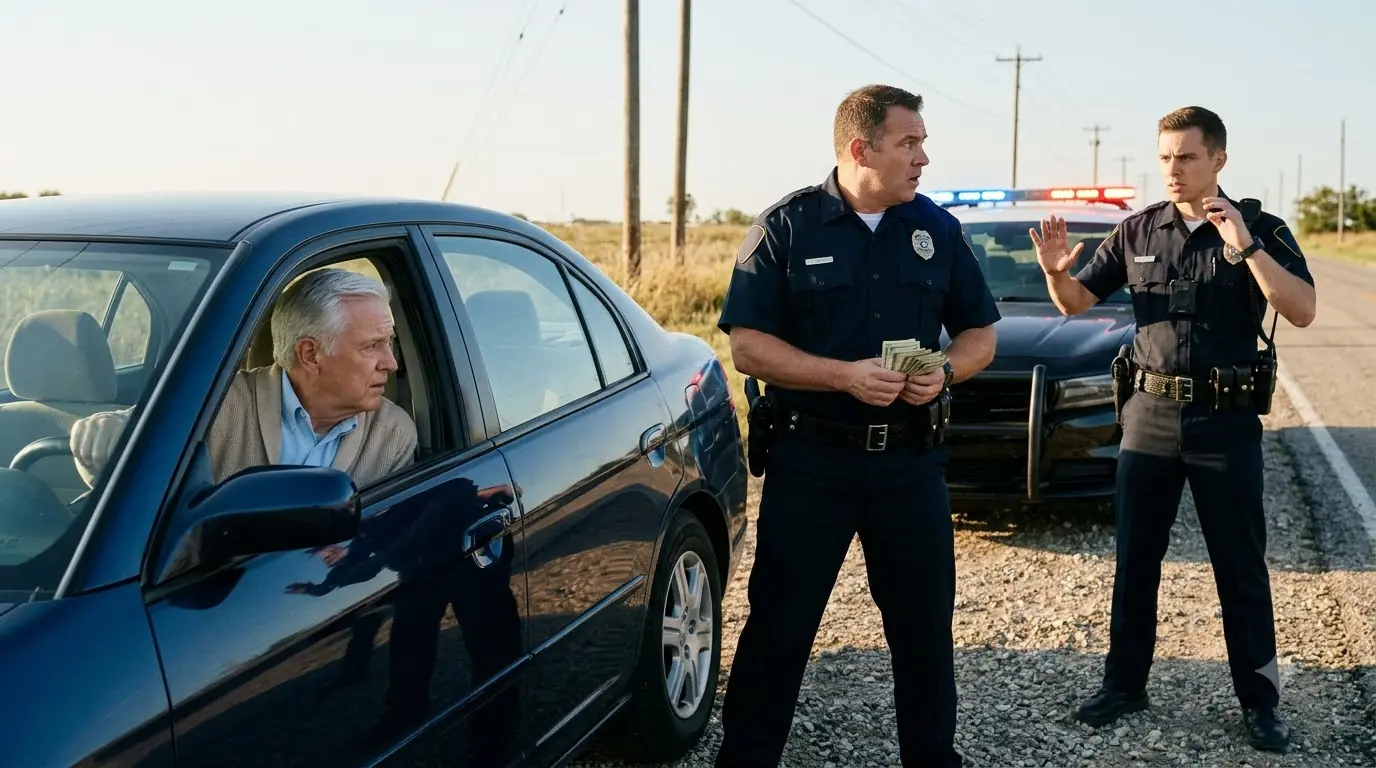
Walter Hayes watched from behind the wheel of his dark blue sedan as the officer lifted the thick stack of cash from the open brown leather wallet and stepped away from the window. The afternoon sun flashed against the patrol car behind them. Red and blue lights washed over the gravel shoulder, the ditch grass, the trunk of a sycamore tree, and the steady hands Walter kept resting on the steering wheel.
He did not protest.
He did not reach for the money.
He did not ask the officer whether he understood what he was doing.
Instead, the seventy-four-year-old man sat very still in his beige cardigan and light blue shirt and said, in a voice so quiet Mercer almost missed it, “Count it carefully.”
Mercer glanced back with a grin that suggested he heard fear where there was only instruction.
“Oh, I will.”
He turned away from the sedan and began counting the bills.
A few yards behind him, Officer Caleb Foster stood near the hood of the marked cruiser. Foster was thirty, narrow through the shoulders, clean-shaven, and still new enough to the county department that he polished his boots more often than necessary. He had been watching the stop with a growing tightness around his mouth, but until that moment he had said nothing.
Then the radio on his shoulder came alive.
“Unit Twelve, hold your position. Do not allow Sergeant Mercer to remove or pocket any currency from that vehicle. Repeat, do not allow him to remove or pocket any currency. Supervisor and state investigators are en route.”
Foster froze.
His eyes went from the radio to the money in Mercer’s hands.
Mercer noticed.
“What’s wrong with you?” he asked.
Foster raised one hand slowly, palm out.
“Derek,” he said, staring at the cash. “Don’t put those bills in your pocket.”
The grin vanished from Mercer’s face.
For the first time since he had walked up to Walter’s window, the road went completely silent.
Walter looked at both officers and waited.
He had waited a long time for that silence.
Six weeks earlier, he had been sitting at his kitchen table when his neighbor, Ruth Alvarez, knocked on the back door with both hands shaking.
Walter lived alone on six acres outside the county seat in a low brick ranch house surrounded by walnut trees and pasture fencing he no longer used. His wife, Margaret, had been dead nine years. His two daughters lived in other states. The house had become quieter after Margaret died, but not empty. Walter filled it with habits: morning coffee at six, newspaper at six-thirty, grocery run on Tuesdays, church on Sundays when his knees allowed it, and financial records filed with the precision of a man who had spent forty years believing paper usually told the truth if people did not interfere with it.
Ruth Alvarez lived half a mile down the road. She was sixty-nine, widowed, and capable of replacing a mower belt without assistance. Walter had known her twenty-three years and had never once seen her frightened by another person.
That morning she was frightened.