The shoes hit the paving with a wet slap.
A spray of mud jumped up from the soles, spotted the pale stone beneath the veranda chairs, and landed in a dark streak across the corner of the leather folder resting on Marcus Greene’s lap. For half a second, nothing moved except two small birds darting across the edge of the terrace railing and the slow turn of a ceiling fan above the clubhouse doors.
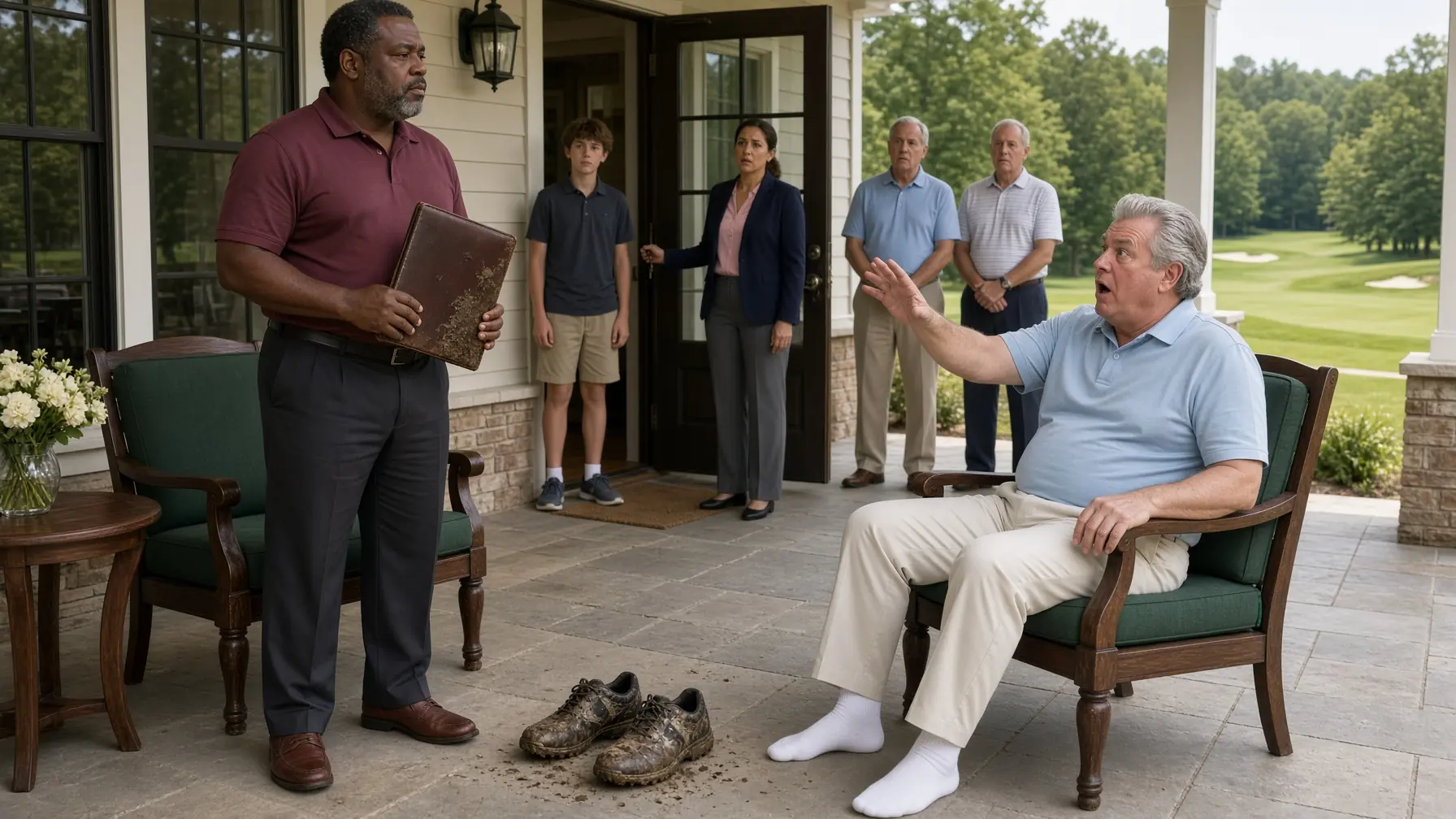
Then Preston Whitaker smiled as if he had done something perfectly reasonable.
“Clean those,” he said, impatient and loud enough for the people nearby to hear. “My tee time’s in ten minutes.”
Marcus lowered his eyes to the stain on the folder.
He did not flinch. He did not reach for the shoes. He simply looked at the brown smear slowly soaking into the leather, then placed the folder with deliberate care on the small round table beside him. The movement was calm enough to make a few of the club members standing nearby stop pretending not to watch.
When Marcus stood, he did it slowly, like a man choosing his next words with restraint instead of anger. He was broad-shouldered and solid, dressed simply in a muted burgundy polo, charcoal trousers, and brown loafers that had seen better days. His beard was neatly trimmed, his graying curls cropped short, and there was nothing flashy about him. From a distance, he looked like someone’s contractor, someone’s accountant, someone who had come to fix something or deliver documents. The kind of man men like Preston Whitaker often stopped seeing clearly the moment they decided he did not belong.
Marcus looked at the muddy shoes on the ground.
Then he looked at Preston.
“Pick them up,” he said, voice level and firm. “I’m not cleaning a damn thing for you.”
The air shifted.
Preston had the thick build and loose arrogance of a man who had spent years moving through private spaces as if they had been built to echo his footsteps. At fifty-five, with swept-back silver hair, a pale blue golf shirt tucked into cream trousers, and a flush already rising in his face from the summer heat, he looked like the kind of member whose name was on plaques and whose opinions made employees nervous.
He took a step closer.
“Excuse me?”
“You heard me.”
A teenage caddie standing several feet away froze with two scorecards in his hand. One of the women on the veranda stopped mid-sip with her iced tea. A man in a visor shifted his weight and stared very hard at the fairway beyond the terrace, as if the shape of a distant bunker had suddenly become deeply important.
Preston snapped his fingers toward the caddie without taking his eyes off Marcus.
“Get security,” he said, contempt dripping from each word. “This guy needs reminding who belongs here.”
The boy did not move.
Marcus remained still. He wasn’t smiling. He wasn’t posturing. If anything, that calm made Preston look smaller, meaner, and more reckless all at once.
Then the clubhouse doors opened behind them.
Elena Ruiz stepped out quickly, one hand still on the brass handle. She was around forty, sharp-eyed, dressed in a navy blazer over a pale pink blouse with gray trousers and black flats, the exact picture of a manager who had learned how to solve problems before they became scenes. Her attention moved first to the muddy shoes, then to the stain on the folder, then to Marcus.
Her expression changed immediately.
“Mr. Greene?” she said, alarmed. “The entire board is waiting for you.”
The words landed more cleanly than the shoes had.
Preston turned toward her. His raised hand, still half-lifted from his order to the caddie, slowly dropped to his side.
Marcus reached for the stained folder. Elena moved to the clubhouse door and held it open for him with both hands, the gesture more formal than any welcome she had shown the other members all morning.
For the first time since he had thrown the shoes, Preston’s face lost its certainty.
He looked from Elena to Marcus, then down at the discarded shoes near his own feet, then back again as if one of them had skipped a line in a script he thought he knew by heart.
Marcus paused only long enough to meet Elena’s eyes.
“Thank you,” he said.
And with Preston still standing beside his muddy shoes and searching the faces around him for an explanation no one offered, Marcus walked past him toward the open door.
Inside, the board was waiting.
What none of the people on the veranda knew—not Preston, not the caddie, not the members whispering into the collars of their golf shirts—was that Marcus Greene had almost turned his truck around at the entrance and left ten minutes earlier.
He had parked beneath a row of oaks just outside the main lot, turned off the engine, and kept both hands on the steering wheel while the club came into view through the windshield. Magnolia Ridge Golf Club stretched in polished quiet before him—white columns, clipped hedges, bright flowerbeds, carts humming in soft loops across rolling green fairways. It looked exactly the way places like that always tried to look: effortless, settled, inevitable. As if money had been planted in the soil generations ago and all that remained was to keep it watered.
Marcus had not been back in fourteen years.
He had told himself the number didn’t matter. Time had a way of smoothing rough edges, or so people liked to say when they were talking about pain that had happened to someone else. But as soon as he saw the veranda and the line of terrace chairs and the stone steps leading down toward the eighteenth green, his chest had tightened with an old familiar weight he had not invited.
He remembered a different morning. Hotter than this one. Younger than this one. He remembered his father in a maintenance uniform lifting bags of fertilizer from the back of a service cart and telling him, not unkindly, to stay in the shade. He remembered being twelve and carrying a dented thermos of sweet tea because his mother had insisted his father stop forgetting to drink water while he worked. He remembered stepping too far onto a section of grass that looked no different from any other section of grass and hearing a member shout across fifty yards as if a crime were underway.
Not there, boy.
Not because the man was important.
Because the man was white, loud, and used to being obeyed.
Marcus had never forgotten the look on his father’s face. It wasn’t fear, not exactly. It was something more exhausting than fear. It was the look of a man calculating, in an instant, how much dignity he could afford to defend before it cost him the week’s pay he needed to buy groceries. He had walked over, taken the thermos from Marcus, thanked him softly, and told him to wait by the service shed.
On the ride home that evening, his father had said only one thing about it.
“Some people mistake access for worth,” he said, eyes on the road. “Don’t you ever help them make that mistake permanent.”
Marcus had carried that sentence longer than he had carried his father.
When the call came three weeks earlier from Magnolia Ridge, he had nearly laughed before hanging up.
The club’s treasurer, a nervous man named Walter Baines, had introduced himself with the careful tone of someone walking barefoot over glass.
“We’re exploring a redevelopment partnership,” Walter had said. “A preservation strategy too, perhaps. We were told you might be willing to hear a proposal.”
Marcus had leaned back in his office chair in Atlanta and stared at the skyline through the window.
He knew exactly why Magnolia Ridge was calling.
Clubs like Magnolia Ridge only said words like redevelopment and preservation when the alternative was collapse. Their membership was aging, debt was growing, younger families weren’t joining at the same rate, and several nearby developments were circling the surrounding acreage like hawks around a field mouse. He also knew the club sat on more than prestige. It sat on land, and land—properly handled—could become leverage, protection, memory, or profit depending on whose hands shaped the future.
“What proposal?” Marcus had asked.
Walter had cleared his throat. “Our board would prefer to discuss that in person.”
Marcus had almost refused. Then Walter had said something unexpected.
“There are archival matters we believe may also interest you. Related to Thomas Greene.”
Marcus had gone still.
His father’s name had not crossed that property in any form that honored him in all the years since his death. Not in public, at least. Not in any way Marcus knew about.
“What archival matters?”
“I think it would be better if you heard it from the board.”
That answer should have irritated him enough to decline. Instead, it opened a door in his mind he had spent years bricking over. He had agreed to come, though even while giving the date he had wondered whether he was walking toward an opportunity, an insult, or a trap disguised as business.
Now, sitting in the clubhouse parking lot with Magnolia Ridge shining like a memory scrubbed for resale, Marcus had considered putting the truck in reverse.
His phone rang before he could.
His younger sister Nia’s name flashed on the screen.
“You there?” she asked when he picked up.
“Unfortunately.”
She laughed softly. “That bad already?”
“I haven’t even gotten out of the truck and I already remember why I left.”
“That’s not why you left.”
He exhaled. Nia had always done that—gone straight through the version of events he offered to the one underneath.
“Part of why I left.”
“Maybe,” she said. “But it’s not why you built what you built.”
Marcus rested his head briefly against the seat. “You sure about that?”
“I’m sure Daddy would say don’t let old disrespect make a new decision for you.”
He smiled in spite of himself. “You been rehearsing that line?”
“All morning.” A beat passed. Then her voice softened. “Whatever happens in there, remember you’re not showing up to ask for a seat at their table. They asked you to come because the table’s wobbling.”
That line stayed with him as he stepped out of the truck.
He had arrived early on purpose, wanting a few quiet minutes to take the place in without audience or ceremony. Elena had met him just inside the foyer, all professionalism and apology.
“Mr. Greene, welcome,” she had said. “The board meeting was delayed for a few minutes. They’re assembling now. If you don’t mind waiting on the veranda, I’ll come get you the second they’re ready.”
She had offered coffee, water, even a private office. Marcus had chosen the veranda because he wanted air.
And because some part of him had wanted to sit in the very place where boys like him once understood without being told that certain chairs were not truly for them.
He had intended to wait quietly for ten minutes.
Then Preston Whitaker had come striding across the terrace from the practice green, carrying his own muddy shoes like an accusation the world was obligated to solve.
The boardroom Elena led Marcus into was cooler than the veranda by at least ten degrees. The air-conditioning hummed softly above paneled walls lined with framed photographs: tournaments, ribbon cuttings, men in blazers shaking hands under banners. At the far end of the long mahogany table, eight board members either rose halfway from their seats or shifted forward awkwardly as Marcus entered. Not all of them knew whether to offer smiles yet. Several had clearly heard some version of what had just happened outside. None seemed sure how much Marcus knew about the club’s internal politics, its finances, or the alliances currently threading under the polished surface.
Walter Baines, a narrow man with rimless glasses and a tie that looked too tight for his neck, came forward first.
“Mr. Greene,” he said, both hands extended, “thank you for coming.”
Marcus shook one hand, not both. “Walter.”
“Please, have a seat.”
At the center of the table sat a woman in her sixties with white-blonde hair cut in a clean bob and a spine so straight it made everyone around her seem uncertain by comparison. She wore a cream jacket, pearls, and the expression of someone long accustomed to speaking only after others had made a mess of things. Walter gestured toward her.
“This is Judith Mercer, board chair.”
Judith inclined her head. “Mr. Greene.”
“Ms. Mercer.”
“Elena told us there was an incident on the veranda,” Judith said without warming the words. “Before we begin, let me say that whatever occurred should not have occurred.”
Marcus took the empty seat Elena had pulled out for him. He laid the stained folder on the table in front of him.
“That depends what you mean by should.”
A few people glanced at the mud mark. Elena, now standing discreetly near the sideboard, said nothing.
Judith’s eyes stayed on the folder for a moment longer than necessary. “Fair enough,” she said. “And noted.”
Marcus sat back.
No one offered coffee now. The meeting had moved past that.
Judith folded her hands. “You are here for two related reasons. The first is the one Walter mentioned on the phone. Magnolia Ridge is under pressure. Rising debt. Deferred maintenance. Two years of storm damage that cost more than projected. A decline in member retention. And a standing development offer that would turn half our outer acreage into luxury homes and the rest into a smaller, more exclusive private course.” She paused. “Several people on this board would prefer not to let that happen.”
“Several?” Marcus asked.
That made one of the men on the right clear his throat.
Judith did not flinch. “Enough to invite you.”
“Not enough to stop it?”
“Perhaps that depends on what this meeting becomes.”
Marcus let that sit. “And the second reason?”
Judith exchanged a glance with Walter. He opened a binder, removed a photocopy of an old typed memo, and slid it across the table.
Marcus recognized his father’s name before he touched the page.
THOMAS GREENE — GROUNDS DIVISION.
He looked up slowly.
Walter spoke carefully. “About six months ago, while preparing documents for an insurance review, we opened several archived storage boxes that had not been cataloged properly. Among them were maintenance memos, payroll records, and internal correspondence from the late 1990s and early 2000s. We also found handwritten recommendations regarding irrigation redesign, erosion control, and drainage management on the southern lower acreage.”
Marcus looked back at the page. The note contained clipped comments in two different inks. One line had been underlined twice:
Proposal submitted by T. Greene dismissed as outside employee scope.
His jaw tightened.
Judith continued. “Years later, nearly identical changes were implemented under a contracted review and later credited in our records to the consulting firm that supervised the project.”
Marcus’s voice went quiet. “You’re telling me my father solved one of your course drainage problems and someone else got paid for it.”
“That appears to be the case,” Judith said.
“Appears?”
“We are still reviewing how fully the idea was appropriated and by whom.”
The man who had coughed earlier shifted in his seat. “To be fair, those kinds of suggestions come up in operations all the time—”
Judith cut him off with a glance sharp enough to draw blood. “Not the moment, Harold.”
Marcus picked up the memo and turned it. There, on the back, was a rough sketch he knew instantly even before the details arranged themselves in memory: his father’s compact, deliberate handwriting, block letters that never leaned, arrows marked with notes about runoff, collection basins, and sloped redirection near the lower ninth.
He remembered sitting at the kitchen table watching that hand move across lined paper after dinner, his father saying he was trying to save the club money if anyone there had sense enough to listen. His mother had told him not to work for free. His father had smiled and said thinking wasn’t free work.
Marcus swallowed once.
“When did he submit this?”
Walter checked the document. “The initial note is dated April 18, 1999.”
Marcus stared at it.
That had been nine months before his father was pushed out after a back injury the club refused to treat as work-related. Nine months before bills multiplied. Eleven months before Marcus left community college for a warehouse job because someone needed to help keep the lights on.
Something hard and old settled into place inside him.
“So,” he said at last, “you’ve found evidence that Magnolia Ridge took from my father when he was alive, ignored him while he was injured, and forgot him once he was gone.”
No one rushed to correct him.
Judith lifted her chin. “Yes.”
“And you called me because?”
“Because truth matters,” she said. “Because the club’s future is unstable. Because the land around Magnolia Ridge has become attractive to people who will erase every trace of what this place has been, good and bad alike. And because your work over the last decade suggests you care about more than profit when land, memory, and community intersect.”
Marcus almost laughed again, though this time there was no humor in it.
His work. That was one way to describe it.
After leaving North Carolina, Marcus had worked nights in a warehouse and days wherever he could find construction labor. He learned quickly, saved carefully, and borrowed only when he understood exactly how he would pay it back. He bought a failing strip of commercial property no one wanted because the pipes were old and the neighborhood had been written off. He fixed what he could with his own hands, leased below market to businesses the banks had ignored, then repeated the process block by block until the pattern became a strategy and the strategy became a company. But real money had not changed him most. What changed him was the afternoon he drove past a public park near one of his early properties and saw children practicing chip shots with bent metal rods and plastic balls because the city had promised a youth golf program but never funded it.
He thought of his father then. Of the greens he had maintained but never owned, the game he had helped preserve but could not afford to play.
That image became the seed of the Greene Foundation—not a flashy charity, not a vanity project, but a structure for scholarships, land access, apprenticeship, public recreation, and youth sports in neighborhoods where private clubs were visible reminders of exclusion. Marcus rarely attached his name publicly to anything unless it served a practical purpose. He preferred projects to announcements. Fields to galas. Leases to plaques.
Which was one reason Magnolia Ridge had not fully understood what kind of man they were inviting to the table.
“How much trouble is the club in?” he asked.
Walter slid another folder toward him. Financial summaries. Debt schedules. Capital needs.
“Enough,” Walter said.
Marcus opened the folder and scanned. Roof work deferred. Irrigation repairs overdue. Member decline more severe than public appearances suggested. There it was: a development offer from Falcon Crest Communities contingent on board approval within sixty days.
“How divided is the board?”
At that, several people looked at one another.
Judith answered plainly. “Deeply.”
“Does Preston Whitaker sit on it?”
Silence, then a low exhale from Elena near the sideboard.
“Yes,” Judith said. “He does.”
“Thought so.”
“He is not present because he has recused himself from this meeting.”
Marcus looked up. “Recused himself?”
Judith’s mouth sharpened at the edges. “He wanted to frame that as generosity. I would frame it as tactical self-preservation.”
The man named Harold muttered, “That’s one interpretation.”
Judith ignored him.
Marcus closed the financial folder. “Let me guess. Preston wants the development deal.”
“He wants control,” Judith said. “The development deal is only the current vehicle.”
That made sense. Men like Preston did not care whether the future arrived in the shape of homes, memberships, or policy. They cared that the future bore their fingerprints and left them standing where others had to come asking.
Marcus folded his hands. “What exactly do you want from me?”
Judith’s answer came immediately. “A partnership proposal. Potential preservation capital. A strategic vote of confidence. And, if warranted, a way forward that would keep Magnolia Ridge from being carved into luxury lots.”
Walter added, “Possibly with public-facing community programming to broaden revenue and support.”
“Public-facing,” Marcus repeated.
Harold let out a tiny skeptical sound.
Marcus turned his eyes to him. “Problem?”
Harold straightened. “Private members do not necessarily want public use of the club.”
“Of course not,” Marcus said. “And yet private members apparently do want private bailouts.”
Harold looked at the table.
Judith’s expression barely shifted, but Marcus caught the brief flicker of satisfaction in it.
“I’m not here to rescue a culture that refuses to change,” Marcus said. “If Magnolia Ridge thinks it can keep its old habits and just swap in my money or my credibility, you’ve called the wrong man.”
“That,” Judith said, “is precisely why I asked you here.”
Before Marcus could answer, the boardroom doors opened without a knock.
Preston Whitaker stepped inside.
He had either changed out of his golf shoes or abandoned the round entirely; now he wore loafers and a face arranged into offended surprise.
“Judith, I’m sorry,” he said, though he did not sound sorry. “I was told this meeting was still in discussion, and given the circumstances outside I felt my presence might clarify a few things.”
“No,” Judith said. “It will likely complicate them.”
Preston’s eyes moved to Marcus, then to the stain on the folder again. There was no apology in his face. Only calculation.
“Mr. Greene,” he said, drawing out the courtesy as if testing whether it fit. “If I’d known you were connected to the board meeting, I’d have handled that interaction differently.”
Marcus did not stand.
“I’m sure you would have.”
A few board members looked down, suddenly interested in nothing.
Preston clasped his hands behind his back. “You were seated on the veranda without identification. No one had introduced you. I assumed you were staff or perhaps grounds support waiting on an assignment. If that was mistaken, it was mistaken.”
Elena spoke before anyone else could.
“You assumed far beyond that,” she said.
Preston turned. “Elena, with respect, I wasn’t speaking to you.”
Judith’s voice sharpened. “Then speak carefully, because I assure you she remains welcome to speak in front of this board.”
Marcus watched Preston absorb that and decide not to contest it directly.
“What exactly are you looking for here, Preston?” Marcus asked.
Preston gave a short smile. “A reasonable path forward for the club.”
“No,” Marcus said. “I mean right now. In this room.”
That took a second longer to answer.
“At the moment? I’d like to know whether Magnolia Ridge is about to mortgage its future to a man whose only relationship to this place appears to be resentment.”
Walter inhaled sharply. Judith’s chair made the smallest sound against the floor as she shifted.
Marcus, however, stayed very still.
“That’s interesting,” he said. “Because my only visible relationship to this place seemed to qualify me for shoe-cleaning duty ten minutes ago.”
Color rose in Preston’s cheeks.
“I have already said it was a misunderstanding.”
“No,” Marcus said. “You’ve said you’d have behaved differently if you had known who I was.”
The room quieted so fully even the air vent sounded loud.
Marcus leaned forward just slightly.
“That tells me everything I need to know.”
Preston opened his mouth, but Judith cut in.
“Enough. Mr. Whitaker, if you cannot contribute constructively, leave.”
Instead he took the empty chair at the far end of the table and sat.
That one decision said more than any statement he could have made. He was not leaving. He believed too strongly that his standing could outlast embarrassment. Men like him often survived by treating consequences as passing weather.
Marcus looked at Judith. “You wanted me to understand how divided the board is?”
Judith’s gaze remained on Preston. “I believe you understand.”
Marcus sat back again. “Good. Then here is what I’m willing to say today.”
Every person in the room straightened.
“I have no interest in being a silent financial patch on a system that remains exactly what it has always been. If Magnolia Ridge wants a check, this meeting can end now. If Magnolia Ridge wants a future, we can keep talking. But that future would require structural changes, public commitments, historical accountability, and a redefinition of who gets to step onto this property without being treated like an intruder.”
Preston gave a disbelieving laugh. “You expect members to vote for that?”
“I expect people to vote for survival if the alternatives are honest enough.”
Judith said nothing. She was listening like someone measuring lumber before a cut.
Marcus continued. “I would need full financial disclosure, decision-making authority in any partnership entity, and guarantees regarding land preservation boundaries. I would also require a public acknowledgment of Thomas Greene’s work and the review of any compensation or recognition the club failed to provide.”
Harold’s eyes widened. “Public acknowledgment?”
“Yes.”
“This could expose the club to reputational issues.”
Marcus looked at him evenly. “The club exposed itself. I’m merely declining to hide the mirror.”
Elena lowered her eyes, but Marcus saw her trying not to smile.
Preston spread his hands. “This is impossible. He walks in here with a grievance from twenty-seven years ago and suddenly wants to redesign the identity of Magnolia Ridge?”
Marcus’s voice remained calm. “No. I walked in here because you invited me. The grievance was already yours.”
The silence after that lasted long enough to become a verdict.
Judith finally spoke. “Mr. Greene, if you were to outline the broad terms of a future vision, what would it include?”
Preston turned toward her sharply. “Judith—”
“I asked the question.”
Marcus took a breath. He had not planned to say this much today. He had planned to listen, maybe challenge, perhaps walk away with folders and think in private. But there were moments when restraint served clarity, and moments when clarity demanded air.
He chose carefully.
“It would include keeping the course intact,” he said. “Not all eighteen holes for private use as they stand now, necessarily, but the land itself preserved from residential carve-up. It would include a sustainable operations model. A public practice and learning wing. Youth training partnerships with local schools. A scholarship pipeline. Apprenticeship programs in turf management, hospitality, and facilities operations. A member structure that remains premium where it needs to but stops confusing exclusivity with dignity. It would include a historical marker, not tucked behind a maintenance shed, but visible. It would include community access days. And it would include written standards of conduct that apply to everyone on this property, whether they pay dues or mop floors.”
No one interrupted.
Even Preston looked momentarily stunned, though whether from the ambition of the idea or the fact that Marcus had clearly thought beyond money, it was hard to tell.
Walter spoke first. “You’ve considered this before today.”
Marcus met his eyes. “I started considering it the moment I heard Magnolia Ridge was in trouble.”
That was true, though he had tried not to admit how quickly his mind had begun shaping possibilities.
Judith nodded once. “And if the board agreed in principle?”
“Then we proceed to real numbers, governance, and legal review,” Marcus said. “If the board does not agree in principle, I leave and you can sell the place to whoever promises the prettiest brochure.”
Preston scoffed. “You talk like you’re our only option.”
Marcus glanced at the financial papers. “I’m the only option in this room offering you a future without erasing the land or lying about the past.”
No one contradicted him.
The meeting adjourned an hour later with no vote, but with something more dangerous than a vote: momentum.
Judith requested forty-eight hours to call a full emergency board session. Walter promised complete financial access by morning. Elena quietly arranged for scans of the archival material concerning Thomas Greene to be sent to Marcus’s legal team. Harold looked ill. Two other board members who had barely spoken lingered afterward to ask cautious questions about revenue models and community partnerships. Preston left before anyone else, but not before stopping at the doorway long enough to say, “Magnolia Ridge was built as a private club for a reason.”
Marcus had answered without standing.
“So were a lot of things.”
That evening, back in his hotel room in Raleigh, Marcus laid the photocopied memo from 1999 on the desk beneath the lamp and called Nia.
“Well?” she asked.
He laughed once, tired. “How much time you got?”
“All night.”
He told her everything, including the shoes.
She went silent for a long beat.
“Say something,” he said.
“I’m deciding whether to be furious or impressed that you didn’t throw them into the pond.”
“That would’ve been satisfying.”
“Deeply.”
He leaned back in the hotel chair. Outside, traffic moved in slow ribbons under the fading sky.
“They found Daddy’s design notes,” he said quietly.
Nia’s response came softer. “Are you serious?”
“Looks like the club used them. Looks like somebody else got the credit.”
Another silence, this one heavier.
“I hate that I’m not surprised,” she said.
“Yeah.”
“What are you going to do?”
Marcus looked at the memo again. At the block letters, the arrows, the confident plain intelligence of a man the club had been willing to use but not see.
“I don’t know yet,” he said. “Part of me wants to walk away and let the place drown in its own choices.”
“And the other part?”
“The other part keeps thinking about what Daddy would say if that land ends up behind another gate and a hundred expensive mailboxes.”
Nia exhaled slowly. “He’d say land remembers who worked it.”
Marcus smiled faintly. “You been rehearsing again?”
“Maybe.” Then, more seriously: “If you stay in it, don’t stay in it to save them. Stay in it to build the thing that should’ve been possible all along.”
That night he barely slept.
Over the next week, Magnolia Ridge turned into a battlefield disguised as a sequence of meetings.
Walter sent records. Marcus’s attorneys reviewed debt. An environmental consultant confirmed portions of the outer acreage would be difficult and costly to develop at the scale Falcon Crest wanted. Elena, operating with the efficiency of someone who understood exactly how institutions tried to protect themselves, helped locate older employee files and identified two retired staff members who still remembered Thomas Greene’s drainage recommendations before they had mysteriously become “consultant innovations” years later.
Meanwhile Preston campaigned.
He called members privately. He framed Marcus as an opportunist who wanted to dismantle the club under the language of reform. He told others that community access would cheapen Magnolia Ridge. He suggested public programming would bring “the wrong expectations” onto the property, a phrase vague enough to protect him and clear enough for everyone to understand.
Marcus heard all of it through back channels and from one board member with a conscience that had matured under pressure. None of it surprised him.
What did surprise him was Elena.
Three days after the initial meeting, she asked whether he could spare twenty minutes before lunch. She met him not in the main clubhouse but in a smaller administrative office overlooking the service yard where carts were washed and equipment stored. It was a deliberate choice, and Marcus noticed.
“Elena,” he said, taking the offered chair. “What’s this?”
She closed the door. “Something you should know before the emergency session.”
Her usual composure held, but he could see anger tucked neatly behind it like a file edge.
“Preston?” he guessed.
“In part.” She set a thin folder on the desk between them. “Several years ago, Magnolia Ridge adopted a member conduct policy. It has rarely been enforced against high-value members, but it exists. Harassment of staff, discriminatory behavior, and public misconduct are all grounds for sanction.”
Marcus looked at her. “You think he can be sanctioned over the veranda incident?”
“I think he should be.” She held his gaze. “And I think what he did was not isolated.”
She opened the folder. Inside were incident summaries, staff complaints, witness notes. No melodrama. Just pattern. Preston belittling a dishwasher in front of guests. Preston berating a groundskeeper over leaf debris after a storm. Preston referring to line staff by job function instead of name. Preston insisting a young Black assistant professional had been “too aggressive” for correcting his tee time after the assistant was three minutes late returning from helping a junior clinic.
Marcus turned one page at a time.
“Why show me this?”
“Because if the board decides your proposal matters, Preston will try to frame you as the destabilizing force.” Her jaw tightened slightly. “I want the record clear about who destabilizes this place.”
He closed the folder.
“Why are you still here?” he asked.
That question made her smile, though not happily.
“My father was the club’s kitchen manager for nineteen years,” she said. “My mother cleaned rooms at a motel off the highway. I got this job because I was good enough that they could benefit from my work and still tell themselves a story about merit.” She folded her arms. “I stayed because institutions do not improve by waiting for the most comfortable people to volunteer. And because I got tired of watching young employees learn in a week what took me years to say out loud—that some people will only respect a uniform or a title if they think it might one day have power over them.”
Marcus absorbed that. “So this is personal.”
“It has been personal for a long time.”
He nodded toward the folder. “Why not take this straight to Judith?”
“I already have. She agrees in principle. But principle and votes are not the same thing.” Elena leaned forward. “Mr. Greene, if you decide to walk away, that is your right. No one should ask you to endure this place for symbolic reasons. But if you stay, understand this: there are people here who need the ground to shift. Not because a golf club is sacred. It isn’t. But because patterns calcify unless something breaks them.”
Marcus took the folder with him when he left.
On the morning of the emergency board vote, Magnolia Ridge looked immaculate. That, too, was institutional instinct. When the house trembles, polish the banister.
Marcus arrived an hour early, not for calm but for perspective. He asked Elena if he could walk the lower southern acreage before the meeting. She sent a grounds supervisor to accompany him, an older man named Reggie Bell who had worked at the club long enough to remember Thomas Greene.
“You’re Thomas’s boy,” Reggie said after a few minutes walking side by side near the edge of a sloped rough. “Thought I recognized the eyes.”
Marcus looked at him. “You knew my father?”
“Knew him? Man saved us from flooding out two springs in a row.” Reggie tapped the grass with the toe of his boot. “Most folks only saw a maintenance uniform. Your daddy saw the whole property like a map in his head. Water, roots, drainage, traffic flow. Didn’t matter. He’d look once and tell you where the problem would show up three storms later.”
Marcus stared out over the lower land.
“Did anyone know they used his plan?”
Reggie let out a humorless breath. “Staff knew something. Not paperwork. But we knew ideas don’t walk uphill by themselves.”
They stopped near a low area where morning dew still clung to the edges of the grass. Reggie pointed toward a subtle grading line.
“He drew that before they touched it,” he said. “I remember because he used to bring a little notebook in his lunch pail.”
Marcus felt something shift in his chest—not closure, exactly, but confirmation, which can be its own kind of mercy.
“He should’ve been listened to,” Reggie said.
“He should’ve been paid,” Marcus answered.
Reggie nodded. “That too.”
When Marcus returned to the clubhouse, the board was already gathering. So were several larger stakeholders: the club’s attorney, two accountants, and, to Marcus’s mild surprise, three staff representatives Judith had invited to speak during the conduct policy review Elena had forced onto the agenda. Preston was present as well, flanked by the kind of members who always materialize when power senses a possible leak.
The meeting lasted four hours.
There were financial presentations, legal caveats, preservation projections, and long arguments dressed up as procedural questions. Marcus presented a framework rather than a plea. He did not oversell. He did not beg. He described what Magnolia Ridge currently was, what it could become, and what it would lose if it chose denial over reinvention. He laid out capital phases, governance safeguards, membership restructuring options, staff apprenticeship tracks, and projected revenue from instructional programs and limited community events. He described youth access not as charity but as pipeline, vitality, and moral repair. He spoke about land as both asset and story. He never raised his voice.
Then Elena testified about the veranda incident.
Then two staff members corroborated broader conduct concerns involving Preston.
Then Walter introduced the archival findings regarding Thomas Greene, including the memo, the sketch, and internal correspondence showing that his recommendations had indeed been absorbed into a later consultant package without credit or compensation.
The room changed after that.
Even members who had planned to hide behind abstraction found it harder to pretend the debate was only about finance. The past had entered the room and sat down.
Preston fought hard.
He dismissed the archival issue as a clerical failure from another era. He called the conduct complaints exaggerated reactions to the pressures of club life. He argued that Marcus’s model would destroy Magnolia Ridge’s identity and dilute membership value. At one point he actually said, “There is a reason institutions preserve standards,” and the phrase hung in the air like an old curtain everyone could suddenly see through.
Marcus let him finish.
Then he stood.
“When you say standards,” he said quietly, “I think you mean access controlled by comfort. I think you mean the benefit of being judged individually only after others are judged collectively. I think you mean the luxury of making a scene on a veranda and calling it a misunderstanding if the man in front of you turns out to outrank your assumptions.”
No one moved.
“You threw shoes at me because you thought there would be no cost,” Marcus continued. “Not because you were confused. You were confident. That confidence did not begin with you, and if this board chooses the easy path today, it will not end with you either.”
He looked around the table.
“I am not asking Magnolia Ridge to become something lesser. I’m asking whether it has the courage to become honest enough to deserve surviving.”
Judith called for the vote thirty minutes later.
The first motion concerned sanctions under the conduct policy. Preston Whitaker was formally censured, suspended from club privileges pending review, and removed from his board position by a margin larger than anyone expected. Two of his closest allies abstained. One abandoned him entirely.
The second motion concerned entering exclusive negotiations with Marcus Greene’s partnership entity and preservation initiative rather than proceeding with Falcon Crest’s development offer.
That motion passed as well.
Not unanimously. But clearly.
When Judith announced the result, something inside the room seemed to exhale after holding itself rigid for years.
Preston stood so abruptly his chair struck the floor.
“This is a disgrace,” he said.
Judith folded her hands. “No, Preston. That was last week on the veranda.”
He left without another word.
The weeks that followed were brutal in the practical ways real change always is. Lawyers revised language. Members complained. A small but noisy faction resigned in protest. Local rumor mills spun wildly, alternating between “Magnolia Ridge sold out” and “Magnolia Ridge got saved by some mystery developer from Atlanta.” Marcus ignored most of it.
What mattered was the work.
He returned again and again, not as a guest now but as a builder. Survey teams walked the outer acreage. Architects studied ways to adapt underused facilities into teaching and training spaces without destroying the club’s strongest features. Public school representatives met with foundation staff. Elena became, unofficially at first and then formally, the operational bridge between old Magnolia Ridge and whatever would come next. Judith, freed from the constant drag of Preston’s maneuvering, proved to have more nerve than many had guessed.
Three months later, Magnolia Ridge held a press conference on the same veranda where the shoes had struck the stone.
Marcus stood there in a dark suit this time, Elena at one side, Judith at the other, and a small cluster of staff, board members, and community leaders behind them. News cameras waited in the driveway. Members lingered near the terrace rail. Reggie Bell stood in the back with his arms crossed and a look on his face Marcus recognized as hard-earned satisfaction.
They announced the Magnolia Ridge Preservation and Access Partnership.
They announced a multi-phase transition that would preserve the land, stabilize operations, expand youth golf and workforce training, and establish new scholarship opportunities for local students. They announced community learning days and a junior development track funded through the Greene Foundation. They announced staff apprenticeship programs and a revised member code of conduct. And then Judith stepped aside for the final announcement.
Her voice carried clearly across the veranda.
“Today,” she said, “Magnolia Ridge also acknowledges a long-overdue truth. Years ago, Thomas Greene, a member of this club’s grounds division, submitted critical design recommendations concerning drainage and land stewardship that materially benefited this course. He was not given the recognition he deserved. That failure belongs to this institution. We are correcting part of that failure today.”
She turned toward Marcus.
“In honor of Thomas Greene’s work and legacy, the lower southern practice and learning grounds will be named The Thomas Greene Learning Links.”
For a moment, Marcus heard nothing else.
Not the cameras.
Not the birds in the trees.
Not the shifting of shoes on stone.
Only his father’s voice from long ago: Some people mistake access for worth.
He had spent so many years outrunning what that place meant that standing there now felt strangely unreal, as though the boy with the thermos and the man with the microphone occupied the same body but had not fully introduced themselves.
When Marcus stepped to the podium, he did not look first at the reporters. He looked at the staff standing near the side steps. Grounds crew. Kitchen staff. Servers. Maintenance workers. The people who made beautiful spaces function while others took the beauty for granted.
“My father worked this land,” he said. “He understood things about it that people with more power failed to value because they confused job title with intelligence.” He paused. “That happens in more places than this one. Probably too many.”
A few people nodded.
“I didn’t come back to Magnolia Ridge because I needed approval from it. I came back because land can either repeat a pattern or interrupt one. This partnership is an interruption.”
He told the story carefully—not every hurt, not every insult, but enough truth to make the shape of things visible. He spoke about access, dignity, and what it means when young people can finally step onto a property not as tolerated outsiders but as invited learners. He thanked Elena by name. He thanked Judith for choosing discomfort over denial. And he ended by saying, “Preservation without honesty is just decoration.”
Afterward, as the crowd broke into clusters of conversation, a boy of about fourteen approached him wearing an oversized polo and holding a borrowed wedge in one hand. Marcus recognized him after a second. The teenage caddie from the veranda. He looked nervous enough to bolt.
“Mr. Greene?”
Marcus turned. “Hey.”
“I wanted to say… I’m sorry I didn’t do anything that day.”
Marcus studied him. The boy’s ears had gone red.
“You didn’t throw the shoes,” Marcus said.
“No, but I just stood there.”
Marcus glanced down at the wedge. “You play?”
“Not really. I caddie more than anything.”
“You want to learn?”
The boy blinked. “Seriously?”
Marcus smiled. “That’s kind of the point.”
The boy smiled back then, relief loosening his whole face.
Across the veranda, Elena was speaking with reporters when she caught Marcus’s eye. She raised one brow as if asking silently whether he was all right.
He was.
Not because the past had disappeared. It had not. Not because one vote or one public acknowledgment healed everything. It did not. And certainly not because men like Preston vanished from the world once exposed. They did not. Preston would land somewhere else, complain somewhere else, insist to someone else that he had been wronged by changing times and unreasonable people. The world was full of Prestons. It was also full of boards that preferred comfort, institutions that preferred polish, and histories that preferred silence.
But the pattern had cracked.
Months later, on the first official opening day of the Thomas Greene Learning Links, children arrived from three local schools with donated clubs slung over their shoulders. Some had never set foot on a golf property before. Some had. None entered through a side gate. Elena insisted on that.
The practice green buzzed with instruction and awkward swings. Coaches from the foundation moved station to station. Reggie stood near the short-game area pretending not to be sentimental. Judith, in a sun hat she claimed to dislike, watched from a cart path with a look that could almost be mistaken for peace.
Marcus stepped away from the crowd and walked alone for a few minutes toward the lower edge of the property where the land sloped gently and the drainage channels his father had once imagined now carried water exactly where it needed to go after a light morning rain. Near the path stood a bronze marker set in stone.
THOMAS GREENE
GROUNDSMAN, PROBLEM SOLVER, STEWARD OF THE LAND
His work helped shape Magnolia Ridge.
His legacy now helps open it.
Marcus read it twice.
Then he rested his hand on the top edge of the stone and let the quiet settle around him.
He wished his father were there. That wish would never stop being part ache, part gratitude. But he also knew something now he had not known when he first parked beneath the oaks on that tense morning months earlier.
You do not always return to a place because it deserves you.
Sometimes you return because someone once denied what your people built there, and leaving the denial unchallenged would cost too much.
Sometimes you return because memory needs a witness.
Sometimes you return because a gate that shut on one generation can be pried open for the next.
Behind him, he heard laughter—young, uneven, unembarrassed. He turned and saw a line of kids moving from the chipping area toward the practice tees, clubs bumping against their knees, instructors calling names, sunlight flashing off metal shafts. Among them was the former caddie, now helping a smaller boy line up his feet.
Marcus smiled.
Then he walked back toward the sound, across the same property where a man once thought a quiet Black stranger on the veranda belonged at his feet, and where now, at last, far more people were beginning to understand who really belonged there all along.