"I bet $5,000 no one can fix my bike."
Garrett Steel slammed the challenge down in front of the crowd outside the Iron Rail. Before anyone else could answer, a quiet voice came from the edge of the parking lot.
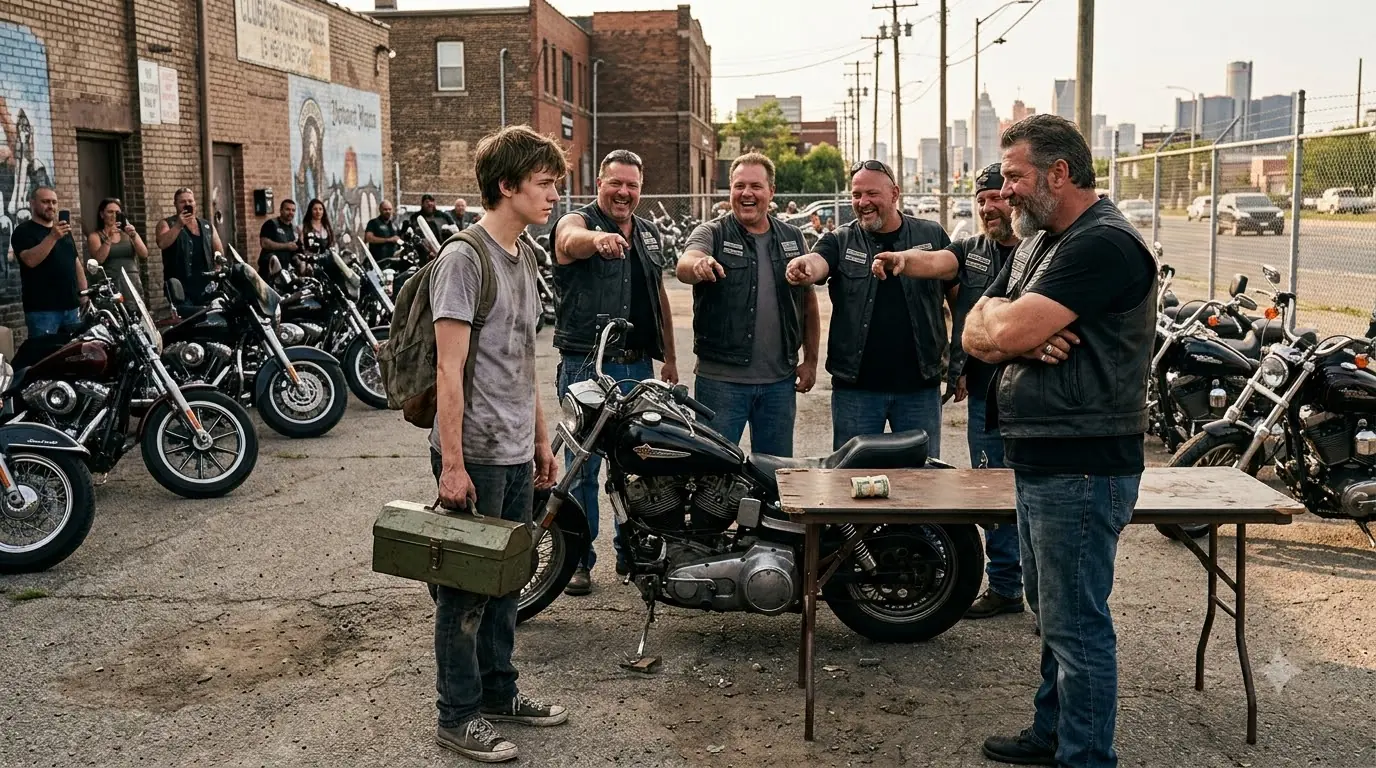
"I can fix it."
Garrett turned and saw Owen Fletcher, 18 years old, skinny, grease-covered, and standing in shoes that were splitting at the soles. He stared at the young man as if the challenge itself had somehow become an insult.
"Who let this kid in here?"
A biker moved in close and shoved Owen back toward the wall. Another mocked the smell of industrial soap and engine grease on his shirt.
Garrett looked him up and down. "Fifteen real mechanics couldn't fix it, and you think you can?"
A biker kicked Owen's dented toolbox across the concrete. The lid popped open and old hand tools scattered across the parking lot.
Owen wiped his face, knelt, and picked up a chipped half-inch wrench. "Five minutes."
Garrett laughed again. "We don't lose bets to kids like you."
Owen tightened his grip on the wrench. Nobody there knew that this kid was about to make every professional mechanic who had already failed look completely wrong.
The Iron Rail sat at the dead end of Michigan Avenue, where Detroit stopped pretending to be polished. It was a concrete bunker with no bright sign out front, only motorcycles, heat, exhaust, leather jackets, and a parking lot that seemed to vibrate whenever the riders arrived together.
Every summer, the Detroit chapter gathered there in force. Fifteen to twenty riders would roll in at a time, chrome pipes rattling windows several blocks away.
At the center of it all was Garrett Steel, 50 years old and president of the Detroit chapter for 11 straight years. His word carried weight in that parking lot, and his temper had become almost as famous as the motorcycles themselves.
Garrett had spent decades making sure nobody confused restraint with weakness. He was used to being obeyed before he had to repeat himself.
His motorcycle was a 1972 Harley-Davidson Shovelhead known as Black Fury. Garrett's father had built the engine by hand in 1971, and Garrett treated the machine less like property than inheritance.
Nobody sat on Black Fury. Nobody leaned against it, borrowed a tool from it, or moved it without permission.
The bike had crossed state lines with Garrett for decades. It carried scratches and worn surfaces he refused to replace because some of them had been there since his father was still alive.
For Garrett, Black Fury was the last living mechanical connection to the man who had taught him how to ride and how to survive. That was why the breakdown had hit him harder than anyone in the crowd understood.
Black Fury died in the middle of Interstate 94, sputtering once, coughing again, and then falling silent. Garrett sat on the shoulder beside it for several minutes before he finally made a phone call.
He did not call an ordinary tow service. He called Dale Prescott.
Dale ran one of the largest garages in Wayne County and had four decades in the business. His office wall was covered with certificates, awards, trade-school credentials, and framed photographs of engines he had rebuilt.
He arrived in a company truck with two assistants and diagnostic equipment worth more than Owen had earned in months. The crowd expected Dale to solve the problem before anyone finished a beer.
Thirty minutes later, Dale stood up, wiped his hands, and shook his head. "Can't figure it.
Might be the whole engine."
"I'd need to tear it down at the shop," he added. "Two, maybe three weeks."
Garrett stared at him. "You're telling me you can't fix it."
"I'm telling you it's complicated."
Garrett pointed toward the road. "Then get out of my sight."
Dale packed his equipment and left without another word. Several people watched his truck disappear and smirked at the sight of Wayne County's best-known mechanic leaving without even a clear diagnosis.
Next came Nolan Briggs, the vintage Harley specialist. Collectors across Michigan called Nolan when they had an old Shovelhead or Panhead that nobody else wanted to touch.
Nolan had been rebuilding motorcycles since before Owen was born. He knew old carburetors, ignition systems, and engine cases by feel.
He spent nearly 45 minutes on Black Fury. He opened the carburetor, cleaned the visible passages, checked the obvious components, reassembled it, and tried to start the engine again.
Nothing.
He tried several more times. Black Fury did not even give him a convincing cough.
"The carb is clean," Nolan finally said. "This engine is done.
I've seen old Shovelheads reach the end before."
Garrett grabbed the front of Nolan's shirt. "You're supposed to be the best in the state."
Nolan's face tightened. "I am one of the best in the state, and I'm telling you she's finished."
Garrett held him there for a moment, then shoved him away. Nolan stumbled into his own toolbox and caught himself before falling.
"Get out," Garrett said. "Every one of you is wasting my time."
By then, the crowd had doubled. Word moved fast whenever the gathering turned into a spectacle.
Mechanics from nearby shops came to watch. Riders from other chapters showed up, neighbors stood near the fence, teenagers stopped with their bicycles, and phones began appearing in people's hands.
Then came Curtis Wade, a former aerospace engineer who had turned himself into a motorcycle consultant. He arrived with a laptop, meters, probes, technical diagrams, and the expression of someone certain that the answer would be waiting inside the data.
Curtis looked professional. He looked thorough.
He tested the bike, studied readings, typed notes, and cross-referenced information. After about 20 minutes, he closed the laptop and delivered his verdict.
"Full engine replacement. New internal components, new rotating assembly, major rebuild.
You're looking at at least $8,000, maybe $12,000 depending on parts."
Garrett's jaw tightened. "Eight to twelve thousand dollars to fix a bike that three experts can't even diagnose the same way?"
Curtis answered calmly, "I don't make the rules of physics, Mr. Steel."
"No," Garrett said. "You just waste my time."
Curtis left with his equipment. Garrett remained beside Black Fury in the summer heat while everyone else waited to see what he would do next.
He reached into his vest, pulled out a thick roll of hundred-dollar bills, and slammed it onto a table. "$5,000 cash."
"Anyone who can make her run in one hour takes all of it," Garrett said. "Right here.
No shop. No excuses."
Silence followed.
Not one professional stepped forward. Five thousand dollars sat in the Detroit sun and nobody was willing to touch Black Fury.
That was when Owen Fletcher happened to walk past.
He had not come for the motorcycles. He had not heard about the bet.
He was walking home after a second shift, six hours at a car wash on Livernois Avenue and another four stocking shelves at a gas station on Grand River. His shirt carried the smell of soap, fuel, and exhaust.
His shoes were coming apart at the soles. He had $11 in his pocket and an engine textbook from the public library in his backpack.
Then he heard something from the dead motorcycle.
Not a roar or a knock. A faint mechanical irregularity buried in the quiet around the engine, the kind of clue almost nobody would notice unless they had spent years listening before touching.
Owen stopped walking. He tilted his head.