The letter arrived at the Blackwood house just after breakfast on a cold Monday morning, and Samuel Blackwood smiled before he had even finished reading it.
It was not the smile of a father receiving good news.
 It was the smile of a man who had just discovered an opportunity to make someone else suffer.
His wife, Martha, recognized it immediately.
She pushed her teacup aside and leaned toward him across the table.
“Well?”
Samuel lowered the letter.
Rebecca and Sarah, his two younger daughters, watched from the opposite side of the room.
Both were beautiful in the conventional way their mother prized. Rebecca had pale golden hair and delicate features, while Sarah possessed dark curls, a narrow waist, and the kind of smile that made young men forget what they had intended to say.
Their older sister Clara had never been treated the same way.
At thirty years old, Clara was extraordinarily large, weighing close to two hundred kilograms. She had a soft round face, warm brown eyes, heavy arms, broad hips, a very large waist, and dark brown hair she usually pinned into a simple bun because elaborate styles only gave her sisters another reason to laugh.
But it was not only Clara’s body that separated her from the family.
Clara asked questions.
She objected when something was unfair.
She defended servants when Samuel blamed them for mistakes they had not made.
She gave food to travelers when Martha said charity encouraged laziness.
She once stood in church and openly contradicted a wealthy landowner who had accused an elderly farmhand of theft without evidence.
Samuel called it disrespect.
Martha called it embarrassment.
Rebecca and Sarah called it proof that Clara did not know her place.
Samuel looked down at the letter again.
“Ezra Stone wants a Blackwood daughter.”
Rebecca’s eyes widened.
“Ezra Stone?”
Sarah sat straighter.
Everyone within several valleys knew the name.
Ezra owned one of the largest mountain ranches in the territory. He controlled thousands of acres of good grazing land, several hundred cattle, timber rights along the eastern ridge, and more freshwater than most neighboring ranches combined.
He was thirty-eight.
Unmarried.
Respected.
And, according to every young unmarried woman who had ever seen him ride into town, remarkably handsome.
Martha smiled immediately.
“Well, Rebecca is the obvious choice.”
Rebecca lowered her eyes, pretending modesty.
Sarah frowned.
“Why Rebecca?”
Samuel slowly lifted the letter.
“He doesn’t want Rebecca.”
Silence.
Sarah’s face brightened.
Then Samuel continued.
“He doesn’t want you either.”
The sisters looked at one another.
Martha frowned.
“Then who?”
Samuel began laughing.
It started quietly.
Then grew until he had to put the letter on the table.
Rebecca snatched it.
Her eyes moved across the page.
Then she screamed with laughter.
“No.”
Sarah grabbed the paper.
The moment she saw the name, she covered her mouth.
“Oh, this cannot be serious.”
Martha took the letter.
Her expression moved from confusion to disbelief.
Then amusement.
There, written clearly in Ezra Stone’s own hand, was the request.
Miss Clara Blackwood.
For one stunned second, nobody spoke.
Then the entire room erupted.
Rebecca bent forward laughing.
Sarah clapped both hands.
Martha pressed a napkin against her lips.
Samuel leaned back in his chair and wiped tears from his eyes.
“Clara!”
Rebecca gasped.
“Ezra Stone asked for Clara?”
Sarah could barely breathe.
“He must never have seen her properly.”
“He’s seen her,” Samuel said.
“Then the man has lost his mind.”
Martha shook her head.
“Perhaps he remembers the girls incorrectly.”
Samuel looked thoughtful.
Then the cruel smile returned.
“No.”
Martha recognized it.
“What?”
Samuel tapped the letter.
“This is perfect.”
The women slowly quieted.
Samuel continued.
“Ezra Stone believes he has selected himself some strong, obedient frontier bride.”
Rebecca laughed again.
“Wait until he sees what arrives.”
Sarah leaned forward.
“You mean send Clara?”
“Of course.”
Martha hesitated.
“She might refuse.”
Samuel waved that concern away.
“She lives beneath my roof.”
“She will go.”
Rebecca smiled.
“And once she is there?”
“She becomes his problem.”
Those words settled comfortably into the room.
His problem.
Not ours.
Martha’s expression softened into satisfaction.
“We would finally have some peace.”
Sarah giggled.
“And poor Ezra Stone would be trapped with her.”
Rebecca imagined it aloud.
“He’ll come outside expecting a proper bride and see a wagon carrying half the county.”
All three women laughed.
Samuel joined them.
None noticed Clara standing just beyond the half-open sitting-room door.
She had come from the rear bedroom carrying folded sheets.
Her grandmother Ruth had been sick for almost two weeks, and Clara had spent most mornings beside the old woman, changing linens, cooling her forehead, preparing broth, and listening whenever Ruth became frightened during fever dreams.
Clara had heard the first laugh from the hallway.
Then her name.
She stopped.
Now she stood perfectly still.
The laundry suddenly felt heavy in her arms.
She listened as the people she had spent thirty years calling family discussed sending her away as though disposing of unwanted furniture.
Burden.
Problem.
His responsibility.
Let him see what he gets.
Clara had heard cruelty before.
She knew its vocabulary.
Her body had been public property inside the Blackwood house since childhood.
At eight, Martha warned visiting relatives not to give Clara a second piece of pie.
At twelve, Rebecca asked why Clara’s arms were “as big as Papa’s legs.”
At sixteen, Samuel began telling her no respectable man would want the cost of feeding her.
At twenty-one, Martha told her she should be grateful the family allowed her to remain at home.
By thirty, Clara had developed the ability to stand through such conversations without showing pain.
But this was different.
They were not merely insulting her.
They were celebrating her disappearance.
Clara’s fingers tightened around the folded sheets.
She waited until the laughter stopped.
Then quietly returned to her grandmother’s room.
Ruth Blackwood opened her tired eyes.
“You heard them.”
Clara froze.
The old woman had always possessed an unsettling ability to know things nobody told her.
Clara sat beside the bed.
“They received a marriage proposal.”
Ruth watched her granddaughter’s face.
“For you?”
“Yes.”
“Good man?”
“I don’t know.”
“Bad family?”
Clara laughed despite the ache in her throat.
“We know the answer to that.”
Ruth reached beneath the blankets.
Her thin hand found Clara’s much larger one.
“Then perhaps God opened a door using fools as hinges.”
Clara looked at her.
“That sounds like something you invented.”
“It is.”
Ruth smiled weakly.
“Still true.”
Clara looked toward the window.
“Ezra Stone.”
Ruth’s eyebrows rose.
“The mountain rancher?”
“Yes.”
“He asked specifically for you?”
“Yes.”
Clara laughed bitterly.
“Apparently my family considers that hilarious.”
Ruth squeezed her fingers.
“Do you?”
Clara thought.
“No.”
“Then don’t live by their laughter.”
The words stayed with her.
That evening, the Blackwood family sat around the long dining table.
Samuel waited until stew had been served.
Then he cleared his throat.
“Clara.”
She looked up.
“I have excellent news.”
Rebecca immediately lowered her face to hide a smile.
Clara saw it.
“Do you?”
Samuel unfolded the letter theatrically.
“You have received a marriage proposal.”
Clara remained calm.
“And you accepted it.”
Samuel paused.
He had expected surprise.
Perhaps tears.
“You’ve heard?”
“I know you.”
Martha frowned.
Samuel ignored it.
“The man is Ezra Stone.”
“I know.”
This time Sarah looked up sharply.
Clara continued eating.
Samuel’s confidence wavered.
“You understand what an opportunity this is?”
“A man asked to marry me.”
“A very wealthy man.”
“That seems more important to you than to me.”
Samuel’s jaw tightened.
Martha intervened.
“Clara, don’t be difficult. This is a blessing.”
Rebecca smiled.
“A miracle.”
Sarah laughed into her glass.
Clara set down her spoon.
“When do I leave?”
The table became silent.
Samuel stared.
“Monday.”
“Fine.”
“You agree?”
Clara looked directly at him.
“You have spent years telling me I am a burden.”
Samuel said nothing.
“Now a man has requested me, and you are so eager to remove that burden that you accepted before asking whether I wanted him.”
Martha’s expression sharpened.
“Respect your father.”
Clara turned toward her.
“I am accurately describing him.”
Samuel slammed one hand on the table.
“You will go Monday.”
Clara nodded.
“Yes.”
Her calm confused them more than resistance would have.
Rebecca smiled again.
Clara noticed.
“But understand something.”
Samuel stared.
“I am not going because you ordered me.”
She looked around the table.
“I am going because I have finally understood that remaining here would be the greater punishment.”
Nobody laughed.
Clara stood.
She left the room.
Five days later, a wagon carried her into the mountains.
Clara brought one trunk.
Most of her dresses.
Her grandmother’s Bible.
Three books.
A sewing kit.
And fourteen dollars she had secretly saved over six years.
Samuel did not accompany her.
Neither did Martha.
Rebecca and Sarah stood on the porch.
Sarah waved.
Rebecca called, “Good luck!”
Clara heard the laughter after the wagon turned onto the road.
She did not look back.
The journey took almost two days.
With each mile, the country changed.
Rolling farmland gave way to pine forests.
The air cooled.
Mountains rose in the distance until they seemed impossibly large.
Clara had spent most of her life in a valley surrounded by people who believed the world ended at the limits of their own opinion.
Now the landscape stretched beyond anything she had imagined.
She felt very small.
For once, that felt peaceful.
But the closer they came to Ezra Stone’s property, the harder fear returned.
Her family’s laughter followed her.
What if they were right?
What if Ezra had confused her with Rebecca?
What if he remembered Clara as she had been at twenty-five and never understood how large she was?
What if he saw her step from the wagon and immediately regretted the proposal?
Clara looked down at herself.
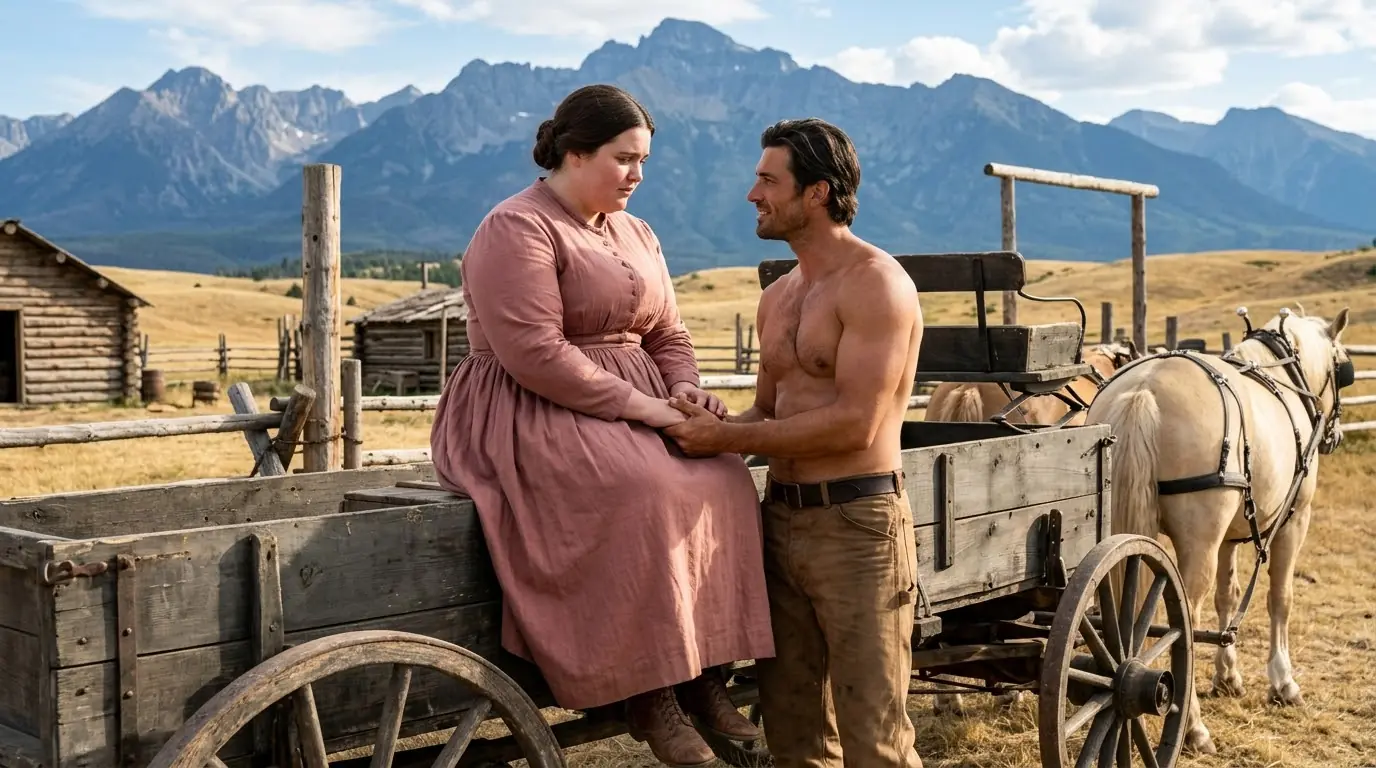
The dusty-rose dress stretched carefully across her enormous body.
Martha had refused to pay a seamstress before Clara’s departure.
Clara had altered it herself.
She knew exactly what she looked like.
Two hundred kilograms did not disappear beneath clever fabric.
Her body filled most of the wagon bench.
The boards creaked whenever the trail became rough.
She had needed help climbing aboard.
There would be no hiding.
At noon, the wagon turned through a wide timber gate.
Clara forgot her fear for several seconds.
Ezra’s homestead spread across a broad mountain valley.
Golden pasture rolled toward dark pine forest.
A clear creek curved through the lower field.
Cattle grazed along the slopes.
Several barns stood near a large timber house with a wide porch.
Beyond everything rose jagged blue-gray mountains streaked with the last snow of spring.
The driver whistled.
“Stone built most of this himself.”
Clara stared.
Then she saw him.
Ezra Stone stood beside a corral.
He had apparently been repairing a gate.
His shirt hung over a fence post.
In the summer heat, he wore only brown work trousers, boots, and a leather belt.
Clara’s breath caught.
Ezra was not enormous.
Perhaps eighty kilograms.
But every part of him seemed shaped by physical labor.