“Then I shall take the daughter.”
The words slid across the gaming table like a blade.
Dice stopped rolling. Cards froze in midair. Even the servants standing near the wall seemed to forget how to breathe.
Lord Edmund Bellamy did not immediately lift his head. His hand still rested on the cards before him, trembling slightly against the green felt.
“You cannot mean that,” he said at last.
Across the table, Lord Ashford smiled with the slow satisfaction of a man savoring cruelty.
“Oh, but I do.”
Around them, the private chamber of White’s Club glowed with candlelight and smoke. Some of London’s most powerful men sat in velvet chairs, pretending to study their drinks while secretly watching a gentleman’s ruin unfold.
“Your debts,” Ashford continued lightly, tapping the stack of promissory notes, “are considerable. Estate sold, carriages gone, credit exhausted.”
He leaned back.
“But there remains one asset of value.”
Bellamy’s voice cracked.
“My daughter is not—”
“Miss Margaret Bellamy is three and twenty,” Ashford interrupted. “Unmarried. Attractive enough. I am a widower with a respectable estate.”
His smile widened.
“Marry her to me, and every debt disappears tonight.”
The silence that followed was suffocating.
Even among men accustomed to ruthless bargains, this felt obscene. A daughter traded for gambling losses. Bellamy’s face turned the color of chalk.
“You would humiliate her,” he whispered.
“I would marry her,” Ashford corrected coolly. “A respectable arrangement.”
He slid the papers forward.
“Or refuse and lose everything.”
The watching gentlemen shifted uncomfortably. No one intervened. Ruin, in rooms like this, was considered a private matter.
Bellamy stared at the table as if the wood might split open and swallow him.
“My daughter,” he murmured hoarsely.
Then a voice came from the doorway, cold, deep, and controlled.
“I will match whatever is on that table.”
Every head turned.
Framed in the entrance stood a man whose mere presence altered the air of the room. Tall, broad-shouldered, dark-haired, with a pale gray gaze that swept across the table with quiet authority.
Maximilian Ashford, Duke of Kingsley.
At thirty-five, he was already a legend in London society. Ruthless in business. Unmoved by gossip. Feared by men who themselves inspired fear.
Ashford straightened in his chair.
“Your Grace,” he said stiffly. “This is a private game.”
“And yet half of London will hear of it by morning,” the Duke replied calmly.
He walked forward. Each step carried the easy confidence of a man no one present could challenge. He stopped beside the table and looked down at the scattered cards.
“Let us end this spectacle.”
Ashford’s smile sharpened.
“And why would Your Grace involve himself in Lord Bellamy’s difficulties?”
The Duke’s gray eyes lifted slowly.
“Because you are not truly interested in his daughter.”
A pause.
“You are interested in watching him beg.”
The words landed with quiet precision.
Ashford’s jaw tightened.
“I merely proposed a practical solution.”
“Yes,” Kingsley said softly. “A cruel one.”
He pulled a chair forward and sat without invitation.
“I will pay Bellamy’s debts.”
Ashford laughed.
“You presume too much.”
“Twenty thousand pounds.”
The room went utterly still.
The sum was staggering, enough not only to clear Bellamy’s debts but to restore his family from the edge of ruin.
Ashford’s expression faltered.
“And what do you gain, Your Grace?”
The Duke did not hesitate.
“I will take the daughter.”
Shock rippled through the room.
Bellamy looked up, stunned.
Ashford leaned forward slowly.
“You propose the same arrangement.”
“No.”
Kingsley’s voice turned colder.
“I propose marriage with dignity, without humiliation.”
He met Ashford’s gaze.
“Or would you prefer the pleasure of bankrupting a gentleman more than the profit of twenty thousand pounds?”
Ashford hesitated.
Greed battled pride.
Greed won.
“Very well,” he said sharply. “The debts are yours.”
The Duke rose.
“Good.”
Then he turned to the broken man beside him.
“Lord Bellamy, we should speak privately.”
Twenty minutes later, Edmund Bellamy stepped into the night air of St. James’s Street with the hollow expression of a man who had exchanged one doom for another.
At that very moment, inside the Bellamy townhouse library, Margaret Bellamy sat reading Wordsworth beside a dying fire.
She sensed her father’s entrance before she looked up. There was something in his silence, something heavy and terrible.
She closed the book slowly.
“Father?”
He looked older than he had that morning.
“My dear,” he whispered.
“What has happened?”
He swallowed.
“Our debts have been purchased.”
Her heart began to race.
“By whom?”
“The Duke of Kingsley.”
The name stirred a faint memory. A tall figure seen once at a ball. A man women whispered about and men avoided offending.
“That is fortunate news,” she said carefully.
Her father closed his eyes.
“No. It is not fortune. It is a bargain.”
Margaret’s fingers tightened on the arm of her chair.
“What bargain?”
His voice broke.
“He wishes to marry you.”
The room seemed suddenly too quiet.
“And if I refuse?”
Her father said nothing.
He did not need to.
Refusal meant ruin. Servants dismissed. Her brother expelled from school. Her mother reduced to dependence. Her family destroyed.
Margaret felt a strange calm settle over her.
“When does he expect an answer?”
“He will call tomorrow.”
She nodded slowly.
“Then I shall meet the Duke.”
The Duke of Kingsley arrived the next afternoon with the punctuality of a man who believed even time should obey him.
At precisely two o’clock, the Bellamy household heard the rumble of carriage wheels outside. Margaret stood near the drawing room window, watching the Kingsley crest gleam upon the carriage door.
When he entered moments later, he seemed carved from darker stone than the rest of the world. His coat was black and perfectly tailored. His hair brushed his collar in a slightly careless manner. But it was his eyes, cool gray and sharp as winter steel, that held Margaret’s attention.
He bowed.
“Miss Bellamy.”
She curtsied.
“Your Grace.”
He declined tea and took the chair opposite her. Lady Bellamy sat nearby with a book she did not read, serving as chaperone and silent witness.
“I believe your father has explained the situation,” Kingsley said.
“Yes. You purchased my father’s debts.”
“Correct.”
“And in return, you request my hand in marriage.”
“I do.”
There was no hesitation in his voice, no attempt to soften the reality.
Margaret studied him carefully.
“You speak of it as if we are negotiating a business contract.”
The Duke inclined his head slightly.
“That is precisely what we are doing.”
Her mother gasped softly, but Margaret did not flinch.
“And what sort of marriage do you expect from such a contract, Your Grace?”
His gaze sharpened.
“An honest one.”
He leaned back slightly.
“You will become the Duchess of Kingsley. You will manage my household, attend necessary functions, and represent my family with dignity.”
“And in return?”
“Your family’s debts vanish. Your estate is restored. Your parents receive sufficient income to maintain their household. Your brother remains at school. Your family is secure.”
The offer was staggering.
Security. Stability. Salvation.
Yet Margaret heard what he did not say.
“And affection?” she asked quietly.
For the first time, his gaze flickered.
A shadow crossed his features.
“I do not pretend to offer romance.”
The bluntness startled her.
“You would rather begin with truth than false promises.”
“Yes.”
Silence lingered between them.
“You could marry any woman in England, Your Grace.”
His lips curved faintly.
“That is precisely the problem.”
She frowned.
“Women who marry dukes expect devotion, admiration, declarations of love.”
“And you believe I cannot provide those things?”
“I believe disappointment is crueler than honesty.”
The words were spoken so quietly they felt almost like a confession.
Margaret looked at him more carefully now. Beyond the title, beyond the power, there was something guarded in him. Something wounded.
“And children?” she asked softly.
“Yes,” he replied. “Eventually, an heir will be necessary.”
Her cheeks warmed slightly, but the Duke did not appear embarrassed. To him, it was another fact, another expectation.
Margaret folded her hands in her lap.
“I will accept.”
Lady Bellamy dropped her book in shock, but Margaret continued calmly.
“On one condition.”
Kingsley’s brow lifted.
“Name it.”
“My brother George remains at Eton. His education must continue uninterrupted, and he must be established properly in life.”
“Done.”
Relief flickered through her chest.
“And my parents?”
“They will want for nothing.”
The certainty in his voice left no room for doubt.
Margaret nodded slowly.
“Then we have an agreement.”
The Duke rose.
“So we do.”
He looked down at her, and his expression softened only slightly.
“I will obtain a special license.”
Her breath caught.
“So soon?”
“Delay serves no purpose.”
His gaze lingered on her face.
“We will be married by the end of the week.”
A strange stillness passed through Margaret.
Four days.
In four days, she would belong to him. Legally. Socially. Completely.
Then the Duke’s voice gentled unexpectedly.
“Miss Bellamy.”
She looked up.
“Yes?”
“I understand the nature of what I ask. You are not entering this blindly.”
The words were careful, almost respectful.
Then he bowed again.
“Good afternoon.”
Moments later, the door closed behind him.
Lady Bellamy collapsed into a chair.
“Oh heavens,” she whispered faintly. “The Duke of Kingsley.”
Margaret stood motionless by the window.
Her future had just been decided. A marriage without love. A husband known across England for coldness. A life she had never imagined.
Yet strangely, she did not feel trapped.
She felt as if she had stepped onto a road whose end she could not yet see.
The wedding was held four days later beneath the pale stone arches of St. George’s Church in Hanover Square.
London society loved spectacle, yet there was none that morning. No orchestra. No crowd of curious onlookers. Only a handful of witnesses.
It was not a celebration.
It was the quiet execution of a bargain.
Margaret walked slowly down the aisle on her father’s arm, her pale blue silk gown whispering across the marble floor. Her hands were steady.
Her heart was not.
At the altar stood the Duke of Kingsley, tall, still, watching her approach with that unreadable expression.
The vicar began.
Margaret listened as if from a distance.
To love. To honor. To cherish.
Words written for marriages born of affection.
Yet when her moment came, she spoke clearly.
“I do.”
The Duke repeated his vows with the calm certainty of a man signing a contract. When he slid the ring onto her finger, his hand was warm.
Unexpectedly warm.
“You may kiss the bride,” the vicar said.
Kingsley leaned down.
The kiss was brief and formal, yet not entirely cold. A whisper of warmth brushed her lips before he stepped away.
And just like that, she was the Duchess of Kingsley.
The wedding breakfast took place at the Duke’s London residence in Grosvenor Square. Grand staircases, crystal chandeliers, servants moving with quiet precision. Everything in the house felt powerful and controlled, just like its master.
Margaret moved through the small gathering in a daze.
Congratulations. Polite smiles. Carefully hidden curiosity.
Her mother wept softly with relief.
Her father avoided the Duke’s eyes entirely.
“Are you well?”
The voice beside her was low.
She turned. Kingsley stood close enough that no one else could hear him.
“Quite well, Your Grace.”
A faint shadow of amusement touched his mouth.
“You need not lie for my comfort.”
She lifted her chin slightly.
“I am managing.”
“That is more honesty than most brides would offer.”
“Most brides,” she replied quietly, “are not sold at card tables.”
For a moment, he said nothing.
Something dark flickered behind his gaze.
“Maximilian,” he said at last.
She blinked.
“My name,” he clarified. “You may use it when we are alone.”
The word felt strangely intimate.
“Maximilian,” she repeated softly.
The way she said it seemed to please him.
Later, when the guests had gone and the drawing room stood quiet, Maximilian said, “We leave for Kingsley Park tomorrow morning.”
“The country estate?”
“Yes.”
She nodded.
“And tonight?”
“You may remain with your family if you wish.”
The unexpected gentleness startled her.
“I thought tonight would be our wedding night.”
His gaze darkened slightly.
“It will be,” he said. “But not tonight.”
Her breath caught.
“I thought you might appreciate one final night in familiar surroundings before your life changes entirely.”
The kindness unsettled her more than cruelty might have.
“Thank you,” she said softly.
He inclined his head.
“I will collect you at nine.”
With that, the Duke of Kingsley left his bride alone in the vast room.
Margaret stood still for a long moment, trying to understand the man she had married. A man feared across England. A man who had purchased her future. And yet, a man who had chosen not to claim her on their wedding night.
The journey to Kingsley Park took two days.
Margaret spent most of it watching the English countryside roll past the carriage window. Green fields softened into hills. Villages appeared and vanished like paintings.
Inside the carriage, silence settled between her and Maximilian like a careful agreement. He worked through correspondence, occasionally glancing up to ensure she was comfortable.
Late on the second afternoon, the carriage turned down a long tree-lined drive.
“Kingsley Park,” he said.
The estate revealed itself slowly.
First the lake glittering in the distance. Then the formal gardens stretching across gentle slopes. Finally, the house itself, a vast Palladian mansion of honey-colored stone glowing in the late sunlight.
Margaret’s breath caught.
“It is enormous.”
“Yes.”
“And it belongs to you.”
He studied her expression.
“It belongs to us now.”
The words struck her unexpectedly.
Us.
Inside, servants waited in perfect formation. Maximilian presented her as the Duchess of Kingsley, and the housekeeper, Mrs. Thornton, greeted her with impeccable formality.
Margaret’s chambers overlooked the gardens. Cream silk walls, golden curtains, and a bed so large it seemed absurd. A door on the far wall connected to the Duke’s rooms.
Her stomach tightened.
But the door remained firmly closed.
“His Grace rarely intrudes upon the Duchess’s privacy,” Mrs. Thornton said.
The reassurance surprised her.
That evening, dinner was formal and quiet. They sat at opposite ends of a long table, speaking politely of rooms, duties, and household matters.
Finally, Margaret asked, “Why did you truly intervene that night at White’s?”
His fork paused.
“You could have paid my father’s debts without marrying me.”
“Yes.”
“Then why did you not?”
For a moment, he said nothing.
“I required a wife.”
The answer felt rehearsed.
“And you believed a woman whose family was desperate would accept a practical arrangement.”
“Yes.”
“Efficient,” she said quietly.
His mouth curved faintly.
“You dislike the word.”
“I dislike hearing marriage described as estate management.”
“I never promised romance.”
“No,” she admitted. “You promised honesty.”
“And honesty is what you shall always receive.”
The first weeks at Kingsley Park passed with measured rhythm. Mornings brought household accounts with Mrs. Thornton. Afternoons were spent in the gardens or library. Evenings brought dinner with the Duke.
And every night, the door between their chambers remained closed.
At first, Margaret had feared the moment it might open.
Then she began to wonder why it never did.
One morning, she wandered into the library, unable to concentrate.
“Wordsworth again.”
The deep voice behind her made her start.
Maximilian stood in the doorway, dressed in riding clothes, his dark hair windswept. For the first time since their wedding, he looked almost human.
“I enjoy poetry,” she said.
“As do I.”
He stepped closer and picked up a volume from the shelf.
“Byron,” he said lightly. “A man with dangerous opinions about love.”
“And you disagree with him?”
“Not entirely.”
The moment stretched strangely between them.
Then he asked, “Are you content here, Margaret?”
The use of her name startled her.
“I have everything I could need.”
“That is not what I asked.”
She hesitated.
“I am adjusting.”
His gaze lowered briefly.
“You are lonely.”
It was not a question.
“You have been very correct with me,” she said carefully.
“Correct,” he repeated. “That is a polite word for distant.”
She did not argue.
“When I arranged our marriage,” he said, “I believed distance would make things easier for you.”
“Easier?”
“Yes. You had no true choice in becoming my wife. The least I could offer was time.”
The realization struck her unexpectedly.
“You stayed away for my sake?”
“I stayed away because I would not have you share my bed out of obligation alone.”
Her heart skipped.
“And if I never wish to?”
“Then you remain Duchess of Kingsley regardless.”
No anger. No wounded pride. Only calm certainty.
For a long moment, neither spoke.
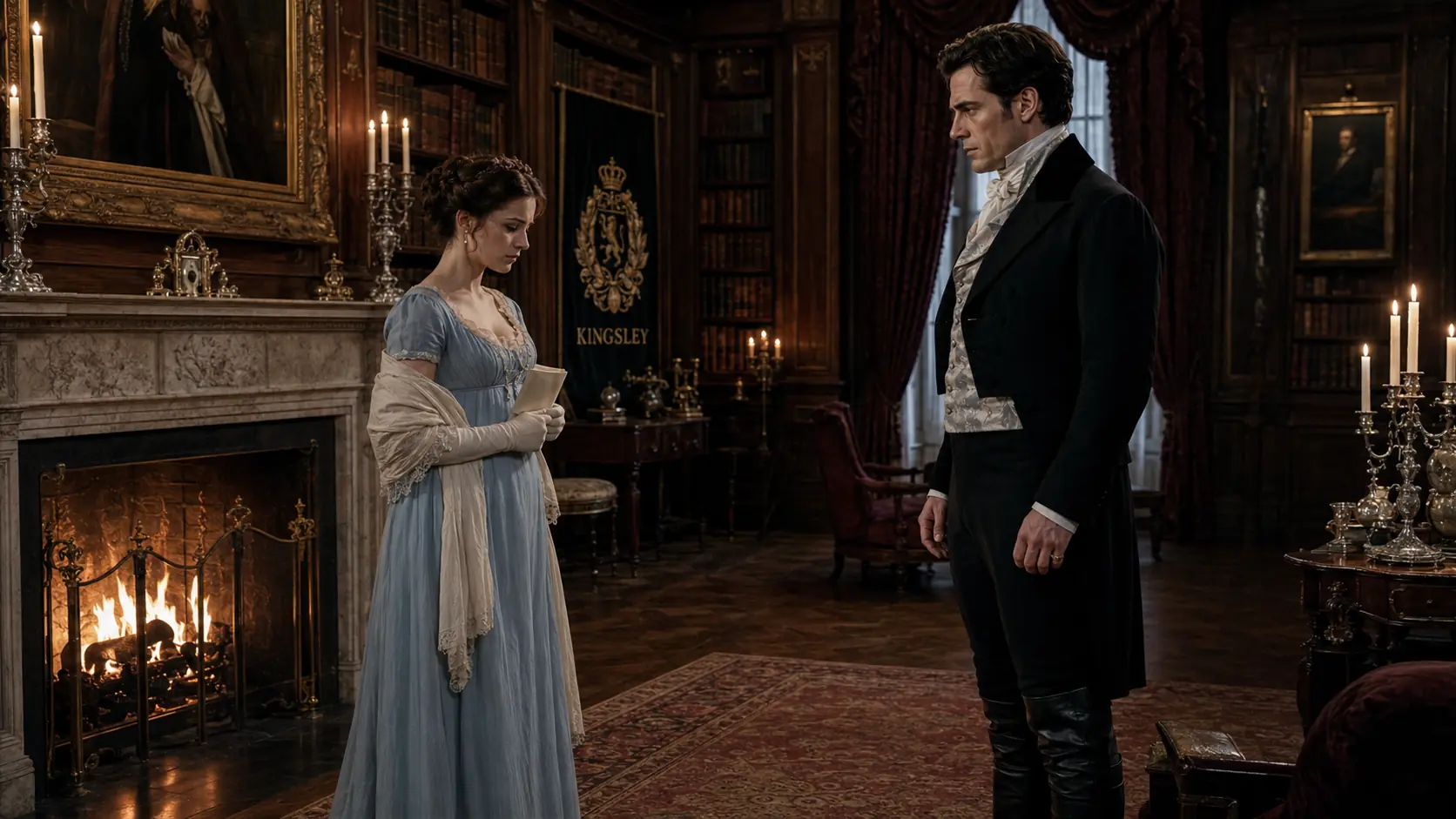
Then Maximilian cleared his throat slightly.
“There is something I hoped you might do with me tomorrow.”
“What is that?”
“Ride. I should like to show you the estate properly.”
The invitation was simple, but somehow it changed everything.
The next morning, they rode together across Kingsley Park. Tenant farms dotted the hills. Villages rested in the distance. Maximilian matched his horse carefully to her pace.
“This land supports over three hundred families,” he explained. “Every harvest affects them.”
“You carry quite a responsibility.”
“It is the burden of titles.”
“And yet you prefer the countryside to London.”
“I despise London.”
The bluntness made her laugh softly.
He looked surprised.
“You laugh easily.”
“Only when something is amusing.”
He shook his head slightly.
“You are unlike anyone I have ever known, Margaret Bellamy.”
“A compliment?”
“A fact.”
They rode in silence for a while.
Then he said, “I served briefly in Crimea.”
She looked at him sharply.
“I did not know that.”
“It changes a man. When you see death often enough, the games of society feel hollow.”
The quiet weight of the confession surprised her.
“You are not cold,” she said gently. “You are careful.”
Maximilian looked at her as if no one had ever said such a thing to him before.
Perhaps no one had.
Something shifted between them then. Something subtle. Something warmer.
When London’s season began, the whispers returned with it.
The Duke who bought a wife.
The girl sold to settle debts.
Every drawing room seemed to know the story. Every ballroom waited to see them.
Margaret felt the weight of those whispers the moment they entered the Devonshire ball.
Chandeliers blazed overhead. Silks rustled. Fans flicked open with subtle excitement. Conversation dipped as the Duke of Kingsley stepped inside with his Duchess on his arm.
Maximilian paused.
“Ready?” he murmured.
“No,” she answered. “But we go anyway.”
A hint of pride flickered in his gaze.
“Good.”
Instead of retreating to the edge of the room, he guided her straight toward the center of the ballroom.
The orchestra began a waltz.
He turned to her formally.
“May I have this dance, Your Grace?”
The use of her title was deliberate.
Public.
Claiming.
“You may.”
They moved across the floor with smooth precision, his strength guiding her through every turn.
Around them, London watched.
“Let them stare,” Maximilian murmured.
“They are.”
“Then let them see the truth.”
“And what truth is that?”
His arm tightened slightly at her waist.
“That you are mine.”
Heat rose to her cheeks.
“And you are mine.”
Something dark and satisfied flickered in his eyes.
When the dance ended, polite applause followed. But before they could step fully away, Lord Ashford approached.
The same man who had once tried to purchase her life.
He bowed stiffly.
“Your Graces.”
Maximilian’s expression turned instantly cold.
“Ashford.”
“I wish to offer congratulations.” His eyes flicked toward Margaret. “A fortunate arrangement for everyone involved.”
The insult lay beneath the politeness.
Before Margaret could respond, Maximilian stepped forward.
“You will address my wife properly.”
Ashford blinked.
“I meant no offense.”
“You implied she should be grateful for rescue.”
His voice dropped lower, colder.
“She owes me nothing.”
The ballroom grew quiet.
Ashford tried to smile.
“I merely remarked upon her improved circumstances.”
Maximilian’s gaze hardened.
“My wife’s worth has never depended upon her circumstances.”
He leaned closer.
“If you speak of her again as if she were a purchased object, you will discover precisely how unpleasant I can be.”
Ashford paled.
“I see.”
“Good.”
The dismissal was absolute.
When Ashford retreated, Margaret looked up at her husband.
“You did not have to defend me.”
“I did.”
His voice was firm.
“You are my Duchess.”
“And your wife?”
“Yes.”
He turned to face her fully.
“And the woman I love.”
The words landed softly between them.
Her breath caught.
“You have never said that before.”
“I should have.”
His gray eyes held hers steadily.
“I love you, Margaret.”
The ballroom faded around them.
The music. The whispers. The watching crowd.
All of it disappeared.
“I love you, too,” she whispered.
His hand lifted slowly to her cheek. He kissed her then, not formally, not politely, but with a tenderness that left no doubt.
When he drew back, his voice lowered near her ear.
“Come home with me.”
Three years later, the house that had once echoed with silence rang with laughter.
Kingsley Park was no longer the austere estate of a solitary duke. It had become warm, alive, and full of small footsteps.
Their daughter, Victoria Ashford, ran through the long gallery toward the library, her nurse hurrying behind her.
“Papa!”
Maximilian looked up from his desk just in time to catch her as she launched herself into his arms.
“You will one day terrify the entire peerage,” he told her gravely.
Victoria giggled.
“I already do.”
From the doorway, Margaret watched with quiet amusement.
Once, London had called the Duke of Kingsley cold and untouchable. Now he sat on the library floor with his daughter in his lap and a wooden horse in one large hand.
Their son Edmund slept upstairs, barely a year old, watched over by a vigilant nurse and a father who checked on him far more often than necessary.
Later that evening, when the house had grown quiet, Margaret and Maximilian sat beside the library fire.
“Do you ever think about that night at White’s?” she asked softly.
He did not need to ask which night.
“Sometimes.”
“And?”
He watched the flames.
“I think about how easily I might have walked away.”
“You would not have.”
“Perhaps not.”
His gaze shifted toward her.
“But I did not intervene for noble reasons.”
“No?”
“I had already noticed you.”
The confession surprised her.
“At several balls that season,” he continued. “You were always at the edges of the room, watching everyone as if you saw through the entire performance. It intrigued me. When Ashford spoke your name that night, I knew exactly who he meant.”
“And you decided to buy me.”
“Yes.”
The blunt honesty made her laugh softly.
“That should sound scandalous.”
“It does.”
“Are you angry?”
She considered the question, then shook her head.
“No.”
“Why not?”
“Because you never treated me like something you owned.”
She moved closer and rested her hand over his.
“You gave me time.”
“You deserved it.”
“You gave me respect.”
“You earned it.”
“And you gave me love.”
Maximilian’s fingers tightened around hers.
“That was never a gift.”
“What was it then?”
“Something you took from me the moment you walked into that drawing room and refused to be frightened.”
The firelight flickered across his face.
“You were never a debt, Margaret. You were always my destiny.”
Her eyes softened.
“And you were mine.”
Outside, the vast estate lay quiet beneath the stars.
Inside, the Duke of Kingsley held the woman he had once purchased with twenty thousand pounds. But the truth neither of them could deny was simple.
He had not bought a wife.
He had found the love that changed his life.
And Margaret, the girl once offered to settle a gambler’s debts, had discovered something far greater than rescue. She had discovered a man who saw her not as a transaction, not as a solution, but as the one person he would choose again and again for the rest of his life.