The trowel stopped against something beneath the leaves, and Maggie Carter nearly pushed harder.
She was kneeling on the north-facing slope behind her grandfather’s Kentucky farm, one boot braced against the hillside, damp earth soaking through the knee of her trousers. Above her, spicebush and young maple crowded the narrow opening where she had been clearing around the old fence.
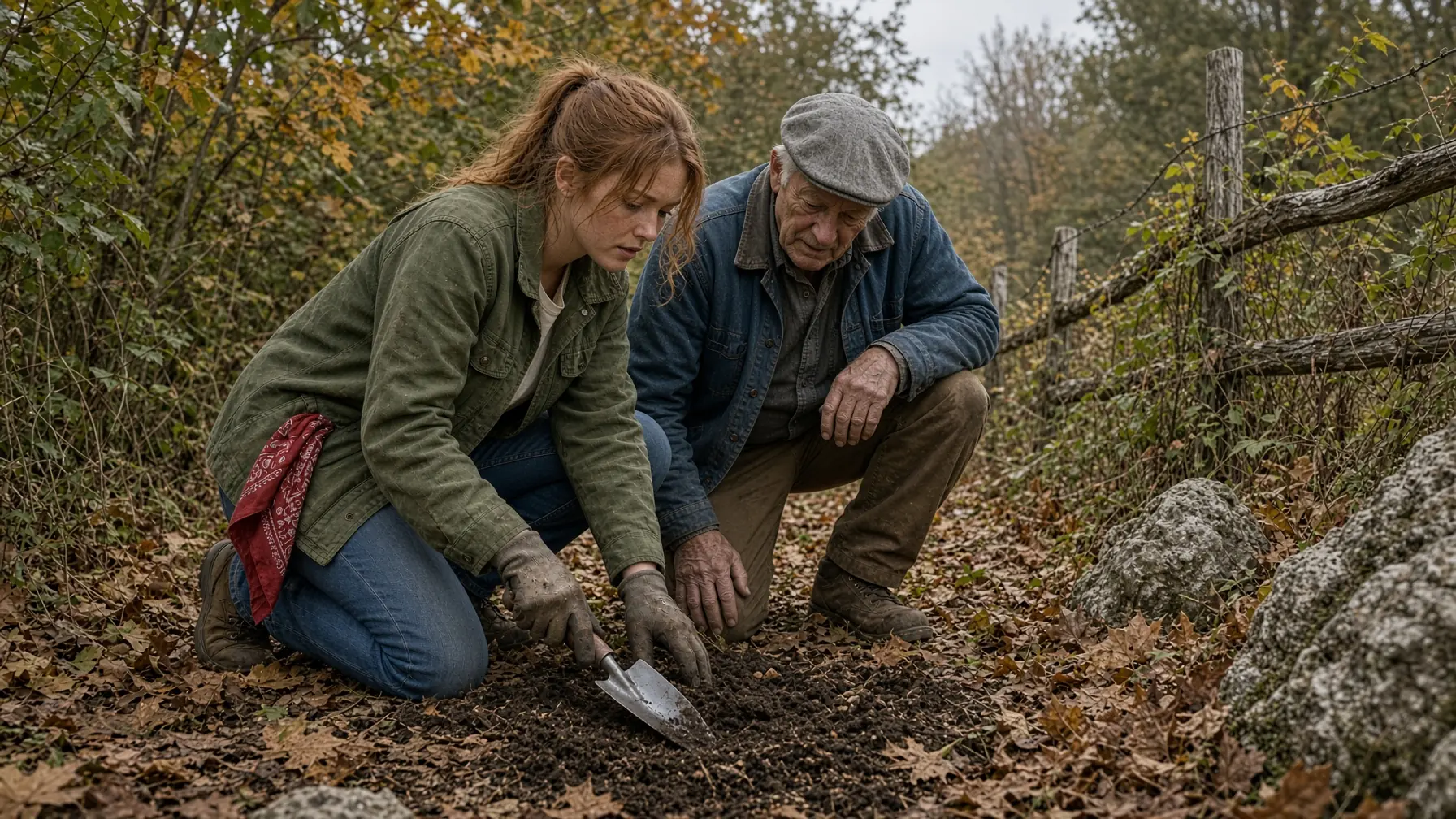
At nineteen, she knew how roots resisted a blade. She knew the sharp refusal of limestone and the hollow scrape of something discarded long ago. This felt different.
She set the trowel aside and worked with her fingers.
A pale neck emerged, followed by a thick, twisted root. It forked beneath her hand, then divided again, with delicate feeder roots disappearing into the dark soil. Maggie widened the opening until she could lift it without tearing those finer strands.
The root lay across her palm, strangely suggestive of a small body.
She smiled.
“Grandpa, look what I just dug up.”
Earl Carter was farther down the fence line, cutting dead blackberry canes away from the wire. He straightened slowly, rested his tool against a post, and came through the brush.
Maggie expected him to identify it, perhaps tell her it was something useless, then return to work. Earl had spent his life making the unfamiliar ordinary.
Instead, he stopped.
She watched the interest leave his face and become something much more serious.
“Hold it still.”
He crouched beside her. His thumb brushed a little soil from the narrow neck. He examined the crowded marks beneath the old stem, then looked at the disturbed ground.
His gaze traveled uphill, downhill, and toward the trail.
“What is it?” Maggie asked.
Earl did not answer immediately. He was seventy-four, with hands that had weathered enough seasons to look almost like the roots themselves, and Maggie had never seen him hesitate over something growing on his own land.
Finally, he looked directly at her.
“If that root is what I think it is, cover the hole back up and don’t say a word to anyone.”
The smile disappeared from her face.
“Grandpa?”
“Loose dirt first. Then the leaves.”
“Why?”
“Do that, and I’ll tell you.”
She obeyed because his voice had changed. Earl rarely made a problem sound bigger than the work required to solve it. A broken fence meant tools. A sick animal meant a call. Bad weather meant preparing before the road became impassable.
He was looking at this root as though someone might come looking for it.
Maggie pressed the soil back into the opening and spread leaves over the disturbed patch. When she sat back, he inspected the ground before looking again at her palm.
“Wild ginseng,” he said.
She glanced down.
“This?”
“Yes.”
She had seen pictures, but the roots in those pictures had been smoother, cleaner, less crooked. This one was dense with creases and thin trailing roots, its neck bent above the heavier body.
“How old?”
Earl rubbed another little patch clean.
“Older than you.”
“That isn’t very impressive.”
He gave her a look.
“Probably older than your mother.”
Maggie stopped smiling.
He showed her the stacked scars near the crown. She tried to count them, lost her place, and started again.