The black Harley-Davidson stopped three miles from the center of Portland on a bright Thursday afternoon. Elena Vasquez twisted the throttle twice, but the engine only coughed before falling silent again. Traffic moved past her while she guided the motorcycle toward the shoulder, her fitted leather jacket quickly becoming uncomfortable beneath the afternoon sun. For several moments, she stood beside the bike and considered calling one of the many people paid to rescue her.
Her security chief would arrive with two vehicles and a mechanic within twenty minutes. Her executive assistant would rearrange every meeting, contact the dealership, and make sure nobody photographed Elena stranded beside the road. Her fiancé, Adrian Cole, would call the incident proof that she should stop riding motorcycles without his permission. Elena wanted none of them near her.
She pushed the Harley instead.
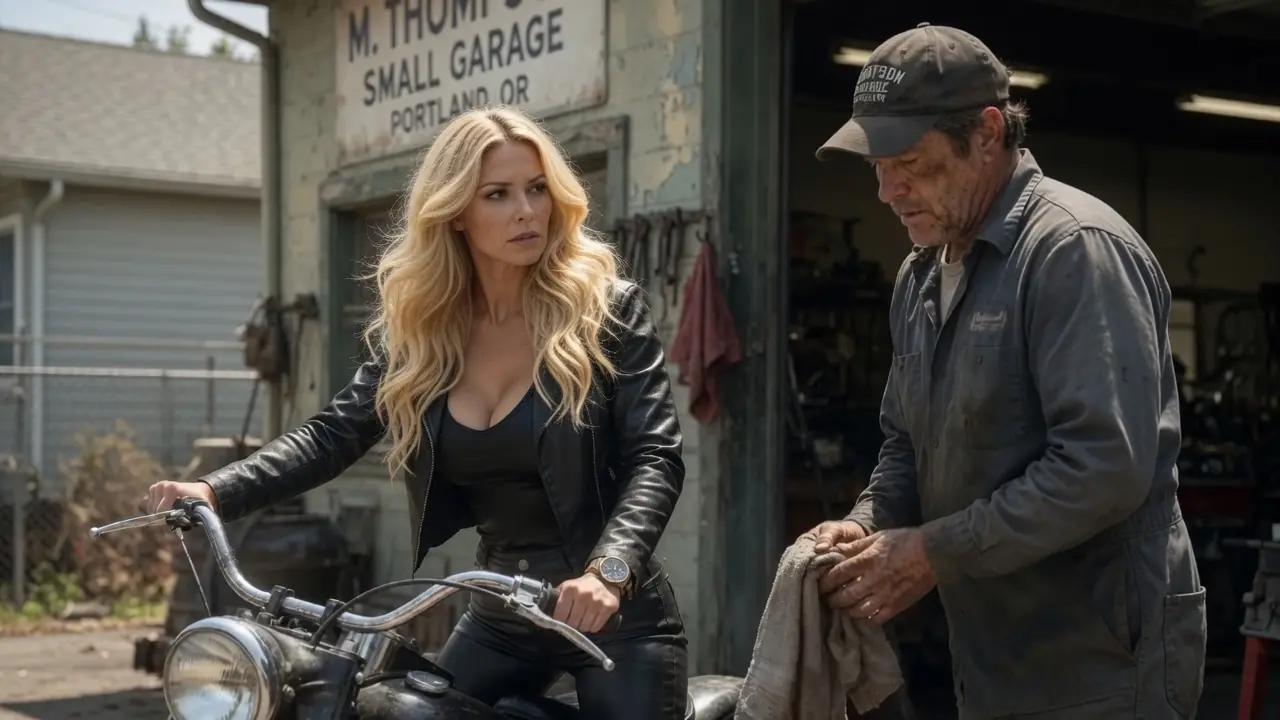
A faded sign appeared beyond a row of warehouses nearly forty minutes later. It read M. THOMPSON SMALL GARAGE in peeling black letters, with PORTLAND, OREGON painted beneath it. The building looked as though it had survived several decades by refusing to admit how tired it was. One service bay stood open, and an old gray pickup rested beside a stack of used tires.
A man in a dark work shirt emerged when he heard the motorcycle rolling across the gravel. He was tall, broad through the shoulders, and covered in the ordinary grease of someone who had been working since early morning. A faded cap shaded his face, and a dirty shop cloth hung from one hand. He looked at the Harley before he looked at Elena.
“Why did you push the Harley here alone?” he asked.
“Because everyone I know wants control,” Elena replied.
The answer made him pause, but he did not ask for an explanation. He walked around the motorcycle, checked the ignition, and crouched beside the fuel system. Elena waited for his attention to move toward her clothing, her face, or the expensive watch partly hidden beneath her sleeve. It never did.
“My name is Marcus Thompson,” he said. “I own the garage.”
“Elena.”
“Just Elena?”
“For now.”
Marcus nodded as though people arrived under incomplete names every day. He wheeled the Harley into the open service bay and placed it on a stand. Elena followed, watching him remove a panel and inspect the fuel line with steady hands. The garage smelled of rubber, motor oil, and old metal heated by the sun.
A child’s backpack sat near the office door. Beside it was a lunch box decorated with silver stars and a pair of small pink headphones. Several drawings had been taped above the workbench, including one of Marcus standing beside a red car while a little girl held an enormous wrench. Elena noticed that the word DADDY had been written above his head.
“Your daughter?” she asked.
Marcus glanced toward the drawings. “Sophie. She’s eight.”
“Does she work here?”
“She believes she is management.”
Elena smiled despite herself. “That sounds expensive.”
“She accepts payment in grilled cheese.”
Marcus loosened the fuel line and found the obstruction within minutes. Dirt and residue had gathered near the filter, preventing enough fuel from reaching the engine. The problem was simple, but Elena knew many mechanics would have invented a larger repair after seeing the motorcycle. She had once been charged four thousand dollars for work that later proved unnecessary.
Marcus cleaned the line, replaced the filter, and tested the flow. He never asked what Elena did for a living or why her boots cost more than most people’s monthly rent. When the engine started again, its deep sound filled the service bay. Marcus listened for several seconds before switching it off.
“It’s fixed,” he said. “Fifty dollars.”
Elena stared at him. “Fifty?”
“The filter was twenty-two. The rest is labor.”
“That is all?”
“That is what the job cost.”
She opened the leather bag hanging across her shoulder and removed several hundred-dollar bills. Marcus accepted one, walked into the office, and returned with exact change. Elena held out the remaining bills.
“For your discretion.”
Marcus looked at the money but did not take it. “Discretion about what?”
“You saw me arrive alone.”
“I see people arrive alone every day.”
“You did not recognize me?”
“No.”
Elena should have felt relieved. Instead, she felt strangely offended and then embarrassed by the feeling. Her face appeared regularly in business magazines, financial broadcasts, and charity reports. She had spent years resenting people who recognized her, yet part of her had forgotten what it felt like to be completely unknown.
“My name is Elena Vasquez,” she said.
Marcus waited.
“Vasquez International Holdings.”
“I’m not familiar with it.”
“We own hotels, technology companies, medical properties, and several shipping firms.”
“That sounds busy.”
Elena laughed once. Marcus’s lack of reaction seemed too natural to be performed. He picked up his tools and wiped the gasoline from his hands.
“Most people change the moment they know,” she said.
“I fixed the motorcycle before I knew.”
“And now?”
“Now it is still fifty dollars.”
Elena studied him carefully. Adrian often spoke about honesty, but every honest thing he said had been rehearsed for a boardroom, investor dinner, or camera. Marcus’s honesty had grease under its fingernails and no interest in being admired. She placed the extra money back into her bag.
“Thank you,” she said.
Marcus nodded toward the Harley. “Where are you heading?”
Elena placed one hand on the handlebar. “I don’t know.”
“That is usually a bad destination.”
“I left my engagement party this morning.”
Marcus’s expression remained neutral, but he stopped arranging his tools. “Does your fiancé know?”
“He knows I left.”
“Does he know why?”
“He knows exactly why.”
Elena had awakened that morning inside a mansion filled with white flowers, hired musicians, and two hundred guests she had never invited. Adrian had organized the engagement celebration without asking her, then announced that their wedding would take place in six weeks. He had also presented a proposed merger placing several Vasquez companies beneath a new holding structure controlled by both families.
Except the documents gave Adrian effective control.
When Elena questioned him privately, he told her marriage required trust. He reminded her that investors preferred stable leadership and that a woman approaching forty should appreciate a man willing to protect her legacy. Then he placed his hand around her wrist and refused to release it until she promised to sign.
Elena had walked upstairs, changed into riding clothes, and left through the service entrance.
“I thought I loved him,” she told Marcus.
“Maybe you did.”
“That is not comforting.”
“It is not meant to be. Loving someone does not make what they do acceptable.”
Elena looked toward the open garage door. She could already imagine Adrian’s people searching highways, hotels, and airports. They would never think to search a small neighborhood garage. For the first time that day, she felt able to breathe without someone reporting it.
A school bus stopped near the end of the street. A little girl with brown hair and a purple backpack climbed down, then ran toward the garage. Marcus’s entire posture changed when he saw her. He stepped outside, took the backpack, and listened seriously while she described an injustice involving colored pencils.
Sophie noticed Elena and stopped.
“Who is she?” the girl asked.
“A customer.”
Sophie looked at the Harley. “Did Dad fix it?”
“He did.”
“He fixes everything.”
Marcus shook his head. “That is not true.”
“You fixed the toaster.”
“After I broke it worse.”
Sophie entered the garage and placed her lunch box beside the office. She studied Elena’s motorcycle with open admiration, then looked at Elena’s leather clothing. Unlike most adults, the child showed neither envy nor suspicion.
“Are you a biker?” Sophie asked.
“Sometimes.”
“Do you fight bad people?”
“Not usually.”
“You look like you could.”
Elena smiled. “I may need to start.”
Marcus glanced at her, understanding more than Sophie did. He asked his daughter to begin her homework in the office. Sophie obeyed after negotiating for a snack and permission to use the good pencils.
Elena checked her phone for the first time since arriving. Thirty-seven missed calls covered the screen. Most came from Adrian, her assistant, the board chairman, and her security chief.
A new message appeared while she watched.
Come home now. You are humiliating both families.
Another followed.
The board meets tomorrow. If you are absent, I will explain your instability myself.
Elena turned the phone facedown.
“You have somewhere safe to stay?” Marcus asked.
“I own twelve homes.”
“That was not the question.”
The directness startled her.
Elena’s primary residence had staff loyal to Adrian. Her penthouse was monitored by corporate security. Her family estate had been converted into a venue managed by people who reported every visitor. She possessed more property than most cities, yet she could not name one place where nobody would open the door for the man she had escaped.
“No,” she admitted.
Marcus did not immediately offer his home, and Elena respected him for that. Instead, he wrote the name of a small hotel owned by an elderly couple near his neighborhood. He called the owner, confirmed that one room remained, and asked them not to share guest information with anyone.
“It is not luxurious,” he warned.
“That may be what I need.”
Marcus watched her put on her helmet. “Do not let anyone follow you.”
“I thought you did not know who I was.”
“I know enough now.”
Elena left before sunset.
The hotel room contained a narrow bed, an old television, and curtains printed with blue flowers. Elena had slept in private villas overlooking oceans and penthouse suites where every window responded to voice commands. Yet the modest room felt safer than any property carrying her surname.
She remained there for three nights.
During the day, Elena spoke with attorneys who had no connection to Adrian or either family. They confirmed that the merger documents would have given him control over several core companies. They also discovered that Adrian had already contacted directors, describing Elena as emotionally exhausted and increasingly unstable.
The story had been prepared before she ran.
By Saturday morning, business websites reported that Elena had disappeared during an apparent personal crisis. Adrian released a statement asking the public to respect her privacy while he worked with the Vasquez board to ensure corporate stability. His concern looked convincing in photographs.
Elena wanted to expose everything immediately. Her attorneys advised patience because Adrian had positioned loyal directors throughout the company. Without clear evidence, any accusation would become another sign of instability.
She rode back to Marcus’s garage.
He was repairing a delivery van while Sophie arranged bolts by size near the workbench. Neither acted surprised to see her. Marcus pointed toward a folding chair and continued working.
“Why did you come back?” he asked.
“Because you did not ask me to.”
“That is an unusual reason.”
“Most people never stop asking.”
Sophie brought Elena a bottle of water. She then showed her a drawing of the Harley with flames painted along the fuel tank. Elena promised to consider the design.
Over the next two weeks, Elena returned almost every afternoon. Sometimes she brought lunch, although Marcus insisted on paying for his portion. Sometimes she sat quietly while he worked, taking board calls from a plastic chair beside the tire rack. For the first time in years, she participated in meetings where nobody could see the room surrounding her.
Marcus never interrupted unless she asked for his opinion. When she described Adrian’s plan, he listened without pretending to understand corporate law. When she explained how every relationship in her life had become attached to business interests, Marcus said something that remained with her.
“Maybe you keep choosing people who need the billionaire,” he said, “because letting someone meet Elena feels more dangerous.”
She did not answer.
Marcus understood hiding in a different way. His wife, Rebecca, had died four years earlier after a long illness. Medical bills consumed their savings, forcing Marcus to sell a larger garage and move into the smaller building he now rented. He raised Sophie alone while working six days a week and sleeping lightly enough to hear every sound from her room.
He did not describe himself as lonely.
Elena could see it anyway.
One evening, Sophie fell asleep in the office while Marcus completed a transmission repair. Elena carried the child to the old sofa, covered her with a shop jacket, and sat beside her until Marcus finished. When he looked through the office window and saw them together, something unspoken passed across his face.
“You are good with her,” he said later.
“I have never been around children.”
“She likes you.”
“She likes the motorcycle.”
“She asked whether you could come to her school presentation.”
Elena looked down. “People may photograph me.”
“Sophie does not care.”
“I do.”
Marcus leaned against the workbench. “Because of Adrian?”
“Because everyone close to me becomes part of a story they did not choose.”
“Then let Sophie choose.”
Elena attended the presentation.
She wore plain trousers, a dark coat, and no visible jewelry. Sophie stood beside a cardboard model of an engine and explained how fuel, air, and ignition worked together. When another student asked why she knew so much, Sophie proudly announced that her father could repair anything except relationships.
Marcus nearly dropped the paper cup in his hand.
Elena laughed harder than she had in years.
The photographs still appeared online. A parent recognized Elena and posted an image of her standing beside Marcus and Sophie. By evening, Adrian’s private investigator had identified the garage.
He arrived the next morning in a black sedan with two attorneys and a security officer.
Marcus was opening the bay when Adrian stepped onto the gravel. He wore a tailored gray suit and carried himself with the confidence of a man who expected every unfamiliar place to submit to him. His eyes moved across the garage with visible contempt.
“Where is Elena?” he asked.
Marcus set down his coffee. “Why are you asking me instead of her?”
Adrian smiled without warmth. “Because she is confused, and you appear to be taking advantage of that confusion.”
“She has seemed clear every time I’ve spoken to her.”
“You repaired a motorcycle and suddenly gained access to a billionaire.”
“I repaired a clogged fuel line.”
Adrian glanced toward Sophie, who stood inside the office. “Men in your position often mistake attention from wealthy women for opportunity.”
Marcus stepped between him and the doorway. “Do not speak about my daughter or my position again.”
The security officer moved forward, but Adrian raised a hand.
Elena arrived before the confrontation escalated. She parked the Harley beside Marcus’s pickup and removed her helmet. Adrian immediately shifted into the gentle public expression he used for cameras.
“Elena, come home.”
“Why?”
“Because this performance has gone far enough.”
“It stopped being a performance when you tried to take my companies.”
Adrian’s eyes narrowed. “We were building a future.”
“You were building control.”
He gestured toward Marcus. “And this mechanic gave you better advice?”
“Marcus never asked me for anything.”
“That is because he is waiting.”
Marcus remained silent, allowing Elena to answer.
She walked closer to Adrian. “You believe every act of kindness hides a negotiation because yours always did.”
One attorney opened a folder and handed Elena a document. The board had scheduled an emergency vote that afternoon to place Adrian in temporary executive control while Elena underwent an independent medical evaluation. Adrian assured her the vote could be canceled if she returned and signed the merger agreement.
Elena looked at the paper and laughed quietly.
“You planned this before I left.”
“I planned for the possibility that you would become unreasonable.”
“You mean disobedient.”
Adrian lowered his voice. “Do not destroy your legacy over a man who charges fifty dollars to clean fuel lines.”
Elena tore the document in half.
The board meeting proceeded without her physical presence, but Elena joined through a secure connection from Marcus’s office. Her attorneys presented the original merger structure, messages in which Adrian discussed removing her, and records showing he had paid investigators to collect private information on several directors. Elena also submitted a recording from the engagement party.
She had activated her phone when Adrian grabbed her wrist.
His voice filled the virtual meeting room, calmly explaining that Elena’s companies would become manageable once she stopped believing independence was attractive. He told her nobody respected an unmarried woman with too much power and warned that the board would accept him before it accepted an unstable heiress.
Several directors who had supported Adrian withdrew immediately.
The vote failed.
A second motion removed Adrian from every advisory role connected to Vasquez International Holdings. An independent investigation began into his access to company records and his coordination with directors who concealed financial interests. The business empire he expected to control closed its doors to him within a single afternoon.
Adrian remained outside the garage while the decision was announced. His attorneys received the notice before he did. For the first time since Elena had known him, he appeared unable to control his expression.
“You will regret humiliating me,” he said.
Elena met his stare. “You are finally going to pay for what you did.”
Adrian looked toward Marcus. “You think he loves you?”
“I never asked him to.”
“Then what exactly are you choosing?”
Elena turned toward Sophie, who watched from the office window, and then toward Marcus. “A life where nobody has to own me to stay.”
Adrian left.
The investigation later revealed that he had used confidential information to benefit private investors tied to his family. He lost two board positions, several consulting contracts, and the reputation that had protected him for years. Elena refused every request for a private settlement that required silence.
She did not return immediately to her old life.
Elena moved into a smaller house near the garage while restructuring her companies. She replaced directors who believed control was more valuable than accountability and created stronger protections against conflicts of interest. She also began riding without informing the world where she was going.
Marcus refused her offer to purchase the garage building for him. He accepted only after she proposed a fair business loan with written terms, normal interest, and no personal conditions. With the money, he bought the property, repaired the roof, and hired another mechanic.
Their relationship changed slowly.
Elena began staying for dinner after the garage closed. Sophie taught her how to make grilled cheese without burning the bread, while Marcus learned that Elena could negotiate international deals but could not assemble inexpensive furniture. They argued over money, privacy, and Elena’s habit of solving emotional problems with contracts.
Once, after she secretly paid six months of Marcus’s mortgage, he returned the money.
“I was helping,” she insisted.
“You were removing my choice.”
The words hurt because they echoed the control she had escaped. Elena apologized without defending herself. A month later, when Marcus needed help buying new diagnostic equipment, he asked her to review the financing agreement instead of asking her to pay.
That request meant more to her than any expensive gift.
A year after the Harley broke down, Elena rode into the garage wearing the same black leather jacket. Marcus stood beside the workbench holding the original clogged filter inside a small glass box. Sophie had attached a handwritten label beneath it.
THE PART THAT BROKE SO OUR FAMILY COULD START.
Elena stared at the words.
“Family?” she asked.
Sophie looked at Marcus. “Was I supposed to wait?”
Marcus sighed. “Apparently not.”
Elena turned toward him. Fear moved through her before happiness could reach her face. She had spent so much of her life believing love became dangerous the moment someone named it. Marcus seemed to understand exactly what she was thinking.
“I do not want your company, your houses, or your name,” he said. “I want you to stop leaving whenever being loved feels real.”
Elena looked toward the open garage door, where the Harley waited beneath the afternoon sky. She could have started the engine and disappeared as she had done before. Nobody stood in her way.
That freedom was what allowed her to stay.
She stepped forward and took Marcus’s hand.
“I am still learning how,” she admitted.
“So am I.”
Sophie wrapped both arms around them before either adult could say more.
The Harley had brought Elena to the garage because of a clogged fuel line, not fate, magic, or some perfect design. Marcus had fixed it for fifty dollars because that was what the work cost. He had treated Elena with respect before knowing her wealth and challenged her without trying to control her.
That honesty became the first safe place she had ever found.
Years later, the garage sign was restored but not replaced. It still read M. THOMPSON SMALL GARAGE, although the building had expanded to three service bays and a training program for single parents learning skilled trades. Elena’s name appeared nowhere on the front.
She never needed it there.
Her place was inside, usually beside the black Harley, arguing with Marcus about maintenance while Sophie managed both of them with increasing authority. Elena had once believed love was something people used to reach her fortune. Marcus and Sophie taught her that real love did not reach for what she owned.
It simply made room for who she was.