Ruth Calloway did not cry when her mother raised the riding switch above her.
She was twenty-three years old, kneeling in the dusty yard behind the collection of rough timber cabins that made up the poorer edge of Millhaven, Colorado. Her faded beige blouse had torn along one shoulder during the morning’s work, her long dirty-blonde braid hung across her chest, and dust clung to the rough brown skirt wrapped around her knees. Behind her, Harriet Calloway stood red-faced beneath a plain headscarf, one hand gripping the switch while she shouted loudly enough for half the settlement to hear.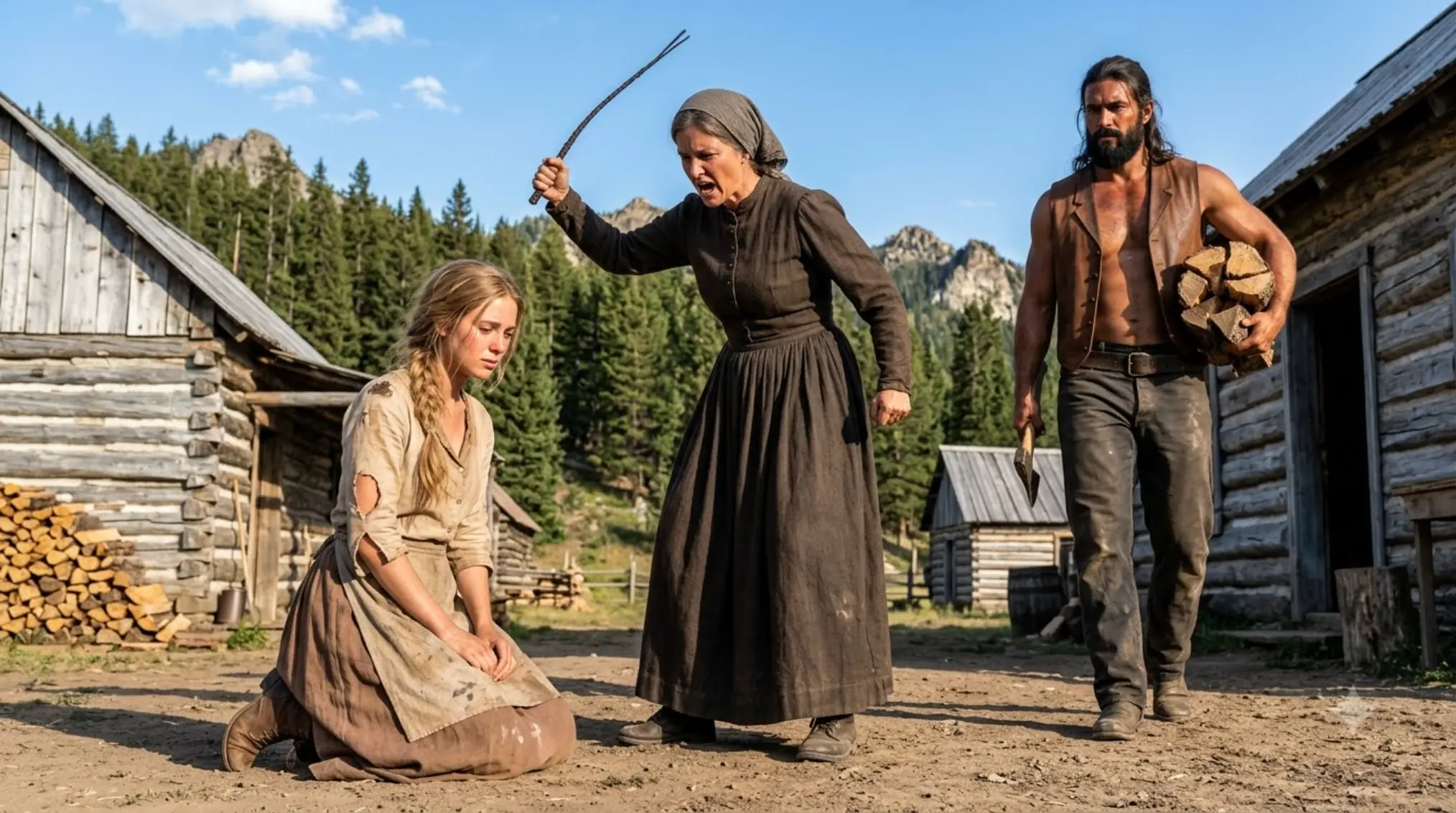
“Get up!” Harriet snapped. “Nobody wants a useless girl who runs from work!”
Ruth pressed one hand against the ground and slowly pushed herself upright.
Years earlier, she would have apologized.
She would have promised to work harder.
She would have lowered her eyes and waited for Harriet’s anger to pass.
That morning, something inside Ruth had finally become still.
“Then keep your house,” Ruth said, wiping dust from her palms. “I’d rather leave with nothing than stay beneath you.”
Harriet stared at her.
Then she kicked Ruth’s battered canvas bag away from the porch.
The bag rolled into the dirt.
“Walk out that gate and you’ll be begging me to take you back by sundown!”
Ruth looked toward it.
Everything she owned was inside.
Two worn dresses.
Her grandmother’s Bible.
A comb.
A small knife given to her by the telegraph operator’s wife.
Forty-seven cents.
It was not much of a life to carry in one bag.
But it was hers.
Ruth stepped toward it.
That was when an armful of split firewood crashed into the dirt behind Harriet.
Both women turned.
A man was walking toward them from the neighboring woodpile.
He was perhaps thirty-six, tall and heavily built, with deeply tanned skin, long dark-brown hair brushing his shoulders, and a thick black beard framing a face that looked as though it had spent most of its life beneath open skies. He wore dusty trousers and an open brown leather work vest, and a small wood axe hung loosely in one hand.
His expression was not angry.
That somehow made Harriet hesitate more than anger would have.
“Who are you?” she demanded.
The man stopped beside Ruth’s bag.
“Eli Harlan.”
Ruth recognized the name immediately.
Harlan Mountain Ranch.
She had seen his handwritten notice outside the feed store weeks earlier.
Cook and ranch help wanted. Board and fair wages provided.
She had memorized every word without understanding why.
Harriet lifted her chin.
“This is family business.”
Eli glanced at Ruth.
Then at the switch.
“Doesn’t look much like family from here.”
Harriet’s face twisted.
“You stay out of this.”
Ruth expected Eli to argue.
Instead, he bent down and picked up her bag.
Then he looked at Ruth.
“You looking for work?”
She blinked.
“Yes.”
“You cook?”
“Yes.”
“Keep accounts?”
“Yes.”
“Know horses?”
“I grew up around them.”
Eli nodded once.
“Then I might have work.”
Harriet laughed sharply.
“You don't want her.”
Eli looked toward her.
Harriet pointed at Ruth as though discussing livestock.
“She eats too much, talks back, and thinks she’s smarter than she is.”
Eli’s gaze returned to Ruth.
“You think you're smarter than you are?”
Ruth almost smiled.
“No.”
“Good.”
He handed her the bag.
“People who think that are exhausting.”
Harriet stepped toward them.
“You take one more step toward that road and don't come back!”
Ruth looked at her mother.
For years she had imagined the moment she finally left.
In those fantasies, she gave speeches.
She listed every insult.
Every humiliation.
Every morning she had awakened already afraid.
Standing there now, Ruth realized she wanted none of it.
Harriet had taken enough of her time.
“I wasn't planning to.”
She picked up her bag.
And followed Eli toward the mountain road.
Harlan Mountain Ranch sat nearly ten miles above Millhaven, tucked against a high shelf of land surrounded by pine forest and a narrow creek.
Eli owned a wagon, but they walked the first mile because one of his horses had thrown a shoe that morning.
Ruth expected questions.
Why had her mother treated her that way?
Where was her father?
Why had she stayed so long?
Eli asked none.
After nearly twenty minutes he finally spoke.
“You hungry?”
Ruth looked at him.
“I’m fine.”
“That wasn’t the question.”
She hesitated.
“Yes.”
Eli removed a cloth-wrapped bundle from his pack.
Bread.
Cheese.
Dried meat.
He handed it to her.
Ruth automatically broke off only a small piece.
Eli noticed.
“There’s more.”
“This is enough.”
Her stomach betrayed her with an unmistakable growl.
Ruth’s face burned.
Eli simply handed her another piece of bread.
No joke.
No comment about her appetite.
No judgment.
“Eat.”
She did.
The word should not have mattered.
It did.
They reached the ranch late in the afternoon.
Ruth stopped at the edge of the yard.
A sturdy two-story timber house overlooked a green pasture, while a barn and corral stood nearby. A narrow kitchen garden ran along the southern wall, and beyond it the creek disappeared among cottonwoods before bending toward the neighboring valley.
It was not wealthy.
But it was cared for.
Eli pointed toward the house.
“There’s a room in back.”
“For me?”
“Yes.”
“How much comes from my wages?”
“Nothing.”
Ruth stared at him.
“Board was in the notice.”
“You actually meant that?”
Eli looked confused.
“Why would I write it if I didn't?”
Ruth had no answer.
He led her inside.
The room contained a narrow bed, a wooden dresser, a washbasin, and one window overlooking the creek.
Nothing fancy.
Ruth stood beside the window longer than necessary.
Eli remained near the doorway.
“If you decide you don't want the work, I'll take you back to town.”
She turned sharply.
“You’d let me leave?”
He frowned.
“You’re an employee, Ruth.”
The simplicity of it struck her.
Not property.
Not obligation.
Employee.
“You work. I pay you. Either of us can end the arrangement.”
Ruth slowly placed her bag beside the bed.
“When do I start?”
“Tomorrow.”
“I can start tonight.”
Eli almost smiled.
“I thought you might say that.”
The first meal Ruth prepared consisted of beans, fried potatoes, biscuits, and pork gravy.
Eli came inside after dark with mud on his boots and exhaustion in his shoulders.
He sat.
Took one bite.
Then another.
Ruth waited by the stove.
“Well?”
Eli looked at her.
“You expecting criticism?”
“I’m expecting an opinion.”
He ate another biscuit.
“These are good.”
That was all.
No exaggerated praise.
No insult hidden inside a compliment.
Just the truth.
Ruth found herself smiling after she turned away.
Three days became a week.
Ruth worked hard because hard work was familiar.
What felt unfamiliar was what did not happen.
When she overslept once, nobody shouted.
When she dropped a jar, Eli swept the glass while she cleaned the spilled beans.
When she disagreed with how he stored feed, he listened to her reasoning.
When she offered to carry a heavy grain sack and he took the other end, he did not say she was too weak.
“We can both carry it,” he said.
That sentence stayed with her.
She began recognizing how much of her old life had been built around proving she deserved basic things.
Food.
Sleep.
A chair.
A roof.
At Harlan Ranch, those things were simply part of living.
By the second week, Ruth discovered another problem.
Eli’s accounts were a disaster.
Not dishonest.
Neglected.
Receipts had been stuffed into a drawer.
Supply payments were written on scraps of paper.
Several deliveries did not match what he had actually received.
Ruth spent one evening organizing everything.
Eli came inside and found columns of figures covering the kitchen table.
“What happened here?”
“Your bookkeeping happened here.”
“I have bookkeeping?”
“Technically.”
He sat across from her.
“How bad?”
“You've been overpaying Caldwell Feed almost twelve percent.”
His eyebrows rose.
“For how long?”
“From what I can reconstruct, fourteen months.”
Eli rubbed his beard.
“You sure?”
Ruth looked offended.
“Yes.”
He smiled faintly.
“Thought so.”
She handed him another sheet.
“And somebody named Silas Calhoun has offered three separate times to purchase your eastern pasture.”
Eli’s expression changed.
“That’s different.”
“How?”
“Calhoun wants the whole ranch.”
Ruth looked up.
“Why?”
“Water.”
He pointed toward the creek.
“My land controls the cleanest upstream access for four ranches below us.”
“And you won't sell.”
“No.”
Ruth studied him.
“What has he done?”
Eli was quiet.
“Pressure.”
“What kind?”
“Offers. Rumors. Men showing up where they shouldn't.”
Ruth looked toward the window.
She knew that language.
Pressure.
Isolation.
Making someone believe surrender would be easier than resistance.
“How long?”
“Two years.”
“Why haven't the other ranchers done anything?”
“They think their problems are separate.”
Ruth looked back at him.
“They aren't.”
Eli leaned against his chair.
“You figured that out quickly.”
“I've met people who control others before.”
She did not need to say Harriet’s name.
Eli understood.
The first men arrived three days later.
Decker and Webb.
Both worked for Calhoun.
Ruth saw them approaching while she was hanging laundry.
Decker dismounted without invitation.
“Pretty lonely place for a young woman.”
Ruth continued hanging a shirt.
“Mr. Harlan is working the south fence.”
Decker looked her over.
“Calhoun heard Harlan finally hired company.”
“I’m hired help.”
“Sure.”
His smile made the word unpleasant.
Ruth stopped.
“You can wait at the front fence.”
“Excuse me?”
“Mr. Harlan doesn't allow uninvited riders inside the yard.”
Decker laughed.
“You speaking for him now?”
“No.”
She looked directly at him.
“I’m speaking for the gate.”
Something changed in his face.
He was not accustomed to women answering calmly.
Ruth held his gaze.
Finally Decker stepped backward.
“We'll wait.”
Ruth found Eli.
When she told him what happened, he almost smiled.
“You put Decker outside the gate?”
“Yes.”
“He didn't like that.”
“I noticed.”
They walked back together.
Eli did not open the gate.
“What does Calhoun want?”
Decker explained that the kitchen-garden diversion supposedly reduced downstream water.
Eli shook his head.
“Twelve feet of irrigation doesn't affect property three miles south.”
“Calhoun disagrees.”
“Then he can disagree before the county assessor.”
Decker glanced at Ruth.
“A man with new company might want to avoid legal trouble.”
Eli’s voice became colder.
“You’d best ride.”
The men left.
Ruth watched them disappear.
“This isn't about water,” she said.
“No.”
“It’s about making you feel alone.”
Eli looked at her.
“Yes.”
Ruth crossed her arms.
“Then stop being alone.”
That sentence changed everything.
They started a ledger the following morning.
Every visit.
Every rumor.
Every offer.
Every threat.
Dates.
Times.
Names.
Exact language whenever possible.
Eli watched Ruth write.
“You write like a lawyer.”
“I write like someone who learned vague memories don't protect anyone.”
He poured coffee.
“Who taught you that?”
“My mother.”
Eli stopped.
Ruth continued writing.
“Just not intentionally.”
Calhoun changed tactics.
First came a pastor from Millhaven questioning the propriety of Ruth living at the ranch.
Ruth listened politely.
Then asked one question.
“Pastor, I sat in your church for twenty-three years. How many times did you ask why I arrived with marks hidden beneath my collar?”
The pastor went silent.
Ruth nodded.
“If the town suddenly cares about my welfare now that I'm safe, forgive me for questioning the timing.”
He left without speaking to Eli.
Then came a rumor that Ruth had stolen from the dry-goods store.
Ruth contacted her former employer.
Mr. Henley publicly confirmed every cent had been accounted for.
Then Decker came again.
This time when Eli was away.
He entered through the side gate.
Ruth found him standing near the porch.
“You're trespassing.”
“I brought you an opportunity.”
He handed her an envelope.
Inside was a train ticket to Denver and enough cash for several months.
Ruth stared at it.
“Calhoun thinks you’d be happier somewhere else.”
Ruth held the envelope toward him.
“Take it back.”
Decker smiled.
“You really think Harlan is worth this trouble?”
“I didn't say anything about Eli.”
“What are you staying for, then?”
Ruth looked around.
Garden.
House.
Barn.
Open mountains.
“The fact that leaving is my decision.”
Decker’s smile disappeared.
“Take the money.”
“No.”
“You arrived with nothing.”
“Yes.”
“And you’ll leave with nothing.”
Ruth stepped closer.
“I arrived with myself.”
She pushed the envelope against his chest.
“That turned out to be enough.”
Decker left angry.
Ruth wrote everything down.
That evening, Eli returned.
When Ruth told him, his face hardened.
“He came here when I was gone?”
“Yes.”
“I’m going to Calhoun’s.”
“No.”
Eli stared at her.
“He came onto my land and threatened you.”
“And he wants you angry.”
“I am angry.”
“I know.”
Ruth stepped closer.
“If you ride there alone, you're doing exactly what he planned.”
Eli’s jaw remained tight.
“What do you suggest?”
“Neighbors.”
He looked at her.
“Dawson. Hicks. Fernley. You said Calhoun pressured all of them.”
“Yes.”
“Then bring them here.”
Eli considered.
“Together.”
“Yes.”
Ruth’s voice softened.
“People like Calhoun survive because everybody thinks they’re fighting alone.”
Eli looked at her for a long time.
Then nodded.
“Saturday.”
“I’ll cook.”
That almost made him laugh.
Eight people sat around the Harlan kitchen table Saturday morning.
Ruth served biscuits, eggs, potatoes, beans, and coffee.
Then the papers came out.
Dawson had lost cattle under suspicious circumstances.
Hicks found his fence deliberately cut.
Fernley’s irrigation ditch had been blocked days after he rejected Calhoun’s purchase offer.
Separate events became a pattern.
Ruth opened the ledger.
Martha Dawson stared at it.
“You recorded everything?”
“Yes.”
“Since when?”
“The first visit.”
Martha looked around the table.
“We should all have been doing this.”
Ruth nodded.
“Start today.”
Eli spread his land deed beside the entries.
“We take everything to the territorial office.”
Fernley looked uneasy.
“Calhoun will know.”
Ruth answered.
“Good.”
Everyone looked toward her.
“He already believes we're afraid.”
She closed the ledger.
“Let him learn he miscalculated.”
The fire came that night.
Ruth woke to smoke.
Not fireplace smoke.
Outside smoke.
She ran barefoot into the hallway.
Eli emerged simultaneously.
They reached the yard and saw flames moving along the southern fence toward the barn.
“Get the horses!”
Eli ran.
Ruth grabbed buckets.
Well.
Fence.
Well.
Fence.
Again.
Again.
Her arms screamed.
Then she remembered the irrigation ditch.
“Eli!”
He turned.
“The garden channel!”
They broke the berm with shovels.
Water rushed across the dry grass.
Together they redirected it toward the flames.
Forty minutes later, the last fire died.
The barn survived.
The horses survived.
Ruth stood covered in soot and mud.
Eli stared at the burned fence.
“He'll keep going.”
“Yes.”
Eli looked at her.
“How scared are you?”
Ruth considered.
“Enough to prepare.”
“And enough to leave?”
“No.”
Something powerful moved across his face.
Ruth looked toward the blackened timber.
“He burned the fence because he wants us repairing instead of filing.”
Eli understood immediately.
“You want to go tomorrow.”
“Today.”
“It’s four in the morning.”
“Then we leave at dawn.”
He almost smiled.
“You're impossible.”
“I've heard worse.”
At sunrise, neighboring riders arrived.
With them came Deputy Marshal Clara Voss.
She had already been investigating Calhoun.
Ruth’s ledger changed the case.
Rumors.
Intimidation.
Attempted bribery.
Trespassing.
Now arson.
Voss read every page.
When she finished, she looked at Ruth.
“You did this yourself?”
“I wrote down what happened.”
“That is precisely what most people fail to do.”
Voss tucked the ledger inside her coat.
“I’ll copy it.”
Ruth immediately said, “Original comes back.”
Voss smiled.
“I thought you might say that.”
Then she revealed something else.
Decker had spoken to Harriet.
Ruth’s mother had provided statements painting Ruth as unstable and dishonest.
Ruth sat completely still.
Eli stood several feet away.
Not interfering.
Not answering for her.
Just there.
“My mother helped them?”
“She may not have understood Calhoun’s purpose,” Voss said. “But yes.”
Ruth closed her eyes.
Harriet had reached even here.
Then Ruth opened them.
“What do we do?”
Voss smiled slightly.
“Exactly what you've already been doing.”
They filed the evidence at the county seat.
Calhoun responded with a challenge against Eli’s original land survey.
Then someone entered the Harlan house while they were gone.
A surveyor’s letter disappeared.
The original document proved the creek boundary had been established legally.
Without it, Calhoun believed he could create months of delay.
Eli stared into the empty document box.
“He won.”
“No.”
Ruth opened drawers.
One.
Two.
Three.
Inside an old household account book she found pages written by Eli’s late wife, Sarah.
Ruth turned them carefully.
Then stopped.
There it was.
A handwritten copy of the missing surveyor’s letter.
Eli took the book.
His hands trembled slightly.
“Sarah copied important papers.”
Ruth looked at him.
“She protected the ranch.”
“From twelve years away.”
For a moment Eli could not speak.
Ruth gave him the silence.
Then she said:
“Let's make sure it works.”
They rode straight to the lawyer.
The copied letter was authenticated.
The original surveyor was located.
Still alive.
Still sharp enough to remember the creek bend personally.
He provided sworn testimony.
Calhoun’s legal challenge began collapsing.
Then Harriet arrived at the Harlan gate.
Ruth almost did not recognize her mother.
Harriet looked smaller.
Older.
“I didn't know what Decker wanted.”
“You didn't ask.”
Harriet lowered her head.
“No.”
Ruth waited.
“I told him things that weren't true.”
“Yes.”
“I was angry.”
“Yes.”
Harriet looked toward the house.
“I suppose you want an apology.”
Ruth thought carefully.
“No.”
Harriet seemed shocked.
“I want you to correct the statement.”
“What?”
“There’s a lawyer named Harmon Reed.”
Ruth held her mother’s gaze.
“You told lies that hurt people who never harmed you. Correct them.”
Harriet’s eyes filled.
“And after?”
“I don't know.”
“Will you forgive me?”
“I don't know.”
It was perhaps the first time Ruth had ever answered her mother without fear or obligation.
Harriet slowly nodded.
“I’ll go.”
She rode away.
Eli appeared from the barn.
“You all right?”
Ruth watched the road.
“Ask me tonight.”
“I will.”
That evening he did.
And Ruth surprised herself.
“Yes.”
She meant it.
Within two months, the case against Calhoun was impossible to dismiss.
Decker cooperated.
He admitted the attempted bribe.
The trespassing.
The pressure campaign.
And finally the fire.
Calhoun was charged.
His land challenge disappeared.
The water rights were permanently confirmed.
For the first time in years, Harlan Mountain Ranch became quiet without that quiet feeling like danger.
One evening Ruth sat at the kitchen table reviewing the final entries.
Eli stood near the window.
“It’s over.”
“The Calhoun part.”
He turned.
“What other parts?”
Ruth slowly closed the ledger.
“I came here because I needed somewhere to go.”
Eli waited.
“I stayed because I wanted to.”
His face softened.
Ruth continued.
“I don't think of this as your ranch anymore.”
Eli pulled out the chair opposite her.
“Good.”
She blinked.
“That easy?”
“No.”
He looked around the kitchen.
“It took me three years to realize I didn't want to live here alone.”
His eyes returned to her.
“Then you walked down my lane carrying practically nothing and started correcting my accounts.”
“They were terrible.”
“They were.”
“You overpaid for grain.”
“I remember.”
“And your fence records—”
“Ruth.”
She stopped.
He smiled.
Not the almost-smile she had learned to recognize.
The whole one.
“I’m trying to tell you something.”
She folded her hands.
“All right.”
“When Sarah died, I thought that part of my life ended.”
Ruth’s expression softened.
“I know.”
“I’m not looking for another Sarah.”
“I know that too.”
“I’m looking at you.”
Ruth stopped breathing for a moment.
Eli continued.
“You arrived here insisting you didn't need rescuing.”
“I didn't.”
“I know.”
His voice became quieter.
“Turns out neither did I.”
She looked puzzled.
Eli smiled.
“I needed someone willing to stand beside me while I remembered how to live.”
Ruth looked down.
Her eyes burned.
“That sounds suspiciously romantic for you.”
“I've been practicing.”
“Needs work.”
“I figured.”
They both laughed.
Autumn turned the mountains gold.
One evening Eli found Ruth on the porch.
He stood beside her.
“I want you to stay.”
“I’m already staying.”
“Longer.”
She looked at him.
“How long?”
He faced her fully.
“All of it.”
Ruth’s heart tightened.
“Ask properly.”
Eli took both her hands.
No audience.
No dramatic speech.
No promise that life would become easy.
“Ruth Calloway, will you marry me and make this place yours in every way it already feels like yours?”
Ruth looked at the man who had first stepped between her and a raised switch without treating her like something helpless.
The man who had given her work instead of pity.
A room instead of ownership.
Trust instead of control.
She smiled.
“Yes.”
Eli exhaled.
“Obviously yes,” she added.
He laughed.
“You could have said that sooner.”
“You weren't ready.”
“And you were?”
“Since approximately the fourth day.”
Eli stared.
“The fourth day?”
Ruth nodded.
“I was waiting for you to catch up.”
He shook his head.
“You're going to do that our whole marriage, aren't you?”
“Probably.”
He pulled her gently closer.
“I think I can live with that.”
They married in November.
Neighbors filled the ranch house.
Martha Dawson cried.
Old Mr. Pruitt denied crying.
Deputy Marshal Voss sent a short note:
Congratulations. Keep the ledger going.
Ruth pinned it above the study desk.
That night, after everyone left, she opened the old incident ledger one final time.
The last official entry read:
Silas Calhoun convicted. Property clear.
Beneath it Ruth wrote:
November 12. Married Eli Harlan. Still here.
She closed the book.
Eli entered.
“You writing about me?”
“Yes.”
“Anything good?”
“Undecided.”
He crossed the room.
Ruth smiled.
Four months earlier, she had left Millhaven with forty-seven cents, an old Bible, one change of clothes, and a decision never to return to the life that had tried to make her small.
Now she possessed something money could never have purchased.
Not a husband.
Not property.
Not even safety.
Choice.
She had chosen the mountain.
Chosen the ranch.
Chosen Eli.
And most importantly, she had finally chosen herself.
Eli took her hand.
Ruth looked through the kitchen window toward the dark Colorado mountains.
“I came up here with nothing.”
Eli shook his head.
“No.”
She looked at him.
“You came up here with everything.”
His thumb moved gently over her fingers.
“You just hadn't learned what it was worth yet.”
Ruth stood quietly beside him.
Outside, the repaired fence stretched across the pasture.
The barn stood secure.
The garden slept beneath the first frost.
Sarah’s old notebook remained protected inside the study.
And the ranch that had once contained one lonely man now held two people who had both survived homes that had become too quiet in entirely different ways.
Ruth thought about Harriet’s final threat.
You'll come begging me to take you back by sundown.
She had never gone back.
Not that evening.
Not the next morning.
Not the next year.
Because the moment Ruth Calloway finally walked away from the woman who spent twenty-three years teaching her that she was worth nothing, she began climbing toward the place where she would discover the truth.
Her mother had not made her weak.
She had simply spent years trying to convince a strong woman not to notice what she already was.