Margaret Thompson had spent three months planning the Hawaii vacation no one else had the patience to organize. She booked the flights, compared villa locations, checked sunset times, read reviews for snorkeling companies, and wrote every confirmation number in her brown leather notebook. At sixty-four, she still believed details were a form of love. If her family arrived somewhere happy, comfortable, and cared for, then maybe all the quiet work behind it had been worth it.
Her daughter Emily had sounded grateful at first. “Mom, you don’t have to do all this,” she had said, though she never once offered to take over the planning. Derek, Emily’s husband, had asked whether first class was “really worth it,” then quickly agreed when Maggie said she would cover the cost. Vanessa, Derek’s daughter from his first marriage, acted as if the trip had appeared because she deserved beautiful things. She posted beach countdowns online before Maggie had even finished paying the villa deposit.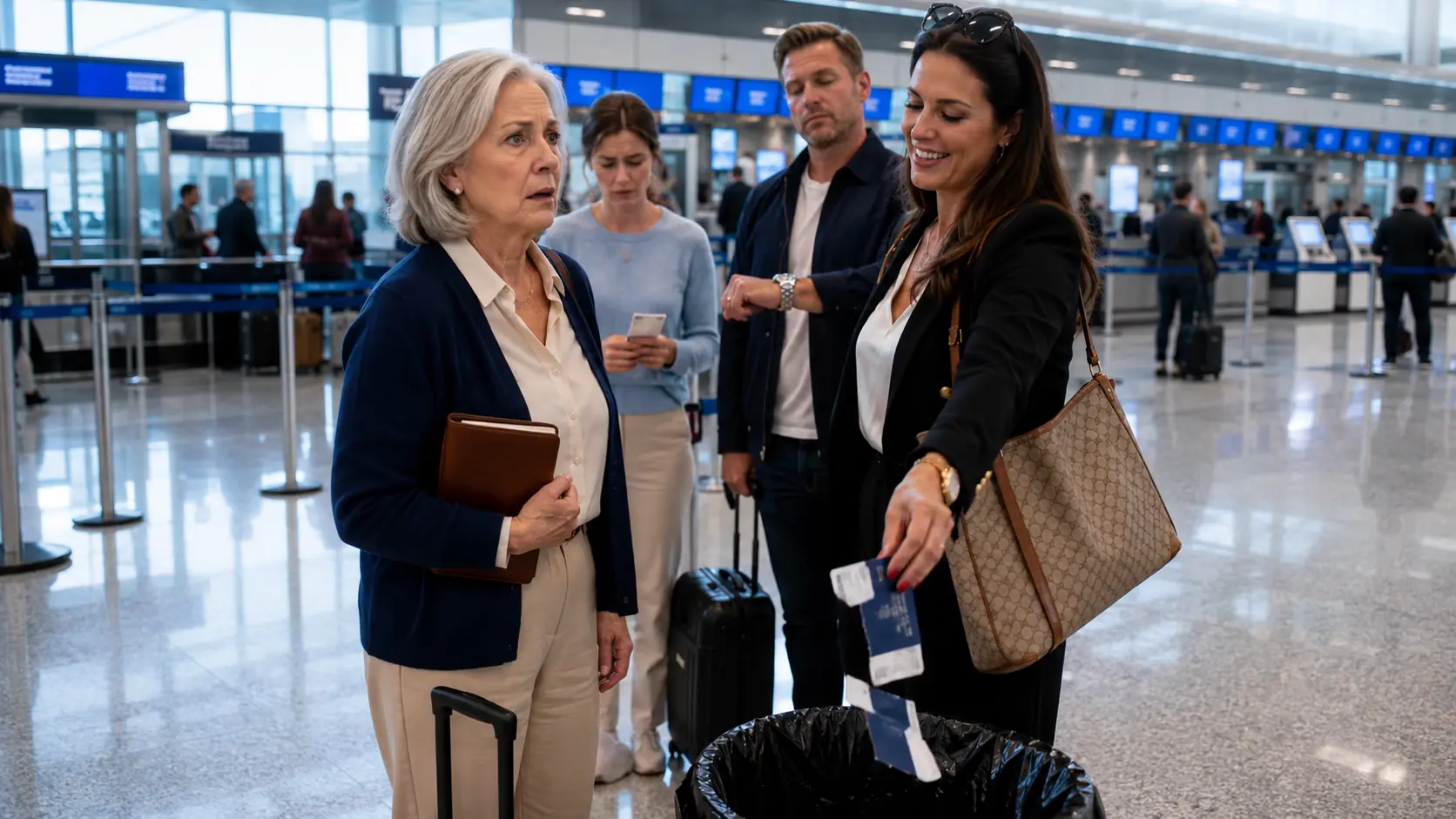
Maggie told herself not to be sensitive. Families were complicated, and stepfamilies even more so. Vanessa was thirty-six, stylish, sharp-tongued, and skilled at turning every room into a stage where she was the injured party. If Maggie objected to her behavior, Vanessa called her controlling. If Maggie stayed quiet, Vanessa called her useful.
For seven years, Maggie had been useful. She had helped with Derek’s SUV after his “temporary setback,” paid for two emergency dental bills, covered a summer camp deposit, helped with school uniforms, and quietly transferred money when Emily whispered that the mortgage was tight. Vanessa never said thank you. Derek said it only when he needed something else.
Still, Maggie hoped Hawaii would be different. She imagined her grandchildren, Lily and Noah, running across the sand with tiny buckets in their hands. She imagined Emily laughing without financial stress tightening her mouth. She imagined family dinners under palm trees where nobody argued about money, schedules, or who had sacrificed the most. More than anything, Maggie imagined being included.
On the morning of the flight, she dressed carefully. She wore cream trousers, a soft white blouse, and a navy cardigan because airports were always colder than they should have been. Her silver hair was brushed neatly around her face, and she tucked pearl earrings into her small travel pouch for the first dinner in Maui. Her coral suitcase stood by the door like a promise.
At Chicago O’Hare, the terminal was bright, crowded, and alive with movement. Boarding screens glowed blue above the counters. Families dragged rolling luggage, business travelers spoke into phones, and the smell of coffee drifted from a busy café nearby. Maggie held her leather notebook against her chest and felt, for the first time in months, almost light.
Vanessa arrived late, wearing sunglasses on top of her head and a smile that never reached her eyes. Derek followed with his watch flashing under the terminal lights, pulling a black suitcase that Maggie had bought him two Christmases ago. Emily came behind them with Lily and Noah, looking tired but hopeful. Maggie smiled at the children first.
“Grandma!” Lily shouted, running into her arms.
Maggie hugged her tightly. “Are you ready to see the ocean?”
Noah bounced beside her suitcase. “Dad said there are turtles.”
“There are,” Maggie said. “And we’re going to look for them.”
For a few minutes, everything felt almost right. The children were excited, Emily smiled weakly, and even Derek managed a polite nod. Maggie handed over boarding pass copies she had printed at home, though everything was also saved on her phone. She had prepared for every possibility, because preparation was how she made fear behave.
Then Vanessa reached for Maggie’s passport.
It happened so quickly that Maggie did not understand it at first. Vanessa smiled, plucked the passport booklet from Maggie’s open travel wallet, and held it up between two glossy red nails. “You don’t need this,” she said.
Maggie blinked. “Vanessa, give that back.”
Vanessa’s smile widened. “Actually, no.”
Before Maggie could move, Vanessa tore the passport in half.
The sound was small, but it split the whole morning open. Rip. The terminal noise blurred around Maggie until all she could hear was that one cruel sound repeating inside her chest. She stared at the torn blue booklet in Vanessa’s hands, unable to make sense of the violence of it. Not because of the paper, but because of the smile.
“You’re not going to Hawaii, Maggie,” Vanessa said, waving the torn pieces. “You’re staying home to watch my cats.”
Maggie’s mouth opened, but no words came.
Vanessa dropped the torn passport into the trash can beside the check-in area. “Princess gets wet food twice a day,” she continued brightly. “Duke panics if the litter box isn’t cleaned exactly on time. I left instructions on the kitchen counter.”
Derek glanced at his expensive watch and gave a soft laugh. “Honestly, Maggie, Hawaii might’ve been too much for you anyway. All that walking. All that sun.”
Maggie turned slowly toward Emily.
Her daughter stood three steps away, gripping her boarding pass with both hands. Her face had gone pale, and her eyes were fixed on the shiny airport floor. She did not laugh. But she did not speak either.
That silence hurt worse than Vanessa’s cruelty. Maggie had survived many kinds of pain: widowhood, loneliness, medical scares, and the slow humiliation of being treated like a wallet with a heartbeat. But watching her own daughter stand silent while someone tore her dignity in half was a different kind of wound. It made something inside Maggie grow cold and clear.
“Emily,” Maggie said softly.
Emily’s lips parted, but no sound came.
Vanessa rolled her eyes. “Don’t start a scene. We’ll miss boarding.”
Derek pulled his suitcase forward as if the matter had been settled. “Come on, everyone. Security’s going to be packed.”
Lily looked confused. “Grandma isn’t coming?”
Vanessa gave the child a bright, fake smile. “Grandma changed her mind, sweetie.”
Maggie looked at her granddaughter’s worried face and felt the last thread snap. She had not changed her mind. They had changed their masks. For years, they had called her generous when they meant available, kind when they meant obedient, and family when they meant useful.
Her coral suitcase stood upright beside her, already tagged. Inside were the clothes she had chosen with care, the sun hat she had saved, and the paperback novels she imagined reading on the balcony after the children went to sleep. She had packed hope into that suitcase. Vanessa had mistaken that hope for weakness.
Maggie bent down, lifted the handle of her suitcase, and turned away.
“Maggie?” Vanessa snapped. “Where are you going?”
Maggie did not answer.
She walked past the trash can, past the coffee stand, past strangers who had seen too much and suddenly looked down at their phones. Her heart pounded, but her steps were steady. She could feel Vanessa watching her, waiting for the usual surrender. But something had changed so completely that Maggie almost felt peaceful.
She stopped at the first-class counter.
A young ticket agent looked up with a polite smile. “How can I help you, ma’am?”
Maggie opened her leather notebook. Her hands did not shake now. “My family is checking in for a trip booked under Margaret Thompson,” she said. “I need to make a change.”
The agent typed quickly, then studied the screen. “Margaret Elaine Thompson?”
“Yes.”
“Five first-class passengers to Maui, villa transfer, partner activity package, and connected hotel reservation?”
“Yes.”
The agent’s smile faded slightly as she looked past Maggie toward Vanessa, Derek, Emily, and the children. They had stopped several yards away. Vanessa’s face still carried irritation, but Derek’s smirk had begun to weaken. Emily looked as if she already knew what was coming.
The agent lowered her voice. “All passenger upgrades and associated travel services are under your payment profile.”
Maggie nodded. “That is correct.”
“What would you like to change, Mrs. Thompson?”
Maggie turned around slowly.
Vanessa crossed her arms. “Maggie, stop being dramatic.”
Derek took one step forward. “Let’s all calm down.”
Emily whispered, “Mom…”
Maggie looked at her daughter first. For one painful second, she wanted Emily to run to her, apologize, take her hand, and say she was sorry for letting it happen. But Emily stayed where she was, trapped between shame and convenience. Maggie loved her, but love no longer felt like permission to be destroyed.
She turned back to the agent. “Cancel every reservation except mine and the children’s.”
Vanessa’s smile vanished. “What?”
Derek stepped closer. “You can’t do that.”
Maggie kept her eyes on the agent. “Can the children still travel with me if their mother approves?”
The agent hesitated. “If their legal parent consents and the ticketing documents are updated, yes.”
Maggie turned to Emily. “Do you want your children to miss the trip because Vanessa wanted me at home cleaning litter boxes?”
Emily’s face crumpled. “Mom, please don’t do this here.”
“Vanessa did this here,” Maggie said. Her voice was not loud, but it carried. “Derek laughed here. You stayed silent here. So yes, Emily, we are doing this here.”
Lily began to cry quietly. Noah stood close to his sister, his small hand clutching the strap of his backpack. Maggie’s anger softened when she looked at them, but it did not disappear. Children should not have to watch adults behave badly. But they also should not learn that cruelty wins because everyone is too embarrassed to stop it.
Vanessa pointed a red nail at Maggie. “You are not taking those kids to Hawaii without us.”
Maggie looked at her calmly. “I paid for the trip. I arranged every reservation. And I still have my driver’s license, Vanessa. You tore my passport because you thought I would panic. Hawaii is not another country.”
Derek’s face changed as he realized the mistake.
Vanessa blinked. “You still need—”
“No,” Maggie said. “I don’t.”
The agent, careful and professional, nodded slightly. “A valid state ID is acceptable for domestic travel.”
For the first time, Vanessa looked truly frightened. Not sorry. Not ashamed. Frightened. There was a difference, and Maggie saw it clearly.
Derek lowered his voice. “Maggie, let’s not make this ugly.”
“It became ugly when your daughter destroyed my passport and you laughed.”
“She was joking.”
Maggie looked at the trash can. “That was not a joke. That was a crime with a boarding pass.”
A man standing at the next counter coughed into his hand. The agent kept her eyes on the computer, but Maggie noticed her jaw tighten with restrained sympathy.
Emily stepped forward at last. “Mom, I froze. I’m sorry. I didn’t know what to do.”
Maggie turned to her. “You knew exactly what to do. You just knew it would cost you something.”
Emily began to cry. “Please.”
Maggie’s voice softened, but only slightly. “I have spent years protecting you from hard moments. I paid bills before they became disasters. I smiled when I was insulted so holidays would stay peaceful. I told myself you were overwhelmed, that Derek was stressed, that Vanessa had her own pain. But today, Emily, you let your mother be thrown away in front of her grandchildren.”
Emily covered her mouth.
Vanessa scoffed, but the sound was weak now. “This is ridiculous. Canceling our tickets over a passport? Do you know how selfish that is?”
Maggie turned back to her. “Selfish is ripping up someone’s identification because you want free pet care.”
“They’re emotional support animals.”
“They are cats, Vanessa.”
Derek rubbed his forehead. “Maggie, I’ll pay you back for the passport.”
That almost made her laugh. “Derek, you still have not paid me back for the SUV you drove here in.”
His face reddened.
Maggie opened her notebook to another page. “Or the dental bill. Or the emergency roof repair. Or the private school deposit you said was due that same afternoon. Or the watch you are checking every thirty seconds like time belongs to you.”
Derek looked down at the watch.
Vanessa stared at him. “What is she talking about?”
Maggie raised an eyebrow. “He did not tell you?”
Derek’s mouth tightened. “This is not the time.”
“No,” Maggie said. “This is exactly the time. Because everyone seems to have forgotten who has been carrying the weight.”
The agent cleared her throat softly. “Mrs. Thompson, I can process the cancellation for three adult passengers and preserve your seat. For the children, I will need parental confirmation.”
Maggie looked at Emily. “Your choice.”
Emily wiped her cheeks. “Mom, I want us all to go together.”
“We were never going together,” Maggie said. “I was being brought as the wallet and left as the help.”
“That’s not true.”
Maggie’s eyes filled at last. “Then why is my passport in the trash?”
Emily looked at the trash can and had no answer.
Lily tugged her mother’s sleeve. “Mommy, did Aunt Vanessa rip Grandma’s book?”
Vanessa snapped, “It was just paper.”
Maggie looked down at Lily. “It was important paper, sweetheart. But Grandma is okay.”
Noah looked up at her. “Are we still seeing turtles?”
The question broke something tender inside her. Maggie crouched slowly, ignoring the ache in her knees, and took his hand. “I hope so, honey. But only if your mom says it is okay.”
Emily stared at her children, then at Vanessa, then at Derek. Her face changed slowly, as if the airport lights had finally shown her the family she had been defending. She walked to the counter with trembling hands.
“I consent,” Emily said quietly.
Derek turned sharply. “Emily.”
She did not look at him. “I consent for my children to travel with my mother.”
Vanessa’s mouth fell open. “You cannot be serious.”
Emily turned then, and for the first time that morning, her voice sharpened. “You tore up my mother’s passport.”
Vanessa laughed in disbelief. “For cats, Emily. Cats. She was going to be fine.”
“No,” Emily said. “You wanted her humiliated. And I let it happen.”
Maggie watched her daughter carefully. It was not enough to erase the pain. But it was something. A small beginning was still a beginning, if it came with action.
The agent processed the changes while Vanessa paced, Derek argued under his breath, and Emily signed the necessary consent forms. Every keyboard click sounded final. Vanessa’s first-class ticket disappeared. Derek’s disappeared. Emily’s disappeared too, at her own request. The villa reservation remained under Maggie’s name, adjusted for one adult and two children.
Vanessa stepped close to Maggie, her smile gone completely. “You think this makes you powerful?”
Maggie picked up her notebook. “No. It reminds me that I already was.”
Derek tried one last time. “Maggie, canceling this will cost a fortune.”
“It cost less than being treated like I do not matter.”
“You’re punishing everyone.”
“No,” Maggie said. “I am stopping payment on my own humiliation.”
That silenced him.
When the new boarding passes printed, the agent handed them to Maggie with both hands. “You are all set, Mrs. Thompson.”
Maggie accepted them. “Thank you.”
The agent glanced toward the trash can. “Would you like airport police notified about the damaged passport?”
Vanessa stiffened.
Maggie paused. For a moment, she imagined the satisfaction of watching Vanessa explain herself to officers in front of the entire first-class counter. She imagined Derek panicking, Emily crying harder, and the whole morning becoming even more public. Then she looked at Lily and Noah, who had already seen enough.
“Not today,” Maggie said. “But I want a written incident note.”
The agent nodded. “Of course.”
Vanessa exhaled like she had won something. Maggie looked at her. “Do not mistake my restraint for forgiveness.”
Vanessa’s face tightened again.
Maggie took Lily’s hand in one hand and Noah’s in the other. Emily stepped closer, crying silently. “Mom,” she whispered, “I’m sorry.”
Maggie looked at her daughter for a long moment. “I believe you are sorry now. But sorry after consequences is not the same as courage before them.”
Emily nodded, tears falling. “I know.”
“I love you,” Maggie said. “But when I come back, things change.”
Emily swallowed. “Okay.”
“No more emergency transfers. No more bills hidden inside emotional phone calls. No more letting Derek and Vanessa speak to me like I am furniture with a bank account.”
Emily nodded again. “Okay.”
Derek muttered, “This is insane.”
Maggie looked at him. “The SUV keys are in your pocket?”
He frowned. “Yes.”
“Good. My lawyer will contact you about the title when I return.”
His face drained of color.
Vanessa barked a laugh. “You’re going to lawyer up against family?”
Maggie smiled sadly. “Family was supposed to stop you before you put my passport in the trash.”
No one spoke.
At security, Lily held Maggie’s hand tightly. Noah kept looking back at his parents, confused but excited. Maggie’s chest ached with guilt, but beneath the guilt was something steadier. She was not taking the children to punish their mother. She was taking them because promises made to children should not be destroyed by selfish adults.
The TSA officer checked Maggie’s driver’s license, then waved her through. Vanessa watched from beyond the barrier with a face full of disbelief. Derek stood beside her, furious and helpless. Emily lifted one hand weakly, and Maggie nodded once.
On the other side of security, the airport opened before Maggie in a way it had not before. The same rolling suitcases, the same announcements, the same smell of coffee and jet fuel. But now the noise no longer blurred beneath humiliation. It sounded like freedom moving.
At the gate, Lily pressed her face to the window. “Grandma, is that our plane?”
Maggie sat beside her and smiled. “Yes.”
Noah climbed into the seat next to Maggie. “Are you sad?”
Children always asked the questions adults avoided.
Maggie looked down at him. “A little.”
“Because of your passport?”
“Because people I love made a very hurtful choice.”
Noah thought about that. “But we still love you.”
Maggie’s throat tightened. She pulled him close. “I know, sweetheart.”
The flight to Maui was long, but the children made it feel alive. Lily drew pictures of turtles on napkins. Noah fell asleep with his head against Maggie’s arm. A flight attendant brought Maggie tea and called her Mrs. Thompson with a kindness that nearly undid her. For the first time in years, nobody asked her to fix anything.
When they landed, warm island air greeted them outside the airport. Lily squealed at the palm trees. Noah asked if the ocean was “behind every building.” Maggie laughed for the first time that day, really laughed, and the sound surprised her. It felt rusty, but it was hers.
The villa was just as beautiful as the pictures. White walls, wide windows, soft beds, and a balcony facing the water. Welcome baskets sat on the counter, filled with fruit, cookies, and little paper umbrellas the children immediately loved. Maggie stood in the doorway for a moment, overwhelmed by the life she had almost been denied.
That evening, she took Lily and Noah to the beach. The sunset painted the water in colors Maggie could not name. The children ran ahead, shoes in their hands, shouting whenever the waves touched their toes. Maggie walked slowly behind them, her cardigan folded over one arm, her face turned toward the breeze.
Her phone buzzed again and again in her purse. Vanessa called six times. Derek sent messages about betrayal, money, and “overreacting.” Emily sent one message only.
I am sorry. I should have stood beside you. I will be moved out before you come home.
Maggie read it twice.
Then she typed back: I love you. Start with the truth. We will talk when I return.
She turned off the phone.
For seven days, Maggie kept her promise to the children and made new promises to herself. They saw turtles from a safe distance, ate shaved ice, collected shells, and watched dancers at a luau where Lily declared she wanted to live in Hawaii forever. Noah fell asleep every night before finishing his sentence. Maggie sat on the balcony after they slept, listening to waves instead of apologies.
On the fifth morning, she booked a video call with an attorney back in Chicago. She discussed the SUV title, the money Derek owed, and how to protect her accounts from future “family emergencies.” The attorney was direct, respectful, and practical. Maggie realized she had been afraid of looking harsh when all she had needed was to become clear.
When they returned to Chicago, Emily was waiting alone near baggage claim. She looked smaller than Maggie remembered, but also more awake. Vanessa and Derek were not with her. Lily ran into her mother’s arms, and Noah followed, talking immediately about turtles, waves, and how Grandma knew the best pancakes.
Emily hugged them, then looked at Maggie. “I moved into the apartment near Lincoln Square,” she said. “The kids and I are staying there for now.”
Maggie nodded. “And Derek?”
“He’s angry.”
“I imagine so.”
“He says you ruined everything.”
Maggie looked at her daughter with tired eyes. “No. I stopped paying for what was already ruined.”
Emily began to cry again, but this time she did not ask Maggie to rescue her from the feeling. She simply stood inside it. “I’m sorry,” she said. “Not because of the trip. Because I saw it happening for years and kept telling myself it was easier not to fight.”
Maggie reached for her hand. “Easy can become very expensive.”
“I know.”
In the weeks that followed, life did not heal like a movie. Derek sent angry messages until Maggie’s attorney responded. Vanessa posted vague complaints online about betrayal and “toxic older relatives,” then deleted them when too many people asked questions. Emily began counseling, found a better job schedule, and slowly learned how to say no without apologizing as if she had committed a crime.
Maggie replaced her passport. The new one arrived in the mail six weeks later, clean and undamaged, with her photo staring back at her more firmly than before. She held it for a long time at the kitchen table. Then she placed it in her leather notebook, not because she planned to let anyone take it again, but because it reminded her of the morning she finally stopped abandoning herself.
One Sunday afternoon, Emily came over with Lily and Noah. They baked cookies, made too much mess, and ate dinner at the small round table where Maggie had once written checks with a knot in her stomach. After the children went to play in the living room, Emily touched the leather notebook on the counter.
“I used to hate that notebook,” she admitted.
Maggie looked at her. “Why?”
“Because it meant you were about to fix something I should have handled myself.”
Maggie smiled faintly. “I used to think fixing things was the same as loving people.”
Emily shook her head. “You loved us. We used that.”
The honesty hurt, but it also made room for something cleaner. Maggie reached across the table and squeezed her daughter’s hand. “Then we learn differently now.”
Months later, Maggie took another trip. This time, she booked only one ticket. She flew to Santa Fe for a long weekend, stayed in a small hotel with blue doors, visited galleries, drank coffee slowly, and bought herself a silver bracelet she did not need to justify to anyone. When she came home, she put the bracelet beside her passport and smiled.
Vanessa never apologized. Derek never fully repaid what he owed, though the SUV was returned after one very direct letter from Maggie’s attorney. Emily continued rebuilding her life, slowly and imperfectly, but with more courage than before. The grandchildren still asked about Hawaii, and Maggie kept a framed photo of the three of them on the beach where the morning light made the ocean look endless.
Sometimes, people asked Maggie why she had not simply forgiven everyone at the airport and gone along to keep the peace. She always thought of the trash can, the torn passport, and Vanessa’s smile. Then she thought of Lily’s hand in hers, Noah’s head on her arm, and Emily finally choosing truth over convenience. Peace, Maggie had learned, was not the absence of conflict.
Peace was refusing to be sacrificed for someone else’s comfort.
And on the morning Vanessa ripped her passport in half, Maggie Thompson finally understood something she wished she had known years earlier. A woman does not become cruel when she stops paying for disrespect. She becomes free.