The first thing Samuel Hale noticed about his new wife was not her beauty.
It was the way she watched doors.
She had done it at the train station in Abilene, standing beside one battered brown trunk while steam rolled beneath the platform and strangers pushed past her in both directions. She had done it in the wagon on the long ride toward Samuel’s ranch, twisting around whenever another rider appeared behind them. Even during the simple wedding ceremony in Reverend Morris’s front parlor, while Samuel answered his vows in a voice roughened by nervousness and Eleanor whispered hers almost too softly to hear, her gray-blue eyes kept flicking toward the windows and the hall.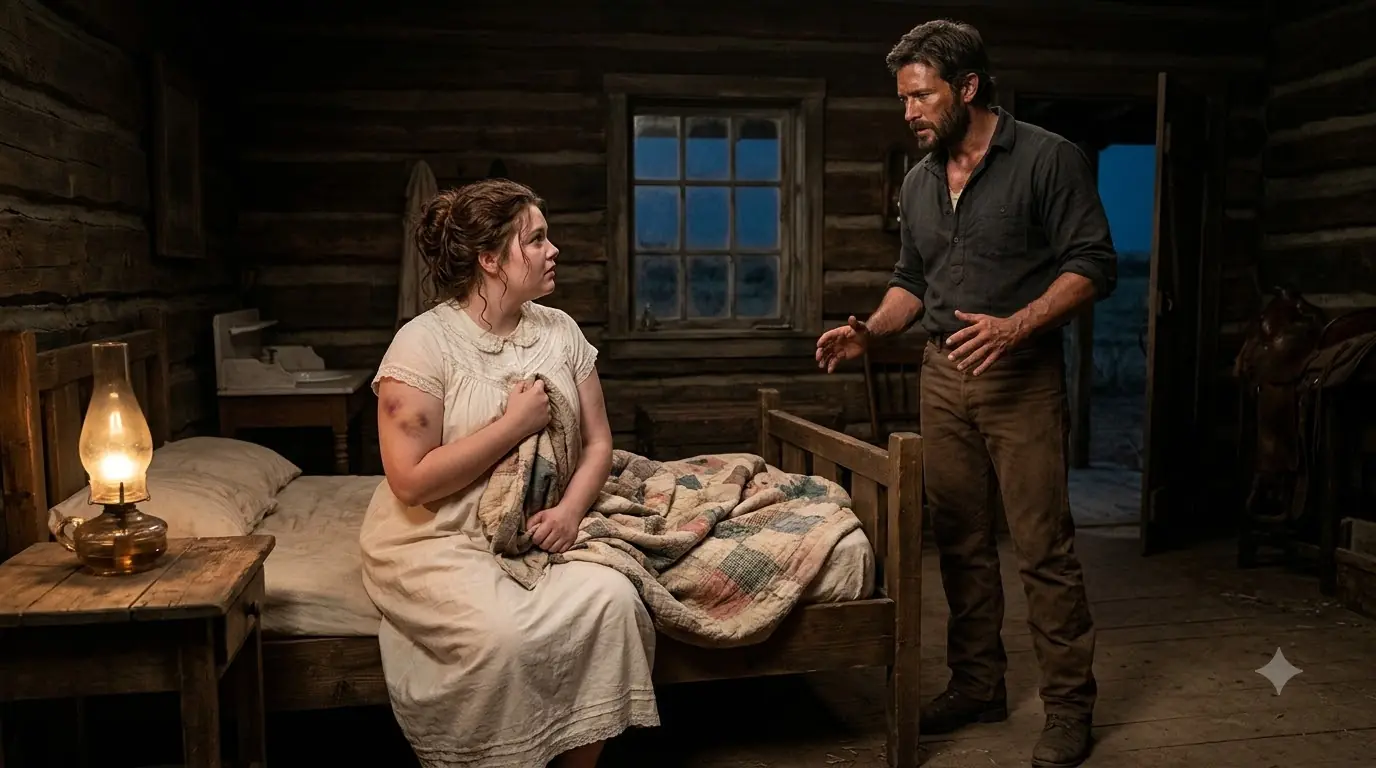
Samuel told himself she was frightened because she had married a stranger.
That explanation made sense.
He was thirty-six years old, widowed for nearly a decade, sun-browned and broad from years of ranch labor. Eleanor was twenty-one, soft-faced and full-figured, with fair skin, chestnut hair, and the unmistakable unease of someone who had never been west of Missouri until four days earlier. Nothing about their circumstances promised comfort.
Samuel had answered the newspaper advertisement because loneliness had eventually become harder to ignore than grief.
His first wife, Clara, had died of fever two winters after their marriage. There had been no dramatic final confession, no last request that he love again, nothing poetic enough to make the loss easier to carry. One week she had been laughing at him for burning biscuits; the next he had buried her beneath a cottonwood tree fifty yards behind the cabin.
For ten years afterward, Samuel built fences.
He raised cattle.
He repaired barns.
He broke horses.
He worked until exhaustion allowed him to sleep without thinking.
At first people stopped suggesting he remarry because they respected his grief.
Then they stopped because they assumed he had chosen solitude permanently.
Samuel almost believed that himself.
But as he approached thirty-six, something changed.
The cabin became too quiet.
Meals tasted different when there was nobody across the table.
Winter evenings stretched endlessly.
When a neighboring rancher showed Samuel a Kansas newspaper containing advertisements from women seeking husbands in the West, Samuel laughed and pushed it away.
Two days later, he borrowed the newspaper.
He wrote one letter.
Nothing romantic.
Nothing clever.
Samuel Hale, thirty-six, cattle rancher outside Abilene. Widower. Modest property, no children. Seeking a woman of decent character willing to share ranch life. I cannot promise wealth. I can promise a respectable home, honest work, and no debts except the ordinary kind.
He stared at the final line before adding:
I would prefer friendship before anything else.
Three weeks later, Eleanor Mercer answered.
Her letter was short.
She said she was twenty-one.
She could cook adequately, sew well, keep accounts, and was not afraid of farm work.
She did not ask how large Samuel’s ranch was.
She did not ask whether he intended to become wealthy.
She asked only three questions.
Is your cabin far from town?
Do many strangers pass your road?
If I came, would anyone from my former life be welcome there without my permission?
Samuel thought the questions unusual.
He answered honestly.
The ranch sat eleven miles from Abilene.
The road saw travelers occasionally but not often.
And no person would be welcome in Samuel Hale’s home if Eleanor asked him to keep them outside.
Her next letter contained only one question.
Do you mean that?
Samuel replied:
Yes.
Two weeks later, she agreed to come.
Now, on their wedding night, Samuel understood that he had not asked nearly enough questions.
The cabin was quiet except for wind moving against the timber walls.
An oil lamp burned beside the bed.
Eleanor sat on the mattress wearing a white lace nightdress she had removed from her trunk after disappearing behind a hanging blanket Samuel had rigged across one corner of the room for privacy. The gown was modest by any reasonable measure, with a fitted lace bodice, short sleeves, and a long cream-white skirt, but Eleanor still clutched Samuel’s patchwork quilt against herself as though the fabric were armor.
Samuel remained near the washstand.
He had removed his coat but nothing else.
He suddenly felt enormous in the room.
His hands, useful everywhere else, seemed dangerous here.
Hands that could hold a struggling calf.
Lift fence posts.
Swing an axe for hours.
He did not know what to do with them.
Eleanor watched him.
Then she looked toward the door again.
Samuel tried to lighten the silence.
“You keep checking that door like you expect Reverend Morris to come ask for another fee.”
Eleanor attempted a smile.
It failed before reaching her eyes.
Samuel’s own smile disappeared.
“You all right?”
“Yes.”
The answer came too quickly.
He sat in the wooden chair several feet from the bed.
“I can sleep here.”
Her eyes widened.
“You don’t have to.”
“I’ve slept in worse places.”
“You’re my husband.”
Samuel rubbed one hand across his jaw.
“That is generally how Reverend Morris described it.”
A tiny laugh escaped her.
The sound surprised both of them.
Then Eleanor looked ashamed of it.
Samuel noticed that too.
He leaned back slightly.
“You’re allowed to laugh here.”
Her fingers tightened around the quilt.
“I know.”
Again, too quickly.
Samuel had spent most of his adult life around horses.
He knew the difference between an animal deciding to stand still and an animal freezing because it believed movement would make things worse.
Eleanor was frozen.
He lowered his voice.
“We don’t have to do anything tonight.”
She looked at him.
Her breathing changed.
“Samuel.”
“Yes?”
“I know what marriage requires.”
Something in the sentence bothered him.
Not the words.
The resignation.
Samuel frowned.
“Requires?”
Eleanor looked downward.
“I was told.”
“By whom?”
She did not answer.
Her fingers twisted the quilt.
Samuel felt unease settle into his stomach.
“Eleanor.”
She swallowed.
“I don’t want you angry.”
“I’m not angry.”
“You might be.”
“At what?”
She lifted her eyes.
“If I’m frightened.”
Samuel stared at her.
“Why would that make me angry?”
Eleanor looked genuinely confused.
Then, as though some decision had been made inside her, she slowly lowered part of the quilt.
Her hands shook.
Samuel understood what she thought she was doing.
He stood immediately.
Eleanor flinched so violently that her shoulder struck the bedpost.
Samuel stopped.
Both his hands rose instinctively.
“Easy.”
Eleanor’s face drained of color.
“I’m sorry.”
“No.”
“I didn’t mean—”
“You have nothing to apologize for.”
Her breathing became shallow.
Samuel took one step backward.
Then another.
Clear space.
He wanted her to see it.
Eleanor stared at him.
Samuel gestured toward the bed.
“You stay there.”
“What?”
“I’m staying over here.”
“But—”
“No.”
His voice had come out too firm.
She flinched again.
Samuel immediately softened it.
“No, Eleanor. I mean you don’t have to do anything.”
Her eyes filled.
Then she whispered:
“It hurts.”
Samuel did not understand.
“What?”
She could barely speak.
“This is my first time.”
For a stupid instant Samuel felt relief because at least he understood one part of her fear.
Trying to reassure her, he said the worst thing he could have said.
“It’ll be over quick.”
The instant the words left his mouth, he regretted them.
Eleanor’s expression transformed.
Pure terror flooded her face.
Not embarrassment.
Not wedding-night nervousness.
Terror.
She pulled the quilt against herself and moved toward the far side of the mattress, eyes fixed on Samuel as though calculating how quickly he could cross the room.
Samuel went cold.
“Eleanor.”
She stared.
“I’m sorry.”
He raised both hands again.
“That was badly said.”
Nothing.
“I was trying to tell you I wouldn’t make anything difficult.”
Still nothing.
Samuel backed toward the wall.
Then Eleanor’s lace sleeve slipped.
The lamplight reached her upper arm.
Samuel saw the bruises.
At first his mind rejected what his eyes told him.
A large yellow bruise curved around the outside of her arm.
Below it lay two darker marks, purple fading toward green.
Near her wrist were smaller discolorations shaped almost like fingers.
Old injuries beneath newer ones.
Samuel stared.
Eleanor noticed.
She jerked the sleeve upward.
Too late.
Samuel’s entire body changed.
Not toward her.
Away.
He stepped back until the edge of the table pressed into his thighs.
“Who did that?”
Eleanor said nothing.
“Who hurt you?”
Her lower lip trembled.
Samuel’s hands curled into fists.
He forced them open.
That mattered.
He could not ask a frightened woman about violence while standing there looking ready to commit some himself.
He inhaled slowly.
Then lowered himself into the chair again.
“Eleanor.”
She watched him.
“I am not going to hurt you.”
Her expression broke.
Not because she believed him.
Because she desperately wanted to.
Samuel reached toward the folded quilt on the chair beside him.
Eleanor stiffened.
He stopped immediately.
“I’m getting the other blanket.”
She nodded once.
Samuel took it.
He walked only close enough to place it at the foot of the bed.
He did not touch her.
“You can pull that around yourself.”
Eleanor reached for it.
Her hand trembled.
Samuel sat again.
After several seconds, she wrapped the blanket around her shoulders.
Then Samuel saw it.
Another flinch.
Small.
Automatic.
When the blanket brushed her bruised arm.
Practiced.
That frightened him more than the injuries themselves.
Someone had hurt Eleanor so often that her body expected pain before anything happened.
Samuel’s jaw tightened.
“Who did this?”
Her gaze moved toward the trunk.
Samuel followed it.
The battered brown trunk sat beside the wall.
He had carried it from the train station himself.
It was heavier than he expected.
Eleanor had never allowed it out of her sight.
At the station, when a porter offered to move it, she refused.
At the ranch, she asked Samuel to place it inside before unhitching the wagon.
Now she stared at it.
Samuel understood there was something inside beyond dresses.
“What’s in the trunk?”
Eleanor’s face crumpled.
A sob escaped.
She immediately covered her mouth with one hand.
The motion was so quick that Samuel’s stomach twisted.
“Don’t.”
She stared.
“You don’t have to stop yourself.”
Another tear slipped down.
Samuel spoke carefully.
“You can cry.”
Her shoulders shook.
He had never imagined three ordinary words could hurt someone.
You can cry.
Yet Eleanor reacted as though he had given her permission to breathe after being underwater.
She cried silently first.
Then one broken sound escaped.
Samuel stayed in the chair.
Every part of him wanted to cross the room, hold her, tell her nothing would happen.
But that would have been for him.
Not her.
She needed proof more than comfort.
So he remained still.
After several minutes, Eleanor wiped her cheeks.
Samuel asked:
“Were you running from somebody?”
Her eyes moved toward the door.
That was answer enough.
Samuel felt his anger deepen.
“Does he know where you are?”
“I don’t know.”
“Who is he?”
She looked toward the trunk again.
“Samuel…”
“Yes.”
“There’s something inside.”
“All right.”
“You need to see it.”
Samuel stood slowly.
He waited until she nodded.
Then crossed the room and knelt beside the trunk.
A small brass lock secured it.
Eleanor reached beneath her pillow.
She removed a key tied to a faded blue ribbon.
Samuel stared.
“You slept with that?”
“Yes.”
She tossed it.
Samuel caught it.
The key turned stiffly.
Inside were ordinary things first.
Two dresses.
A comb.
Needlework.
A Bible.
Then Samuel lifted a folded shawl.
Beneath it lay a leather document case.
A bundle of letters.
A bank ledger.
And a small revolver wrapped in cloth.
Samuel stared at the weapon.
Eleanor whispered:
“I don’t know how to use it.”
Samuel looked back.
“Then why carry it?”
“Because Martha told me sometimes having one is enough.”
“Who’s Martha?”
“The woman who helped me leave.”
Samuel opened the leather case.
The first document was a deed.
He read the name.
Eleanor Mercer.
Not Hale.
That was expected.
Then he read the property description.
One hundred sixty acres in Jackson County, Missouri.
Another document listed cattle.
Another described a trust created by Eleanor’s late father.
Samuel looked toward her.
“You own land.”
Eleanor nodded.
“How much?”
“The farm. Some cattle. Money in a bank in Independence.”