“Shut it down. Now.”
The bulldozer operator looked down at me through dusty glass.
Behind him, the yellow machine idled in what had been my father’s north field.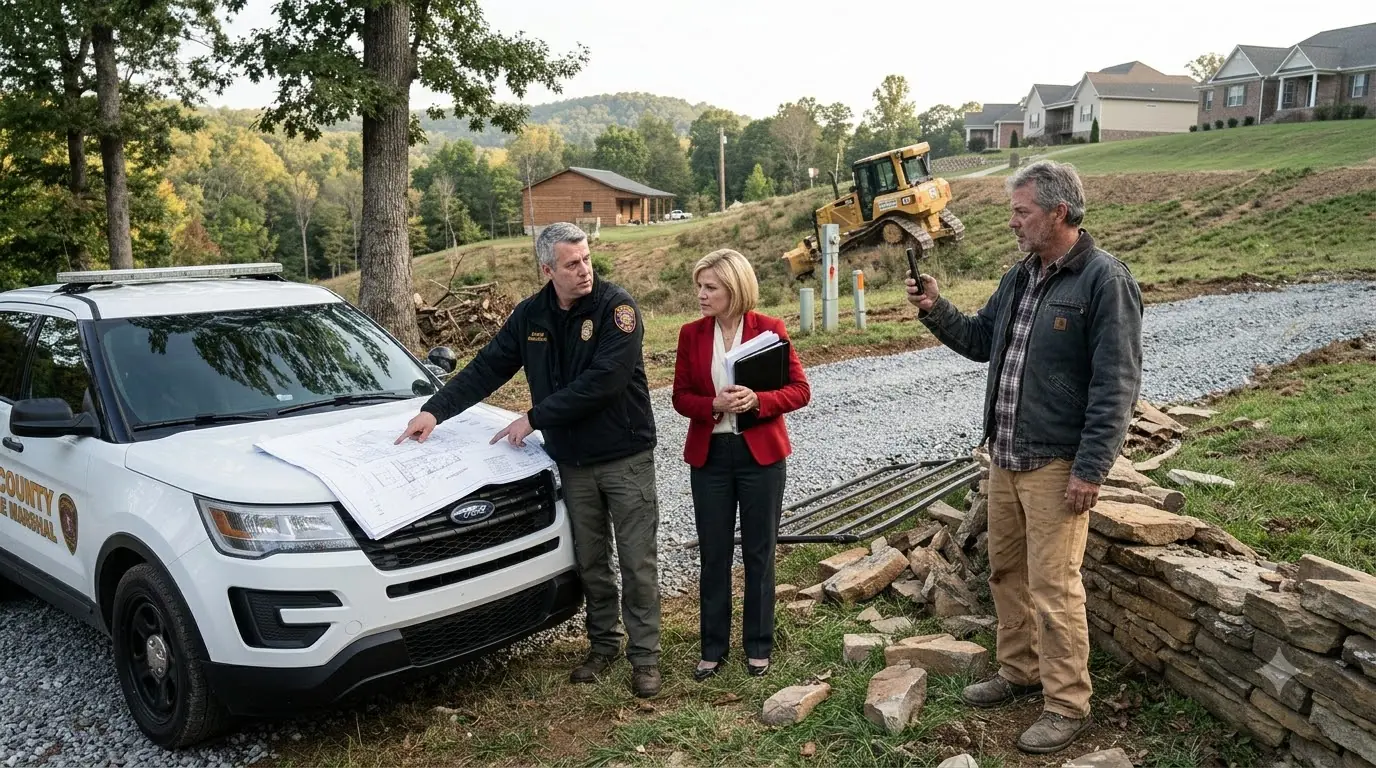
Its tracks had already crushed thirty feet of hand-laid sandstone wall into the ditch.
My steel farm gate lay flat in the weeds with one hinge twisted almost completely off.
Beyond it, a strip of fresh gravel cut straight across the property toward my workshop driveway.
Eighteen feet wide.
Three hundred twenty feet long.
Built before sunrise.
A white sign stood beside the opening.
EMERGENCY ACCESS
TIMBER RIDGE RESIDENTS ONLY
I raised my phone and kept recording.
“This is private property.”
The operator lowered the blade until it rested on the ground.
“HOA says this is emergency access.”
“I’m not in your HOA.”
He glanced uphill.
A white pickup stood at the end of Timber Ridge’s western cul-de-sac.
Beside it was a woman in a scarlet jacket.
“Keep moving,” I told him.
A voice behind me answered.
“He can’t stop us.”
I turned slightly, making sure the phone caught her.
“Good.”
“What?”
“I needed that on camera.”
That was the first moment Celeste Ward realized the morning might not unfold the way she had planned.
It was 6:14 a.m. on a Thursday.
Eleven days before I was supposed to deliver $38,000 worth of custom white oak cabinetry to a renovation outside Knoxville.
And somebody had just driven a twelve-ton bulldozer through land my family had owned since 1979.
My name is Daniel Mercer.
I was fifty-six years old and had spent most of my adult life building cabinets in a cedar-sided workshop behind the house where I grew up.
The property covered fourteen mountain acres in eastern Tennessee.
Not much by farming standards.
Enough for us.
Old Mill Road formed the southern edge.
Timber Ridge Estates sat above us on the northern ridge.
Laurel Branch cut through the lower section, narrow enough to step across in August and loud enough to hear from the porch after heavy spring rain.
The property was shaped like a long wedge.
House near the southern road.
Workshop farther back.
North field climbing toward the ridge.
Stone wall at the top.
That wall mattered.
My father, Samuel Mercer, built it over three summers.
He bought the property when I was nine.
The first year, he spent more time repairing fences and cleaning brush than working on the house.
The second summer, he decided the northern boundary needed something permanent.
Not barbed wire.
Not posts.
Stone.
There was sandstone everywhere near Laurel Branch.
My father gathered it slowly.
Wheelbarrow load after wheelbarrow load.
He believed machinery made people impatient.
When I suggested renting a small loader years later, he looked offended.
“You’re trying to deprive yourself of character.”
“I have enough character.”
“That’s exactly what somebody without enough character would say.”
At ten, my job was carrying small stones.
At eleven, medium stones.
At twelve, I finally realized there had never been a formal size system.
Dad simply gave me whatever he did not feel like carrying.
He dry-stacked the wall.
No mortar.
Broad stones at the base.
Smaller pieces wedged carefully.
Every few yards, he would step back, squint, remove three stones, and rebuild the section because something looked wrong only to him.
My mother once asked:
“How straight does a farm wall need to be?”
Dad answered:
“Straight enough that a man knows where he stands.”
She laughed.
He didn’t.
Samuel Mercer took boundaries seriously.
Not aggressively.
Precisely.
If his cow crossed onto another property, he apologized.
If someone accidentally drove through ours, he helped them turn around.
If a neighbor needed access to clear storm debris, Dad usually said yes.
But he believed permission mattered.
The wall survived storms.
Deer.
Fallen branches.
Teenagers cutting through the woods.
My father’s death.
And twenty-five years later, the construction of Timber Ridge Estates.
Then, on one Thursday morning, an HOA bulldozer pushed through it before breakfast.
Timber Ridge did not exist when my father bought our land.
The subdivision arrived much later.
By the early 2000s, a developer had purchased several hundred acres above us and carved roads into the ridge.
Expensive homes.
Stone entrances.
Decorative streetlights.
A small private park.
One paved road connected the community to State Route 28.
The main entrance wound down the eastern side of the ridge through a narrow switchback.
It worked.
Residents used it every day.
Delivery trucks used it.
School buses used it.
Fire apparatus could use it under normal conditions.
Our property never joined the development.
My father declined every offer.
He did not hate subdivisions.
He simply preferred trees.
When Timber Ridge’s final plat was recorded, its western cul-de-sac stopped at our boundary.
Twenty-two feet before the wall.
The homeowners association inherited roads, common spaces, drainage responsibilities, and several utility corridors.
It inherited no rights across Mercer land.
That had never been controversial.
Until the clubhouse.
The first time I heard about Timber Ridge’s new clubhouse was from one of my customers.
She lived there.
“Three-point-two million dollars,” she told me while choosing cabinet hardware.
“For a neighborhood clubhouse?”
She smiled.
“They're calling it an amenity center.”
“What do you get?”
“Pool.”
“Event room.”
“Commercial kitchen.”
“Fitness room.”
“Outdoor terrace.”
“Parking.”
I whistled.
“Sounds expensive.”
“It is.”
Then she said:
“Apparently property values will love it.”
At the time, I had no opinion.
Timber Ridge could build whatever it wanted on Timber Ridge land.
The problem came during county review.
The proposed clubhouse sat near the top of the ridge.
Large event occupancy.
Commercial kitchen.
Pool.
Over one hundred parking spaces.
The county fire review determined that, for that specific project, the existing access arrangement required a secondary route meeting certain emergency-access conditions.
There was already an alternative.
A vacant parcel east of the development.
Timber Ridge could purchase an access strip there, construct two retaining walls, replace a culvert, and build several hundred feet of paved emergency road.
Expensive.
But possible.
My land offered another possibility.
At least on paper.
Timber Ridge’s western cul-de-sac sat just above my north field.
Cross the wall.
Travel three hundred twenty feet downhill.
Join my gravel workshop lane.
Follow it over Laurel Branch.
Exit at Old Mill Road.
Simple.
If the land were free.
If the bridge could carry emergency apparatus.
If the geometry worked.
If I agreed.
None of those conditions were true.
That Thursday morning, Celeste Ward walked down the freshly graded strip as if all of them were.
She was fifty-one.
President of Timber Ridge Estates HOA for her third consecutive year.
Always polished.
Dark blond hair cut precisely at the shoulders.
Pearl earrings.
Scarlet jacket.
Black slacks.
Leather binder under one arm.
She spoke in a calm, moderated tone that made nearly every statement sound as though the decision had already happened in another room and everyone else had simply failed to receive the memo.
“Mr. Mercer.”
I kept the phone pointed at her.
“Celeste.”
“Please stay clear of the equipment.”
“That equipment is on my property.”
“This is a permitted emergency-access improvement.”
“On whose land?”
She unrolled a drawing.
“The recorded corridor connects Timber Ridge with Old Mill Road.”
“No.”
Her expression barely moved.
“The underlying access rights date to 1989.”
“In 1989 Timber Ridge did not exist.”
“The rights predate the subdivision.”
I looked toward the bulldozer operator.
“What company are you with?”
He climbed down.
“Mason Reed.”
He pointed toward the company logo on his vest.
“Carter Site Works.”
“Did anyone give you written authorization from the Mercer property owner?”
Celeste answered before Mason could.
“Your office has the easement exhibit.”
I kept looking at him.
“That was not my question.”
Mason removed one glove.
He was mid-forties.
Heavy build.
Mud dried around both knees.
He looked less like an enforcer than a man discovering someone else had handed him an insurance claim.
“Mr. Mercer, we were given a construction package showing an existing corridor.”
“Did it contain my signature?”
“No.”
“Did it contain a recorded vehicle easement?”
He hesitated.
“It contained an exhibit.”
Celeste’s voice sharpened.
“Mason, the association has already addressed title.”
Mason looked at her.
Then at the crushed wall.
Then at my camera.
He pulled out his phone.
“I’m calling my project manager.”
Celeste stepped closer.