They had a signed court order.
Not a warning letter.
Not an attorney’s threat.
Not a mediation request.
A court order.
The judge’s actual signature was on the last page, the county clerk had entered it into the docket, the sheriff’s office had been notified, and the HOA’s attorney had acknowledged receipt in writing.
The board members had even read part of it aloud during an emergency meeting.
Then, less than twelve hours later, they sent the same work crew back to my property at six in the morning and ordered them to keep cutting my fence.
That was the moment I realized I was no longer dealing with an aggressive homeowners association.
I was dealing with people who genuinely believed a court order became optional when it interfered with what they had already decided they wanted.
My name is Michael Turner.
I was forty-nine years old when Ridgehaven Estates Homeowners Association decided that three inches of imaginary encroachment gave them the right to tear apart a fence that had stood for fourteen years.
I owned a little over six acres outside Asheville, North Carolina, on a legacy parcel that existed long before Ridgehaven Estates was built around it.
The property had belonged to an older couple named Frank and Evelyn Hartwell before I bought it.
Frank had sold most of the surrounding acreage to a developer in the late 1990s but retained the six-acre homesite, workshop, and pasture.
When Ridgehaven was eventually created, Frank’s parcel remained outside the HOA.
That mattered.
My deed specifically excluded the property from the Ridgehaven declaration.
At the same time, Frank had reserved a permanent recorded easement over what later became Ridgehaven’s western private road so the parcel could continue reaching Henderson Mill Road.
The easement was not vague.
It granted the owner of my parcel, family members, guests, contractors, service providers, emergency responders, and other lawful invitees the right of ingress and egress over a twenty-two-foot strip running from my driveway through Ridgehaven to the public road.
It was recorded before the HOA existed.
The developer later built Ridgehaven Drive directly over that easement.
For almost twenty years, nobody had a problem with it.
Frank used the road.
His contractors used the road.
UPS used the road.
Propane trucks used it.
When I bought the property twelve years earlier, I used it exactly the same way.
Nobody stopped me.
Nobody asked permission.
Nobody needed to.
It was my legal access.
The fence dispute began along the opposite side of my property.
That was what made the later guard shack so absurd.
The two issues were technically separate.
The HOA simply managed to violate my rights on both sides of the parcel at the same time.
I had built the fence fourteen years earlier, shortly after buying the property.
Four-board horse fence.
Pressure-treated posts.
Black wire mesh behind the boards because my daughter had a pony back then and I did not enjoy chasing livestock through suburban landscaping.
Before construction, I hired a licensed surveyor.
He located every corner.
We set the fence several inches inside my line rather than directly on it because I wanted room to maintain both sides without arguments.
I still had the invoice.
Still had the survey.
Still had photographs of the stakes before the posts went in.
For more than a decade, Ridgehaven never challenged it.
Then a new board took office.
The president was Patricia Weller.
Patricia was fifty-five, retired from regional banking, and possessed the kind of confidence that made every sentence sound like the conclusion of a committee meeting nobody else remembered attending.
She had lived in Ridgehaven for eight years.
Within six months of becoming president, she replaced the previous management company with Sterling Community Management.
She also created what she called an “infrastructure compliance initiative.”
In practical terms, that meant the board began looking for things prior boards had tolerated and converting them into violations.
Mailboxes.
Landscaping.
Basketball hoops.
Parking.
Fence colors.
Trailer storage.
Drainage.
Anything that could be measured became something the board could control.
I ignored most of it because I was not a member.
That turned out to offend Patricia.
The first letter arrived in February.
STERLING COMMUNITY MANAGEMENT
NOTICE OF ENCROACHMENT
According to the letter, approximately forty feet of my western fence sat three inches inside a “community drainage and maintenance easement.”
I reread it three times.
Then pulled my survey.
No Ridgehaven drainage easement crossed that location.
There was a five-foot utility strip on Ridgehaven’s side of the boundary.
Not mine.
I called the management company.
A woman named Claire responded.
“Mr. Turner, the board has reviewed the matter.”
“With what survey?”
“The association’s site plan.”
“Is it recorded?”
“I would need to check.”
“Who prepared it?”
“I would need to check.”
“Does it show my deed?”
“I’m sure the board has reviewed all relevant documents.”
That sentence became familiar.
I emailed the original boundary survey.
Recorded plat.
Deed.
Photographs.
Then requested the document supporting the HOA claim.
Three days later, I received another letter.
No survey.
No easement document.
Just a violation notice.
REMOVE ENCROACHMENT WITHIN TEN DAYS.
Below it:
Failure to comply may result in enforcement costs, legal expenses, and corrective action.
I called again.
“I’m not in Ridgehaven.”
Claire said:
“The board believes the fence affects association property.”
“Then show me how.”
“You can request a hearing.”
“I already did.”
Silence.
“What?”
“My email requested a hearing under the procedures your attorney cited.”
She clicked somewhere.
“I don’t see that.”
“I have the sent copy.”
“I’ll note the file.”
I sent the request again.
Certified mail this time.
Received.
Signed for.
Nothing.
Another week passed.
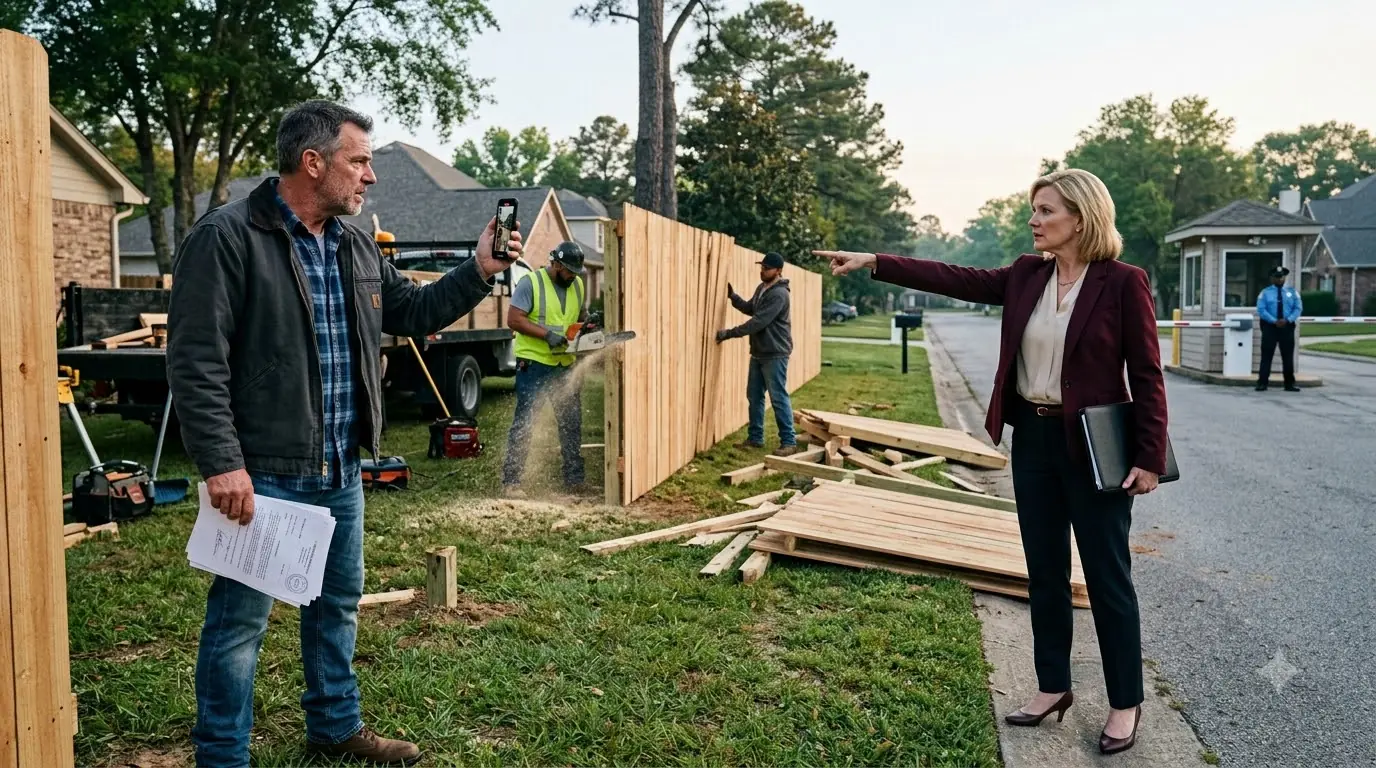
Then I came home from work on a Tuesday afternoon and found forty feet of fence lying on the ground.
I remember stopping my truck before I reached the house because the sight did not make sense.
The posts were still standing in places.
Boards had been cut.
Wire mesh rolled back.
Two sections had been thrown into my pasture.
A skid steer had crossed the grass and left tracks in the wet soil.
For several seconds, I sat behind the steering wheel thinking:
Maybe a tree fell.
There was no tree.
Then I saw the orange paint.
HOA crews had marked the supposed easement line before cutting.
I got out.
My neighbor across Ridgehaven Drive, Carl Benton, walked toward me.
“You know about this?”
“No.”
“I figured.”
“What happened?”
“Crew came around nine.”
“Sterling truck.”
“Two board members.”
“Patricia?”
“No.”
“Ron and Denise.”
Ron Weaver was the board vice president.
Denise Harmon handled architectural review.
Carl continued.
“I asked what they were doing.”
“They said they had authority to remove an encroachment.”
“Did anyone speak to me?”
“Not that I saw.”
I took out my phone.
Started recording.
Every board.
Every post.
Every tire mark.
Saw marks.
Orange paint.
Tools left temporarily near the road.
I found a small laminated work order caught beneath a board.
RIDGEHAVEN HOA
CORRECTIVE MAINTENANCE
REMOVE FENCE WITHIN ASSOCIATION EASEMENT
Authorized by:
P. WELLER
That piece of paper changed everything.
I called the sheriff’s non-emergency line.
A deputy came out.
Deputy James Cole.
Young.
Professional.
He looked at my deed.
Then the work order.
Then the fence.
“This sounds civil.”
“I understand.”
“But somebody entered my parcel and destroyed property.”
“That part can still be documented.”
He made a report.
Photographed the damage.
Took my statement.
Carl gave one too.
The deputy did not arrest anyone.
I did not expect him to.
The report created a timestamp.
That mattered later.
My next call was to Sarah Kendall.
Sarah had handled a commercial access issue for the engineering firm where I worked.
I was a civil project manager specializing in municipal water systems.