I had seen plenty of entitled people in my life, but HOA president Brenda Ashworth actually called the police because I refused to give her free fuel from my own private pump.
I was standing in my driveway, minding my own business and filling my truck, when Brenda came marching across the property like she was conducting an inspection.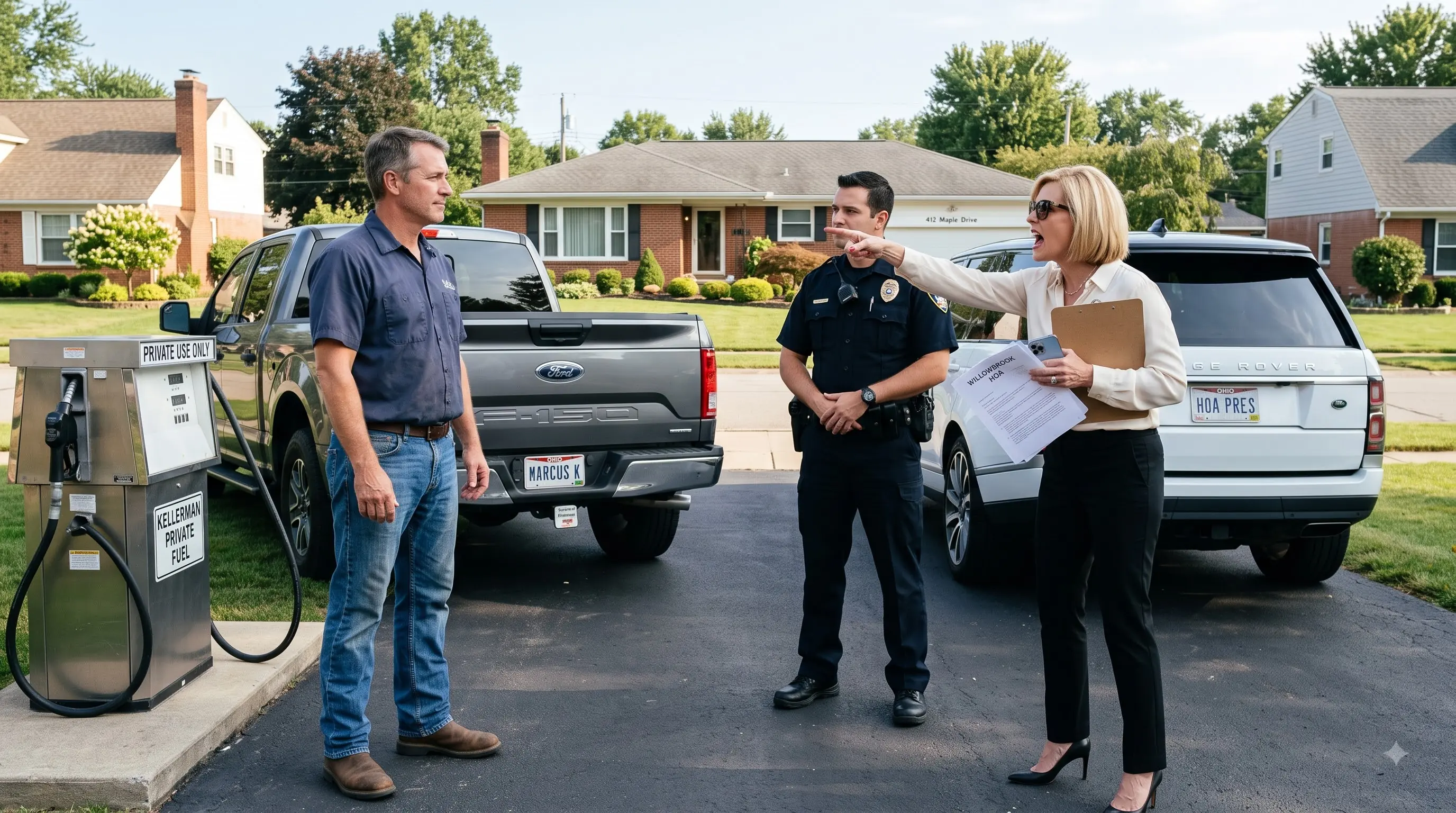
She wore designer heels, carried her usual clipboard, and approached with the kind of confidence that suggested the word “no” had rarely been directed at her.
“Fill up my Range Rover, Marcus,” she said. “As HOA president, I shouldn’t have to pay for gas when residents have fuel available.”
I stared at her for a second, certain I had misheard.
“No.”
Her expression tightened.
“What did you say?”
“I said no. This is private fuel on private property. It isn’t an HOA resource.”
Brenda immediately pulled out her phone.
“I need police assistance,” she told the 911 dispatcher. “This man is being hostile and threatening me.”
The smell of diesel hung in the air while I watched her calmly manufacture an emergency out of being denied free gasoline.
What made that call one of the worst decisions of her life was simple.
Brenda had absolutely no idea who she was talking to.
My name is Marcus Kellerman. I was fifty-two years old and had been through more professional chapters than most people experience in a lifetime. I started in military logistics, where I learned that preparation was not merely useful; sometimes it was survival.
For twenty years, diesel fumes, freight manifests, supply schedules, maintenance reports, and long stretches far from home defined my life. I moved equipment and supplies across three continents and learned how to solve problems before they became emergencies.
Then life handed me a problem no amount of planning could solve.
My wife, Sarah, developed cancer.
For two years, our lives became treatments, hospital rooms, medical bills, test results, hopeful mornings, devastating afternoons, and sleepless nights. When she died the previous spring, I discovered that every room in our house had become a memory I was not prepared to carry.
The creak of certain floorboards reminded me of her footsteps.
Her coffee cup was still in the cabinet.
Her coat remained near the door for weeks because I could not bring myself to move it.
Eventually, I sold the house, packed what I could keep, and moved to Willowbrook Estates in Ohio.
Willowbrook had around two hundred homes. Most residents were decent people working regular jobs and chasing some version of the suburban dream: tree-lined streets, children riding bicycles, carefully maintained lawns, weekend cookouts, and neighbors who waved without demanding explanations for how you lived.
The HOA had once been managed by a retired teacher named Mrs. Henderson.
Her philosophy was simple.
Mow your lawn.
Do not turn your house neon purple.
Pay your dues.
Do not make life miserable for everyone around you.
Then Brenda Ashworth arrived.
Brenda had moved from an expensive gated community and worked in real estate. She drove a spotless Range Rover, dressed as though every HOA meeting might become a luxury listing appointment, and possessed the particular confidence of someone who seemed genuinely shocked whenever another person refused her.
Within eight months, she had campaigned herself into the HOA presidency.
Her platform promised “elevated standards,” “enhanced community values,” and the removal of what she called “undesirable elements.”
It did not take long to understand what that language meant in practice.
The Rodriguez family received repeated notices for “excessive vehicle parking.”
They owned two cars.
Old Mr. Orion received fines because his vegetable garden supposedly violated neighborhood aesthetics.
A young Black couple received harassment letters over a basketball hoop while similar equipment at other homes drew no attention at all.
Selective enforcement became Brenda’s favorite tool.
Then she discovered my fuel pump.
The property I bought included a large garage and workshop, which was one of the main reasons I chose it. Restoring vintage trucks had become a form of therapy after Sarah died. I could spend six hours rebuilding an engine and, for those six hours, grief became something mechanical rather than emotional.
The previous owner had been a farmer.
He had installed a permitted private diesel storage system under the property’s agricultural use history.
When I bought the house, I spent around fifteen thousand dollars updating the equipment.
New safety systems.
Updated containment.
Professional installation.
Regular inspections.
Clear PRIVATE PROPERTY signage.
The fire marshal inspected it annually.
The setup was legal, documented, and safer than many commercial facilities.
During a major power outage, the fuel also became unexpectedly useful.
I helped three elderly neighbors keep their backup generators operating.
One family had medical equipment that could not simply wait for electricity to return.
Another had a basement pump that prevented thousands of dollars in flooding.
I did not sell fuel.
I did not operate a business from the pump.
I helped people during an emergency.
That was apparently enough to attract Brenda.
She arrived one morning in designer heels, clicking across my driveway loudly enough that I could hear her before I saw her.
She began asking about zoning compliance, fuel storage, environmental rules, insurance, and something she called “community resource equity.”
I produced the permits.
Then the inspection reports.
Then the agricultural documentation.
Her face soured.
“Well,” she said, “we’ll see about that.”
Five hundred dollars for unauthorized commercial activity.
The letter was longer than some of my military discharge paperwork and considerably less friendly.
According to Brenda, my fuel system created “unfair residential advantages,” “commercial traffic,” and “negative community impacts.”
I spent three hours reading the HOA covenants.
Then I prepared a written response showing that the installation predated my ownership, remained lawfully permitted, and did not constitute commercial activity.
I delivered the packet personally.
I assumed that would end the matter.
That was when I learned something important about people like Brenda.
They are not always trying to determine what is correct.
Sometimes they simply want to win.
Three days later, Brenda called an emergency HOA board meeting.
Emergency.
As if my fuel pump were about to level half the county.
The community center smelled like stale coffee, industrial carpet cleaner, and decades of neighborhood arguments.
Around thirty residents sat in squeaky folding chairs beneath fluorescent lights that buzzed like dying insects.
Brenda had prepared a PowerPoint presentation.
A PowerPoint.
About my fuel pump.
“Ladies and gentlemen,” she announced, holding a laser pointer, “we are facing a serious safety hazard requiring immediate action.”
A photograph of my equipment appeared on the screen.
Red arrows pointed toward the tank.
Large text read:
EXPLOSION RISK.
ENVIRONMENTAL HAZARD.
The image looked less like a neighborhood presentation and more like advertising for a disaster movie.
“This unauthorized commercial installation poses significant risks to our families, our children, and our property values.”
I raised my hand.
“Brenda, I provided documentation showing—”
“The floor recognizes only board members during formal presentations.”
She cut me off with a smile.
Brenda had actually done some research.
That almost made things worse.
She had pulled fire codes, zoning language, and county regulations concerning fuel storage. Unfortunately for her, she had missed the exemptions and grandfathered provisions that applied to my property.
During my military career, I had encountered people who read half a manual and then acted like they had written the whole thing.
They were dangerous because they possessed just enough information to be confidently wrong.
For fifteen minutes, Brenda described catastrophic scenarios.
Explosions.
Environmental contamination.
Insurance companies abandoning the neighborhood.
Property values collapsing.
Neighbors who had waved to me for months began shifting nervously in their seats.
“Therefore,” Brenda announced, “I move for an immediate one-thousand-dollar fine and a forty-eight-hour removal deadline.”
Four board members raised their hands.
That was when I stood.
My chair scraped across the linoleum.
“Before you vote, perhaps we should review actual evidence.”
I carried a thick manila folder to the front.
Brenda’s expression changed slightly.
I removed the first document.
“Here is last month’s fire marshal inspection. Passed. The installation exceeds current safety standards.”
Murmurs moved through the room.
I removed another sheet.
“Here is the agricultural exemption and permitting history, filed with the county and renewed as required.”
More murmurs.
“Here is confirmation from my insurance carrier showing full liability coverage.”
Then I looked toward the third row.
“And Fire Marshal Jim Henderson is sitting right there.”
Heads turned.
“Jim, would you mind explaining how dangerous this installation is?”
Jim Henderson stood with a grin.
“I’ve inspected hundreds of private and commercial fuel systems over thirty years. Marcus’s setup is exceptionally well maintained. Frankly, it is safer than plenty of commercial stations I’ve inspected.”
The room erupted.
Questions flew toward the board.
Residents demanded to know why they had been shown disaster photographs instead of inspection reports.
Someone applauded.
Brenda’s face moved through several shades of red.
“Well,” she said, “safety isn’t the only concern. There are still property values, aesthetics, traffic patterns—”
Dorothy Martinez interrupted from two rows behind me.
“During the winter outage, Marcus kept my husband Harold’s oxygen equipment running.”
The room quieted.
“He helped keep my husband alive.”
Another resident spoke.
Then another.
A single mother explained how I had provided emergency fuel during an ice storm.
A veteran described backup power for his medical equipment.
A family talked about the generator that prevented their basement from flooding.
One story after another dismantled the picture Brenda had created.
She abruptly called for a recess.
The vote was postponed.
As people left, several apologized to me for believing the presentation.
Brenda did not apologize.
She stood near the front of the room typing rapidly on her phone.
The sharp clicking of her acrylic nails sounded like tiny hammers.
Round one was mine.
But Brenda Ashworth was not finished.
Two weeks passed quietly.
For a moment, I thought perhaps she had accepted defeat.
I should have known better.
Tuesday morning, I was inside my garage rebuilding the carburetor on a 1973 Chevrolet when unfamiliar voices drifted in from the driveway.
I looked through the window.
A man wearing a city polo stood outside with a clipboard and radio.
Official.
I wiped my hands on a shop rag and walked outside.
“Mr. Kellerman?”
“Yes.”
“I’m Dave Morrison from City Planning. We received a complaint about unauthorized commercial activity at this address.”
“Commercial activity?”
He checked his tablet.
“The complaint says you’re operating an unlicensed fuel station, selling fuel to residents, creating environmental hazards, and possibly avoiding taxes.”
The accusation was so ridiculous that I almost laughed.
Instead, I invited him to inspect everything.
I provided every permit.
Every inspection.
Every insurance document.
I gave him Fire Marshal Henderson’s direct number.
The inspection lasted about an hour.
Dave eventually closed his tablet.
“Honestly, Mr. Kellerman, this is one of the better maintained private fuel systems I’ve inspected. The equipment is permitted, your safety measures are appropriate, and I see no evidence that you’re operating a commercial station.”
Then Brenda appeared.
Her heels struck the asphalt in quick, sharp clicks.
“Inspector Morrison. Brenda Ashworth, HOA president. I assume you are addressing this serious violation appropriately.”
Dave shifted slightly.
“Ma’am, I completed the inspection. I found no violation.”
Her smile cracked.
“What about the environmental concerns?”
“None detected.”
“The safety problems?”
“The system exceeds current requirements.”
“The commercial sales?”
“I found no evidence of sales.”
Dave paused.
“And I should mention that knowingly filing repeated false complaints can result in penalties for wasting municipal resources.”
Brenda’s face tightened.
“There must be some mistake. I have extensive documentation.”
“I’m happy to review legitimate evidence,” Dave said, “but what I observed today does not match the complaint we received.”
When he left, Brenda remained in my driveway.
“This isn’t over, Marcus.”
Her voice had lost its sweetness.
“There are other ways to deal with problem residents.”
That evening, Jake, a contractor who lived three houses away, texted me.
“Check Nextdoor. Someone’s going nuclear on you.”
I rarely used neighborhood social media.
Jake sent screenshots.
An account called Concerned Willowbrook Resident had begun posting warnings about dangerous fuel storage, declining home values, safety risks, and “residents who refuse to cooperate with community standards.”
Many neighbors defended me.
Others were worried.
Then I noticed something.
Three of the loudest accounts attacking me had been created within days of one another.
Their photographs looked like stock images.
Their posting styles were nearly identical.
Someone appeared to be manufacturing neighborhood outrage.
I documented everything.
Screenshots.
Dates.
Account creation times.
Wording patterns.
Twenty years of logistics had taught me to think beyond the immediate problem.
Brenda was getting more desperate.
Desperate people made mistakes.
The next morning, an unmarked sedan rolled slowly into my driveway.
Two people stepped out.
A woman wearing a wrinkled business suit and a man with a close-cropped haircut who carried himself like someone impersonating authority.
Neither knocked.
They began photographing my property.
I stepped onto the porch holding coffee.
“Morning. Can I help you?”
The woman glanced up from a tablet.
“Routine property assessment for insurance compliance.”
“My insurer didn’t notify me of an assessment. May I see identification?”
The man stepped forward.
“Sir, we have legitimate business here. I strongly suggest you return inside.”
I had spent too many years dealing with real authority to be impressed by imitation authority.
“I strongly suggest you leave my private property before I call actual law enforcement.”
They retreated.
But not before the man took dozens of photographs of my fuel system.
Two hours later, my phone rang.
“Mr. Kellerman, this is Rick Santos from Apex Investigations. We need to discuss Brenda Ashworth.”
I set my coffee down.
“I’m listening.”
“She hired my firm to investigate you. She specifically requested anything illegal, embarrassing, or compromising. She offered a five-thousand-dollar bonus for information that could lead to your arrest or removal from the neighborhood.”
For a moment, I said nothing.
“Why are you telling me?”
“Because when we conducted the background review, we discovered your profession.”
There was an embarrassed pause.
“This woman hired my company to dig for criminal dirt on the local police chief.”
That was the part Brenda had apparently never bothered to learn.
After leaving military logistics, I had spent years in law enforcement.
Eventually, I became Police Chief Marcus Kellerman.
Brenda had spent months treating me like some anonymous blue-collar homeowner with a workshop.
She had never once checked who I actually was.
“She doesn’t know?” I asked.
“Apparently not. When I told her you were law enforcement, she accused me of making excuses and ordered us to continue.”
I thanked Rick.
After the call, I considered what the investigation meant.
Hiring a private investigator was not automatically illegal.
Hiring one specifically to fabricate grounds for arrest or intimidation was another matter entirely.
At the very least, it established intent.
That afternoon, dispatch called.
“Chief, we have a strange situation.”
“What?”
“Someone filed a formal harassment complaint against you. Stalking, intimidation, abuse of authority.”
“Who?”
“Brenda Ashworth.”
I laughed once.
Not because it was funny.
Because the irony was almost perfect.
She had filed a police complaint against the police chief based on conduct that had never occurred.
“Route it through standard procedure,” I said. “Assign Lieutenant Martinez. I’m recusing myself because I’m personally involved.”
“Chief, everyone knows this is nonsense.”
“That’s exactly why we handle it properly. The evidence will decide.”
Two hours later, Lieutenant Maria Martinez sat at my kitchen table with a recorder and official forms.
Maria was sharp, disciplined, and one of the least political officers I had ever supervised.
“This is awkward,” she admitted. “But I have to ask. Any basis whatsoever for the stalking allegations?”
“None.”
I showed her security footage.
Dates.
Timestamps.
My movements.
Brenda entering my property more frequently than I had ever approached hers.
Every direct interaction between us had been initiated by her or occurred during public meetings.
Maria reviewed everything.
“Chief, I’ve investigated some very questionable complaints, but this one is remarkable.”
She completed her report.
The allegation was unfounded.
The evidence also documented a growing pattern of Brenda targeting me.
That weekend, I stopped treating the HOA as a nuisance and started studying it like an organization.
Willowbrook’s financial information was available to homeowners.
Most people never looked closely.
I did.
Eight months of expenses since Brenda became president painted an ugly picture.
Legal consulting fees: fifteen thousand dollars to Ashworth & Associates Legal Services.
Ashworth.
Brenda’s maiden name.
The firm belonged to one of her relatives.
Landscaping contract: eighty-two hundred dollars to Premier Grounds Management.
Owned by Brenda’s twenty-two-year-old nephew Derek, whose practical landscaping experience appeared minimal.
Security consultation: sixty-five hundred dollars to Residential Safety Solutions.
Run by Brenda’s cousin Mike.
Emergency roof repair: twelve thousand four hundred dollars to Quality Construction Solutions.
Another relative.
The community center roof had been replaced three years earlier.
The pattern continued.
Every major contract Brenda approved seemed connected to family.
The prices were consistently inflated.
Around forty-seven thousand dollars in questionable spending appeared in less than a year.
More importantly, those relationships had not been disclosed in the board minutes I reviewed.
Every contract had been presented as though it came from independent competitive bidding.
During my logistics years, I had seen procurement corruption.
You did not need to be an accountant to recognize the pattern.
Officials directing money toward friends or family while hiding those relationships.
Now the situation was bigger than a fuel pump.
Homeowners had trusted Brenda with community funds.
Elderly residents on fixed incomes paid those dues.
Young military families paid them.
Single parents paid them.
People who believed their money was being used for legitimate neighborhood needs.
I could not investigate Brenda through my own department because of my personal involvement.
But I could take evidence to people who had no such conflict.
Monday morning, I called the District Attorney’s Office.
Not as Police Chief Kellerman.
As Marcus Kellerman, homeowner.
“White Collar Crime Unit, Detective Reynolds speaking.”
“I’d like to report suspected financial misconduct involving an HOA board. Undisclosed family contracts, inflated pricing, possible misuse of association funds. Roughly fifty thousand dollars from what I can document.”
“Can you come in this afternoon?”
“Yes.”
The DA’s office smelled like industrial coffee and printer toner.
Detective Jim Reynolds had the personality I wanted on a financial case.
Patient.
Precise.
CPA background.
The kind of man willing to stare at invoices for six hours until one number stopped making sense.
I spread my documentation across the conference table.
Contracts.
Corporate registrations.
Board minutes.
Vendor ownership records.
Comparable pricing.
Reynolds looked from one document to another.
“She didn’t disclose these relationships?”
“Not in any minutes I found.”
He examined three contracts approved at the same meeting.
“All family-connected businesses?”
“Yes.”
I gave him competing quotes.
“The landscaping contract cost more than twice what established contractors quoted for comparable work.”
Reynolds leaned back.
“This warrants investigation. Potential fiduciary breaches, fraud, conspiracy, possibly electronic financial offenses depending on the payment structure.”
“How long?”
“For a case we want to survive court? Six to eight weeks, minimum. We verify every relationship, obtain banking records legally, interview witnesses, determine intent, and establish who knew what.”
He looked at me.
“You hold any HOA office?”
“No.”
“Vote on these contracts?”
“No.”
“Benefit financially?”
“Not a cent.”
“You willing to testify?”
“Absolutely.”
That evening, I organized a meeting at Mel’s Diner.
Neutral ground.
Six neighbors gathered around a corner booth while coffee poured and bacon hissed somewhere behind the counter.
Dorothy Martinez stirred sugar into a cup strong enough to resurrect the dead.
“Marcus says he found something about HOA finances.”
I kept the explanation simple.
Contract amount.
Vendor name.
Vendor owner.
Relationship to Brenda.
Lack of disclosure.
Bob Orion, a retired electrician whose wife had been harassed over garden decorations, stared at the numbers.
“You’re telling me she’s been routing our money to her relatives?”
“That is what the records strongly suggest. Around forty-seven thousand dollars in questionable transactions so far.”
The table erupted.
I let everyone vent.
Then I explained the strategy.
“The DA is investigating. That needs to run independently and carefully. Meanwhile, homeowners can demand an audit and a special meeting.”
“Can we remove her?” Janet Williams asked.
Dorothy opened a worn copy of the bylaws.
“Article Seven, Section Three. Ten homeowners can petition for a special meeting. A proper vote can remove board officers for documented cause.”
Brenda knew real estate.
She had apparently underestimated people willing to actually read HOA governance documents.
Bob looked nervous.
“What happens when she retaliates?”
That was when I finally told them.
“There’s something you should know.”
Everyone looked at me.
“I’m the city’s police chief.”
Silence.
Then Dorothy started laughing.
“You’re serious?”
“Yes.”
“This woman has spent months filing fake reports against the police chief?”
“Yes.”
Dorothy shook her head.
“That might be the dumbest thing I’ve heard all year.”
From that evening forward, the situation changed.
Neighbors began documenting their own experiences.
Selective fines.
Harassment letters.
Suspicious assessments.
Discriminatory enforcement.
Pressure tactics.
By closing time, we had transformed scattered frustration into organized evidence.
Brenda responded two days later.
Emergency HOA board meeting.
Twenty-four hours’ notice.
The agenda read:
EMERGENCY SAFETY RESOLUTION.
Immediate removal of hazardous fuel storage.
Ten-thousand-dollar community safety deposit.
Failure to comply within forty-eight hours would allegedly permit forced removal.
When I arrived, Brenda had filled the community center with supporters, nervous homeowners, and board members who clearly wanted the conflict to end.
“Ladies and gentlemen,” she announced, “we are facing an imminent safety crisis.”
This time, she brought what she claimed were federal safety reports.
A consultant connected to one of her relatives supposedly provided expert analysis.
A PowerPoint showed industrial explosions unrelated to my property.
“According to federal findings,” Brenda said, “Mr. Kellerman’s system poses immediate explosion, environmental, and potential terrorism concerns.”
Terrorism.
Over a permitted private fuel tank.
She moved for a ten-thousand-dollar deposit and mandatory removal.
Bob raised his hand.
“Didn’t Fire Marshal Henderson already inspect this?”
“Local fire officials are not qualified to assess federal terrorism protocols.”
That sentence was when I realized something else.
The ten-thousand-dollar demand was not only about me.
If Brenda established the authority to impose emergency deposits without meaningful board oversight, she could repeat it with anyone.
I stood.
“Before a vote, I’d like copies of the federal documents.”
Brenda’s smile faltered.
“They contain sensitive security information.”
“I am the homeowner affected by them.”
“The board has reviewed them.”
“Then identifying the issuing agency should be easy.”
She hesitated.
I pulled out my phone.
“Let’s verify.”
Her face changed.
“That’s unnecessary.”
I had already contacted a federal environmental official about Brenda’s claims before the meeting.
The call connected on speaker.
“Agent Morrison speaking.”
“Agent Morrison, Marcus Kellerman in Willowbrook. Our HOA says federal terrorism protocols require removal of a properly permitted private residential fuel system. Does your agency issue such requirements?”
“No, sir. Environmental regulations address storage, containment, quantity, and safety. Terrorism assessments are handled separately, and an ordinary permitted private tank would not automatically trigger such action.”
The room came alive.
Board members demanded Brenda’s documents.
Residents started asking where the alleged federal report came from.
Agent Morrison added that falsely presenting material as official federal documentation could create serious legal problems.
Brenda gathered her papers.
“I think we should postpone the vote.”
Dorothy stood.
“I move that we postpone all extraordinary assessments until a complete independent audit is conducted.”
The motion passed.
Unanimously.
Even Brenda’s allies were unwilling to vote against financial transparency after the supposed federal evidence collapsed.
The next morning, activity increased at Brenda’s house.
Boxes.
Shredded paperwork.
Family members coming and going.
Detective Reynolds texted me.
“Charges likely Monday. Keep your head down.”
Brenda had other plans.
By noon, flyers appeared throughout Willowbrook claiming I was under investigation for terrorism-related activity.
Anonymous social-media posts accused me of storing dangerous chemicals.
Calls hit city offices accusing me of weapons violations, hazardous operations, and criminal activity.
I documented every one.
Then child protective services arrived following an anonymous claim that neighborhood children were being exposed to hazardous fuel.
The caseworker was professional and clearly uncomfortable.
“Mr. Kellerman, I’m required to inspect when allegations involve environmental danger to children.”
“Absolutely.”
I showed her the permits before she even asked.
Inspection records.
Insurance.
Containment systems.
Fire safety documentation.
Twenty minutes later, she closed her tablet.
“I found no safety issue requiring intervention.”
She paused.
“Knowingly malicious false reports can have serious consequences.”
Another report for the evidence file.
Friday morning, Reynolds called.
“We found financial movement.”
“What kind?”
“Large withdrawals. Attempted transfers. Multiple accounts being liquidated.”
“Is she leaving?”
“Possibly. But here’s the big one. Yesterday she attempted to move nearly the entire HOA reserve account.”
I sat upright.
“How much?”
“About sixty-three thousand dollars.”
“For what?”
“She described it as emergency legal expenses relating to community safety.”
The bank had flagged the transaction.
The money was frozen pending investigation.
Brenda had allegedly tried to empty funds residents had saved for storm cleanup, road repair, pool maintenance, and genuine emergencies.
Reynolds continued.
“We also traced several fake social-media accounts attacking you. Three originated from devices associated with her residence.”
Digital evidence.
The manufactured outrage had a source.
“How close are you?”
“Monday.”
That Friday afternoon, Brenda’s home looked like an evacuation site.
Boxes left the house.
Documents disappeared into shredders.
Her husband looked stunned.
Family members argued in the driveway.
Smoke from backyard burning eventually attracted the fire department.
Fire Marshal Henderson responded personally.
He gave me a slight nod while his crew addressed the improper burn.
Saturday was silent.
No posts.
No calls.
No surprise inspectors.
No new accusations.
Sunday evening, I sat outside with a beer while children played in the street.
For the first time in months, Willowbrook sounded normal.
Monday morning changed everything.
Unmarked vehicles began entering the subdivision shortly after sunrise.
Brenda had scheduled another emergency HOA meeting for nine o’clock.
Her agenda included removing my HOA privileges and declaring my property a continuing safety threat.
I entered the community center at eight forty-five.
Brenda had packed the room.
Photographs of my fuel pump covered the projector screen.
Petitions sat on the front table.
Some signatures looked questionable.
“Ladies and gentlemen,” Brenda began, “today we finally resolve the danger threatening this community.”
She pointed toward me.
“This individual has repeatedly refused reasonable safety requirements, abused city resources, and created a hostile environment for law-abiding families.”
I sat quietly.
Brenda continued.
“Therefore, I move that Marcus Kellerman be expelled from all Willowbrook HOA rights and privileges and that further enforcement begin immediately.”
The back doors opened.
Detective Jim Reynolds entered.
Two federal investigators and a state prosecutor followed.
The room went silent.
“Brenda Ashworth?”
Her expression went blank.
“Yes?”
“Mrs. Ashworth, you are under arrest in connection with alleged embezzlement, financial fraud, false reports, and conspiracy-related offenses. You have the right to remain silent.”
Gasps rolled through the room.
Chairs scraped.
Phones appeared.
A local news crew had apparently received word that something significant was happening.
Reynolds turned toward the homeowners.
“Residents should understand that this investigation concerns HOA funds allegedly routed through undisclosed family-connected businesses. The current documented amount exceeds fifty thousand dollars, with additional transactions still under review.”
Dorothy covered her mouth.
Other board members stared at Brenda.
Reynolds continued.
“The investigation also includes false complaints, efforts to intimidate residents, and the attempted transfer of HOA reserve funds.”
That was when I stood.
“Brenda.”
She looked toward me.
“You have spent months demanding that I remove my fuel pump. You filed complaints, hired investigators, accused me of crimes, and called law enforcement because I refused to give you free fuel.”
I paused.
“You probably should have learned one thing about me before deciding I was an easy target.”
She stared.
“I’m Police Chief Marcus Kellerman.”
For perhaps two seconds, no one spoke.
Then the room erupted.
“You’re what?” Brenda whispered.
“The police chief whose department you filed false complaints with.”
The handcuffs clicked around her wrists.
Board members immediately began insisting they knew nothing about the contracts.
Neighbors demanded records.
Someone started applauding.
Dorothy stood.
“I move that every pending action initiated by Brenda be suspended and that we schedule immediate emergency elections.”
The motion passed unanimously.
Then she grinned at me.
“I nominate Marcus Kellerman as interim HOA president.”
I lifted my coffee.
“Absolutely not.”
People laughed for the first time that morning.
“I already run a police department. One government at a time.”
Six months later, Willowbrook looked like a different community.
Brenda Ashworth ultimately entered a guilty plea to charges arising from misuse of HOA money and related conduct. She received eighteen months in federal custody, followed by probation, and was ordered to pay restitution connected to approximately sixty-seven thousand dollars in losses established through the investigation.
Her real-estate license was revoked.
Businesses connected to the questionable contracts collapsed or were investigated separately.
The judge noted that Brenda’s repeated harassment, false reporting, and misuse of community authority demonstrated that the financial crimes had not occurred in isolation.
Recovered money returned to Willowbrook.
This time, residents could actually see where it went.
Needed road repairs.
New playground equipment.
A legitimate emergency fund.
Storm preparation.
No mysterious “consulting” invoices.
No relatives quietly collecting inflated checks.
Dorothy Martinez became president after proper elections.
Her administration introduced radical new concepts.
Published minutes.
Competitive bids.
Open budgets.
Conflict-of-interest disclosure.
Treating residents like human beings.
My fuel pump stayed exactly where it had always been.
During an ice storm the following February, it helped support generators for eight families.
Harold Martinez’s medical equipment remained powered throughout the outage.
The fire department eventually used photographs of my setup during safety presentations as an example of how a properly maintained private fuel system should look.
I helped start a Neighbors Helping Neighbors emergency-preparedness program.
We held free workshops on backup power, household emergency planning, home safety, and properly permitted fuel storage.
Twelve families eventually installed backup systems of their own.
Every one was professionally handled.
Every one was inspected.
The program expanded.
Financial-literacy classes.
HOA-rights education for first-time homeowners.
Legal clinics teaching residents how to read covenants, ask for financial records, and recognize conflicts of interest.
The biggest lesson was simple.
Knowledge makes intimidation much harder.
We also created a small scholarship program benefiting children of veterans and elderly residents, two groups Brenda had frequently treated as easy targets.
Jake Martinez became one of the early recipients of community education support and enrolled in automotive technology classes.
The Willowbrook story eventually spread outside Ohio.
Footage of Brenda’s arrest appeared online with variations of the headline:
HOA PRESIDENT TARGETS WRONG NEIGHBOR — HE’S THE POLICE CHIEF.
Millions watched.
Interview requests followed.
I turned down most of them.
I agreed to several community-policing and neighborhood-governance discussions because the useful lesson was not that I happened to be a police chief.
The useful lesson was that Brenda should have been held accountable regardless of who I was.
State lawmakers began discussing stronger HOA disclosure requirements.
Financial oversight became a bigger issue.
Other communities started reviewing conflicts of interest.
Some reforms were inspired partly by what happened in Willowbrook.
Personally, the entire experience taught me something twenty years of military service and years in law enforcement had not fully taught.
Sometimes the most important form of public service happens without a uniform.
Sometimes you are simply a resident refusing to allow a neighbor, board president, or institution to misuse authority.
My life changed in other ways, too.
I eventually remarried.
Dorothy’s granddaughter, Sarah, had returned to Willowbrook following her divorce. She worked as a paralegal and began helping with the neighborhood legal clinics.
At first, we mostly argued about procedures.
Then we worked together.
Then we drank coffee after meetings.
Then somehow coffee became dinner.
Fighting corruption is not the traditional foundation for romance, but life had stopped following traditional plans for me years earlier.
Sarah kept me honest whenever my instinct was to move faster than proper procedure allowed.
Her children loved my garage.
I taught them basic mechanical skills and emergency preparedness.
They taught me how loud a house could become after years of living alone.
We began planning an addition to the house, including a larger emergency-preparedness room that could serve neighborhood families during severe weather.
Permits first.
Inspections next.
Complete documentation.
I had learned enough HOA lessons for one lifetime.
Willowbrook eventually became the neighborhood people thought they were buying into from the beginning.
Neighbors helped each other.
Financial decisions were transparent.
Board positions became service jobs instead of personal kingdoms.
Disagreements still happened.
Lawns still got too tall.
People still complained about parking.
But no one was afraid of receiving punishment simply for questioning the person holding the clipboard.
The pump remained outside my workshop.
Still legal.
Still inspected.
Still mine.
And whenever I heard it running during a winter outage, I remembered the morning Brenda Ashworth marched onto my property and demanded free gasoline because she believed the title “HOA president” entitled her to whatever she wanted.
She thought the pump was the source of her authority problem.
It never was.
The real problem was that she believed authority existed to serve the person holding it.
Everything I had learned in the military and law enforcement taught the opposite lesson.
Authority is a responsibility.
Money entrusted to you belongs to the people who entrusted it.
Rules must apply consistently.
Evidence matters.
Procedure matters.
And when someone uses a position of trust to punish neighbors, enrich relatives, silence critics, or invent authority they do not possess, eventually the paperwork catches up.
Brenda spent months trying to turn my fuel pump into a crime.
In the end, the fuel pump remained exactly where it was.
The records were what brought her down.