The day Margaret Windham called the sheriff on me for illegally fishing on her lake was the day she signed her own eviction notice.
There I was at dawn, casting my line at the same spot I had fished for twenty-three years, when this shrill voice cut through the morning like nails on a chalkboard.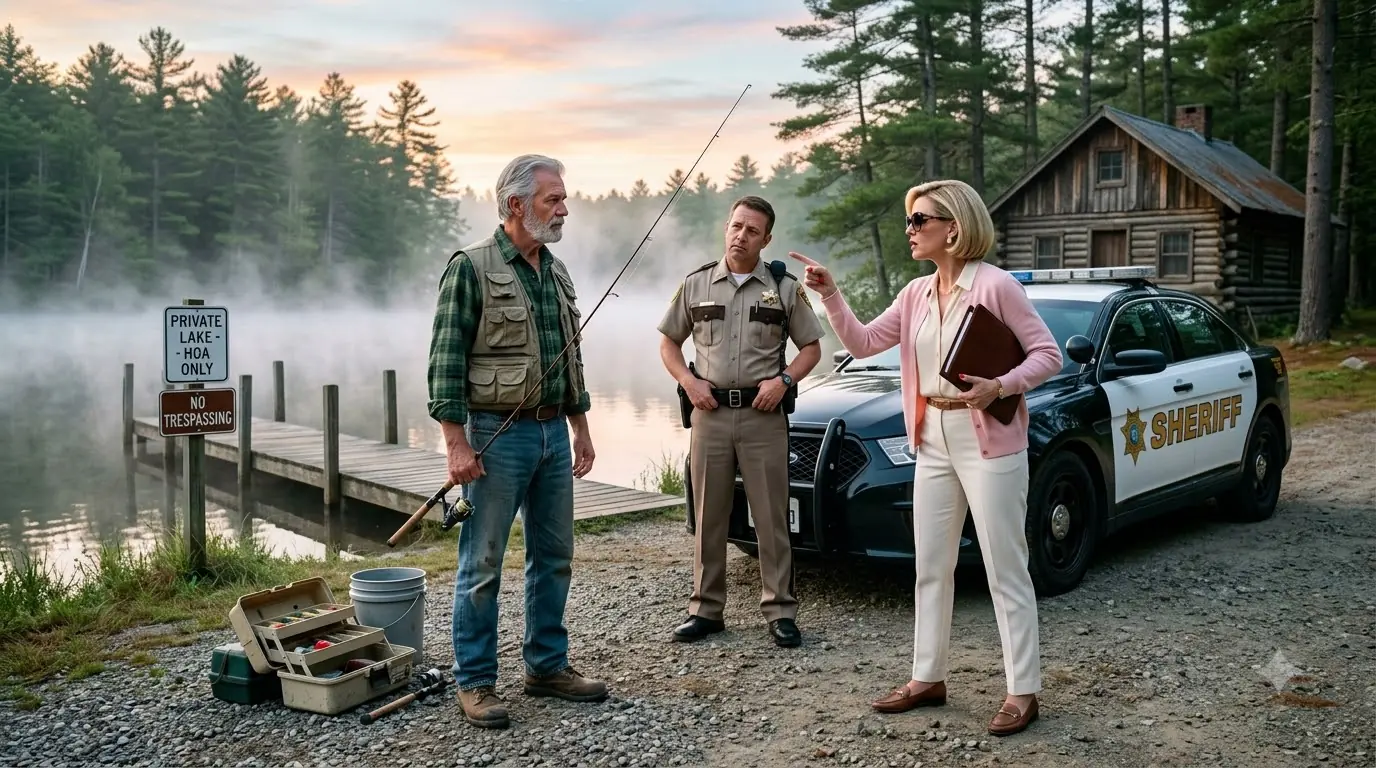
"You're trespassing on HOA waters!" she shouted. A sheriff's deputy showed up looking uncomfortable as hell and said, "Sorry, Theo, but she filed a complaint. I have to ask you to leave."
Margaret stood there in pastel clothes with that satisfied smirk, watching me pack up my tackle box. The snap of that box closing echoed across the water like a gunshot.
What this newcomer did not know was that I did not just have permission to fish that lake. I owned the entire thing, every drop of water rights and every square foot of lake bottom tied to the old deed. And she had been charging my neighbors two hundred dollars a month to use property she did not own.
My name is Theo Blackstone, and I moved to Pine Ridge Lake in 1999 after my wife, Sarah, passed away. Cancer took her at forty-eight, and I needed somewhere quiet to put the pieces back together.
This little two-acre plot came from my grandfather's estate, just raw land with a view of the water. I built the cabin myself, board by board and nail by nail. When your hands are busy, your heart hurts a little less.
The lake became my therapy. Every dawn for twenty-three years, I cast my line into that dark water while mist rose like ghosts off the surface. The smell of pine needles mixed with damp earth, and the only sounds were loons calling across the water and the gentle crunch of gravel under my boots at the boat launch. This was not just fishing. It was healing.
Pine Ridge Lake is a forty-acre, natural, spring-fed beauty surrounded by a mix of old cabins like mine and newer McMansions that started popping up around 2015. The original residents were good people, mostly blue-collar retirees, veterans, teachers, and folks living on modest pensions. We looked out for each other, borrowed tools, and shared fish when the catching was good. Nobody cared if your truck had more rust than paint or if your lawn looked like a patchwork quilt.
Then came the gentrification wave, and with it came Margaret Windham, who arrived like a hurricane in designer shoes. Margaret rolled into town six months earlier in a white BMW with a vanity plate that practically announced she had arrived.
Fresh from a divorce settlement that landed her an eight-hundred-thousand-dollar lakefront property, she moved in with the confidence of someone used to being obeyed. She was forty-eight, with helmet hair that seemed to defy both gravity and good sense, and she was always overdressed like she was heading to a board meeting instead of living next to a fishing hole.
Margaret had worked in corporate compliance in Atlanta, which explained her talent for turning simple conversations into hostile takeovers. Within two weeks, she organized what she called a concerned homeowners meeting.
Her pitch was simple: Pine Ridge Lake needed a homeowners association for property values and safety. She had charts, folks. Actual PowerPoint slides about optimizing community assets and managing recreational liability.
I had not seen that much corporate buzzword bingo since my last contract meeting. Margaret targeted everything that made our little community special: fishing restrictions, dock permits, landscaping standards that would make Augusta National jealous.
But the real kicker was her claim that the lake itself was a common area requiring monthly membership fees of two hundred dollars per household. She collected signatures from eight of the twenty-three properties, mostly newcomers who bought into her fear-mongering about property values.
The rest of us got certified letters demanding mandatory HOA enrollment. I called her up, polite as my mama raised me. "Ma'am, I appreciate your enthusiasm, but I'm not interested in joining."
Her response could have frozen that lake in July. "It's not optional, Mr. Blackstone. This affects everyone's investment."
I kept fishing anyway. What else was I going to do? This was my routine, my peace, and my connection to Sarah's memory. But Margaret stationed herself at her picture window with binoculars, taking photos like I was some escaped convict instead of a guy trying to catch breakfast.
That was when she made the call that lit the whole powder keg. Deputy Charlie Morrison showed up looking like he would rather wrestle an angry bear. Charlie was local. His daddy and mine had worked construction together back in the day.
"Sorry, Theo," he said, avoiding my eyes. "Got a complaint about trespassing. I have to ask you to leave." Margaret stood on her deck in a pink cardigan that probably cost more than my truck payment, arms crossed with that satisfied smirk of someone who thought she had just checkmated a chess grandmaster. I packed up without a fuss. But as that tackle box snapped shut, one thought crystallized like ice on a winter morning: this lady had just picked a fight with the wrong fisherman.
The next morning, I woke up to find Margaret had filed a formal trespassing complaint with the county. Not just a phone call to Charlie, but an actual written complaint with my name on it, complete with photos of me illegally accessing what she called HOA waters. The woman had documented my fishing trips like I was running a cartel instead of catching bass. Within forty-eight hours, she had organized an emergency HOA meeting about what she called non-compliance issues.
The agenda was how to deal with problem residents who refused to respect community standards. Margaret had recruited Dale Pemberton, a retired bank manager with the personality of wet cardboard, as her HOA treasurer. Dale brought legitimacy to her operation. Nothing says official like a man who spent forty years foreclosing on other people's dreams.
Margaret's next power play hit like a sledgehammer. She identified four other problem properties around the lake: Betty Kowalski's cottage with its cheerful garden gnome collection, the Martinez family's weekend cabin with an unapproved fishing boat, old Frank's place with the vegetable garden that apparently violated aesthetic standards, and the Johnson family's modest dock that predated Margaret's arrival by fifteen years. We all got violation notices on the same day.
The aggressive thwack of Margaret's designer heels clicking across driveways as she personally delivered each letter sounded like a countdown timer to war. Betty's offense was an "unapproved garden gnome collection disrupting neighborhood aesthetic standards." I kid you not. The woman was being fined for ceramic lawn decorations that had been there longer than some of the houses around them.
Betty knocked on my door that evening. Her weathered hands trembled like autumn leaves as she held Margaret's legal-sounding letter. The smell of her lavender perfume mixed with genuine fear. "Theo, I don't understand half these words, but they want fifty dollars a day until I remove my gnomes. Those belonged to my late husband."
That was when I decided to do what any reasonable person does when facing a bully: research the hell out of the situation. The county courthouse sits downtown in a brick building that reeks of old paper, stale coffee, and broken dreams. I spent Tuesday morning in the land records office talking to Joyce Miller, a clerk who had worked there since dinosaurs roamed the earth. Joyce had the patience of a saint and the institutional memory of a steel trap.
"Son," she said, squinting at Margaret's HOA filing through glasses thick enough to start fires, "this paperwork is messier than a soup sandwich. She's missing required property descriptions, boundary surveys, and legal authority documentation." Joyce explained that an HOA had to legally define its boundaries and authority in county and state records. Posting laminated signs did not magically create ownership. Her advice was simple: always verify an HOA's legal claims before paying a single dime.
While I was learning property law, Margaret escalated by hiring private security. She brought in some kid who looked like he would rather be wrestling alligators and stationed him at the boat launch during peak fishing hours. The poor guy had the enthusiasm of a wet mop and the authority of a mall cop on vacation. I walked up bright and early Wednesday morning with my tackle box in hand, my boots crunching on frost-covered gravel.
"Morning," I said. "Mind if I ask what legal authority you have to enforce HOA rules?" The kid shifted like he had fire ants in his uniform. "Uh, the lady just told me to be visible and take photos of anyone fishing without permission."
I asked, "Permission from who exactly?" He shifted again. "The, uh, HOA."
I smiled and cast my line anyway. The soft plop of my lure hitting the water punctuated the awkward silence. "Well, you have yourself a nice day, son. Don't forget to wave for those photos." The security guard lasted exactly three days before quitting. Apparently, watching an old man fish while taking creepy surveillance photos was not the exciting career opportunity he had imagined.
Margaret was not done. She hired an actual attorney, some shark from the county seat who specialized in HOA enforcement. The cease-and-desist letter arrived while I was fixing Betty's porch step, because that is what neighbors do for each other around here. The legal language was impressive, full of words like forthwith and pursuant to, demanding five hundred dollars in administrative fees plus immediate compliance with fishing restrictions.
Betty read over my shoulder, her face growing paler with each paragraph. "What's so funny?" she asked when I started chuckling. I folded the letter and slipped it into my shirt pocket. "Margaret just picked a fight with the wrong fisherman."
See, while she was busy playing lawyer and hiring security guards, I had been doing my homework. That morning's courthouse visit had turned up something interesting on old county survey maps: a discrepancy suggesting the lake extended well beyond Margaret's claimed HOA territory. More importantly, I had found a reference to subsurface mineral rights in my grandfather's deed. It was time to find out exactly what Grandpa Blackstone had left me, because something told me it was a lot more than Margaret bargained for.
Margaret's attorney letter triggered what she called an emergency enforcement meeting at her pristine lakefront palace. Her living room looked like a corporate boardroom had a baby with a country club, all beige leather and motivational artwork about success and excellence. The air reeked of expensive vanilla candles and desperation. She assembled her nervous coalition of eight HOA members, each clutching violation notices like talismans against common sense.
"Property values are at stake," Margaret announced, clicking through her PowerPoint like she was launching a hostile takeover instead of harassing retirees. Her enforcement plan included liens, small claims court, and police reports. When Dale suggested maybe they should verify their legal authority first, Margaret steamrolled him faster than a freight train through a paper bag. "We can't show weakness to non-compliant residents," she declared. "Give them an inch, they'll take a mile."
Two days later, I woke up to the aggressive buzz of power tools at seven in the morning, a sound more jarring than nails on a chalkboard. Margaret was installing a decorative fence across the traditional fishing path to the lake, the same dirt trail elderly residents like Betty and Frank had used for decades. The fence was white vinyl with little flourishes that screamed, "I spent more on this eyesore than most people make in a month."
Margaret stood supervising in a lavender pantsuit, sipping coffee from china that probably cost more than my truck payment. When Frank Martinez showed up for his doctor-ordered morning walk, she pointed to a shiny new sign. "Private HOA property. Authorized members only." Frank said in his polite, old-school way, "Ma'am, I've been walking this path since 1987."
Margaret's smile could have frozen hell itself. "Times change, Mr. Martinez. Safety and liability require proper management." That fence was the last straw for a lot of folks. Margaret had just blocked lake access for three elderly residents whose daily walks were literally doctor's orders for their heart conditions.
While she was busy playing neighborhood dictator, I was getting educated about something called riparian rights. Back at the courthouse, Joyce Miller pulled out maps and legal books like she was conducting a master class in property law. The musty smell of old records mixed with her determination to help. "Theo," she said, adjusting those thick glasses, "riparian rights are trickier than a three-card monte game. When you own land adjacent to water, you often get usage rights too, sometimes way more than people realize."
Joyce also found something that made her eyebrows climb toward her hairline: a reference to lake-bottom mineral rights in my grandfather's 1958 deed. "Son, this language is unusual. You might want to dig deeper into what exactly your grandfather bought from that mining company." The lesson was becoming obvious. If you live near a lake or river, read your deed carefully, because old water and mineral rights can contain surprises modern owners never think to look for.
While I was learning legal history, Margaret escalated to full-blown harassment. She filed noise complaints about my boat motor, claiming it disturbed the peace at dawn. She called the county health department alleging my septic system threatened lake quality, forcing me to take time off work for inspections that found absolutely nothing wrong. Then she tried to get my dock declared unpermitted, which was rich considering it predated her birth certificate.
But here is where Margaret made her first real mistake. She got greedy and sloppy. I hired surveyor Jake Patterson to map my exact boundaries, three hundred dollars well spent. Jake spent half the morning taking measurements and the other half scratching his head like he had found buried treasure.
"Theo," he said, pointing at his equipment, "your lot extends thirty feet farther into the lake than anyone expected. Plus, I've seen references to old mining claims from the 1940s around here. Might be worth checking what rights came with those original purchases." That evening, I found an envelope in my mailbox made from expensive paper, written in fountain-pen ink that smelled like old money and carried handwriting that suggested private-school education. The note read, "Check the old Thompson Mining Company records at the state archives."
Someone in Margaret's own coalition was having second thoughts. Meanwhile, Margaret announced her lake beautification project, funded by HOA fees, planning to remove "unsafe" docks belonging to older residents. She scheduled contractor consultations without permission and referred to the lake as "our community asset" in her newsletter. Her exact quote, printed in bold, was: "Some people just don't understand that progress requires sacrifice."
As I studied Jake's survey report that night, listening to loons call across the dark water, one detail jumped out like a lighthouse beacon: SUBSURFACE MINERAL RIGHTS CONVEYED IN PERPETUITY. It was time for a road trip to the state archives. Grandpa Blackstone had not just left me a fishing spot. He had left me the keys to Margaret's worst nightmare.
Margaret's confidence hit dangerous levels after she successfully intimidated Frank Martinez away from his walking path. She scheduled what she called enforcement action with the sheriff's department for my continued trespassing, complete with official-looking paperwork and a timeline for my arrest. The woman had created an actual fine schedule: fifty dollars per day for unauthorized lake access, payable to the Pine Ridge Lake HOA, which had about as much legal authority as my tackle box.
She installed security cameras pointing at fishing spots, their mechanical whirring tracking movement like robotic vultures circling carrion. The cameras were expensive, the kind banks use to catch actual criminals, not retirees trying to catch breakfast. The red recording lights blinked like angry eyes watching every cast of my line.
Margaret's real master stroke was organizing a concerned citizens petition to county commissioners. She gathered forty-seven signatures, mostly from her church group and country club friends who had never seen Pine Ridge Lake except in her carefully curated social media posts about "unregulated recreational threats." Her plan was to present the petition at the next public county meeting, complete with PowerPoint slides that would make a corporate consultant weep with pride. She had already booked a caterer for the post-meeting celebration and invited the local newspaper to document her enforcement success story.
While Margaret planned her victory parade, I took a three-day trip to the state archives. The building reeked of history and bureaucracy: dust, old paper, and the crushed dreams of a thousand researchers. I spent those days digging through Thompson Mining Company records from 1943 to 1962, learning more about my grandfather's business dealings than family reunions had ever revealed.
Here is what I discovered. Thompson Mining had not merely leased mineral rights. The company had purchased comprehensive mineral and water rights to Pine Ridge Lake for copper exploration. The copper turned out to be worthless, but those legal rights were never rescinded when the company folded.
The paper trail was clearer than spring water. Thompson Mining transferred its rights to a consolidated holding company in 1965. When that company dissolved in 1978, the assets transferred to individual partners. One partner was Theodore "Bud" Blackstone Sr., my grandfather. His rights passed to my father and then to me when I inherited the property in 1999.
But here was the kicker that made my coffee taste like victory. Those rights included lake-bottom ownership, not just mineral extraction. Every square foot of lakebed, from shore to shore, legally belonged to the Blackstone property interest that had passed to me. The precise meaning of surface-water usage still needed a lawyer's interpretation, but the ownership chain itself was staring at me in black and white.
Back home, Margaret was sabotaging everything with the desperation of a sinking ship captain. She reported my boat as an abandoned vessel to state environmental agencies. She filed complaints claiming I was running commercial operations without permits. Apparently, one guy with a fishing rod qualified as commercial fishing in Margaret's alternate universe where logic went to die.
She spread rumors about property tax delinquency, which was hilarious because I had been current for twenty-three years. The woman went full scorched earth, even approaching my part-time employer to suggest I was unreliable and involved in neighborhood disputes. My boss knew me well enough to laugh off her complaint, but the audacity was breathtaking.
Meanwhile, Betty Kowalski was doing detective work that would shame professional investigators. She discovered Margaret's HOA had never filed proper incorporation papers with the state. It existed only as an informal neighborhood group with about as much legal authority as a quilting circle.
"Theo," Betty said over morning coffee, steam rising from our mugs while the smell of bacon drifted from her kitchen, "that woman's been running a con game since day one." Dale Pemberton visited me personally, looking more uncomfortable than a vegetarian at a barbecue contest. He suggested a compromise: reduced HOA fees in exchange for a limited fishing schedule. I politely declined without revealing my research findings.
Dale left frustrated, warning me that Margaret would not back down easily. If only he knew how spectacularly right he was. Margaret hired a private investigator to excavate my background, desperately hunting for criminal history, tax liens, anything she could use to discredit me. The investigator found nothing but reported my financial situation as modest and stable, probably not the smoking gun Margaret had hoped to buy.
Her frustration grew like kudzu in summer heat. The simple intimidation tactics that had worked in corporate boardrooms were failing against a guy who just wanted to fish in peace. That was when Margaret decided to go nuclear. She scheduled a final compliance meeting at her house, setting it up like a hostile takeover negotiation with Dale as a witness.
She invited me to "resolve this situation like adults," clearly expecting her boardroom intimidation to finally break me. I agreed to attend, bringing my own folder of documents. As I sat in my truck that evening, the leather seat creaking as I checked my grandfather's original deed one more time, I could not suppress a grin. Margaret thought she was playing chess. I was about to show her she had not even been using the right board.
Attorney Samuel Bennett's office smelled like leather-bound law books and expensive coffee, the kind of place where justice costs money but at least delivers results. I drove to the county seat with my grandfather's deed package, hoping for clarity but half expecting another dead end. Bennett reviewed my documents with the methodical precision of a surgeon, occasionally making notes in handwriting that looked like it required a decoder ring.
"Mr. Blackstone," he said after twenty minutes of silence that felt like twenty hours, "this is extraordinary. Your mineral rights do not just include subsurface ownership. The original conveyance also grants broad lake-bottom ownership and continuing water-use rights tied to the resource estate."
My coffee cup froze halfway to my lips. The leather chair creaked as I leaned forward. "Come again?"
Bennett spread the documents across his mahogany desk like he was laying out a royal flush. "When Thompson Mining purchased these rights in 1943, mining law allowed comprehensive resource acquisition. They bought everything from the lake bottom to the water-use rights needed for extraction and related activities. Those rights were never extinguished." He tapped the inheritance chain. "And they passed lawfully to your grandfather, then through your family to you."
The implications hit me like a Category Five hurricane made of pure justice. "So when Margaret's HOA claims lake ownership..." Bennett smiled. "They are attempting to charge fees for access to property rights they do not own. Every violation notice, every fine, every restriction they have imposed on your use of the lake potentially interferes with your legal property rights."
The silence in that office was so profound I could hear my own heartbeat. I did not just have permission to fish that lake. I had the strongest ownership claim in the entire dispute. Margaret had spent six months pretending to regulate something she had never legally acquired.
Bennett's paralegal found Thompson Mining's 1962 comprehensive lake survey: detailed depth charts, spring locations, and fish habitat zones. The brittle yellow maps crackled as we unfolded them, revealing environmental data that would make any modern agency jealous. "What are my options?" I asked, though part of me already knew the answer.
"Immediate cease-and-desist demands, trespass remedies for structures placed on your property, and civil claims if the harassment continues," Bennett said. Then he paused, studying my expression like I was an interesting legal puzzle. "Or we could let Mrs. Windham continue digging her own grave until she strikes bedrock." I chose patience. Let her take the most aggressive action possible and commit herself fully to a position the records would destroy.
Unknown to Margaret, allies were already mobilizing. Joyce at the courthouse was helping because her grandmother had faced similar harassment years earlier. The county surveyor admitted he had suspected unusual ownership around the lake. Deputy Morrison quietly documented the repeated harassment calls tied to the dispute.
Margaret scheduled her county commissioner presentation for the middle of the week, complete with PowerPoint slides about unregulated access destroying property values. She booked a caterer, invited the newspaper, and reserved the community center for her "lake management success" celebration. Her words to Dale were, "After this meeting, the lake will finally be managed properly."
While Margaret planned her coronation, I prepared evidence packets: tax records, photographs of unauthorized structures, the harassment timeline, survey maps, and the ownership chain. The fresh ink smell from the copy machine mixed with the musty courthouse basement air as I built Margaret's legal education in triplicate. The delicious irony was that Margaret's own research had found lake taxes paid by "T. Blackstone." She assumed it was a typo, never connecting it to the fisherman she had been harassing.
The war council convened at my cabin on Sunday evening. Betty, Joyce, and Attorney Bennett gathered around my kitchen table like generals planning D-Day. Betty brought homemade cookies that smelled like cinnamon and righteous anger. Wood smoke from my fireplace mixed with the aroma of coffee and the determination of people who had finally had enough.
"All right," Bennett said, spreading legal documents across the table like battle plans. "Let's discuss how to present the ownership evidence clearly and lawfully." Joyce leaned forward, her glasses catching the lamplight. "We also need to think about the other families Margaret has been harassing. This isn't just about Theo. It's about establishing that you cannot bully people out of their homes with paperwork that has no authority behind it."
Betty nodded so hard her coffee nearly sloshed over the rim. "That woman fined me fifty dollars a day for garden gnomes. My late husband gave me those gnomes." Bennett explained our legal options with the patience of a teacher. We could challenge the fines, demand removal of unauthorized structures from my property, document defamation and harassment, and pursue civil remedies if necessary.
"But I sense you want something more educational than punitive," Bennett said, looking at me over his reading glasses. "I want people to learn from this," I answered. "Margaret isn't the first HOA bully, and she won't be the last. Maybe if this becomes public enough, people will learn to check the paperwork before they surrender their rights." Bennett nodded. Property disputes can become expensive quickly, and good documentation matters: dates, photos, letters, surveys, witnesses, and certified records.
Joyce pulled out her organizational masterpiece, a chronological evidence file that would make a prosecutor weep with joy. Every photo, letter, witness statement, and recording was organized by date with color-coded tabs. The satisfying click of her three-hole punch had clearly been working overtime. "We've got a parallel timeline," she explained, pointing to her charts. "Margaret's escalating claims on one side, Theo's actual legal rights on the other. The gap between what she claimed and reality is the Grand Canyon of legal liability."
Betty coordinated with the other harassed residents, four families who agreed to attend the county meeting as witnesses. Each had documentation of bogus violations and fee demands. Her kitchen table had become mission control, covered with violation letters, photographs, and handwritten statements telling stories of systematic bullying.
The media angle came together thanks to Joyce's friend at the county newspaper. The reporter was initially skeptical when Joyce pitched "newcomer HOA attempts to claim ownership of privately controlled lake rights." Her skepticism vanished after seeing the deed documentation. "This is actually newsworthy," she admitted. "I'll attend the county meeting for potential follow-up."
Bennett prepared a short legal brief explaining riparian rights, mineral rights, lake-bottom ownership, and inheritance in language that would not require a law degree to understand. He created visual aids showing the lake boundary, ownership timeline, and the old Thompson Mining transfers. His advice was simple: when presenting property disputes, visual documentation beats jargon. Make the chain clear enough that nobody can pretend not to understand it.
The psychological strategy session was my favorite part. "I want to let Margaret make her presentation first," I said. "Let her publicly claim lake ownership, explain all her plans, and commit herself to that position before we reveal the documents." Betty looked worried, her weathered hands fidgeting around her coffee cup. "Won't that be humiliating for her? In front of the whole community?"
"Natural consequences," I said quietly. "She's been publicly humiliating neighbors for months. I don't need to insult her. I just need to let the facts arrive after she finishes talking." Bennett did not smile, but I saw the corner of his mouth twitch.
Deputy Morrison had privately shared Margaret's planned enforcement timeline. She expected sheriff's deputies to be present after the county meeting for a trespassing arrest if commissioners recognized her lake restrictions. I prepared certified deed copies for the sheriff's department in case anyone needed documentation showing that the alleged trespasser was actually the person with the strongest ownership claim.
Our network expanded like ripples on water. The surveyor agreed to attend with boundary maps. A township attorney volunteered to review the documentation. A state environmental contact stood ready by phone if commissioners needed clarification about water-use rules. Each confirmation felt like another safeguard against Margaret's habit of turning confidence into counterfeit authority.
Margaret's aggressive marketing of the meeting was actually helping us. Her social media posts about "property rights protection" were drawing a larger crowd than usual. She invited three HOA presidents from neighboring developments, creating a bigger stage for her own claims to be examined. Bennett suggested using the meeting for community education beyond Margaret's comeuppance and prepared handouts explaining how to research deed history and verify HOA authority.
The physical preparations were simple but symbolic. I cleaned and organized my fishing tackle, planning to arrive at the meeting looking exactly like the man Margaret had been photographing for months. Betty coordinated transportation for elderly residents who wanted to attend but could not drive at night. The county tax assessor agreed to attend as a neutral witness, ready to confirm my lake-property tax history.
The assessor also revealed Margaret had never paid taxes on any portion of the lake itself because her deed did not include it. The environmental agency representative remained available by phone. Margaret, meanwhile, distributed victory-celebration invitations for after the county meeting, reserved the community center for her success party, and hired a photographer to document what she believed would be her HOA enforcement triumph.
Her confidence peaked at exactly the wrong moment, like a general celebrating victory before the battle started. I spent the evening retrieving my grandfather's original mining-company correspondence from a storage box I had not opened in years. The letters showed Thompson Mining's intention to preserve portions of the lake for long-term family recreation after exploration ended. Grandpa specifically mentioned fishing and peaceful retirement in his notes.
Reading his words, I realized this was not just about protecting property rights. It was about honoring a family legacy. The county meeting was close now. Margaret had no idea she was about to face someone who owned not just a fishing spot, but the legal foundation beneath the argument she had built.
As the meeting drew closer, my phone buzzed with Margaret's urgent "community safety alert" before I had even finished my first cup of coffee. She sent a mass message to every lake resident claiming an anonymous tip about tax delinquency on lake property creating an "ownership vacuum." Her argument was that the HOA had to step in to protect community assets from government seizure.
The rapid-fire ding of notifications echoed through the neighborhood as phones lit up with her fear-mongering nonsense. It was like watching someone yell fire in a crowded theater, except the fire was imaginary and the theater was a peaceful lakefront community. Margaret was not done with her pre-meeting blitz.
She tried to get me banned from the county meeting itself, filing a complaint claiming I had threatened HOA members. When the commissioner's office politely explained that public meetings were open to residents, I could practically hear her grinding her teeth through the phone lines. Dale's doubts were growing louder than his loyalty.
At a hastily called HOA meeting, Dale questioned Margaret's increasingly extreme tactics. "Shouldn't we get an independent legal opinion about actual lake ownership before the county meeting?" His voice carried the nervous energy of a man realizing he had backed the wrong horse.
Margaret dismissed his concern like she was swatting a mosquito. "Possession is nine-tenths of the law, Dale. We have the signs, the fences, and the documentation. They have excuses."
Dale's uncomfortable expression suggested he was reconsidering every decision that had led him there. Margaret's social media campaign escalated to absurd levels. She created a group called Pine Ridge Lake Property Protection and posted photos of me fishing with captions about "unauthorized commercial fishing operations threatening community safety." She shared questionable legal citations about HOA authority over common areas that any actual lawyer would have challenged in seconds.
Meanwhile, I maintained my normal routine: fishing at dawn, helping neighbors with repairs, and staying calm while Margaret spun herself into a frenzy. The contrast was not lost on our neighbors. Betty mentioned that people were starting to notice how peaceful I remained while Margaret grew more agitated by the hour. The morning mist rose off the lake like ghosts while Margaret's voice echoed from her deck, barking orders at her remaining supporters like a general losing control of her troops.
Margaret's private investigator delivered his final report. It said I had a clean record, modest finances, and a strong reputation among longtime residents. But the investigator noted something Margaret should have taken seriously: SUBJECT OWNS MORE PROPERTY THAN APPARENT BASED ON VISIBLE STRUCTURES. The report also mentioned inherited mineral interests but apparently did not dig deeply enough to map the full chain.
Margaret missed the warning completely. She focused instead on what she called my "financial vulnerability." The woman thought I was poor and desperate. She had no idea I was sitting on property rights worth more than her BMW.
Her coalition-building efforts brought three neighboring HOA presidents to Pine Ridge for a "property rights solidarity" meeting. Each had their own stories about residents resisting HOA authority. They planned a coordinated presentation showing a pattern of noncompliance across multiple communities. Margaret even created a narrative about property values declining because of unmanaged lake access, complete with cherry-picked real-estate data that would make a statistician weep.
The environmental inspection was one of Margaret's most desperate moves. She filed a complaint claiming my dock threatened the lake ecosystem. When the inspector arrived, he found a structure that exceeded modern standards in several respects because it had originally been built to support heavy equipment access decades earlier.
"Mr. Blackstone," he said, examining the old construction, "this dock is sturdier than most modern residential docks I've seen. Keep every piece of original paperwork you have. Old permits and construction records can be extremely important in disputes like this." His visit produced no enforcement action against me.
Betty's intelligence network delivered another useful detail. Margaret had never paid property taxes on the lakefront area she claimed to manage, and the assessor confirmed her deed stopped at the high-water mark like the other residential deeds. We shared coffee while reviewing Betty's findings, the steam rising between us like visible proof of Margaret's evaporating case.
Margaret hired a second attorney for a legal opinion supporting lake-access restrictions. The attorney wrote a polished letter based entirely on Margaret's version of the facts. The opinion was useless once you removed her central assumption that the HOA owned the lake. But Margaret waved it around like a papal decree.
Anonymous support arrived in my mailbox the next morning. Copies of Margaret's private emails showed coordination with other HOA supporters about using financial pressure and social isolation to push "problem residents" into compliance. Someone in her inner circle was having serious second thoughts and wanted me armed with evidence of a broader pattern.
Margaret's media manipulation attempt also backfired. She contacted the local newspaper claiming a lake-safety crisis and supplied photos of my supposedly unauthorized fishing equipment. The reporter fact-checked her claims and discovered that Margaret's professional background was corporate compliance, not property law or environmental science. The follow-up questions made Margaret defensive enough that she blurted out the kind of statement people remember: "People like him lower property values."
That quote would haunt her. I spent the afternoon installing official boundary markers at my property line after the survey was completed. The solid thunk of stakes being driven into the earth sounded like drumbeats announcing an approaching reckoning. My discreet security cameras captured Margaret's face when she saw the markers: panic first, then the rapid return of manufactured confidence.
The community polarized quickly. Longtime locals quietly aligned with me while Margaret's support crumbled as her tactics became more extreme. Several HOA members privately contacted me to express concern about her methods. The nervous shuffling of papers as former allies distanced themselves sounded like rats abandoning a sinking ship.
Margaret's point of no return came the evening before the county meeting. She announced plans to have me arrested for criminal trespassing after her presentation, coordinated with private security as backup if the sheriff refused to act, and confirmed her celebration venue and photographer. Her exact words to her remaining supporters were, "After tomorrow night, we'll never have to deal with his type again."
I spent that final evening on my porch, listening to loons call across the water and reviewing my evidence one last time. Margaret was about to learn that some fishing holes bite back harder than she ever imagined.
The morning of the meeting arrived with perfect irony. I followed my normal routine, casting my line into the dawn mist at the exact spot Margaret claimed as HOA waters. The lake was glass-smooth, reflecting pink and orange sunrise colors like a postcard from a world where bullies did not exist.
Margaret watched from her window with binoculars, phone already pressed to her ear. Within ten minutes, Deputy Morrison's cruiser rolled up the gravel path, the crunch of tires breaking the morning peace like an unwelcome alarm clock. "Theo," Charlie said, stepping out with the enthusiasm of a man walking to his own execution, "she filed another complaint. I have to ask you to leave until tonight's meeting resolves this."
I complied gracefully, loading my tackle box with the same careful movements I had made for twenty-three years. Margaret stood on her deck in a cream-colored blazer that probably cost more than most people's monthly rent, arms crossed in triumph, watching me pack up like she had just conquered Mount Everest in high heels. The confident click of her designer shoes echoed across the water as she walked back inside, probably to rehearse her victory speech one more time.
Margaret spent the day coordinating her coalition like a general preparing for Normandy. She arrived at the county building two hours early with three neighboring HOA presidents, all wearing matching navy blazers like they were starting a cult. Her entourage carried matching binders, poster boards, and enough documentation to wallpaper a small house.
She reserved front-row seats for her supporters, distributed talking points about safety and property values, and tested her PowerPoint three times to ensure technical perfection. The photographer she hired set up equipment like he was covering a royal wedding instead of a county meeting about fishing rights. Dale expressed final concerns about legal authority, his voice cracking with the desperation of a man who realized too late he was on the wrong side of history.
Margaret dismissed him with a wave that would make a Roman emperor proud. "Dale, we've come too far to show weakness now." I arrived at 6:45 p.m., fifteen minutes before the meeting, carrying my tackle box and one manila folder. My worn flannel and work boots contrasted sharply with Margaret's perfect styling and her supporters' corporate uniforms.
Betty, Joyce, and the other longtime residents scattered throughout the room like seasoned guerrillas preparing for asymmetric warfare. We did not sit together or coordinate obviously. We simply occupied space and waited. The county newspaper reporter sat near the back with a notepad ready, and the air smelled like floor polish, nervous sweat, and impending justice.
Commissioner Williams called the meeting to order at seven sharp. After routine business about road maintenance and budget approvals, he announced, "Next item: public comment regarding Pine Ridge Lake access and homeowner-association concerns. Ms. Windham, you have the floor."
Margaret practically levitated to the podium, her professional PowerPoint gleaming on the projection screen like a corporate presentation from hell. She had created graphs, charts, and statistics that would make a marketing team proud. "Commissioners, concerned residents," she began in the practiced voice of someone who had rarely been told no, "I'm here tonight representing the Pine Ridge Lake Homeowners Association to address a critical community safety issue."
Her presentation was polished, too polished. Professional photos of my fishing gear were labeled "unauthorized commercial equipment." Charts showed declining property values supposedly caused by unregulated lake access. Quotes from her petition warned about community safety concerns and liability risks.
She presented her forty-seven signatures like they were the Declaration of Independence, claimed the HOA represented the responsible majority of homeowners, and showed photos of me with my tackle box labeled "repeated trespassing incidents." Then came the line we had all been waiting for.
"We're not trying to prevent recreation," Margaret said, her tone suggesting exactly the opposite. "We're simply requesting official support for reasonable access restrictions and safety standards. The HOA has taken responsibility for lake management because no clear private ownership exists." That sentence hung in the air like a grenade with the pin pulled.
Margaret's closing was pure corporate manipulation. "We must protect our community investment from those who don't respect progress and property values. I'm formally requesting that the commissioners grant the Pine Ridge Lake HOA enforcement authority over lake access, support our citation program for trespassing violations, and officially recognize our organization as the managing body for this community asset."
Her supporters applauded. The photographer captured Margaret's satisfied smile. Dale looked like he wanted to sink through the floor.
Commissioner Williams cleared his throat, the sound cutting through the applause like a judge's gavel. "Thank you, Ms. Windham. That was very thorough." He paused and scanned the room. "Are there any responses or alternative perspectives?"
I raised my hand slowly, deliberately, like a student who had been waiting for exactly this question. Margaret's confident smirk suggested she expected surrender or fumbling excuses. Her body language screamed victory: shoulders back, chin up, arms crossed in satisfaction.
Commissioner Rodriguez nodded. "Mr. Blackstone, please approach." I walked to the podium carrying only my manila folder. The thud of my work boots on the floor sounded like the countdown to Margaret's worst nightmare.
The room fell silent enough to hear the fluorescent lights humming overhead. Margaret leaned back in her front-row seat, clearly expecting me to beg for mercy or negotiate terms of surrender. Instead, I opened my folder with the casual deliberation of someone holding a royal flush and said seven words that drained the color from her face.
"Commissioners, I'd like to clarify property ownership."
I started with gratitude because that is how you hook an audience before dropping a bomb. "Thank you, commissioners, for your time and for allowing the democratic process to work as intended. I also want to thank Ms. Windham for her passionate presentation about community management." Margaret's smirk widened. She thought I was surrendering.
"I agree that lake management is an important responsibility," I continued, my voice steady as bedrock. "Which is why I take my property-tax payments seriously. I've been paying them faithfully for twenty-three years on Pine Ridge Lake."
The room's energy shifted like a weather front moving in. Papers rustled as I opened my folder with deliberate slowness, the sound echoing in the suddenly attentive silence. "Ms. Windham stated that no clear private ownership exists for the lake. I'd like to correct that misunderstanding."
I produced a certified copy of my property deed, the official county seal visible even from the back row. "This deed and its recorded chain establish that my grandfather, Theodore Blackstone Sr., acquired the lake-bottom, mineral, and water-use rights that originated with Thompson Mining Company." Margaret's face shifted from smug to confused faster than a traffic light.
"Those rights," I continued, "include ownership of the lake bottom and continuing water-use rights tied to the resource estate. Those interests passed through my family and are part of the property I inherited in 1999." I placed the deed and ownership chain on the commissioner's desk like a lawyer presenting Exhibit A.
Commissioner Williams leaned forward, suddenly very interested. "Mr. Blackstone, are you saying you own the lake?" I nodded. "I am saying the records show that I own the lake bottom and the associated water rights at issue here, and I have been paying the taxes tied to those interests every year since I inherited them."
The room erupted in whispers like a kicked hornets' nest. Margaret shot to her feet, her cream blazer suddenly looking less authoritative and more like a costume from a play that had gone horribly wrong. "This is impossible!" Her voice cracked with panic that no amount of corporate polish could hide. "We researched ownership. This can't be legal."
Attorney Bennett stood from where he had been sitting quietly in the middle rows. "If I may, commissioners. Samuel Bennett, representing Mr. Blackstone. I can clarify the property law here." Commissioner Rodriguez gestured for him to continue, clearly fascinated by the drama unfolding better than any reality show.
Bennett approached with the calm authority of someone who had read every relevant document twice. "Riparian rights, mineral rights, and inherited resource estates can be complex, but the chain here is well documented. Thompson Mining acquired the interests in 1943. Those interests were transferred through the holding company, then to Theodore Blackstone Sr., and ultimately to Mr. Blackstone. None of the recorded transfers extinguished the lake-bottom ownership at issue."
He produced certified documentation showing every transfer, properly recorded and notarized. "More specifically, the HOA Ms. Windham represents has been collecting fees for access to property it does not own. Every violation notice, every fine, and every restriction imposed on Mr. Blackstone's use of that property lacks the ownership foundation Ms. Windham claimed tonight."
Margaret's face had gone from cream to white to a shade of red that suggested either rage or a medical emergency. "You can't just own an entire lake! What about our investments? Our property values?"
Commissioner Williams held up a hand. "Ms. Windham, please hold your comments. Mr. Bennett, do you have verification of Mr. Blackstone's tax payments?"
Joyce stood up from her seat, bless her organized soul. "Commissioner, I'm Joyce Miller from the county land records office. I can confirm Mr. Blackstone has been paying the recorded property taxes tied to these lake interests annually since 1999. I can also confirm that the group Ms. Windham calls an HOA has not completed the state filings that would give it the authority it has been claiming."
The county tax assessor, sitting near the back, added his voice. "I can verify Mr. Blackstone's payment history. I can also confirm that Ms. Windham's residential deed stops at the high-water mark and does not include the lake-bottom ownership she has been describing as HOA property."
Margaret looked like someone had pulled the floor out from under her expensive shoes. Her supporters began whispering urgently among themselves, the sound of loyalty evaporating faster than morning dew in August. Dale officially resigned as HOA treasurer right there in his seat, loud enough for everyone to hear.
"I'm out," he said. "This is not what I signed up for."
Commissioner Williams requested a brief recess to review the documentation. During those ten minutes, Margaret stood frozen at the front of the room while her photographer quietly packed his equipment and her supporters executed the fastest political retreat since Napoleon left Moscow. Betty approached me with tears in her eyes.
"Theo, does this mean she can't fine me for my gnomes?" she asked. I smiled. "Betty, it means she never had the authority she claimed to fine anyone for anything."
When the commissioners returned, Williams delivered the finding with the weight of official judgment. "After reviewing the documentation presented tonight, the county recognizes Mr. Blackstone's recorded ownership interests as valid. The Pine Ridge Lake homeowners group has no authority from this commission to collect fees, impose fines, or restrict access to Mr. Blackstone's private property. Any structures placed on property outside the group's legal control must be removed or addressed through the lawful property process."
Sheriff Martinez, who had been standing in the back after Margaret requested law-enforcement support, approached with a bemused expression. "Just to clarify," he said, "I was asked to arrest Mr. Blackstone for trespassing on property the records say he owns?" The room burst into laughter that sounded like justice being served with a side of poetic irony.
Margaret grabbed her purse and rushed toward the exit, her high heels clicking frantically against the floor like a drumbeat of defeat. The celebration she had planned, the photographer she had hired, the victory party she had booked, all of it was waiting for a victor who had just become the defeated.
A reporter caught her at the door. "Ms. Windham, would you like to comment on the county's finding?" Margaret practically shouted, "No comment!" and shoved past into the parking lot where her BMW waited like a getaway car.
I stayed to answer questions because that is what you do when you win with grace instead of arrogance. I did not call Margaret names. I did not demand revenge. I simply explained how I had found the old records and why I thought every homeowner should know what their deed actually says before an aggressive organization tells them what they are allowed to do.
One week after the county meeting, I woke up to something I had not experienced in six months: complete silence. No security cameras whirring, no Margaret voice echoing across the water, just the peaceful morning sound of loons calling and gentle waves lapping against my dock.
The county had required removal of unauthorized signs, fences, and structures from the disputed areas. Margaret's decorative fence that blocked the fishing path was gone by Thursday morning. The security cameras were dismantled soon after. The laminated "Private HOA Property" signs disappeared faster than free beer at a construction site.
I resumed my dawn fishing routine without harassment. The morning mist rose off the dark water like it always had, and the smell of pine needles mixed with damp earth reminded me why I had fallen in love with this place twenty-three years earlier. The crunch of gravel under my boots at the boat launch sounded like a victory march I had never asked for but thoroughly earned.
Three families formally withdrew from Margaret's HOA group within days. Without Dale as treasurer and with the group's legal authority exposed as fiction, the organization effectively dissolved like sugar in hot coffee. The remaining members quietly stopped paying fees and removed their HOA stickers from their mailboxes.
Betty organized a community workday the following Saturday to repair the damage from Margaret's "improvements." Twenty-three neighbors showed up, including several who had initially supported the HOA before seeing Margaret's true colors. We pulled fence posts, filled holes, and restored the fishing path to its natural state.
Former HOA members brought tools and apologies. One couple brought homemade barbecue that smelled like redemption and tasted like community healing. The satisfying thunk of fence posts being pulled from the earth sounded like liberation.
Margaret listed her lakefront property for sale within two weeks. The FOR SALE sign went up on a Tuesday, and she was gone by the following Monday. Her BMW disappeared from the neighborhood, and with it went the toxic energy that had infected our peaceful community.
The house eventually sold below what Margaret had expected. Apparently, a reputation for harassing neighbors does not help property values. The new owners, the Patterson family, specifically chose the location for fishing access and the quiet community. Their kids were out on the dock with rods their first weekend, laughing and splashing near water that could finally be enjoyed without someone shouting about laminated rules.
Joyce organized a "Know Your Property Rights" workshop at the library that drew seventy-three people from three counties. Attorney Bennett volunteered his time for free legal-education sessions, teaching people how to research deeds, verify HOA authority, and protect themselves from similar harassment. Most property disputes start with ignorance. Education can prevent years of unnecessary conflict.
I created an informal lake-access agreement for the neighbors. No fees, no complicated rules, just basic respect. My only requirements were simple: respect the quiet fishing hours, do not litter, and do not harass other people. I installed a tasteful wooden sign at the boat launch: BLACKSTONE FAMILY LAKE - ALL WELCOME - FISH RESPONSIBLY.
Several neighbors offered to pay me for lake access. I refused every offer. This had never been about money. It was about community.
The story spread through regional property-owner networks faster than gossip at a church picnic. Two other aggressive HOA groups faced challenges from residents who had learned to verify claims before paying fees. County commissioners reviewed local HOA formation and documentation procedures, adding clearer standards to prevent another situation built on bluff and paperwork.
Betty's garden gnome collection returned to full glory and expanded with three new additions that neighbors contributed. One of them held a fishing rod, and I laughed every time I walked past it. She organized a "Gnome Sweet Gnome" garden tour that became an annual tradition.
I proposed an annual lake cleanup and fish-habitat improvement program, partnering with state environmental staff for professional guidance. We created a small memorial fund honoring Grandpa Blackstone's conservation vision, awarding scholarships to local students studying environmental science. Private property ownership can benefit an entire community when it is managed thoughtfully. It is not always about control. Sometimes it is about stewardship.
The Pine Ridge Lake Days Festival launched that summer, celebrating community, conservation, and the kind of neighborly respect Margaret never understood. Kids competed in fishing contests, adults shared stories over barbecue, and everyone remembered why small communities matter.
My morning fishing routine became a kind of group meditation. Several neighbors began joining me for quiet dawn companionship. We did not always talk much. We just shared coffee and the peaceful ritual of casting lines into water that reflected the kind of community we had fought to preserve.
Even my back pain improved once the stress disappeared. It turns out constant harassment takes a physical toll you do not always notice until it stops. One morning, Betty mentioned a cousin facing similar HOA trouble involving a community garden and a disputed piece of land.
I smiled quietly, sipped my coffee, and watched the sunrise paint the lake in colors that never get old. "Some folks never learn that bullies eventually meet their match," I told her. "Justice isn't always about punishment. Sometimes it's about teaching a lesson that ripples outward and protects people you'll never meet from tyrants they haven't encountered yet."
Then I cast my line into Pine Ridge Lake, listened to the lure touch the water, and waited for the morning to begin.