They tried to sell my $2.3 million ranch while I was burying my father.
I got back at six in the morning after cutting the funeral trip short, only to find strangers carrying clipboards across my land, professional surveying equipment planted near my fence, and a giant FOR AUCTION sign staked into my front yard.
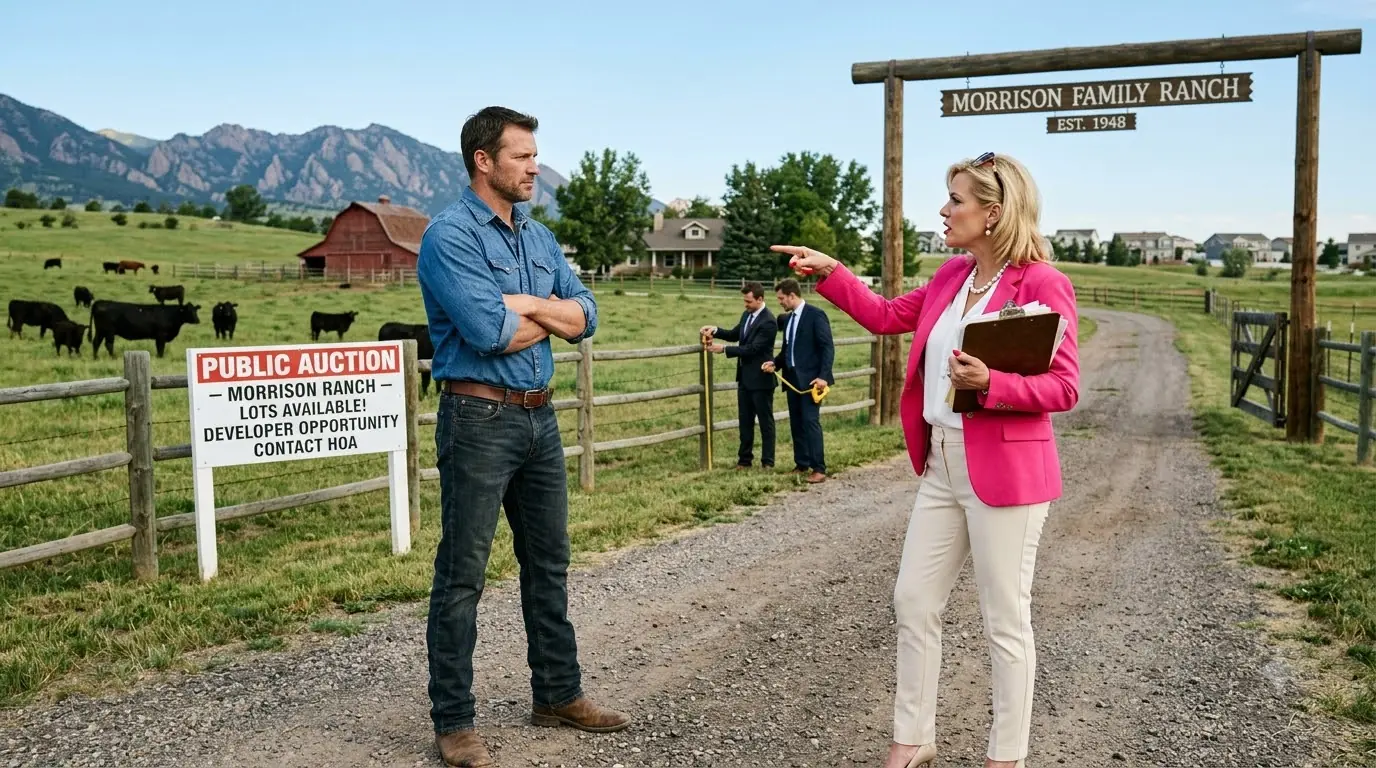
Before the sun was fully over the Colorado Front Range, HOA president Karen Whitfield was already calling 911 to report me for trespassing on property that had belonged to my family for three generations.
I had never joined their HOA.
I had never signed one of their covenants.
I had never given them one inch of my property.
But they thought I had been gone long enough for them to take everything.
My name is Jake Morrison, and I am a third-generation cattle rancher in Colorado. The forty-seven-acre spread I call home has been in my family since 1967, when my grandfather bought raw land and built almost everything himself. The cedar fence, the barn, the cattle pens, and even much of the gravel road leading toward the house came from his hands and the hands of friends who helped him in exchange for meals and favors.
After my wife, Sarah, died from cancer two years ago, the ranch became even more important to me. It was the last place where I could still hear her laughter without trying, the place where our sixteen-year-old daughter, Emma, had grown up, and the place I intended to leave to her someday. Together, Emma and I kept about thirty head of cattle and did everything we could to preserve what my grandfather and father had built.
For most of my life, the land around us had been open country.
Then, three years earlier, developers bought the acreage next door and built Maplewood Heights.
Within months, the subdivision had expensive houses, landscaped medians, matching street signs, a clubhouse, and a homeowners association. The residents elected Karen Whitfield as HOA president, a former city planner who had moved from Denver and arrived with very strong opinions about property values, aesthetics, and what she liked to call community standards.
Karen was the type of person who seemed to know exactly how long someone’s grass was without ever touching it. She sent violation notices for holiday lights left up too long, complained about garden structures that could barely be seen from the road, and treated every HOA rule as though it had been carved into stone.
The problem was that she wanted those rules to apply to me.
They did not.
My ranch existed long before Maplewood Heights.
That did not stop her from trying.
The first dispute was over my cedar fence. Karen claimed it extended eighteen inches into HOA common property, even though the fence had been standing decades before the subdivision existed. After that came odor complaints about cattle during hot summer months.
Then she decided my gravel access road somehow interfered with the subdivision’s entrance median.
Every few weeks brought another letter, another complaint, another threat, or another attempt to force me into compliance with rules I had never agreed to follow.
I ignored most of it and kept records of the rest.
Then, on Tuesday, I got the call every son dreads.
My father had suffered a massive heart attack in Montana.
I left Colorado almost immediately.
Emma stayed with her best friend’s family, while my neighbor Bill Hendricks agreed to check the cattle twice a day. I expected to be gone for about a week while we handled the funeral, paperwork, and everything else that follows a death.
Thursday evening, Emma sent me a message.
Dad, you need to come home now. Something’s happening at the ranch.
I called her.
She told me strangers had been coming and going near the property. Someone had been taking photographs. Bill had seen men measuring near the fence.
Then Emma said something that made my stomach tighten.
“There’s an auction sign in our yard.”
I drove through the night.
By the time I reached the ranch, dawn was beginning to spread across the Front Range. I turned through my gate expecting to see cattle in the pasture and the barn roof catching the first morning light.
Instead, I saw two men in expensive suits standing beside my fence with professional surveying equipment.
A massive wooden auction sign dominated my front yard.
For several seconds I simply sat behind the wheel.
My father had just been buried.
I had driven hundreds of miles through the night.
And now strangers were apparently preparing to sell the land where my grandfather had raised him.
I parked the truck.
My boots crunched over the gravel my grandfather had laid more than fifty years earlier.
“Excuse me, gentlemen. What exactly are you doing on my property?”
The taller man barely looked away from his clipboard.
“Sir, we’re conducting a pre-auction assessment. This property is scheduled for public sale this Saturday.”
I stared at him.
“This is my land.”
Neither man answered.
“You’re trespassing.”
The shorter one smiled.
Not politely.
Not nervously.
He smirked.
“Sir, we have legal authorization. Please don’t interfere with our work.”
I reached for my phone.
Before I could call the sheriff, the taller man had already made a call.
“We have a situation here,” he said. “Subject is being confrontational.”
“Subject?”
I almost laughed.
Apparently I was now the suspicious person standing on my own ranch.
Within minutes, a white Mercedes SUV came racing up the driveway, throwing dust behind it.
Karen Whitfield stepped out.
She was dressed like she was headed into a corporate meeting rather than trespassing on a cattle ranch before breakfast. Cream blouse, tailored jacket, expensive sunglasses, leather folder in one hand.
“Mr. Morrison,” she said with the practiced smile I had come to hate. “You’re in violation of a court order. These gentlemen have every right to be here.”
“What court order?”
She opened the folder.
“This property is subject to forfeiture because of unresolved HOA assessments and boundary violations.”
“This property isn’t part of your HOA.”
“That issue has already been determined.”
“By whom?”
Karen did not answer directly.
Instead, she lifted her phone.
“911? Yes. I need police immediately. We have a trespasser threatening our legal assessment team.”
I looked at her.
“You just reported me for trespassing on my own ranch.”
“You’re interfering with authorized personnel.”
Twenty minutes later, Deputy Maria Santos pulled up in a county sheriff’s cruiser.
I knew Maria.
Her daughter and Emma had attended several school events together, and Maria had been to the ranch once when a loose dog wandered into the cattle pasture.
She stepped from her cruiser, looked at me, looked at Karen, looked at the survey equipment, and seemed genuinely confused.
Karen reached her first.
“Officer, this man is interfering with a legal property assessment. We have full authority to be here under Colorado law.”
Maria kept her expression neutral.
“Ma’am, can you show me the documentation?”
Karen handed her a thick folder.
The top page carried large bold lettering:
NOTICE OF PROPERTY FORFEITURE.
Below it was the name Maplewood Heights Community Authority.
According to the paperwork, I supposedly owed approximately $47,000 in accumulated fines, assessments, administrative charges, and penalties. The HOA claimed my fence had encroached onto common property and that the alleged encroachment triggered an abandonment provision allowing them to take control of the disputed area and initiate action against the rest of my property.
I stared at the pages.
“Maria, I’ve never seen this in my life.”
Karen crossed her arms.
“Ignorance of the covenants isn’t a defense, Mr. Morrison. Certified notices were attempted repeatedly. Refusal to accept delivery constitutes acknowledgement.”
“I never refused certified mail.”
“That isn’t what our records show.”
I pulled up my deed, property tax documents, and county parcel information on my phone.
“This ranch has been in my family since 1967.”
Deputy Santos studied both sets of documents.
Her frown deepened.
“Mrs. Whitfield, county records appear to identify Mr. Morrison as the legal owner.”
“The HOA has statutory authority.”
“Over land that isn’t in the HOA?”
Karen pointed toward the fence.
“His encroachment triggered our abandonment clause.”
I felt something inside me go cold.
“Forty-seven thousand dollars for a fence that was standing before Maplewood Heights existed?”
Karen did not blink.
Deputy Santos handed the folder back.
“This appears to be a civil property dispute. I don’t have grounds to remove Mr. Morrison from property county records identify as his.”
Karen’s voice sharpened.
“Then remove him from the section controlled by the HOA.”
“I’m standing on my land,” I said.
Maria nodded.
“Without a valid court order establishing otherwise, I’m not removing him. Both sides need to handle this through the appropriate legal process.”
“The auction is Saturday,” Karen snapped. “Every delay costs the association money.”
That was when I noticed the sign.
It was not merely beside my property.
It was a good two feet inside my fence line.
I pointed at it.
“Karen, remove that sign.”
Her expression hardened.
“If you touch HOA auction property, I’ll report you for vandalism.”
For a second I had no response.
She had planted a sign in my dirt announcing the sale of my ranch and was threatening to have me arrested if I removed it.
I called my attorney, Tom Bradley.
Voicemail.
He was out of town until Wednesday.
I contacted two other lawyers.
Neither could see me before the weekend.
The timing was perfect.
Too perfect.
Karen seemed to read that thought on my face.
“Timing is everything, Mr. Morrison.”
While we argued, the assessors continued working.
I went inside, opened the fireproof document cabinet, and removed my grandfather’s original 1967 survey.
The paper was yellowed and worn at the folds, but the property markers were clear.
According to that survey, the cedar fence was not eighteen inches beyond my boundary.
It sat approximately three feet inside it.
I carried the document outside.
The taller assessor looked at it briefly.
“This is outdated.”
“It is the original recorded survey.”
“We have an updated survey from 2022.”
“Updated by whom? Nobody had permission to survey my land.”
“The HOA commissioned a professional review,” Karen said.
I turned toward her.
“Without entering my property?”
She did not answer.
Then an old Ford pickup came through the gate.
Bill Hendricks climbed out.
Bill was seventy-three and had spent much of his career surveying land for the county before retiring. Age had slowed his steps, but not his memory.
“Jake,” he called. “I tried reaching you. They were here yesterday too. Measuring. Taking pictures.”
Karen turned.
“Sir, this is private HOA business.”
Bill gave a dry laugh.
“Lady, I’ve lived next to this ranch for forty years. That fence hasn’t moved since Jake’s grandfather put it there.”
Several Maplewood Heights residents had begun appearing near the entrance, drawn by the commotion.
Some clearly supported Karen.
Others looked uneasy.
Mrs. Patterson, whose dog I had pulled out of my cattle pond twice, stood near the sidewalk and avoided my eyes.
Two people I did not recognize started recording.
“Please document everything,” Karen told them. “We need evidence of obstruction.”
Deputy Santos looked again at the old survey.
Then she looked at Bill.
“How long has that fence been in that location?”
“Longer than your subdivision has existed.”
Maria nodded slowly.
She explained that whatever argument Karen intended to make about possession or boundaries would have to overcome the much older recorded ownership and evidence of continuous use. The ranch had existed first, the fence had existed first, and there was no obvious indication that I had abandoned any portion of my property.
Karen remained unmoved.
“We’ll see what the emergency board decides this afternoon.”
At two o’clock, Karen called an emergency HOA board meeting at her house.
I was not invited.
I showed up anyway.
Karen opened the door only a few inches.
“This is a private board meeting.”
“You’re discussing the seizure of my property.”
“You are not an HOA member.”
“Exactly. Yet somehow you’re claiming authority to sell my ranch.”
I refused to leave until they allowed me to present my documents.
The board had five voting members: Karen as president, Dr. Richard Stanton as vice president, Jennifer Walsh as secretary, Marcus Chen as treasurer, and Patricia Vance as member at large.
What I learned later was that the relationships among them were far from neutral.
Jennifer worked for Karen’s real estate company.
Dr. Stanton had invested about $50,000 in one of Karen’s business ventures.
At the time, I knew none of that.
I laid my evidence on the table.
The 1967 deed.
The original survey.
Continuous property tax records.
My grandfather’s notes describing construction of the fence.
“These documents are old,” Karen said.
I stared at her.
“That’s generally considered a strength when proving that my property existed before your subdivision.”
She ignored the remark and produced the HOA’s survey.
It was dated March 2022 and supposedly prepared by a licensed surveyor named Robert Kumar of Mountain West Land Services.
I had never heard of either.
“I want to speak to this surveyor.”
“That isn’t necessary,” Karen said quickly.
“If his survey says my family’s recorded survey is wrong, I’d say it’s very necessary.”
“The document is certified.”
Dr. Stanton opened the HOA covenant and read language concerning encroachment and abandoned property rights.