The wind coming off Lake Superior carried fresh snow across the forecourt of Hollis Gas and Grocery, turning the concrete around the pumps into a gray mixture of ice, salt, and slush.
Wyatt Hollis stood beside pump four with a fuel nozzle in one hand and his dark work jacket zipped to his throat. At fifty-six, he had the steady posture of a man who had spent most of his life facing difficult people without allowing them to set the rhythm of a conversation. His salt-and-pepper hair was damp with snow, his beard stubble had gone silver around the chin, and his brown winter boots were stained by decades of work around engines, roads, and Michigan winters.
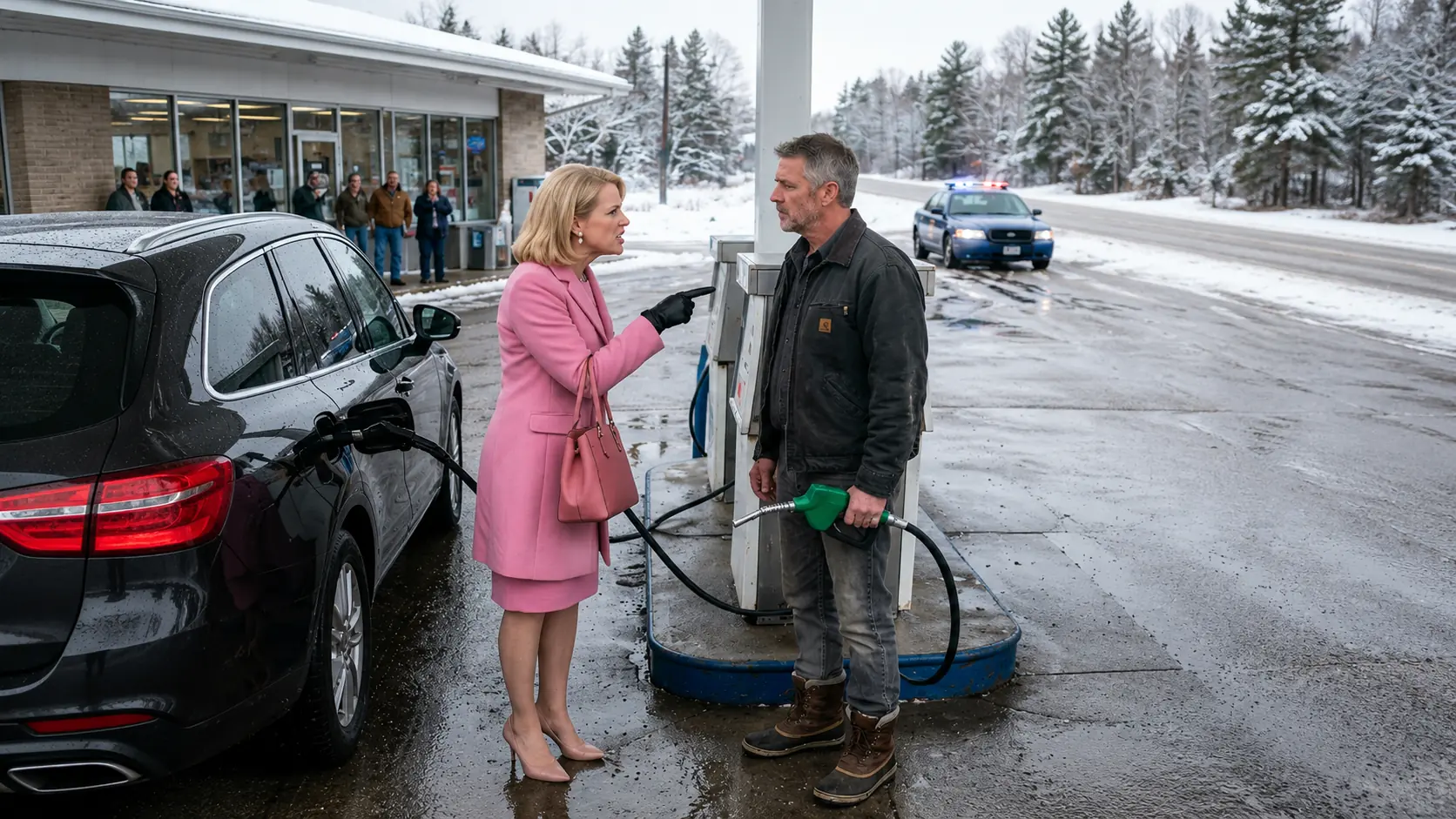
Across from him stood Margaret Kilroy.
Her bright-pink wool coat looked as if it had never touched a dirty surface before that morning. Beneath it, she wore a matching knee-length dress, beige heels, black leather gloves, pearl earrings, and an expression that suggested the gas station had personally insulted her.
Her black luxury SUV waited beside the pump.
The tank was still empty.
Margaret pointed one gloved finger toward Wyatt’s chest.
“I asked you to fill it.”
Wyatt returned the nozzle to the pump.
“And I told you the price.”
“I’m not paying retail.”
“Then you’re not buying gas here.”
Her narrow blue eyes hardened.
“I am president of Birch Harbor Estates. We represent thirty-six of the most valuable properties in this township.”
“Congratulations.”
“You should be grateful for our business.”
“I’m grateful for every customer who pays.”
Margaret stepped closer.
Snow collected along the shoulders of her pink coat.
“Our residents drive trucks, SUVs, recreational vehicles, snowmobiles, and boats. We purchase thousands of gallons every year. A sensible business owner would understand the value of a partnership.”
Wyatt glanced toward the SUV.
“A partnership usually involves both sides receiving something.”
“You receive our loyalty.”
“I receive a loss on every gallon.”
Margaret exhaled through her nose.
Inside the station, four regular customers had stopped drinking coffee. They stood near the front windows, watching through the glass while Wyatt and Margaret faced one another between the pumps.
His sister Cora remained behind the register with both arms folded.
She had seen Margaret enter local businesses for nearly two years, request special prices, and leave offended whenever the owners refused. The hardware cooperative had denied her discounted firewood. The local café had refused to provide weekly catering below cost. The deer processor had charged her the same rate as everyone else.
Margaret treated ordinary prices as personal attacks.
This morning, however, she wanted more than a discount.
She wanted fuel for free.
Wyatt looked at her calmly.
“Tell me exactly what you’re asking for.”
Margaret straightened, interpreting the question as surrender.
“The HOA board has authorized a preferred-provider agreement. Your station will supply our private neighborhood pump at wholesale cost. You will also provide complimentary fuel for HOA administrative vehicles.”
“Which vehicles?”
“My SUV, my husband’s truck, our landscaping equipment, maintenance vehicles, private security patrols, and anything used for official association business.”
“You decide what counts as official?”
“I am the president.”
“How much free fuel per month?”
“We can establish reasonable limits later.”
“That means there are no limits.”
Margaret’s face tightened.
“It means the details can be handled professionally once you stop being difficult.”
Wyatt placed both hands inside his jacket pockets.
“My family has sold gasoline here since 1962. We make a few cents on a gallon after delivery, tax, equipment, card fees, and maintenance. I’m not selling your HOA fuel below what it costs me, and I’m not filling your vehicles for free.”
“You’re refusing a legitimate commercial proposal.”
“I’m refusing to subsidize people living in million-dollar houses.”
“You have no right to comment on our homes.”
“You brought up their value.”
Margaret looked toward the station windows and saw the customers watching.
Embarrassment sharpened her anger.
“Fill our private tank for free,” she said, “or I’ll shut this dump down.”
Wyatt did not move.
“What private tank?”
“You know exactly what I mean.”
“I know you mentioned a neighborhood pump two years ago. I asked whether it was licensed. You never answered.”
“That is HOA property.”
“Fuel regulations apply there too.”
“You are not an inspector.”
“No.”
Wyatt met her stare.
“But I know enough to recognize when someone avoids a simple question.”
Margaret stepped directly into him and jabbed her finger against his chest.
“You don’t speak to me like that.”
Wyatt knocked her hand aside.
“Touch me again, and you’ll leave in cuffs.”
She pulled a phone from her handbag.
“I’ll have the police drag you out of your own station.”
“Call them.”
He took one step closer.
“Then explain your illegal fuel tank to their chief.”
Margaret stared at him for a moment, then pressed the emergency number.
She placed the call on speaker so Wyatt and everyone behind the glass could hear.
“This is Margaret Kilroy at Hollis Gas and Grocery on US 41. The owner has refused service, threatened me, and become physically aggressive.”
The dispatcher’s voice remained calm.
“Are you injured?”
“He struck my hand.”
Wyatt’s expression did not change.
“Is he preventing you from leaving?”
“He is trying to intimidate me.”
“Ma’am, are you free to leave?”
Margaret looked toward her SUV.
“Yes, but that is not the point.”
“Does he have a weapon?”
“I don’t know. He looks dangerous.”
Inside the station, Cora shook her head slowly.
The dispatcher asked Margaret to remain at a safe distance and promised to send an officer.
Margaret ended the call with a triumphant smile.
“You should have taken the offer.”
“You should have paid for your gas.”
Six minutes later, a new Oakdale Police Department patrol car turned off the highway and entered the station lot. Its tires cut through the snow before it stopped near pump three.
Officer Daniel Polanski stepped out.
He was twenty-six, six months removed from the academy, and only four days beyond the end of supervised field training. He wore a dark winter patrol jacket and approached with the focused seriousness of a young officer who still mentally reviewed every procedure before speaking.
Margaret walked toward him before he reached the pump.
“Officer, thank God. That man threatened me, refused service, and struck me when I tried to discuss a business matter.”
Polanski looked toward Wyatt.
“Sir, Mrs. Kilroy has filed a complaint that you refused service and threatened her. I need to ask you a few questions.”
Wyatt nodded toward the radio clipped to his shoulder.
“Before we begin, key your microphone.”
Polanski hesitated.
“Sir?”
“Call dispatch.”
The young officer pressed the radio button.
“Dispatch, Unit Twelve.”
Wyatt leaned just close enough for the microphone to catch his voice.
“Patty, this is Chief Hollis.”
The dispatcher answered within two seconds.
“Go ahead, Chief.”
Polanski’s face changed immediately.
Margaret looked from him to Wyatt.
“Chief?”
Wyatt Hollis had worked for the Oakdale Police Department since 1996. He had spent seven years on patrol, eight as a sergeant, seven as a detective, and the last six as chief.
Before that, he had served as a military police corporal.
The gas station belonged to his family, but it was not the only place where Oakdale residents knew his name.
Margaret, who had lived three miles away for nearly four years, had never bothered to learn it.
Polanski straightened.
“Chief, I didn’t realize you were working at the station.”
“You did nothing wrong. You responded to the call you were given.”
Margaret recovered enough to lift her chin.
“His position changes nothing. A police chief can still threaten a customer.”
Wyatt looked at Polanski.
“Keep your body camera running. Take her statement exactly as she gives it.”
Margaret shifted her weight.
“Why are you saying that?”
“Because false police reports are recorded too.”
“I did not make a false report.”
Polanski removed a notebook.
“Ma’am, let’s begin with the refusal of service. What did Chief Hollis refuse to sell you?”
“Gasoline.”
Wyatt pointed toward pump four.
“At the posted price?”
Margaret glared at him.
“That was not the agreement.”
Polanski looked between them.
“What agreement?”
“I offered his station a preferred-provider relationship with Birch Harbor Estates.”
“What would the station provide?”
“Fuel.”
“At what price?”
“Wholesale.”
“And you requested fuel for your vehicle today?”
“Yes.”
“Did he offer to sell it at the posted retail price?”
Margaret paused.
“That is not relevant.”
“It is relevant to whether he refused service.”
She crossed her arms.
“Yes, he offered retail.”
Polanski wrote the answer down.
“Did he prevent you from using the pump?”
“No.”
“Did he tell you to leave before or after you threatened to close his business?”
Margaret looked sharply at Wyatt.
“He is influencing the interview.”
Wyatt stepped away.
“Continue without me.”
Polanski looked at her hand.
“You said he struck you.”
“He slapped my hand away.”
“Why was your hand close enough for him to do that?”
“I pointed at him.”
“Did you touch him?”
“Barely.”
“Where?”
“His chest.”
“Did he hit you, or did he remove your hand after you touched him?”
Margaret’s cheeks flushed.
“I felt threatened.”
“That is not what I asked.”
She looked toward the station windows.
The customers inside had not moved.
Cora stood at the register watching with a cold, patient expression.
Margaret lowered her voice.
“Perhaps I overstated certain details because I was upset.”
Polanski wrote the words down.
“Perhaps you overstated.”
“I was under stress.”
“Did Chief Hollis threaten to injure you?”
“No.”
“Did he prevent you from leaving?”
“No.”
“Did he display a weapon?”
“No.”
“Did he refuse to sell you fuel at the same price offered to every customer?”
“No.”
Polanski closed his notebook.
“Then this appears to be a disagreement over a requested discount, not a refusal of service.”
Margaret pointed toward Wyatt.
“He threatened me with arrest.”
“After you touched him?”
“He said I would leave in cuffs.”
Wyatt answered from several feet away.
“I told her not to touch me again.”
Margaret collected her handbag from the SUV’s hood.
“I will file a formal complaint with the township board. I will have this station’s license reviewed, and I will make sure everyone knows the chief uses his badge to protect his own business.”
Wyatt opened the SUV’s driver door for her.
“Make sure you include the private fuel tank in your complaint.”
Margaret climbed inside and slammed the door.
Her tires threw slush across the pavement as she left without buying fuel.
Polanski watched the SUV disappear.
“Chief, should I cite her for the report?”
“Not yet.”
“Why not?”
“Because she just gave us something more useful than a citation.”
Wyatt looked toward the road leading north.
“A reason to ask what she is doing with that tank.”
By ten fourteen that morning, he was on the phone with Lieutenant Hannelore Idakowski at the Michigan State Police post near Negaunee.
They had known one another since the academy.
Wyatt explained Margaret’s demand for wholesale fuel, the private neighborhood pump, and her reaction when he asked whether the system was licensed.
Hannelore searched the complaint database.
“I have eleven open incidents connected to Margaret Kilroy or Birch Harbor Estates.”
“What kind?”
“Three possible false reports. Two consumer complaints. Several financial disputes. And one tip from a former groundskeeper about an underground fuel tank.”
Wyatt sat forward.
“Name?”
“Pella Lehtinen.”
Wyatt remembered Pella. The man had worked at Hollis Gas during the summer of 1988 before taking maintenance jobs around Marquette County.
“What does the tip say?”
“He helped pour a pad near the Birch Harbor gatehouse. He says a tank went underground, but he never saw an inspector.”
“Bring in environmental enforcement.”
“You think she’s reselling?”
“She asked for wholesale supply and free administrative fuel. She is not preparing for emergencies.”
Two days later, Pella entered the Oakdale Pasty Cafe carrying a manila folder beneath one arm.
Wyatt sat with Hannelore, Sheriff Halford, Assistant County Prosecutor Annika Ronquist, and Charles Kotila from the state environmental department.
Pella opened the folder.
Sixteen photographs covered the table.
They showed a buried storage tank, a private dispensing pump, fuel drums transported in the back of pickup trucks, an unmarked monitoring box, and darkened soil surrounding a concrete pad near the shoreline.
One photograph showed a hose hidden beneath a black tarp.
Another showed oily water entering a drainage ditch.
Charles studied the images.
“Where does that drainage run?”
“Toward the cove,” Pella answered.
“Any observation wells?”
“None that I saw.”
“Spill containment?”
“No.”
“Permit markings?”
“Nothing.”
Charles removed his glasses.
“If this is operating as it appears, the HOA has an unpermitted underground fuel system in a protected shoreline and groundwater zone.”
Annika picked up a photograph of several vehicles waiting near the pump.
“How long has it been selling?”
“At least three years.”
“Who collects the money?”
“Margaret and her husband. Residents pay through a company they own.”
The investigation continued quietly.
An inspector entered Birch Harbor Estates under the cover of a routine environmental survey. Soil samples near the tank showed petroleum contamination above state limits. Groundwater testing found fuel components moving downhill toward Lake Superior.
Financial records revealed something even larger.
Margaret had created Birch Harbor Hospitality Ventures, a private company registered in her name. HOA members paid for gasoline through the company, believing the money returned to neighborhood operations.
Instead, Margaret bought fuel at retail, transported it without proper safeguards, and resold it at a markup.
The HOA paid for maintenance, deliveries, and equipment.
Margaret kept the profit.
More than two hundred thousand dollars had also disappeared from community reserve accounts through false invoices connected to her company.
The strongest evidence arrived at Wyatt’s home one cold Thursday evening.
Joyce Larkin, secretary of the Birch Harbor HOA, stood on his porch with a banker’s box in her arms and a tuna casserole balanced on top.
“I’ve been copying records for two years,” she said.
Inside the box were invoices, bank statements, construction documents, meeting notes, and a handwritten log of conversations between Margaret and her husband.
Joyce had watched Margaret punish residents who questioned her. Violation notices appeared after disagreements. Architectural applications were delayed. People were threatened with legal fees.
“Why bring this now?” Wyatt asked.
Joyce placed a copy of Margaret’s latest complaint on the kitchen table.
“She wants the township to revoke your station’s commercial license.”
Wyatt read the document.
Margaret accused Hollis Gas of operating as a nuisance beside an upscale residential community. She claimed the legal station was an environmental threat while her own unpermitted tank leaked toward the lake.
“She plans to present this publicly?” he asked.
“At the April township meeting.”
Wyatt closed the folder.
“Then let her.”
On April 16, the Oakdale Township Hall filled with one hundred seventeen residents.
Margaret arrived wearing a bright-pink blazer, pearls, and a confident smile. Her husband sat beside her. Joyce took the row behind them with a recorder hidden inside her handbag.
The meeting agenda listed Margaret’s complaint as item six.
Item seven was an emergency regulatory action concerning Birch Harbor Estates.
Margaret had brought her own agenda and did not notice the addition.
When her turn arrived, she approached the podium.
“For decades,” she began, “Hollis Gas and Grocery has operated as an outdated commercial nuisance. The owner refuses reasonable community partnerships, applies discriminatory pricing, and uses his public position to intimidate residents.”
She demanded immediate revocation of the station’s license.
Wyatt listened without interruption.
When she finished, the township supervisor invited him to respond.
He walked to the podium.
“Hollis Gas has operated legally on commercial property since 1962. It holds every required license and has never received a sustained environmental or consumer complaint.”
Margaret folded her arms.
Wyatt looked toward the board.
“I request that we proceed to item seven.”
The supervisor nodded.
Hannelore approached the podium in uniform.
“At seven fourteen this evening, state and federal environmental teams executed an emergency order at the Birch Harbor Estates amenity park.”
Margaret stopped breathing for a moment.
“An unpermitted underground fuel tank is currently being emptied and excavated. Testing confirmed petroleum contamination in the surrounding soil and groundwater.”
Daniel Kilroy turned toward his wife.
“What is she talking about?”
Margaret did not answer.
Hannelore continued.
“Investigators have also identified an unlicensed retail fuel operation and more than two hundred thousand dollars removed from HOA reserves through false invoices.”
Residents began whispering.
Margaret turned toward Joyce.
“You gave them the records.”
Joyce met her eyes.
“I gave them what belonged to the homeowners.”
Margaret stood.
“You little traitor.”
Sheriff Halford stepped away from the back wall.
“Sit down, Mrs. Kilroy.”
She looked around and finally noticed the investigators seated throughout the hall.
Wyatt remained beside the podium.
Margaret pointed at him.
“This is revenge because I demanded fair prices.”
“You demanded free gasoline.”
“You used your badge to destroy me.”
“No.”
Wyatt’s voice remained quiet.
“You used your office to take money from your neighbors.”
Sheriff Halford approached.
“Margaret Kilroy, you are under arrest for fraud, false reporting, theft by deception, and unlawful operation of a fuel-storage facility.”
She stepped backward.
“You cannot arrest me here.”
“This is where you chose to make the issue public.”
He secured her hands while the hall remained silent.
As he led her toward the side exit, Margaret stopped beside Wyatt.
“You ruined my life.”
Wyatt looked at her pink blazer, the pearls, and the fury still burning in her face.
“You built the tank. You took the money. You called the police.”
Margaret was escorted outside.
The criminal case ended months later with guilty pleas from both Margaret and Daniel. They were ordered to repay the stolen reserve funds and cover the environmental cleanup.
Birch Harbor removed Margaret from office.
Joyce became interim president.
Her first official visit to Hollis Gas was different from Margaret’s last.
She waited in line, paid for her coffee, and asked whether Birch Harbor could help organize a shoreline cleanup.
Cora agreed before Wyatt finished drinking.
That spring, residents from the development and the town removed tires, appliances, scrap metal, and truckloads of trash from the woods and shoreline.
Months later, Wyatt established a heating-fuel program for low-income Oakdale households. Birch Harbor matched the station’s contribution.
Margaret had demanded free gasoline for luxury vehicles.
The community used that same idea to help elderly neighbors survive the winter.
Hollis Gas remained beside the highway, its pumps working through another season of snow.
Above the register hung a photograph of Wyatt’s grandfather standing outside the station on opening day in 1962.
When customers asked Wyatt how a demand for free fuel uncovered an illegal tank and years of theft, he never spoke about revenge.
He gave them simpler advice.
“Keep the receipts. Save the messages. Write down the dates.”
Margaret believed the loudest person controlled the story.
Wyatt knew better.
Anger faded.
Threats changed.
People lied.
Evidence stayed exactly where it was placed.