When a power-tripping HOA president decides you do not belong in her pristine neighborhood, she might send you letters.
She might fine you.
She might call a towing company.
She might complain about your truck, your fence, your trash cans, your lawn, your paint color, or whatever else she has convinced herself falls under the sacred jurisdiction of a volunteer board with a quarterly newsletter.
Brielle Edwards did all of those things.
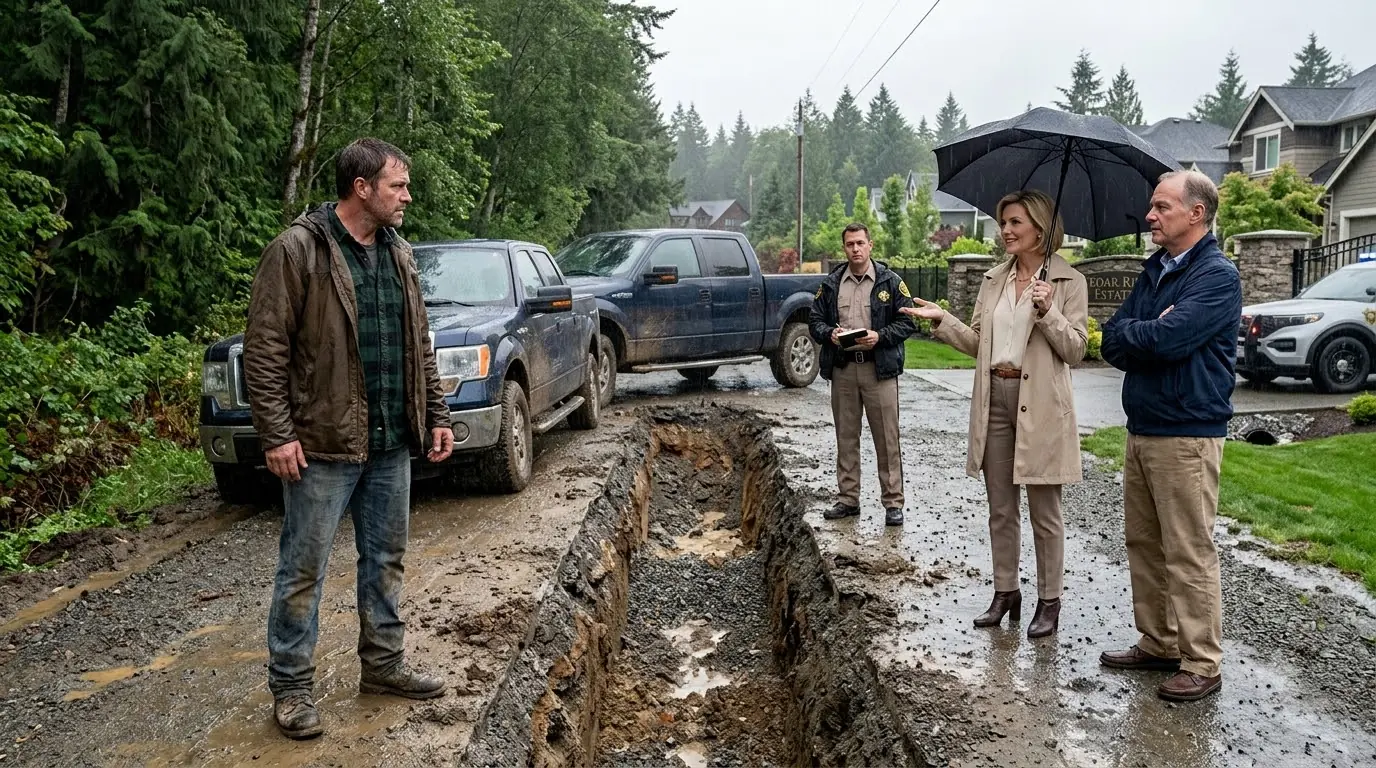
Then, when none of them worked, she hired a man with an excavator and paid him cash to dig three enormous trenches across the only road leading to my house.
Not across a shared access road.
Not across an easement.
Not across HOA property.
Across my land.
My private land.
She believed that if she made my property physically inaccessible, I would finally surrender the thirty-foot strip she wanted.
She thought she had buried me.
Instead, she opened the ground beneath Bailey Lane and found something she never knew existed.
A regional high-capacity fiber-optic trunk.
By the time the mud settled, the repair invoices, service-level penalties, legal costs, environmental work, and emergency response expenses totaled approximately $2.64 million.
The Cedar Ridge HOA collapsed under the weight.
Brielle lost her position.
Then her house.
Then most of the reputation she had spent years building.
And the road she wanted paved more than anything in the world?
It ended up paved.
Just not by me.
My name is Dobby Bailey.
I bought twelve wooded acres outside a small Washington town in 2017 because I wanted distance.
Not isolation exactly.
Distance.
I had spent most of my twenties and early thirties living in places where opening the bathroom window meant looking directly into someone else's kitchen.
Apartments.
Townhouses.
Condos.
Places where you learned your neighbors' schedules because their washing machine vibrated through your wall at midnight.
I wanted trees.
I wanted enough space that if I sat on my porch, nobody could hear the conversation unless I invited them into it.
I found the property almost by accident.
The listing had been on the market for nearly a year.
Twelve acres of fir, cedar, maple, fern, and rocky ground tucked behind open pasture near the lower Cascade foothills.
There was a small two-bedroom cabin on the acreage.
Nothing fancy.
Metal roof.
Wood stove.
Detached shop.
A seasonal creek along the north side.
The unusual part was the shape.
The property was a flag lot.
Most of my acreage sat roughly a quarter mile back from the county highway.
Connecting it to the highway was a long rectangular strip approximately thirty feet wide.
Think of a flag on a pole.
The twelve acres were the flag.
The narrow strip was the pole.
That strip became Bailey Lane.
When I bought the land, my title agent explained the distinction several times because flag lots sometimes create confusion.
“You own this strip in fee simple.”
She pointed at the survey.
“Not access rights.”
“Not an easement.”
“The actual land.”
I remember asking:
“So nobody can block it?”
“Not lawfully.”
“What about neighbors?”
“They would need an easement or another recorded right.”
“Any?”
She flipped through the title package.
“There is one underground utility easement.”
I barely listened to that part.
The document seemed ordinary.
Some telecommunications company had obtained the right in the late 1990s to bury infrastructure beneath the long straight strip running toward the highway.
The easement reserved maintenance and emergency access.
I signed an acknowledgment.
Then promptly forgot almost everything about it.
At the time, I cared much more about whether the cabin septic system worked.
For the first four years, Bailey Lane was nothing more than a gravel driveway.
Quarter mile.
Packed rock.
A few potholes every spring.
Dust in August.
Mud near the edges in November.
I maintained it with a tractor blade.
Every two years I had gravel delivered.
Nobody cared.
There was almost nobody around to care.
To the east of Bailey Lane lay open pasture owned by an elderly ranching family.
To the west, scattered woods.
My nearest occupied house was several hundred yards away through trees.
At night, I could stand outside and see almost no artificial light.
That was exactly why I had bought the place.
Then the pasture sold.
The announcement appeared on a county planning notice first.
CEDAR RIDGE DEVELOPMENT.
Residential subdivision.
Approximately 150 lots.
Stormwater improvements.
New internal roads.
Landscaping.
Clubhouse.
Walking paths.
The developer, NorthWest Dominion Homes, purchased nearly two hundred acres.
Within six months, survey crews arrived.
Then excavators.
Then dump trucks.
Then streets.
The open land beside my quiet gravel driveway slowly became a construction site.
I did not object.
The pasture was not mine.
People have a right to develop property within the law.
I knew my life would become noisier.
That was unfortunate.
Not illegal.
By the end of 2022, Cedar Ridge Estates looked like someone had copied the same luxury suburban house one hundred and fifty times, then changed the garage orientation and exterior paint enough to claim variety.
Large houses.
Three-car garages.
Decorative stone facades.
Black-framed windows.
Perfect sod.
Young ornamental trees held upright by stakes.
A grand entrance boulevard came off the county highway.
The developer installed brick columns and a stone sign reading:
CEDAR RIDGE ESTATES
The boulevard ran almost perfectly parallel to Bailey Lane.
That was the unfortunate part.
There was only a narrow landscaped strip between the HOA entrance and my gravel road.
From the county highway, visitors saw two roads heading in the same direction.
One wide, paved, landscaped, illuminated.
One narrow, dusty, gravel.
Mine.
The developer could have screened Bailey Lane with fencing or trees.
They did not.
Instead, their entrance architecture seemed designed to make the contrast obvious.
Cedar Ridge looked polished.
Bailey Lane looked rural.
That was the first problem Brielle Edwards decided needed solving.
I met her approximately one month after she moved in.
Saturday morning.
I had been cutting fallen branches in the back acreage and was driving toward the highway in my 2008 Ford F-150.
The truck was muddy.
So was I.
I came around a slight bend and found a woman standing in the middle of Bailey Lane.
Clipboard in one hand.
Sunglasses.
Cream blouse.
White pants.
Perfect blonde bob.
White Range Rover parked on the Cedar Ridge boulevard beside her.
I slowed.
She did not move.
I stopped.
Rolled the window down.
“Can I help you?”
She looked at my truck before looking at me.
“You need to slow down.”
“Okay.”
“The speed limit in Cedar Ridge is fifteen miles per hour.”
I glanced toward the paved boulevard.
Then back at her.
“I’m not in Cedar Ridge.”
“You're driving beside Cedar Ridge.”
“Yes.”
“And your truck is throwing dust onto our landscaping.”
I looked behind me.
A small trail of dust hung above my gravel.
It was August.
Dry gravel creates dust.
“I’m driving about twenty.”
“Too fast.”
“For my driveway?”
She frowned.
“This road is adjacent to our entrance.”
“That is true.”
“I’m Brielle Edwards.”
That explained nothing yet.
“HOA president.”
There it was.
“Dobby Bailey.”
“I know.”
She said it in a way that made it sound as though my name had already appeared in a meeting.
Brielle looked toward the road.
“This entire strip is a problem.”
“My driveway?”
“It is visually inconsistent with Cedar Ridge.”
I nearly laughed.
“I imagine so.”
“We have significant investment in landscaping.”
“Congratulations.”
“The dust gets onto the plantings.”
“I can water the road if it gets unusually bad.”
“That isn't enough.”
She adjusted the clipboard.
“The HOA wants this paved.”
I stared.
“Then the HOA should pave its road.”
“Our road is paved.”
“Exactly.”
Brielle's mouth tightened.
“I am formally requesting that this access lane be paved by the end of the month.”
“Request denied.”
“I haven't finished.”
“I think I understand.”
“If you fail to correct the condition, the association may have to levy fines.”
That was when I laughed.
Not aggressively.
Honestly.
I could not help it.