“Sure. Hand over the pool keys.”
That was the first thing out of his mouth. Not a question. An order.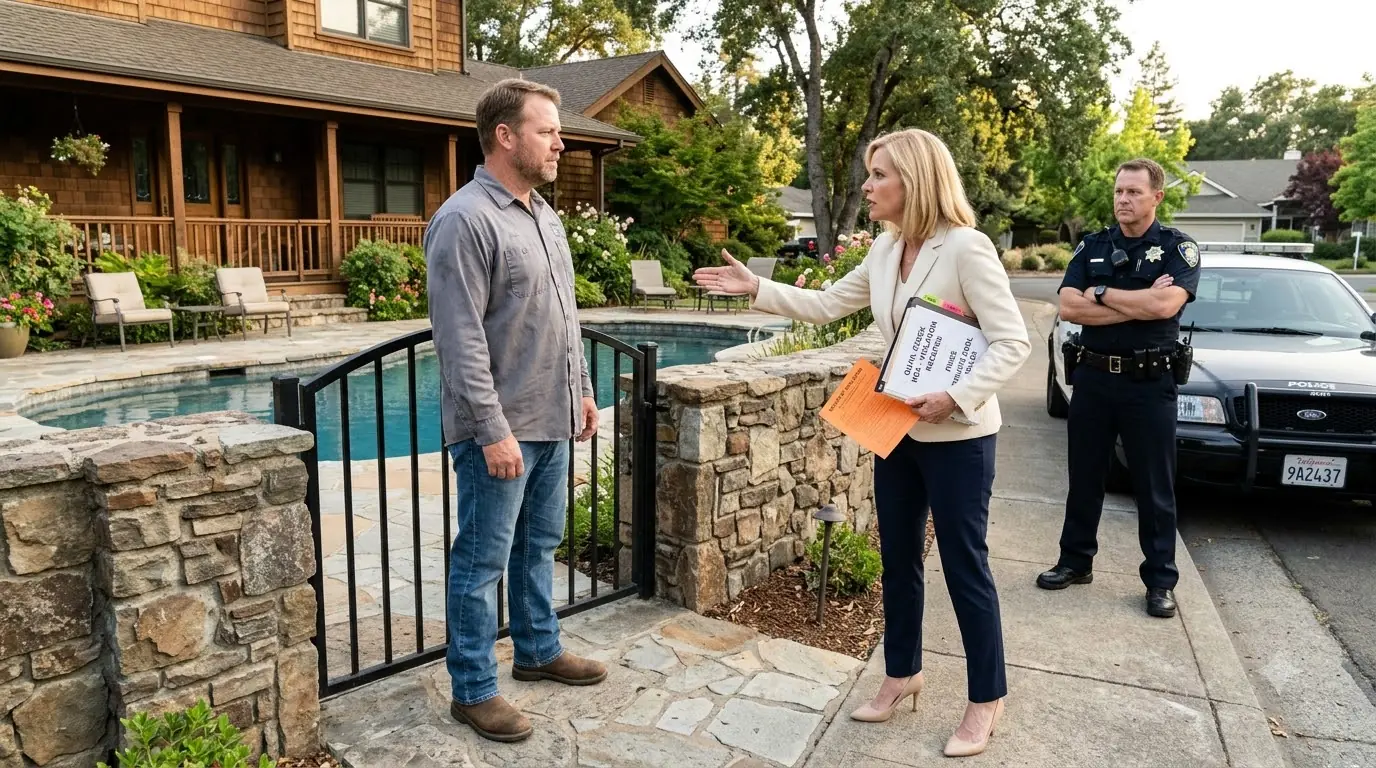
Karen stood a few feet behind him with her arms crossed, wearing the kind of satisfied smile that told me she believed the matter was already settled. I looked at the officer, then at her.
“You really sent your husband for this?” I asked.
She did not blink.
“You’ve ignored three notices,” she said. “The pool belongs to the community.”
Her husband tightened his jaw as if he had been waiting for permission to play the role Karen had assigned him.
“It’s on my property,” I said.
“Not according to her,” he replied.
Karen stepped closer. “Don’t play dumb. You either cooperate, or we escalate.”
I could feel the pressure coming from both of them. One was leaning on the appearance of authority. The other was feeding on it.
But underneath my silence, I was almost smiling.
Because while Karen thought the argument was about pool keys, it wasn’t.
It was about power.
And she had just walked deeper into something I had already begun documenting without realizing it.
When her husband repeated, “Keys. Now,” I stepped slightly closer and kept my voice level.
“You might want to be careful about who you’re threatening, Officer.”
Neither of them understood what I meant.
Not yet.
When the patrol car finally rolled away, I stood near the pool and watched the fading reflection of its lights disappear across the water. My hands were steady.
My heart was not.
It was not every day that your neighbor sent her husband in law enforcement to demand access to property your father had built with his own hands.
The truth was that this had never really been about a swimming pool.
With people like Karen, it was rarely about the thing written on the notice.
It was about control. It was about making sure everyone understood who supposedly ran the neighborhood.
My name is Cole. I moved back into my childhood home the previous spring after my father passed away.
The house had been in our family since the 1970s. My father had built much of it himself. The cedar porch, the stonework, the retaining walls, and the pool in the backyard had all been shaped by his hands.
I came back to restore the place, not fight over it.
Six weeks later, the homeowners association introduced itself.
New board. New rules. Same familiar obsession with authority.
At the center of it was Karen Langford, a retired real estate agent who had somehow transformed herself into the unofficial ruler of the subdivision.
Karen spoke as though every sentence belonged in a property brochure.
She smiled constantly.
She watched constantly, too.
The first notice arrived two days after the neighborhood welcome meeting.
UNAPPROVED STRUCTURE DETECTED. POOL REQUIRES INSPECTION.
My father’s pool.
The same pool that had existed long before the association became involved in the neighborhood.
I ignored the notice.
Then came another.
Then fines.
Then threats of further action.
And eventually, Karen sent her husband.
She believed his presence would scare me into submission.
What she did not know was that intimidation had always looked like paperwork to me. You document it. You date it. You preserve it.
My father taught me construction.
My years in federal investigative work taught me documentation.
Truth means very little if you cannot prove what happened.
I grew up on that property before the neighborhood had glossy entrance signs, committee meetings, approved paint palettes, or three-page forms for replacing a mailbox.
Back then, it was just my father, me, and a patch of rough land that smelled like pine trees, gasoline, fresh soil, and concrete dust.
The pool had not been installed by a contractor.
My father carved it out himself.
He mixed concrete in a wheelbarrow, laid the stone one piece at a time, ran the lines himself, and spent countless evenings checking levels under a work lamp.
He used to tell me, “Never let anyone claim what you built.”
I did not understand it when I was a boy.
Now it had become the line I lived by.
Every summer followed the same rhythm. Cicadas humming in the trees. The steady knock of his hammer. Water rushing into the basin when repairs were finished.
Dad did not believe in shortcuts.
“If you build it right,” he would say, “you only have to build it once.”
To him, that pool represented more than recreation. It represented work, ownership, independence, and the satisfaction of creating something that belonged to your family because you had earned it.
When he died, I promised myself I would keep it alive.
So when I returned home, I cleaned the leaves from the bottom, repaired the filter, replaced worn equipment, and patched cracks along the stone edge.
For a few months, working beside that water made it feel as though Dad had never really left.
Then Karen knocked on my door.
“Welcome to the neighborhood,” she said brightly.
It was July, yet she was wearing a blazer.
She handed me a glossy booklet titled Community Harmony Guidelines.
I skimmed it.
She smiled as if she had just given me a contract I had already signed.
A week later, she confronted me at an HOA meeting.
The room smelled like burnt coffee and nervous politeness.
Karen opened a thick binder and announced loudly enough for everyone to hear, “Mr. Cole, you have an unregistered water structure on your property.”
Someone near the back laughed.
“It’s a pool,” I said.
“Unregistered,” she repeated, enjoying the word.
“It has been there since before this association had any involvement with this property.”
“Then it is definitely noncompliant.”
That was the moment I understood Karen did not care about inspections.
She cared about being obeyed.
And she was not operating alone.
Her husband, Officer Langford, was never far away.
Some evenings, I would see his cruiser parked close to my driveway with the headlights angled toward my mailbox.
There was never a citation.
Never an official reason for him to be there.
Just presence.
The message was obvious.
We are watching you.
The first night it happened, I stood on the porch with a drink and watched the minutes pass.
The cruiser remained there.
He wanted me to feel cornered.
I wanted him to understand I was paying attention.
After that, I started keeping records.
Dates.
Times.
Photographs.
Copies of every letter.
The following weeks felt like a slow invasion.
There would be a yellow notice attached to my gate.
A drone would hover near the backyard.
A neighbor would walk slowly past while holding a phone pointed toward the house.
Karen called it community vigilance.
I called it excessive surveillance.
One morning, I found her near my fence with a clipboard in her hands.
“You know you’re standing beyond the common area, right?” I asked.
She barely reacted.
“Just verifying compliance,” she said. “We cannot have unauthorized pools drawing water from the community supply.”
That almost made me laugh.
The pool was not connected to a shared community supply.
My father had tapped a natural spring decades earlier. The water line came through our property from the hillside.
No neighborhood meter.
No shared system.
Just a source that had been there before most of the surrounding homes existed.
That evening, I started reading the HOA bylaws.
Page after page.
Noise restrictions.
Fence styles.
Lawn height.
Exterior paint colors.
Parking rules.
Guest rules.
Not one clause clearly gave the association control over my private spring or the old pool.
Then I pulled county plat maps and deed records.
That was when things became interesting.
The spring sat outside the association’s recorded common-property boundary.
There was no easement transferring control of it to the HOA.
Karen could write whatever she wanted in a neighborhood memo.
That did not make it legally true.
The following weekend, she escalated again.
An envelope arrived marked URGENT.
Inside was an invoice for $2,500.
The listed reason was unauthorized community water usage.
No formal hearing.
No documented water connection.
No clear authority.
Just a number and a demand.
I walked to Karen’s house that afternoon.
She was trimming roses in her front yard, visor tilted over her forehead, expression perfectly composed.
“Is this a joke?” I asked, holding up the invoice.
“Rules are rules.”
“I don’t owe the association $2,500.”
“You’ll find the payment instructions on the back.”
She continued clipping roses as though we were discussing landscaping.
Then she lowered her voice.
“You think you’re different because that pool belonged to your daddy.”
I stared at her.
“Around here,” she continued, “we do things by the book.”
“Whose book?”
Karen looked directly at me.
“Mine.”
The garden shears snapped closed.
That sound stayed with me.
That night, I sat beside the pool with a flashlight, county records, old permits, photographs, and copies of my father’s hand-drawn plans spread across the patio table.
The air smelled like chlorine and pine.
Exactly as it had when Dad sat there after long workdays.
I could almost hear him again.
Never let anyone claim what you built.
For the first time, I understood how much larger the sentence was than property.
It was about refusing to let someone rewrite reality simply because they had a title and a louder voice.
Karen believed the fine would make me surrender.
Instead, I gathered every document.
Every photograph.
Every notice.
I built the file the same way my father had built that pool.
One layer at a time.
Then I wrote a response.
One sentence sat across the top in bold letters.
YOU WANT PAPERWORK? YOU’LL GET PAPERWORK.
I delivered it to the HOA mailbox and walked home under the same moonlight that reflected from Officer Langford’s cruiser parked farther down the street.
The difference was that I was no longer angry.
I was focused.
The next phase would not be fought with shouting.
It would be fought with records.
The surveillance became more obvious after that.
One morning, I heard a faint buzzing above the pool.
A drone hovered over the property with its camera angled downward.
I looked up and waved.
It stayed.
The next day, there were two.
A week later, one of the HOA volunteers walked past with a long camera lens and claimed he was “documenting possible violations.”
I asked him to remain off my property.
He smiled as though it were a joke.
Soon came noise complaints.
Excessive splashing after dark.
Unauthorized gatherings.
One complaint claimed I was operating a commercial recreation facility from the house.
None of it was true.
I rarely even played music outside.
Still, every complaint generated another letter.
And many of those letters were personally delivered by Officer Langford.
He would pull up in the cruiser, sometimes with the engine idling, walk to the gate, place the envelope inside, then look toward the house.
Never an explanation.
Never a formal police purpose.
Just the authority of the uniform used as theater.
Sometimes I could hear Karen’s golf cart nearby.
She would be waiting around the corner to see my reaction.
Her silence said the same thing her notices did.
I own this neighborhood.
I tried once more to reason with her.
She was near the mailboxes looking at her phone.
“Karen, can we handle this like adults?”
She looked up.
“Talk to the board.”
“You are the board.”
She turned and walked away.
That was when I realized the campaign was not intended to correct a violation.
It was intended to exhaust me until I sold the property.
I began talking quietly with neighbors.
One homeowner had recently sold after months of fines over lawn equipment and minor maintenance issues.
Another had been targeted over the number of guests at a family gathering.
Karen did not apply rules evenly.
She applied pressure selectively.
The association had become her personal kingdom.
And her husband’s presence gave that kingdom a layer of intimidation.
So I stopped reacting publicly.
When the drones appeared, I documented them.
When her husband delivered something, I logged the date and time.
When a notice arrived, I scanned it.
I stacked facts while Karen stacked accusations.
Then one night, while reading HOA financial reports, I found something that changed the entire problem.
A pool maintenance fund.
Thousands of dollars listed as operational expenses.
But the reports contained no clear contractor names for several payments.
No attached receipts.
No matching permit records.
And some approvals carried Officer Langford’s signature.
I leaned back from the computer.
This was no longer just a neighborhood power struggle.
There might be financial misconduct involved.
Once I started looking, other cracks appeared.
A neighbor told me her community pool access card had suddenly been disabled and that Karen had offered to reactivate access in exchange for a cash payment.
Another homeowner described nearly the same thing.
No receipt.
No formal record.
Just cash.
I returned to the ledgers.
The expense category for guest and pool amenities had climbed dramatically in a single quarter.
There was no convincing explanation.
Meeting minutes showed Karen directly handling several access-fee collections.
I began comparing the reported income with known resident payments.
The numbers did not make sense.
It looked as though money was moving without a proper paper trail.
And Officer Langford had signed approvals related to several questionable expenses.
His involvement gave me another concern.
He was not merely standing beside his wife during HOA arguments.
He appeared to be participating in private association activity while presenting himself to residents through his law-enforcement role.
That could create serious ethical problems.
I needed evidence, not assumptions.
So I kept documenting.
I added exterior cameras covering my own entrances, gate, and mailbox.
I preserved each interaction.
When Langford appeared, I remained calm and let him speak.
I did not argue.
I wanted the record to speak for itself.
Then the visits stopped for several days.
No drone.
No letter.
No cruiser.
People mistake silence for peace.
Sometimes silence means planning.
At the next HOA meeting, Karen stood at the front of the room with her familiar binder.
“We have received multiple reports of noncompliance,” she announced, looking directly at me. “Residents should remember that our enforcement personnel may act when necessary.”
She used the word personnel very carefully.
Officer Langford stood near the back wall.
He was still in uniform.
His badge had no HOA authority.
But Karen understood exactly what its presence communicated.
The residents understood it, too.
Most said nothing.
After the meeting, I walked past Karen.
“You’re not as subtle as you think,” I said.
She smiled.
“You should consider selling. These situations can become exhausting.”
I walked out before answering.
On the way home, Dad’s words returned.
Never let anyone claim what you built.
I decided I was staying.
The days after that meeting felt heavier.
Mail began arriving partially opened.
My trash cans were tipped over at night.
One morning, an orange notice appeared on my work truck claiming it was an unauthorized commercial vehicle.
My own name was painted on the door.
I did not react.
Every notice went into the file.
Every incident received a date.
I even logged drone activity.
The pattern was becoming clearer.
Whenever I addressed one complaint, another appeared.
Karen called it compliance.
I called it harassment.
The worst part was how many neighbors acted as though it were normal.
Fear had become part of the neighborhood routine.
Karen might fine one homeowner for weeds while ignoring another identical yard for months.
Rules had become a tool for rewarding loyalty and punishing resistance.
One night around midnight, the cruiser appeared near my driveway again.
Headlights low.
Engine running.
I walked outside with my phone recording from my property.
Officer Langford remained in the vehicle.
Ten minutes.
Then fifteen.
Finally, he drove away slowly.
When I reviewed my home-camera footage, I noticed his position.
He had not been monitoring traffic.
His vehicle had been angled toward my backyard and pool entrance.
That was when my anger changed into something colder.
Resolve.
I began keeping a formal logbook.
Dates.
Times.
Names.
Short factual descriptions.
I also checked publicly available work records against several of Langford’s visits.
Some of the timing did not appear connected to a regular patrol assignment.
That mattered.
If he was using the appearance of official authority while acting privately on behalf of his wife and the HOA, the ethical questions became much more serious.
For one evening, I almost gave up.
I sat at the computer looking at real-estate listings.
Selling would have been easy.
I could leave Karen, the notices, the drones, the meetings, and the resentment behind.
Then I stepped outside.
The pool lights shimmered beneath the porch.
I remembered another thing Dad used to tell me.
“You only lose what you hand over.”
I closed the listings.
I was not leaving.
The final push arrived exactly the way Karen liked to operate.
Paperwork wrapped in arrogance.
A white envelope taped to the front door carried the words URGENT HOA LEGAL ACTION.
Inside was a cease-and-desist notice.
According to the document, I had to stop “unauthorized use of community water features.”
The evidence attached to the notice consisted of photographs of my private pool.
I read it three times.
The signature at the bottom was not Karen’s.
Officer Langford had signed it under a title identifying him as a community enforcement liaison.
As far as I could determine, that was not a recognized governmental role.
It appeared to be a private HOA label designed to make the document look more official than it was.
I called the county clerk.
No formal government enforcement action had been filed against my property.
There was no county order regarding the pool.
The threatening document was internal HOA correspondence.
That confirmed what I had suspected.
Karen was bluffing.
The dangerous part was that the bluff came wrapped in the appearance of police authority.
That night, I opened every file.
Drone footage.
Letters.
Meeting notes.
Photographs of the cruiser.
Security timestamps.
Financial reports.
I organized them by category.
Jurisdiction.
Property.
Harassment.
Financial concerns.
Use of official position.
Patterns became easier to see when the emotion was removed.
The next afternoon, Karen arrived in her golf cart.
“I hope you read the notice,” she said.
“I read it.”
“Failure to comply will escalate matters.”
“Karen, you’ve escalated enough.”
She tilted her head.
“Then we understand each other.”
I nodded.
“Perfectly.”
She drove away looking satisfied.
I watched the golf cart disappear and returned inside.
I placed the cease-and-desist notice in a clear sleeve and added it to the evidence file.
By sunset, the pool lights reflected across the folders on my patio table.
Dad used to sit there with his old thermos and say, “Some people build. Others only control. Builders last longer.”
I closed the binder.
“You wanted paperwork, Karen,” I whispered. “Now you’re going to get the serious kind.”
The following morning, I drove to the county records office.
I asked for historical plats, water-resource filings, easements, and subdivision boundary records.
The clerk brought out a thick binder that looked as though no one had opened it in years.
I worked through old maps until I found the original property boundary.
My parcel extended beyond the line shown in Karen’s neighborhood packets.
Near the rear portion of the property was a notation regarding the natural spring.
The old filing indicated that the source was subject to a longstanding federal environmental and water-resource easement.
More importantly, the HOA boundary ended before it reached that protected area.
The association had no recorded ownership of the spring.
I scanned the relevant pages.
I photographed the original stamps.
I also found documentation from 1979 showing that my father had completed the required federal water-resource permitting process when he established the system.
Dad had planned decades ahead.
I sat there staring at his name.
He used to tell me, “I built this place to last longer than the people who think they run it.”
He had.
By the time I left, I did not merely have an argument.
I had documentation.
I contacted an old colleague named Miller, someone I knew from my federal investigative years who now worked cases involving environmental and financial misconduct.
I kept the initial conversation simple.
“I may have private interference involving a federally protected water easement,” I told him. “There may also be financial issues inside the HOA.”
“Send me what you have.”
That was all he said.
That evening, I assembled a preliminary evidence package.
Maps.
Notices.
Photographs.
Association financial reports.
Copies of disputed approvals.
Documentation of repeated attempts to treat my private water source as HOA property.
A day later, Miller called.
“This deserves a closer look,” he said. “We’ll conduct a preliminary review. No promises.”
“That’s all I’m asking.”
Once outside scrutiny becomes possible, people who have been hiding things often become nervous.
I began building quiet alliances inside the neighborhood.
The HOA treasurer, Linda, had looked exhausted for months.
One evening, I saw her near the mailboxes.
“Do you ever wonder where all the maintenance money is going?” I asked.
She gave a bitter laugh.
“Every day.”
We met later in my garage.
Linda brought invoices.
Some were tied to businesses that appeared to be inactive.
Others claimed repairs that no resident remembered seeing.
Several lacked supporting details.
I studied the stack.
“This needs to be reviewed properly.”
Linda nodded.
“I’ve been saying that for months.”
For the first time since the conflict began, I felt as though I was no longer standing alone.
My next ally lived two houses away.
Tom Willis was seventy-two, a retired city planner with decades of experience reviewing permits, drainage plans, and property boundaries.
When I showed him the historical maps, he leaned closer.
“They extended the HOA line on the neighborhood version.”
“That’s what I thought.”
He compared the recorded county plat against the map Karen distributed.
The association packet showed a boundary reaching farther toward my spring than the official map did.
Someone had altered the presentation.
“They cannot create jurisdiction with a marker,” Tom said.
Together, we reviewed years of association records.
Questionable maintenance payments.
Inflated service costs.
Vendors with little or no traceable history.
Approvals involving both Karen and her husband.
Several payments appeared linked to a company called Blue Leaf Services.
A few days later, Officer Langford visited my property in civilian clothes.
“You should back off these accusations,” he said. “You’re starting to look paranoid.”
“I’m not making accusations.”
He stared at me.
“I’m documenting.”
He smirked. “Keep filming. Maybe you’ll get famous.”
He turned away.
That was when I noticed a small custom ring on his hand bearing the initials B.L.
It might have meant nothing.
Or it might not.
I checked Blue Leaf Services again.
The company records raised more questions than they answered.
Its connection to the association needed proper investigation.
I forwarded the information to Miller without drawing conclusions.
His reply was short.
Stay quiet. Let us verify it.
That was exactly what I intended to do.
The neighborhood tension changed.
People noticed I had stopped fighting publicly.
Karen noticed, too.
For months, she had relied on reactions.
Anger gave her material.
Silence gave her uncertainty.
A week later, flyers appeared near mailboxes.
NONCOMPLIANT RESIDENT.
COMMUNITY SAFETY CONCERN.
My address was printed beneath the headline.
A photograph of my house appeared below that.
No explanation.
No evidence.
Just fear.
I tore one down and almost laughed.
Karen was losing patience.
And people lose precision when they lose patience.
The harassment grew more personal.
A rolled flyer appeared beneath my doormat.
HOA VIOLATOR. DANGEROUS PROPERTY OWNER.
My photograph.
My address.
A community-watch label.
Later came anonymous notes.
LEAVE WHILE YOU STILL CAN.
SELL BEFORE THE FINES INCREASE.
YOU’RE NOT WANTED HERE.
Several were written or printed on the same stationery used for HOA correspondence.
I photographed each one.
Preserved each one.
Logged the dates.
Then Miller emailed me.
We found significant inconsistencies in the association’s filings. Continue preserving records.
That was all I needed.
I turned next to the insurance expenses.
Every annual HOA budget included a large payment for pool liability coverage.
The insurer listed was Cedar Reserve Pool Liability Coverage.
I searched the state corporate database.
The company had been dissolved years earlier.
Yet the HOA continued reporting payments as though an active policy existed.
I checked again.
Then again.
No current registration.
No active company in that name.
I sent the finding to Linda.
Her response arrived almost immediately.
This may explain why I could never get a current policy certificate.
If homeowners had been paying toward insurance that did not actually exist, the financial implications were serious.
By then, Karen had begun driving past my house more often.
One evening, she rolled by in the golf cart and stared directly at the porch.
I waved.
She did not.
For the first time, the confidence on her face looked different.
It looked forced.
Power rarely disappears quietly.
It claws for relevance.
Karen went door to door telling residents I was under investigation.
Then she posted a statement on the HOA website accusing me of tampering with community property.
According to her, I had damaged a pool gate and removed water equipment.
The photographs she attached showed my own backyard.
Her strategy was becoming desperate.
But people were no longer automatically believing her.
Neighbors started approaching me privately.
“I know something isn’t right,” one woman whispered.
Another homeowner left a note at my door.
Stay strong. People are finally paying attention.
That is how entrenched control begins to fail.
Not necessarily through one giant confrontation.
Sometimes it fails because loyalty quietly disappears.
I kept working.
Every evening, I organized records and compared signatures.
My binder now contained questionable invoices, disputed inspection records, the inactive insurance company, HOA notices, property maps, and repeated examples of Officer Langford appearing in connection with private association enforcement.
I did not need to claim which statutes applied.
That was for investigators.
My job was to preserve facts.
Miller eventually called.
“If the documents authenticate the way they appear to,” he said, “there could be serious fraud and misuse-of-position issues here.”
“What do I do?”
“Exactly what you’ve been doing. Stay calm. Don’t interfere. Preserve everything.”
So I did.
I stopped attending most HOA arguments.
I stopped replying emotionally.
I stopped giving Karen the confrontation she wanted.
The notices became increasingly petty.
Grass height.
Exterior lighting.
Noise.
One complaint claimed excessive noise occurred on a night when I was not even home.
I documented it.
Every weak accusation added context to the larger pattern.
One evening, I saw Officer Langford parked near the corner again, looking at his phone.
I walked to the edge of my driveway.
“Evening, Officer.”
He looked up.
“Nice night for community service.”
He did not answer.
I smiled slightly.
“You may want to tell Karen to locate the current insurance certificate.”
His expression changed.
Only for a second.
But I saw it.
Then he drove away.
That night, I sat beside the pool.
For the first time, the water did not feel like the target of the dispute.
It felt like the line that had finally exposed everything around it.
Karen had tried to bury me in paperwork.
Instead, she had given me enough documents to build a case.
The email arrived Thursday morning.
Subject: EMERGENCY COMMUNITY ENFORCEMENT MEETING.
Attendance requested.
The meeting would take place Saturday evening in the clubhouse.
Everyone knew who the agenda was really about.
Karen intended to stage one last public confrontation.
What she did not know was that investigators had reached the point where they were ready to observe what happened next.
Miller called Friday night.
“We have enough to move forward with record preservation and formal investigative steps,” he said. “Tomorrow, stay calm. Do not provoke anyone.”
I agreed.
Saturday was hot and heavy.
The clubhouse windows glared beneath fluorescent light as I walked toward the entrance.
Inside, neighbors were already seated.
Karen stood at the front.
Her husband stood beside her.
He was not wearing his full duty equipment, but his posture and accessories were clearly meant to remind everyone of his profession.
I entered.
The room went quiet.
Karen smiled.
“Mr. Cole. Thank you for joining us. We’ve received several complaints regarding your property. I’m sure we can settle this civilly.”
I said nothing.
I sat near the front.
Karen began her presentation.
Photographs of my pool.
My gate.
My backyard cameras.
“This is what happens,” she said, “when one homeowner refuses to respect community standards.”
Murmurs moved through the room.
Then her husband stepped forward with an envelope.
“As acting community enforcement liaison,” he said, “I am here to collect association property, specifically the pool keys.”
There it was.
The statement they had been building toward for months.
I stood.
“You really want to make that official?”
Karen frowned.
“Excuse me?”
I looked from her to her husband.
“If that is your official position, then say it clearly.”
Karen straightened.
“The pool is subject to community oversight.”
Her husband held out his hand.
“Keys.”
Outside, engines approached.
The room heard them before anyone understood.
Several dark government vehicles turned into the clubhouse parking area.
Karen’s expression changed.
“What’s going on?”
I looked at her.
“You’re about to find out.”
The first knock at the clubhouse door was firm.
Officer Langford moved toward it.
When he opened the door, several investigators were waiting outside.
“Please step away from the entrance,” one of them said.
No shouting.
No theatrics.
Just authority that did not need to perform.
Two investigators entered first.
Miller came behind them.
He looked exactly as I remembered.
Gray suit.
Patient expression.
Completely composed.
He gave me the smallest nod, then addressed Karen.
“Mrs. Langford, we are here pursuant to lawful authority to preserve and obtain HOA financial and operational records connected to an ongoing investigation involving possible misuse of community funds and questions concerning property and jurisdictional representations.”
Karen blinked.
“This is ridiculous. We’re a homeowners association.”
“You’ll have an opportunity to respond,” Miller said. “For now, please do not interfere with the collection of records.”
The room erupted in whispers.
Officer Langford shifted.
One investigator addressed him directly.
“Sir, keep your hands visible and step away from the documents.”
Karen’s face went pale.
“He’s a police officer.”
The investigator’s tone remained neutral.
“He is not acting in an official law-enforcement capacity for this association.”
For months, the uniform had been used to fill rooms with silence.
Now it did nothing.
The investigators began securing computers, financial folders, and association records.
Linda was asked to provide a formal statement.
She walked out with one of the investigators looking more relieved than frightened.
Karen kept talking.
“This is a setup. He’s behind this.”
She pointed at me.
Miller did not respond to the accusation.
Instead, he opened one of the evidence summaries.
“We have identified multiple invoices requiring verification, entities that appear inactive or connected to association leadership, insurance records that do not match current corporate filings, and questions about how residents were charged for certain services.”
Karen’s mouth opened.
Nothing came out.
Miller continued.
“We also have concerns regarding representations of HOA jurisdiction over property that county records do not place within the association’s control.”
“You don’t understand,” Karen said. “I was protecting the community.”
Miller looked at her.
“That is what the investigation will determine.”
Her husband stared at the floor.
For the first time, Karen looked toward him for help and did not receive it.
I did not smile.
I did not celebrate.
I simply stood near the back wall.
The truth did not need help anymore.
Investigators photographed documents.
Computer files were preserved.
Records from the HOA office were boxed and labeled.
Neighbors watched from their chairs.
Some filmed quietly.
One older man near the back whispered, “About time.”
Karen stepped toward one of the tables.
An investigator raised a hand.
“Please remain back.”
She stopped.
Her polished confidence was disappearing in front of the same residents she had controlled for years.
There was something almost poetic about it, although I took no pleasure in the fear on her face.
She had built the stage herself.
Every notice.
Every humiliation.
Every invented authority.
Every threat.
Now the documents were being examined in the open.
Miller approached me when the initial collection was nearly finished.
“Mr. Cole, we’ll need a full statement later.”
“Of course.”
“You can head home when we’re done here.”
His tone remained professional.
But his expression told me the months of documentation had mattered.
Karen heard us.
Her eyes narrowed.
“This is harassment,” she said. “He set this up. He’s the reason this happened.”
Miller turned.
“He preserved records and reported concerns.”
Karen pointed at me.
“He’s not even supposed to be involved in any of this. He’s—”
She stopped.
Something changed in her face.
Maybe she finally understood why I had remained calm.
Why I knew how to build timelines.
Why threats on letterhead had never frightened me.
She looked at me.
“You’re not just some homeowner.”
I met her eyes.
“No.”
That was all I said.
I did not need to make myself larger than the facts.
Investigators escorted Officer Langford outside for further questioning and procedural steps. Karen followed separately, still insisting that everything had been misunderstood.
Her voice faded beyond the clubhouse doors.
Inside, relief moved through the room like air returning after a storm.
Neighbors began talking at once.
Some apologized for staying silent.
Others admitted they had been afraid of becoming her next target.
One man I barely knew stopped near the door.
“Thank you for standing up to them.”
“I was standing up for my property.”
He shook his head.
“No. It was more than that.”
Maybe he was right.
When the clubhouse finally emptied, I walked outside.
Government vehicles still sat beneath the trees.
Reflections moved across the nearby wet pavement.
Miller came over.
“We’ll handle the reports from here.”
I nodded.
“You did good.”
“I didn’t do it to be good.”
“I know.”
“I did it because I wanted peace.”
Miller gave a tired smile.
“That’s usually the better reason.”
After he drove away, I returned home.
The backyard was silent.
The pool lights glowed beneath the water.
For months, that water had been photographed, cited, discussed, threatened, and falsely claimed by people who did not own it.
Now it was simply water again.
I sat at the edge and dipped one hand beneath the surface.
Dad used to say water carried memory.
I hoped he was right.
Because this pool had witnessed everything.
Karen’s notices.
Her husband’s intimidation.
My anger.
My doubts.
The nights I almost surrendered.
The evenings I sat surrounded by documents instead of enjoying the home I had returned to save.
I thought about the neighbors who had finally spoken.
Maybe the neighborhood could heal.
Maybe freedom was not always found by leaving a difficult place.
Sometimes it was found by refusing to surrender it.
Across the street, a light came on inside someone’s home.
I could hear faint laughter.
That sound meant more than any victory speech.
The neighborhood felt human again.
Three weeks passed before the larger consequences became clear.
Karen faced serious criminal allegations involving financial misconduct, false filings, and misuse of association funds.
Her husband was suspended from duty while his conduct and connection to the HOA transactions were reviewed.
Local news covered the investigation carefully.
In a small community, details traveled faster than official statements.
Everyone knew.
The HOA board collapsed almost immediately.
Several members resigned.
At an emergency community meeting, residents voted to dissolve the association structure that Karen had controlled.
The rules she had used against neighbors disappeared with it.
One of the first provisions removed from the old documents was her rule claiming broad HOA oversight of private water features.
That one mattered.
People started visiting my house in the following weeks.
They rarely stayed long.
Mostly they came to say thank you.
An older man from the corner property shook my hand.
“You’re the man who ended the HOA.”
“I wasn’t trying to end anything,” I said. “I was trying to live in my own house.”
He smiled.
“Sometimes that’s enough.”
The county records were corrected and clarified.
The disputed fines disappeared.
The cease-and-desist letters became part of the investigative file.
My pool was no longer treated like community property.
It became a pool again.
I hired a small crew to help restore it properly.
We cleaned the stone.
Replaced cracked tile.
Repaired the old edge where decades of weather had worn the surface.
Watching the water rise after the repairs felt like watching time repair itself.
Slow.
Steady.
Linda came by one morning carrying a folder.
She looked younger somehow.
Not because her face had changed.
Because the fear was gone.
“Feels strange, doesn’t it?” she asked.
“What?”
“Silence.”
I smiled.
“We could use some.”
Before leaving, she handed me the folder.
Inside was a community motion asking that the natural spring associated with my father’s original property work be formally recognized locally as Langford Spring Preserve, preserving the historic name connected to the land and acknowledging my father’s work maintaining it.
I read the paper twice.
Dad would have laughed.
He never cared about plaques or recognition.
I could almost hear him.
Long as it’s still yours, son.
That’s all that matters.
That weekend, I built a small wooden sign near the fence.
Nothing elaborate.
LANGFORD SPRING PRESERVE.
I carved the letters by hand and sealed the wood against rain.
Below it, I planted one sunflower.
My mother loved sunflowers.
She used to say, “Sunflowers remember where the light comes from.”
Every morning, when sunlight reached the pool, I thought about both of them.
My father had built something physical.
My mother had taught me how to recognize what was worth protecting.
The neighborhood changed without Karen’s board controlling every detail.
Neighbors repaired fences together.
People repainted porches without asking permission from a committee.
Someone organized a barbecue near the lake.
No forms.
No inspection.
No committee approval.
Just food, laughter, children, folding chairs, and people who had somehow forgotten that community was supposed to mean helping each other.
Sometimes I wondered what Karen told herself afterward.
Maybe she still believed she had been protecting property values.
People who become consumed by control often rewrite their own memories until they remain the hero.
But the truth was simpler.
She had tried to control something she did not own.
And when anyone questioned her, she used rules, fear, money, and her husband’s position to create the illusion that resistance was impossible.
It was not.
One afternoon, a boy from down the road stopped beside my fence.
“Mister?”
“Yeah?”
“Is it true you beat the HOA?”
I laughed.
“No, son.”
He waited.
“I just reminded people that organizations like that are supposed to serve homeowners, not rule them.”
He considered the answer seriously, nodded once, then ran off.
Simple lesson.
People still called me the man who ended the HOA.
Eventually, I stopped correcting them.
Maybe that was what the story became.
A reminder that patience is not surrender.
Silence is not permission.
Documentation is not weakness.
I never set out to destroy Karen.
I never wanted a raid, a scandal, or a neighborhood war.
I wanted to repair my father’s house.
I wanted to swim in his pool.
I wanted to sit on the cedar porch in the evening and remember him without someone taping a violation notice to the gate.
That should not have required a fight.
But once the fight arrived, walking away would have meant handing over more than water.
It would have meant accepting a lie because the person telling it sounded confident.
I could not do that.
Now, when I walk past the wooden sign by the spring, I sometimes run my hand over the top edge.
Dad once told me, “Never measure someone by what they control. Measure them by what they protect.”
For years, I thought he meant property.
Now I understand.
Real authority does not come from uniforms.
It does not come from titles.
It does not come from a binder full of rules.
It comes from integrity.
From knowing your limits.
From refusing to misuse whatever power has been trusted to you.
Karen had titles.
Her husband had a badge.
They had notices, fines, meetings, signatures, and frightened neighbors.
Eventually, all of it disappeared.
The water kept flowing.
The pool kept holding it.
The house remained.
Some nights, I sit on the porch with coffee and listen to the pump running softly beneath the crickets.
The neighborhood is quiet now.
Not the fearful kind of quiet Karen created.
Real quiet.
Peace.
The light moves across the pool as the sun drops behind the trees.
Dad’s stonework still catches the last glow exactly as it did when I was a kid.
And I realize the fight is finally over.
The peace no longer feels suspicious.
It feels earned.
Maybe somewhere, someone else is facing their own version of Karen.
Maybe it is an HOA president, a manager, a committee chair, or simply someone who has mistaken authority for ownership.
Maybe the person being pressured has started wondering whether standing their ground makes them unreasonable.
I know that feeling.
Truth does not always need to shout.
Sometimes it only needs to remain standing long enough for the documents to catch up.
That pool taught me that.
My father taught me first.
Karen simply made me remember.