The deep-blue BMW M8 Competition sat beneath the morning sun in Marcus Bennett’s driveway, its polished body reflecting the neat brick homes and trimmed lawns of Hawthorne Ridge. Marcus stood beside the open driver’s door with his arms folded, wearing a charcoal T-shirt and faded jeans after spending the morning cleaning the interior. At forty-two, the Black single father had endured enough suspicion in his life to recognize the moment someone decided he did not belong beside something expensive. What surprised him was not the accusation—it was the frightened expression on the teenage boy standing behind the woman making it.
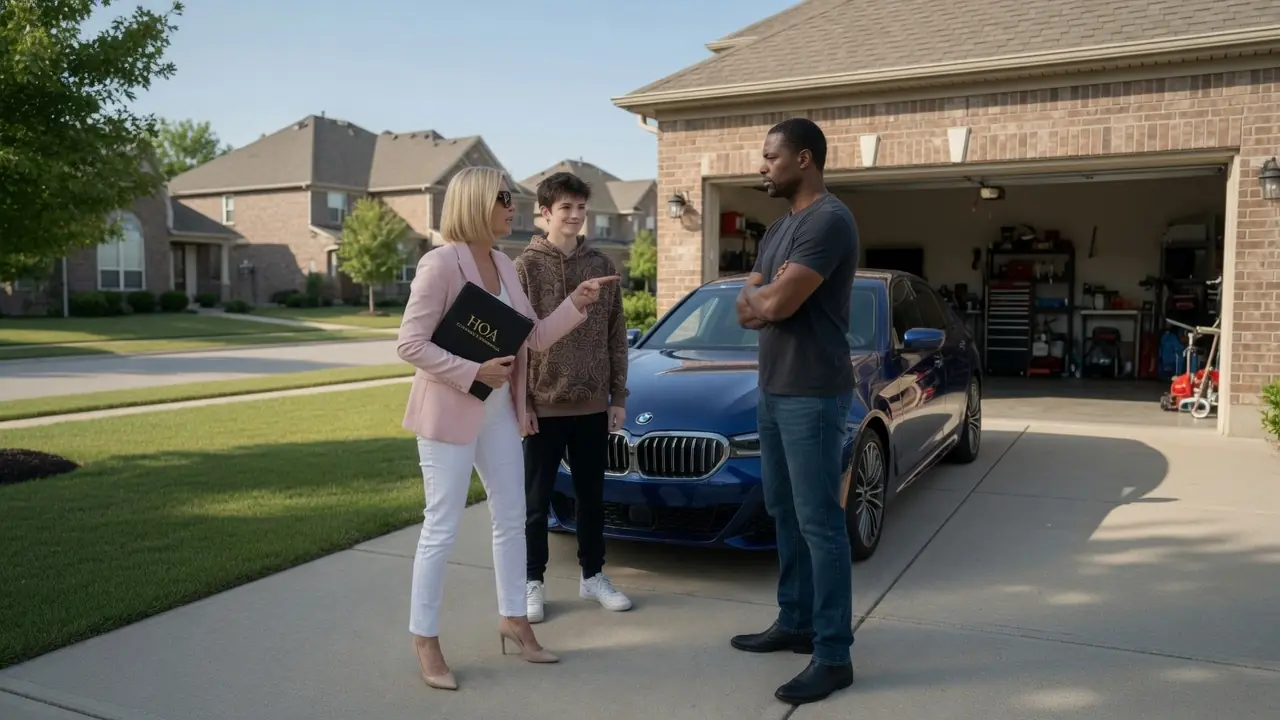
Brenda Whitmore, the sixty-three-year-old president of the Hawthorne Ridge Homeowners Association, pointed at Marcus as if she were directing police toward an armed criminal. Her blonde bob remained perfectly shaped despite the heat, and her pale pink blazer looked more appropriate for a charity luncheon than a confrontation in someone else’s driveway. Behind her oversized sunglasses, she wore the confident expression of a woman accustomed to transforming her assumptions into neighborhood policy. Her seventeen-year-old son, Tyler, kept his hood pulled over his dark hair and refused to look directly at the BMW.
Brenda had arrived without warning carrying a black HOA binder against her chest. She claimed the BMW had appeared in Marcus’s driveway only two days earlier and therefore violated a rule requiring residents to report newly acquired “high-value or commercially associated vehicles.” Marcus had already read every page of the association’s bylaws. No such rule existed.
The BMW was legally registered, properly insured, and parked entirely on Marcus’s property. It carried no dealer plates, advertising decals, or commercial equipment. The title listed Marcus as the sole owner, and the purchase documents were locked inside his home. Yet Brenda spoke as though her son’s desire to own the car overruled every document connected to it.
Tyler finally whispered, “Mom, we should go.”
Brenda turned sharply. “You told me this was the car.”
“I said it looked like the one.”
“You gave me the identification number.”
Marcus’s eyes narrowed. The vehicle identification number was visible through the windshield, but Tyler should not have had any reason to record it. More importantly, someone had tried to use that number three nights earlier to request a replacement digital key through an online BMW service portal.
Marcus had discovered the attempt because the security notification reached his phone at 2:13 in the morning. The request included a photograph of an altered driver’s license, a falsified insurance card, and a bill of sale carrying Marcus’s forged signature. The name listed as the supposed new owner was Tyler Whitmore.
Marcus reported the attempted transfer immediately. A detective had advised him not to contact the person named in the application until investigators preserved the digital evidence. Marcus had followed that instruction, expecting police to speak with Tyler before anyone realized he knew.
Brenda had now brought her son directly to his driveway.
“You knew his name was on a report?” she demanded.
“I knew someone used his name to claim my car.”
“My son would never steal anything.”
Marcus glanced at Tyler. “Then he should be able to explain why his photograph was attached to the key request.”
Tyler took a step backward.
Brenda raised her phone and announced that she was calling the police. She told the dispatcher that a suspicious man had stolen a luxury vehicle her son had already arranged to purchase. She described Marcus’s height, clothing, and skin color before mentioning that the confrontation was taking place at his own address.
Marcus remained silent while she spoke. His doorbell camera, garage camera, and exterior microphone recorded every word.
His twelve-year-old daughter, Ava, watched from behind the living-room curtain. Marcus had told her to stay inside as soon as Brenda began shouting. Ava had lived with him long enough to understand that calm did not mean danger was absent—it meant her father had decided not to give anger control of the situation.
The BMW represented more than wealth to Marcus. It had belonged to his older brother, Julian, who had died unexpectedly from a heart condition eighteen months earlier. Julian had purchased the vehicle after selling the small software company he built from his apartment, promising Marcus that one day they would drive it across the country together.
They never made the trip.
Julian’s estate left the BMW to Marcus. He could have sold it and paid off part of his mortgage, but Ava remembered riding in the passenger seat while her uncle explained every feature as though he were introducing her to a spacecraft. Marcus kept the car because it carried a part of Julian’s joy that grief had not managed to erase.
For most of the year, the BMW remained stored in a secured garage across town while the estate paperwork was completed. Marcus brought it home only after receiving the final title. Within twenty-four hours, Brenda sent an HOA violation notice claiming that “unverified luxury vehicles” could attract theft and reduce neighborhood security.
Marcus replied with proof of ownership.
Brenda rejected it without explanation.
Two days later, someone entered his driveway shortly after midnight. The security footage showed a hooded figure photographing the BMW’s windshield, door handle, license plate, and rear badge. The person tried the driver’s door twice before walking away.
The face was partially hidden, but the shoes matched the white sneakers Tyler wore now.
Marcus had sent that video to Detective Lena Foster along with the fraudulent digital-key application. The detective asked him whether anyone in the neighborhood had recently expressed interest in the vehicle. Marcus mentioned Brenda’s violation notice but stopped short of making an accusation.
At the time, he had not known how closely the HOA president was connected to the attempted theft.
The first police cruiser arrived eight minutes after Brenda’s call. Officer Samuel Reed stepped onto the driveway with his body camera active, followed by Officer Claire Donnelly. Brenda rushed toward them before they could speak to Marcus.
“Thank goodness,” she said. “That man is refusing to surrender a stolen vehicle.”
Samuel looked from Brenda to Marcus. “Who owns the property?”
“He does, but that is irrelevant.”
“It is usually relevant when we are standing in someone’s driveway.”
Brenda thrust her binder toward him. Inside was a printed advertisement showing a deep-blue BMW M8 listed for sale through a private online marketplace. The asking price was nearly forty thousand dollars below market value, and the listing stated that the owner needed an immediate cash transaction.
Tyler had contacted the seller and transferred a five-thousand-dollar deposit.
According to Brenda, the seller promised to deliver the car to Hawthorne Ridge. When Tyler saw Marcus’s BMW, he concluded it was the vehicle from the listing. Brenda decided Marcus must have intercepted the sale, stolen the car, or purchased it using money that should have been returned to her son.
Samuel examined the advertisement. “Did your son ever meet the seller?”
“No, but they exchanged messages.”
“Did he verify the title?”
“The seller said the paperwork would come later.”
“Did he inspect the vehicle?”
“He chose it from the photographs.”
Marcus looked closely at the listing. The images were not generic dealership photographs. They showed Julian’s BMW inside the private storage facility where it had remained during probate.
One photograph displayed a distinctive silver scratch beneath the rear passenger window. Another showed Julian’s custom leather key case resting in the center console.
Someone had photographed the actual vehicle before Marcus brought it home.
Tyler spoke without looking up. “The seller said his name was Julian Bennett.”
Marcus felt the air leave his lungs.
Julian had been dead for eighteen months. His death was public record, but the storage company’s database still carried his name because the title transfer had not yet been finalized when the photographs were taken.
“Who gave you those pictures?” Marcus asked.
Brenda stepped between him and Tyler. “Do not interrogate my son.”
Officer Claire raised a hand. “Mrs. Whitmore, let him answer.”
Tyler swallowed. “A guy named Evan. He works at the vehicle-storage place.”
Marcus recognized the name. Evan Whitmore was Brenda’s twenty-six-year-old nephew and Tyler’s cousin. He had worked nights at Northfield Premier Storage until being dismissed the previous week for unauthorized access to customer files.
Detective Foster had mentioned the dismissal during their last call.
Samuel contacted dispatch and read the BMW’s license plate and VIN aloud. The response came within a minute.
The vehicle was registered to Marcus Bennett. It had not been reported stolen. However, the identification number was attached to an active fraud investigation involving attempted title transfer, digital-key theft, and unauthorized access to estate property.
The named suspect was Tyler Whitmore.
Samuel lowered the radio slowly. “Mrs. Whitmore, your son is listed in the report. Mr. Bennett is the complainant.”
Brenda stared at him. “That is impossible.”
Claire looked at Tyler. “Did you submit an online request for a replacement key?”
Tyler hesitated.
His mother answered for him. “He was instructed to do that by the seller.”
“Did he upload identification?”
“He had to prove he was the buyer.”
“Did he upload a bill of sale?”
Brenda’s confidence faltered. “The seller provided one.”
Marcus opened the secure application on his phone and displayed the forged document. The signature read Marcus Bennett, not Julian Bennett. Someone had created the paperwork after the BMW was transferred into Marcus’s name.
The timestamp showed it had been generated on Brenda’s home computer.
Detective Foster arrived twenty minutes later carrying a sealed evidence envelope. She had been on her way to question Tyler when dispatch informed her that Brenda had summoned officers to Marcus’s address. The coincidence, she said, saved investigators the trouble of locating both of them separately.
Foster showed Tyler a printed copy of the fraudulent key application. His photograph, email address, and phone number appeared on the first page.
“Did you submit this?” she asked.
Tyler looked at his mother.
Brenda said, “He is a minor. He will not answer without an attorney.”
Foster nodded. “That is his right. But I need everyone to understand that this is no longer an HOA disagreement.”
Marcus asked whether the storage photographs had been traced.
“They came from an employee account belonging to Evan Whitmore,” Foster said. “The account accessed Mr. Julian Bennett’s vehicle file seven times after his death.”
Brenda removed her sunglasses. “My nephew had permission.”
“From whom?”
“The estate.”
Marcus shook his head. “No one in my family gave him permission.”
Foster continued. Evan had copied photographs, VINs, ownership documents, and access schedules for several expensive vehicles stored during probate disputes. He then created fake online listings and collected deposits from buyers who believed they were purchasing cars below market value.
Most victims lost money and never saw a vehicle.
Tyler’s case was different. Evan allegedly promised him that Julian’s BMW could be taken physically because “the estate had abandoned it.” He told Tyler the title could be transferred after a new digital key was issued.
Tyler had not merely been deceived by a fake advertisement. Security footage from the storage facility showed him accompanying Evan into the building two weeks earlier.
They entered Julian’s BMW with an employee key.
They photographed the interior and attempted to start it.
When the system rejected the unauthorized key, Evan instructed Tyler to submit the fraudulent replacement request using Marcus’s identity.
Brenda turned toward her son. “You told me you had only seen it online.”
Tyler finally looked at her. “I knew you would say no if I told you the truth.”
Marcus almost responded, but Foster asked another question first.
“Where did the five-thousand-dollar deposit come from?”
Tyler looked down.
Brenda’s face changed.
The money had not come from Tyler’s savings. Three days earlier, five thousand dollars had been withdrawn from the Hawthorne Ridge HOA emergency-maintenance account using Brenda’s authorization code.
Brenda claimed the withdrawal paid for drainage repairs.
No drainage contractor had received it.
Officer Claire opened the binder Brenda had been carrying. Behind the fake BMW listing were account statements, handwritten notes, and a page labeled VEHICLE ACQUISITION—TYLER.
The page listed the HOA withdrawal, payment to Evan, estimated resale value, and instructions for filing an abandoned-vehicle claim if Marcus resisted.
Marcus read the final handwritten line:
If Bennett challenges ownership, issue parking violations until surrender.
Brenda snatched for the binder, but Samuel pulled it away.
“You cannot read private board documents,” she shouted.
“They stopped being private when you carried them into a police investigation.”
Brenda insisted the notes were misunderstood. She said the HOA had considered purchasing the BMW for a neighborhood security program and that Tyler merely volunteered to manage the transaction.
No one believed a two-door performance car had been intended for community patrol.
Foster asked Brenda why the association would buy an eighty-thousand-dollar vehicle without board approval. Brenda replied that emergency powers allowed her to act without consultation when neighborhood safety was at risk.
Marcus looked toward Ava, still watching through the window. Brenda had used the language of safety to justify nearly every intrusion she made into residents’ lives. She called surveillance protection, control compliance, and humiliation enforcement.
Now she had used homeowners’ money to help her son obtain a dead man’s car.
Foster separated Tyler from Brenda and spoke with him near the police cruiser. Without his mother interrupting, the teenager’s story unraveled quickly.
He admitted that Evan showed him the BMW months earlier. Tyler became obsessed with owning it after seeing photographs of Julian standing beside the car. He knew his family could not afford one, but Brenda repeatedly told him that her HOA position gave them access to “opportunities ordinary residents never understood.”
Evan proposed a scheme.
They would list the BMW online using photographs from the storage facility. Tyler would appear as the buyer, allowing them to create a paper trail suggesting a legitimate sale. After acquiring a digital key, they would remove the car, sell it through an out-of-state broker, and divide the profit.
Tyler was supposed to receive another BMW later.
Brenda learned of the plan after discovering messages on Tyler’s phone. Instead of stopping it, she decided the vehicle should remain with her son. She believed Marcus would surrender it if she generated enough HOA violations and threatened police involvement.
When the BMW appeared in his driveway, she assumed the estate transfer had failed and Marcus had taken the car before Tyler could collect it.
Her confrontation was intended to frighten him into handing over the keys.
“She told me people like him don’t fight HOAs,” Tyler said quietly.
Marcus heard the statement from several yards away.
Brenda shouted that her son was confused and being manipulated. She attempted to walk toward him, but Claire instructed her to remain beside the porch.
Foster requested permission to examine the HOA account records in the binder. The statements showed that the five-thousand-dollar payment was only one of several suspicious withdrawals.
More than one hundred and eighty thousand dollars had been transferred over two years into companies controlled by Brenda’s relatives. The descriptions included security consulting, architectural reviews, emergency legal research, and resident-compliance services.
Evan’s name appeared beside three payments.
What began as a vehicle-fraud investigation expanded into a review of the association’s finances.
Police did not arrest Brenda on the driveway that morning. They seized the binder, copied the doorbell footage, preserved the fraudulent documents, and instructed her not to contact Marcus or interfere with the BMW.
Tyler was released to his father, who arrived visibly shaken after learning what had happened.
Brenda stood on the sidewalk as officers departed, her sunglasses back over her eyes.
“This is not over,” she told Marcus.
He closed the BMW’s driver’s door. “For you, it just started.”
The HOA sent Marcus seven violation notices the following week. One accused him of operating an illegal luxury-car dealership. Another claimed the BMW’s dark-blue paint conflicted with the neighborhood’s approved “visual harmony.”
Marcus forwarded every notice to Detective Foster and his attorney.
A judge issued an order prohibiting Brenda from using association powers against witnesses in the investigation. The HOA board then called an emergency meeting, expecting Brenda to explain why police had seized financial records from her binder.
More than two hundred residents attended.
Marcus sat in the back beside Ava while an independent accountant projected the association’s bank statements onto a screen. Residents learned that reserve funds intended for roof repairs, drainage improvements, and storm cleanup had been redirected into shell companies.
Brenda’s sister received payments for landscaping work never performed. Her brother’s consulting firm billed the HOA for legal reviews despite having no attorneys. Evan received more than forty thousand dollars for security inspections that consisted largely of photographing residents’ vehicles and collecting ownership information.
The BMW scheme was not an isolated act.
Evan had accessed databases containing luxury cars, motorcycles, and recreational vehicles owned by residents or their deceased relatives. Brenda used HOA records to identify when properties were vacant, when estates were unsettled, and when surviving family members lived elsewhere.
Investigators found six additional fraudulent listings.
Two residents had already lost deposits. Another family discovered that their late father’s classic Porsche had been removed from a storage unit using a copied authorization letter.
Brenda had converted the HOA into an information network for selecting targets.
The board removed her as president before the meeting ended.
She attempted to declare the vote invalid, but the association’s attorney read the section allowing immediate removal for financial misconduct. Brenda then accused the entire room of betraying her after years of service.
A resident in the front row replied, “You were serving yourself.”
Tyler eventually cooperated with investigators. Because he was a minor and had not successfully taken the BMW, the court placed him in a supervised diversion program that required restitution, community service, and testimony against Evan.
He wrote Marcus a letter.
Tyler admitted that he had looked at the BMW and seen only something he believed he deserved. He never considered Julian’s life, Marcus’s grief, or Ava’s memories. He apologized for entering the car and helping forge the paperwork.
Marcus did not forgive him immediately.
He did, however, agree that the teenager should be given an opportunity to understand the harm instead of learning only how to fear punishment. As part of his restitution, Tyler worked weekends at a nonprofit automotive program that taught young people vehicle maintenance and ethics in the used-car industry.
Evan faced more serious consequences.
Digital records connected him to the storage breach, forged sales, copied keys, and stolen Porsche. He pleaded guilty after investigators recovered customer files and blank title forms from his apartment.
Brenda was charged with financial fraud, conspiracy, misuse of HOA funds, witness retaliation, and participation in attempted vehicle theft. Her attorney argued that she had only tried to protect her son from an online scam.
The binder contradicted that claim.
Her own notes documented the plan to pressure Marcus until he surrendered the BMW. The computer used to generate his forged signature belonged to her. HOA bank records showed she financed the deposit after learning the vehicle was not legally for sale.
The court ordered restitution to the association and the affected families. Brenda lost her leadership position permanently and was prohibited from managing community funds. Assets connected to the shell companies were seized to restore the HOA reserves.
Hawthorne Ridge rewrote its governance rules.
No president could issue financial payments without independent approval. Vehicle information collected for parking enforcement could not be shared outside the association. Residents gained access to quarterly financial reports, and retaliation through fabricated violations became grounds for immediate removal.
Marcus declined a position on the new board.
He had no interest in replacing one controlling leader with another. He did agree to help create a resident privacy policy that prevented HOA officers from collecting unnecessary ownership documents or photographing vehicles on private property.
Several months later, Marcus finally took the BMW on the road trip he and Julian had once planned.
Ava sat beside him with a printed map across her knees, refusing to rely entirely on the navigation system because her uncle had taught her that “the best roads are the ones computers think are unnecessary.”
They drove north through Arkansas, crossed into Missouri, and stopped beside a quiet lake before sunset.
Ava ran her fingers across the leather key case Julian had left in the center console.
“Do you think Uncle Julian would be mad that somebody tried to take it?” she asked.
Marcus looked across the water. “He would be mad that they thought wanting something made it theirs.”
“Did Tyler learn that?”
“I hope so.”
When they returned to Hawthorne Ridge, the BMW went back into Marcus’s garage. He still drove it on weekends, but he no longer worried every time a phone appeared near the driveway.
Brenda’s old house had been sold as part of the financial settlement. Tyler moved with his father to another neighborhood, though he continued working at the nonprofit garage.
One Saturday, he visited Marcus with his supervisor’s permission.
He stood several feet from the BMW and kept his hands inside his jacket pockets.
“I don’t expect you to trust me,” Tyler said. “I just wanted to tell you I understand now.”
Marcus studied him. “Understand what?”
“That choosing a car isn’t the same as earning it. And seeing something doesn’t give you the right to take it.”
Marcus opened the garage and handed him a clean microfiber cloth.
“Then start by helping me remove the fingerprints you left on the window.”
Tyler looked surprised, but he accepted it.
They cleaned the BMW in silence while Ava watched from the doorway. Marcus did not pretend the damage had disappeared, and he did not excuse what Tyler had done. He simply allowed the teenager to begin replacing entitlement with responsibility, one small action at a time.
Brenda Whitmore had marched into Marcus’s driveway believing her title could transform her son’s desire into legal ownership. She expected police to see a Black man beside an expensive BMW and accept her accusation before examining the documents.
Instead, they checked the registration.
They read the theft report.
They followed the digital key request, the forged signature, the storage photographs, and the HOA payment. Every piece of evidence led away from Marcus and directly toward the two people accusing him.
The BMW had never belonged to Brenda’s son simply because he had chosen it.
It belonged to Marcus because the title carried his name, the history carried his brother’s memory, and the truth remained stronger than every false claim written inside an HOA binder.