The first towel appeared on a Wednesday in late June.
Cole Pruitt noticed it at 6:14 in the evening when he returned home from East Texas Ironworks with twelve hours of heat still trapped inside his work shirt.
He parked his dark pickup beneath the pecan tree at the side of the house, killed the engine, and sat behind the wheel for a few seconds without moving.
The cab smelled like steel dust, old coffee, leather gloves, and the faint citrus cleaner his daughter used whenever she borrowed the truck.
Outside, cicadas screamed from the pine trees.
A sprinkler hissed somewhere across Piney Hollow Estates.
The temperature gauge on the dashboard still read ninety-seven degrees.
Cole picked up his dented lunchbox, stepped onto the driveway, and walked toward the backyard.
He was forty-five years old, broad across the shoulders, weathered from years around fabrication shops, with short dark-brown hair usually hidden beneath a faded cap and a beard that had begun showing silver near the chin.
He spent his days supervising structural welding crews.
He understood steel.
He understood load.
He understood heat distortion.
And he understood that something could look perfectly straight while carrying more stress than anyone realized.
That afternoon, his own life looked exactly like that.
Stable.
Quiet.
Functional.
Until he turned the corner of the house.
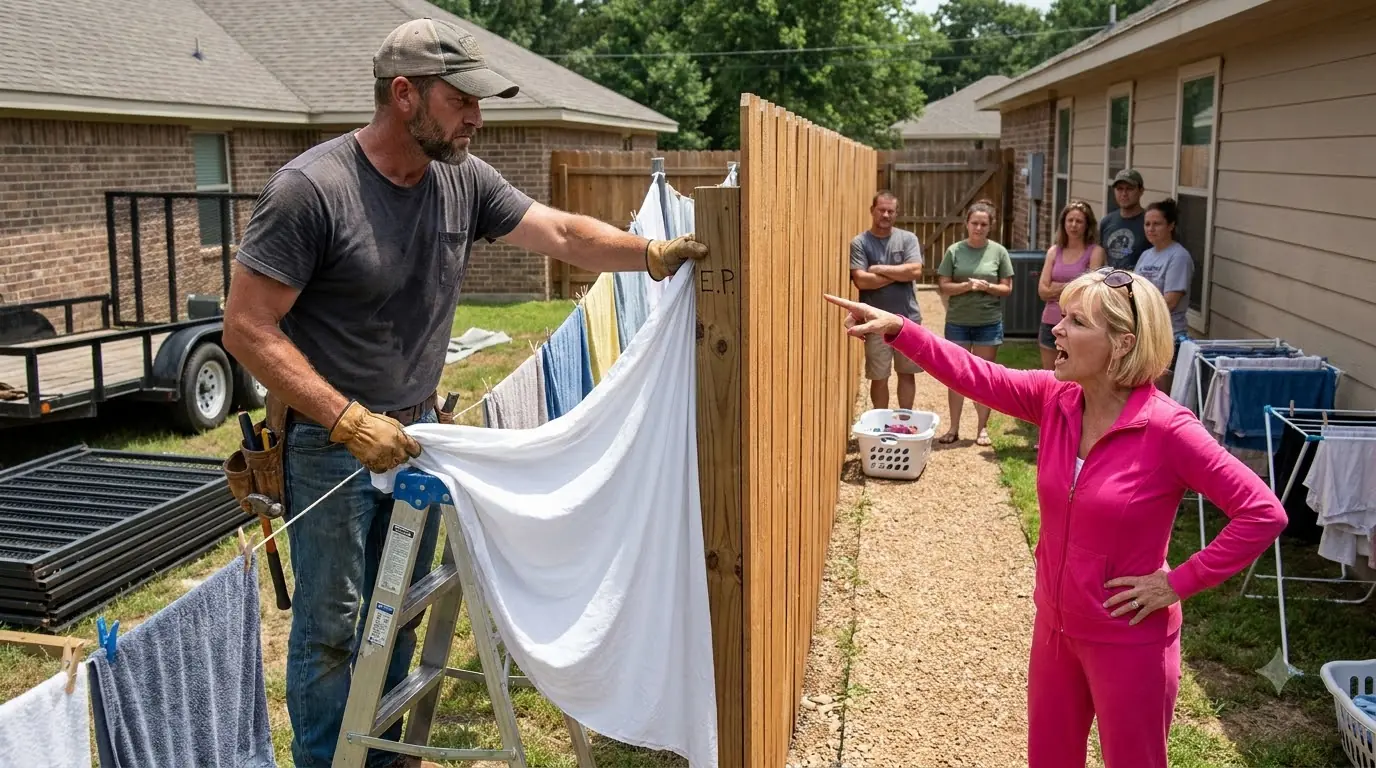
Two wet towels hung over his fence.
One blue.
One white.
Both dripping.
Cole stopped.
The cedar fence ran nearly eighty feet along the rear edge of his lot, separating his backyard from a narrow landscaped walking corridor maintained by the homeowners association.
The boards were honey-brown once.
Time had darkened them.
Texas summers had silvered the upper edges.
But Cole had kept the fence in good condition.
He cleaned it every spring.
Restained it every few years.
Replaced warped boards himself.
The fence mattered.
Not because cedar was expensive.
Not because it increased the value of the house.
Because Elaine had helped build it.
Three years earlier, when sleep had become impossible after his wife died, Cole spent nights sitting on the patio looking at those boards.
He remembered Elaine laughing at him because he measured every post twice.
He remembered her standing barefoot in the grass holding a level against a rail.
He remembered their daughter, Mia, twelve at the time, carving her mother’s initials into the inside corner post with a tiny pocketknife before Cole caught her.
E.P.
Elaine Pruitt.
The letters were uneven.
The E leaned too far left.
The P looked almost like a D.
Cole had pretended to be angry.
Elaine had kissed Mia on the head and told Cole to leave it.
“It’s signed now,” she had said.
So he did.
Now somebody’s wet towels hung over those same boards.
“Cole.”
He turned.
Dennis Poole was crossing the walking path.
Dennis lived diagonally behind him.
Fifty-three.
Soft around the waist.
Retired cable technician.
Good neighbor most of the time.
He carried an apologetic expression before he even reached the fence.
“Those yours?” Cole asked.
Dennis looked at the towels.
“Yeah.”
Cole waited.
Dennis rubbed the back of his neck.
“Brenda said we could use the fence.”
Cole blinked once.
“What?”
“At the meeting.”
“What meeting?”
“Last Thursday.”
“I was working nights.”
Dennis nodded quickly.
“Right. Yeah. She said the fencing along the common trail was being designated as a seasonal drying area.”
Cole stared at him.
“A drying area.”
“Community amenity.”
Dennis winced as he said it.
Cole looked back at the towels.
His voice stayed calm.
“Did Brenda buy this fence?”
“No.”
“Did the HOA?”
“No.”
“Is it on HOA property?”
Dennis shifted his weight.
“I don’t think so.”
“You know it isn’t.”
Dennis sighed.
“Yeah.”
Cole removed the towels.
He did not throw them.
He did not drop them in dirt.
He folded each once and held them over the fence.
Dennis took them.
“I should’ve asked.”
“Yes.”
“Sorry.”
Cole nodded.
Dennis started to leave.
Then stopped.
“She made it sound official.”
Cole looked at him.
“That’s what Brenda does.”
Dennis gave a tired half-smile.
Nobody in Piney Hollow needed that explained.
Brenda Cheswick had been president of the homeowners association for almost four years.
Before that she had been secretary.
Before that she had been the resident who attended every meeting and asked why other people did not attend more meetings.
Brenda was fifty-four, slim, blonde, energetic, and constantly dressed as though she might be photographed for a neighborhood newsletter.
Bright jackets.
Matching pants.
Large sunglasses.
Clipboards.
Color-coded folders.
She was not physically intimidating.
She did not need to be.
Brenda had discovered that confident paperwork could frighten people almost as effectively as confrontation.
Cole went inside.
The house felt cooler than usual.
He placed his lunchbox on the kitchen counter.
The old clock above the doorway ticked five minutes slow.
Elaine had bought it at a flea market outside Nacogdoches.
Cole had repaired it twice.
It still ran five minutes slow.
He had finally accepted that some things preferred their own version of time.
He opened the HOA website.
Newsletter.
June issue.
Lavender banner.
Photograph of the community pool.
Message from Brenda.
Cole scrolled.
Pool rules.
Parking reminder.
Landscaping.
Pet waste.
Then:
COMMUNITY AMENITIES UPDATE
He read.
To encourage energy-conscious summer living and reduce unnecessary residential dryer use, the board has designated fencing adjacent to the Piney Hollow walking corridor as a shared seasonal drying resource. Residents may hang light household textiles during daylight hours provided items do not obstruct pedestrian access.
Cole read it twice.
Then found the map.
A yellow line highlighted fences bordering the common corridor.
His fence.
Dennis’s.
Three others.
Cole stared.
He clicked meeting minutes from previous Thursday.
Attendance:
Brenda Cheswick.
Treasurer Harold Ames.
Secretary Lynn Carter.
Board member Paul Grant.
Property manager absent.
Motion 6C:
Seasonal sustainability initiative discussed. President authorized to coordinate voluntary resident participation.
Voluntary resident participation.
Nothing about private fences.
Nothing about community ownership.
Nothing about clotheslines.
Cole took a screenshot.
Then another.
He opened property survey from closing documents.
Fence line sat seven inches inside his property boundary.
Not on it.
Inside.
Entire fence belonged to him.
He printed the survey.
Then walked outside again.
The sun had dropped lower.
He went to the corner post.
E.P.
Still there.
He touched the letters.
The cedar was warm beneath his fingertips.
“Dad?”
Cole turned.
Mia stood near patio door.
She was fifteen now.
Tall like Elaine.
Brown hair pulled into a loose ponytail.
She wore running shorts, a high-school band T-shirt, and one earbud.
“What happened?”
Cole looked toward fence.
“Nothing.”
Mia followed his eyes.
She knew that answer.
“Something happened.”
“Dennis hung towels.”
“So?”
“Brenda told people fence is a community clothesline.”
Mia pulled earbud out.
“She what?”
Cole almost smiled.
Mia inherited Elaine’s ability to turn two words into an entire argument.
“Apparently.”
“That fence is ours.”
“I know.”
“Mom built that.”
“I know.”
Mia walked toward corner post.
She touched initials.
Then turned.
“Are you going to tell her?”
“Yes.”
“How?”
Cole held up printed survey.
Mia smiled.
“Of course.”
“What?”
“You fight with documents.”
“I don’t fight.”
“You absolutely fight.”
“With documents.”
“That counts.”
Cole looked at fence again.
“Better than shouting.”
Mia shrugged.
“Depends how good the documents are.”
The next morning Cole emailed Brenda.
Not angry.
Not long.
Brenda,
I saw the June newsletter stating that privately owned fences bordering the walking corridor have been designated as shared drying resources. My rear cedar fence is entirely inside Lot 47 according to the recorded survey. I have not consented to community use. Please remove Lot 47 from the program and correct the newsletter.
He attached survey.
Then went to work.
At 10:37, Brenda replied.
Cole,
The board has broad authority to regulate and utilize perimeter features interacting with association-maintained common areas. The seasonal drying initiative is temporary, non-damaging, and intended to benefit the community. Cooperation is appreciated.
Cole read it during lunch.
He replied:
Please identify the covenant provision granting the HOA use of privately owned structures for association programs.
Thirty-one minutes later:
The governing documents should be read collectively rather than selectively.
Cole smiled.
That was not a citation.
He replied:
Please provide the specific authority. Until then, I do not consent to any person attaching, hanging, fastening, drilling, tying, clipping, or otherwise placing items on my fence.
Brenda did not answer.
When Cole returned home, six items hung from the fence.
Two towels.
Three shirts.
One fitted sheet.
He removed them carefully.
Placed them in clean plastic bin.
Set bin on walking path with handwritten note:
PLEASE DO NOT USE PRIVATE FENCE. ITEMS MAY BE CLAIMED HERE.
At 7:20 Brenda appeared.
Hot-pink jacket.
White top.
Matching trousers.
Sunglasses pushed onto blonde hair.
Clipboard.
Cole saw her from kitchen.
Mia saw her too.
“Oh, this should be good.”
“You’re staying inside.”
“I’m fifteen.”
“That sentence changes nothing.”
Cole walked outside.
Brenda stood at fence.
Hands on hips.
“You removed residents’ property.”
“I removed items from my fence.”
“You cannot interfere with board-approved use.”
Cole held printed survey.
“This is my fence.”
Brenda barely glanced at it.
“It borders common space.”