“Move, or I’ll have that pipe buried through your ranch with you watching.”
Clare Phillips stood on the edge of a freshly excavated trench outside Fort Worth, Texas, stabbing one manicured finger toward Brandon Rogers while a crane suspended a massive concrete sewer pipe between them. Her burnt-orange designer blazer looked absurdly clean against the torn pasture, red soil, broken fence posts, and workers in neon safety vests standing ankle-deep inside the excavation. Behind Brandon, his weathered ranch house sat beneath a broad Texas sky, while excavators and bulldozers idled across land his family had spent decades protecting. Brandon folded his arms, stared at Clare for a long second, then raised his phone and photographed the cloudy runoff collecting near the trench.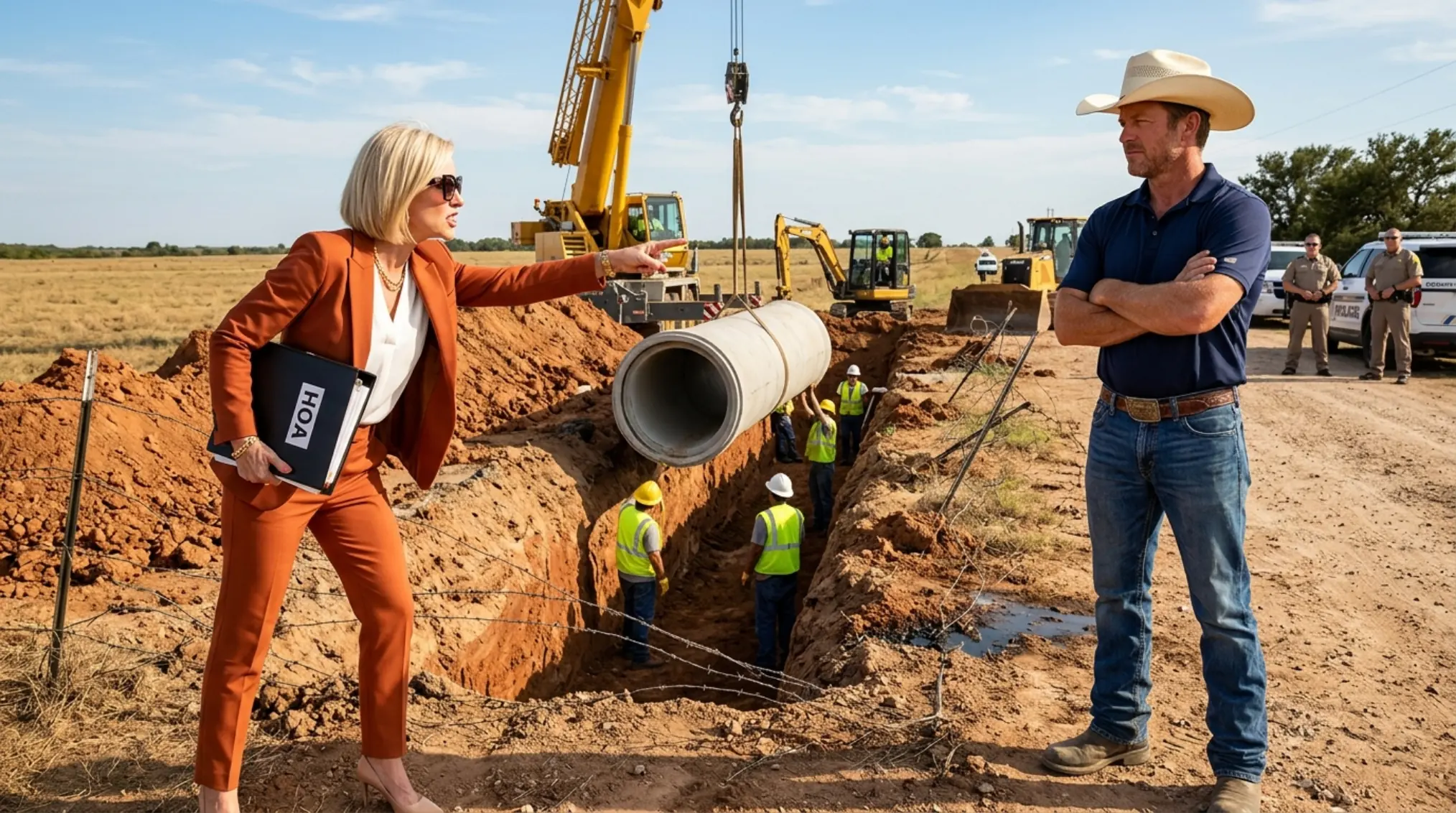
“Keep digging,” he said quietly. “Every foot makes the federal case against you bigger.”
Clare laughed.
Not nervously.
Not because she thought he was joking.
She laughed because she genuinely believed nothing he could say mattered.
“You keep throwing around words like federal as if they scare me,” she snapped. “Whispering Pines approved this project unanimously.”
Brandon looked toward the enormous concrete pipe hanging from the crane.
“And apparently unanimously forgot to get permission from the man who owns the land.”
Clare slammed her black HOA binder against the suspended pipe.
“Lower it!”
The crane operator hesitated.
“Ma’am?”
“You heard me.”
The foreman, Carlos Medina, stepped forward.
“Mrs. Phillips, we need to clear up the ownership problem first.”
“There is no ownership problem.”
Carlos glanced toward Brandon.
“He has county records.”
Clare turned sharply.
“He has opinions.”
Brandon almost smiled.
That sentence told him everything he needed to know.
The confrontation had begun forty-eight hours earlier, when Brandon stepped onto his porch just after sunrise and heard machinery coming from the eastern pasture. At first he assumed one of his neighbors had started excavation work beyond the property line. Then he saw a bulldozer inside his fence.
By the time he reached the field, nearly sixty yards of pasture had been opened.
A trench almost eight feet wide cut through grazing land like a fresh scar.
Three sections of fencing had been removed.
One irrigation branch had been crushed.
And sitting beside the excavation were enormous sections of sewer pipe.
A plywood sign had been hammered into the ground.
HOA SEWER PROJECT — AUTHORIZED PERSONNEL ONLY.
Brandon stared at it for several seconds.
Then Clare appeared.
She stepped from behind a construction truck wearing a pink blazer, sunglasses, white pants, and the expression of someone arriving to inspect property she believed belonged to her.
“Good,” she said. “You’re finally here.”
Brandon looked at the trench.
“What is this?”
“The Whispering Pines sewer expansion.”
“On my ranch?”
“It’s the shortest route.”
“That wasn’t my question.”
Clare sighed.
“The board approved an emergency easement.”
Brandon turned toward her.
“Show me.”
“Show you what?”
“The easement.”
She opened her binder.
Inside were meeting minutes, contractor estimates, HOA maps, and several pages covered in colored highlights.
There was no recorded easement.
No deed.
No county authorization.
No environmental review.
No signed permission from Brandon.
He flipped through the papers and handed them back.
“This is HOA paperwork.”
“Yes.”
“Your HOA doesn’t own this ranch.”
“Whispering Pines borders it.”
“That doesn’t make it yours.”
Clare crossed her arms.
“The community needs additional sewer capacity.”
“Then build it on community property.”
“That route costs nearly four hundred thousand dollars more.”
Brandon looked toward the trench.
“So you decided my land was cheaper.”
Clare smiled.
“We decided cooperation was reasonable.”
“You never asked.”
“We sent notices.”
“To whom?”
“You.”
“I never received one.”
“That isn’t our responsibility.”
Brandon stared at her.
It was the kind of logic Clare had apparently used for years. If she wrote a letter, the other person had consented. If the board voted, the decision became law. If enough people benefited, private ownership turned into an inconvenience.
Brandon walked toward the construction crew.
“Who hired you?”
Carlos lifted one hand cautiously.
“Whispering Pines HOA.”
“What did they tell you about the property?”
“That they had permission.”
Clare snapped, “Carlos, you work for me.”
“No,” Brandon said. “He works for the company you hired.”
Carlos looked relieved someone had said it.
Brandon pulled up the county parcel map on his phone.
He showed the property line.
The trench sat well inside his ranch.
Carlos went pale.
“Mrs. Phillips…”
Clare stepped forward and slapped Brandon’s phone downward.
“That map is outdated.”
Brandon caught the device before it hit the ground.
“County records updated six months ago.”
“The HOA has different records.”
“Your records don’t determine ownership.”
Her face tightened.
“Do not obstruct this project.”
Brandon looked toward the workers.
“Do you have county excavation permits?”
Nobody answered.
“Wastewater routing approval?”
Silence.
“Environmental review?”
Carlos looked toward Clare.
She lifted her chin.
“We completed internal authorization.”
Brandon repeated the phrase slowly.
“Internal authorization.”
“Yes.”
He nodded.
That was when he realized arguing would accomplish nothing.
So he documented.
Photographs of the trench.
Photographs of every machine.
Serial numbers.
Contractor logos.
Pipe specifications.
Damaged irrigation.
Removed fencing.
Survey monuments.
Runoff.
He even photographed Clare standing beside the plywood sign.
“What are you doing?” she demanded.
“Preserving evidence.”
“Evidence of what?”
Brandon looked directly at her.
“That depends on what you damage next.”
Clare laughed.
Then she gave the order to keep digging.
Brandon walked back toward his truck and made a phone call.
He did not call the HOA attorney.
He did not call the sheriff first.
He called a regional environmental response coordinator he had known for eleven years.
Brandon Rogers was not merely a rancher.
His ranch was where he escaped from Washington meetings, policy briefings, enforcement conferences, and the endless politics attached to running a major federal environmental office. He had spent most of his professional life dealing with contaminated groundwater, industrial discharge, illegal dumping, hazardous materials, and large infrastructure projects that became expensive disasters because somebody decided permits were optional.
In the fictional world of this story, Brandon served as a senior EPA regional director responsible for environmental enforcement coordination across several states.
He deliberately avoided telling Clare.
Not because he wanted a theatrical reveal.
Because his title did not change the facts.
The land was private.
The project lacked permission.
The environmental rules applied whether Brandon worked for the federal government or sold cattle full time.
By the following morning, Clare had escalated.
Brandon woke to his bedroom windows rattling.
When he walked outside, the small construction crew had become a full project.
Bulldozers.
Excavators.
Dump trucks.
A crane.
Fifteen workers.
Another hundred feet of pasture torn open.
Brandon found Carlos near the trench.
“You came back?”
Carlos looked miserable.
“She said everything was resolved.”
“It wasn’t.”
“She showed us an HOA letter.”
“An HOA cannot grant itself an easement across someone else’s ranch.”
Carlos wiped sweat from his forehead.
“I told our office that.”
“Then stop.”
Before Carlos could respond, Clare stormed toward them.
Today she wore the burnt-orange suit.
“What did I tell you about interfering with my workers?”
Brandon looked around.
“They’re not your workers.”
“I’m paying them.”
“With HOA money.”
“Exactly.”
Brandon pointed toward a cloudy puddle beside one excavator.
“What is that?”
Clare barely looked.
“Water.”
“From where?”
“They encountered an old line.”
“What line?”
“I don’t know.”
Brandon crouched near the runoff.
An unpleasant smell rose from the disturbed soil.
He stood immediately.
“Carlos, shut the equipment down.”
Clare stepped between them.
“No.”
“That may be wastewater.”
“It’s mud.”
“It smells like sewage.”
She shrugged.
“Then your cows should love it.”
Several workers looked at one another.
Brandon’s voice hardened.
“Stop the excavation.”
Clare moved closer.
“You don’t give orders here.”
“This is my ranch.”
“This is an HOA infrastructure project.”
“You don’t have a permit.”
“The board voted.”
“The board is not the county.”
“The county is slow.”
“The law is still the law.”
Clare turned toward the excavator operator.
“Keep going.”
The machine moved.
Brandon stepped back.
Seconds later came the sound of metal striking something underground.
Then a crack.
A brownish stream burst into the trench.
Workers jumped away.
The operator killed the machine.
Carlos shouted, “Everybody out!”
The smell spread quickly.
Brandon watched contaminated liquid flow toward a drainage swale connecting to a small seasonal creek.
Clare covered her nose.
“Oh, for God’s sake.”
Brandon turned toward her.
“You ruptured a wastewater line.”
“It can be repaired.”
“After contaminating what?”
“You’re exaggerating.”
“There’s runoff moving toward surface water.”
“It’ll dry.”
He stared at her.
“You have absolutely no idea what you’re doing.”
Clare pointed toward the workers.
“Repair it and continue.”
Carlos shook his head.
“No.”
“What?”
“We’re done until somebody shows us permits.”
“I hired you.”
“You emailed a purchase order.”
“That is a contract.”
“No, ma’am.”
Clare’s face turned red.
“I will destroy your company.”
Carlos looked at Brandon, then back at her.
“I’d rather lose one client than lose my license.”
That was when the first three government vehicles appeared at the ranch entrance.
Clare noticed them.
“What now?”
Brandon said nothing.
The vehicles rolled across the pasture and stopped near the trench.
Field investigators stepped out carrying cases, sampling equipment, cameras, protective boots, and documentation bags.
Clare marched directly toward them.
“This is a restricted construction site.”
A woman leading the team showed identification.
“Environmental response team. We received a report of a wastewater release.”
“You don’t have permission to be here.”
Brandon spoke from behind her.
“They have mine.”
She spun around.
“You called them?”
“Yes.”
“Over mud?”
“Over unauthorized sewer construction and a ruptured line.”
Clare laughed angrily.
“You are unbelievable.”
The investigators ignored her and began working.
They photographed the rupture.
Collected water.
Marked soil locations.
Measured distance to the drainage channel.
Recorded the pipe route.
One investigator asked Carlos for permits.
He handed over everything Clare had provided.
The investigator flipped through the packet.
“These are HOA meeting documents.”
Carlos nodded.
“That’s all we were given.”
Clare interrupted.
“They’re sufficient.”
“No, ma’am.”
She stepped closer.
“Who exactly are you to decide that?”
The investigator looked at her identification badge again as if checking whether Clare had somehow missed it.
Clare turned toward Brandon.
“This is harassment.”
Brandon remained quiet.
The lead investigator approached after twenty minutes.
“We’re recommending immediate suspension of excavation pending review.”
Clare threw both hands up.
“No.”
The woman blinked.
“No?”
“You don’t have authority to stop an HOA sewer project.”
“We have authority to require work stop where an uncontrolled wastewater release presents an environmental concern.”
Clare grabbed the temporary stop-work notice.
“This is ridiculous.”
Then she tore it.
Carlos closed his eyes.
Brandon almost did the same.
The investigator stared at the torn pieces.
“Ma’am, I strongly recommend you stop destroying official documents.”
Clare threw them into the mud.
“Write another one.”
So they did.
Then they photographed her refusing it.
Construction ended that afternoon.
The equipment stayed in place, but the engines shut down.
Workers packed tools.
Carlos apologized to Brandon before leaving.
“We were lied to.”
“I know.”
“I should have verified.”
“Yes.”
Carlos accepted that without argument.
Clare did not.
She stood beside the trench as everyone departed.
“This isn’t finished.”
Brandon looked at the damaged pasture.
“No.”
He turned toward her.
“It’s just getting expensive.”
That evening, Whispering Pines held an emergency HOA meeting.
Brandon attended.
The clubhouse was packed.
Residents had heard rumors about sewer contamination, federal investigators, and construction on private property. Most believed Clare had authorization because she had repeatedly told them she did.
Clare took the microphone.
“This rancher has sabotaged essential infrastructure.”
Brandon remained near the back.
“He invited government investigators onto our construction site without board approval.”
A man raised his hand.
“Was the project actually permitted?”
Clare ignored him.
Another resident asked:
“Did we own the land?”
“We had an emergency community easement.”
“Recorded where?”
Clare slammed her palm against the podium.
“Can everyone stop interrogating me?”
That did not help.
Brandon finally walked forward.
Clare pointed at him.
“There. Ask him why he brought federal agents into a neighborhood matter.”
Brandon looked around the room.
“This stopped being a neighborhood matter when your sewer trench crossed my deed line and wastewater started flowing toward a creek.”
A woman whispered, “Wastewater?”
Clare snapped, “It was temporary runoff.”
Brandon removed several photographs from a folder.
“Your contractor disagrees.”
Residents crowded closer.
Photographs showed the rupture.
The open trench.
The runoff.
Broken irrigation.
Removed fencing.
Then Brandon placed the county parcel map on the table.
“This is my property.”
Clare folded her arms.
“We know.”
The room went quiet.
Brandon looked at her.
“You know?”
She realized too late what she had admitted.
A board member turned toward her.
“You told us the association had an easement.”
“We do.”
“Where?”
“Our vote created one.”
An older homeowner laughed in disbelief.
“You cannot vote yourself somebody else’s ranch.”
Clare’s frustration exploded.
“This community needed the sewer route!”
Another resident shouted:
“Then buy one!”
Applause followed.
Clare grabbed the microphone.
“Enough!”
Brandon waited until the room quieted.
Then a board member asked the question Clare had somehow never considered.
“Why did the federal response team arrive so quickly?”
Every face turned toward Brandon.
He hesitated.
He had wanted the evidence to matter more than his title.
But the answer was now relevant.
He removed a credential wallet from his jacket and placed it on the table.
“I work in environmental enforcement.”
Clare scoffed.
“You’re a rancher.”
“I’m both.”
She picked up the credential.
Her expression changed.
She read it again.
“Director?”
Brandon nodded.
The room became completely silent.
Clare dropped the wallet.
“This is some kind of setup.”
“No.”
“You deliberately waited to tell me.”
“Yes.”
“Why?”
“Because you should have obeyed the law even if I were nobody.”
That landed harder than any threat.
The investigation widened over the following week.
County officials confirmed there had been no valid construction permit for the route crossing Brandon’s property.
No recorded easement existed.
The HOA had not completed required engineering review for the excavation route.
The contractors had been given inaccurate representations about land ownership.
Environmental sampling showed contamination near the rupture and required controlled cleanup.
The situation became even worse when investigators examined internal HOA communications.
Clare had received an email from the association’s management company two months earlier warning that the proposed route crossed privately owned agricultural land.
She replied:
Rogers rarely uses that field. Start before he has time to make this complicated.
Another message read:
Once the pipe is buried, removing it will cost more than letting it stay.
Brandon read that sentence three times.
It explained everything.
This had never been a misunderstanding.
Clare had intentionally created a completed-project problem.
She assumed economics would defeat ownership.
If the HOA spent enough money and buried enough concrete, Brandon would eventually decide fighting was too expensive.
Instead, her strategy created exactly the evidence the association could not defend.
The HOA board suspended Clare.
Then an independent attorney reviewed the entire project.
The numbers were devastating.
Nearly $190,000 had already been spent.
Restoration estimates exceeded $300,000.
Environmental cleanup costs remained uncertain.
Legal defense expenses were climbing.
The association’s insurer requested additional documentation because leadership had apparently proceeded despite warnings.
At the next meeting, the room was standing-room only.
Clare arrived anyway.
No longer president.
Still carrying the orange blazer like armor.
She demanded the microphone.
“You’re all blaming me for trying to improve this neighborhood.”
Treasurer Raymond Ellis stood.
“We’re blaming you for authorizing construction on land we didn’t own.”
“I had board authority.”
“Not for this.”
“You voted!”
“Based on what you told us.”
Clare pointed toward Brandon.
“He manipulated all of you.”
Brandon remained seated.
Raymond continued.
“You told us the land was subject to an existing utility easement.”
“It should have been.”
“That isn’t the same thing.”
Clare’s face reddened.
“We needed that route.”
Raymond held up the engineer’s alternative plan.
“No. You wanted that route because it saved money.”
The alternative followed public right-of-way and HOA-owned land.
It was longer.
More expensive.
But legal.
Clare had rejected it.
A resident stood.
“How much is her shortcut costing us now?”
Nobody laughed when Raymond gave the estimate.
By the end of the meeting, Clare resigned from the board entirely.
The civil dispute between Brandon and the HOA settled months later.
Whispering Pines agreed to restore his fencing, rebuild the irrigation line, remove all unauthorized infrastructure, compensate him for documented land damage, and pay significant portions of professional and legal costs. The association also adopted strict rules requiring independent property verification, engineering approval, and legal review before future infrastructure projects crossed or approached private boundaries.
Environmental cleanup proceeded separately.
Contaminated soil near the rupture was removed.
The damaged wastewater line was repaired correctly.
Water monitoring continued until authorities were satisfied the immediate threat had been controlled.
Brandon’s pasture looked wounded for months.
Fresh soil formed an ugly stripe across the grass.
But nature returned.
Seed took hold.
The irrigation system came back online.
Cattle eventually grazed across the restored section as though nothing had happened.
One afternoon, Carlos visited.
He stood beside the repaired fence holding an envelope.
“What’s this?”
“Statement from our company.”
Brandon opened it.
The contractor formally acknowledged that its workers had relied on false ownership information supplied during project planning.
“We should have checked ourselves,” Carlos said.
Brandon nodded.
“You should have.”
Carlos looked toward the pasture.
“I’ve changed our policy.”
“How?”
“No machine moves until somebody independently verifies the parcel.”
Brandon smiled slightly.
“Expensive lesson.”
“Cheaper than repeating it.”
They shook hands.
Months later, Brandon attended the first HOA meeting under the new president.
Not because he had joined Whispering Pines.
He had not.
But the board invited neighboring landowners to review future infrastructure proposals before plans were finalized.
A large map covered the clubhouse wall.
HOA property was outlined clearly.
Private ranches were marked separately.
Utility corridors were identified.
Recorded easements were highlighted.
Nobody referred to anything as “community property” unless the community actually owned it.
Brandon considered that progress.
Afterward, Raymond approached him.
“I never asked you something.”
“What?”
“Why didn’t you tell Clare who you were immediately?”
Brandon looked through the clubhouse windows toward his distant pasture.
“Because it shouldn’t have mattered.”
Raymond waited.
Brandon continued.
“If the only reason she stopped was because she discovered I had federal authority, then she learned the wrong lesson.”
“What was the right lesson?”
“That a rancher saying no should have been enough.”
Raymond nodded slowly.
That was the heart of it.
The story spread around the county as the tale of an HOA president who accidentally ran an illegal sewer project across the property of an environmental official.
People loved that irony.
But Brandon never believed his job was what defeated Clare.
Documents did.
The deed.
The maps.
The missing permits.
The contractor records.
The photographs.
The wastewater samples.
The emails Clare believed nobody else would ever read.
Her downfall did not happen because Brandon possessed extraordinary power.
It happened because she behaved as though ordinary limits did not apply to her.
She believed an HOA vote could create an easement.
She believed construction already underway created ownership.
She believed a private landowner could be pressured into surrender.
She believed permits were paperwork rather than safeguards.
And she believed environmental rules mattered only when someone powerful enough arrived to enforce them.
She was wrong about all of it.
One evening, Brandon stood beside the rebuilt fence watching the Texas sunset stretch red across the pasture. The final traces of excavation had almost disappeared beneath new grass. Somewhere beyond the creek, Whispering Pines residents were using a properly permitted sewer connection built entirely within legal corridors.
It had cost more than Clare’s shortcut.
But it belonged where it was.
Brandon rested both hands on the fence rail.
Months earlier, Clare Phillips had stood in that field pointing at him while a giant concrete pipe hung overhead.
“Move,” she had ordered.
He had not moved.
That simple decision had protected more than a strip of ranch land.
It protected the principle underneath it.
Communities needed roads.
Water.
Sewers.
Infrastructure.
Sometimes private land genuinely had to become part of those systems.
But there were lawful processes for that.
Negotiation.
Recorded easements.
Engineering.
Permits.
Environmental review.
Compensation.
Consent where required.
No HOA president could replace all of that with a binder and a loud voice.
Brandon looked across the restored pasture one final time before heading toward the house.
Clare had tried to bury a sewer line beneath his ranch before anyone could stop her.
Instead, every foot she dug exposed how little authority she actually had.