At 7:13 on a humid Saturday morning outside Ocala, Florida, Ryan Mercer was standing waist-deep in water so clear he could see his own feet resting on pale limestone six feet below the surface.
The spring was cold.
Always cold.
Even in August, when the air above the property felt heavy enough to wear, the water rising from beneath the limestone remained cool and steady.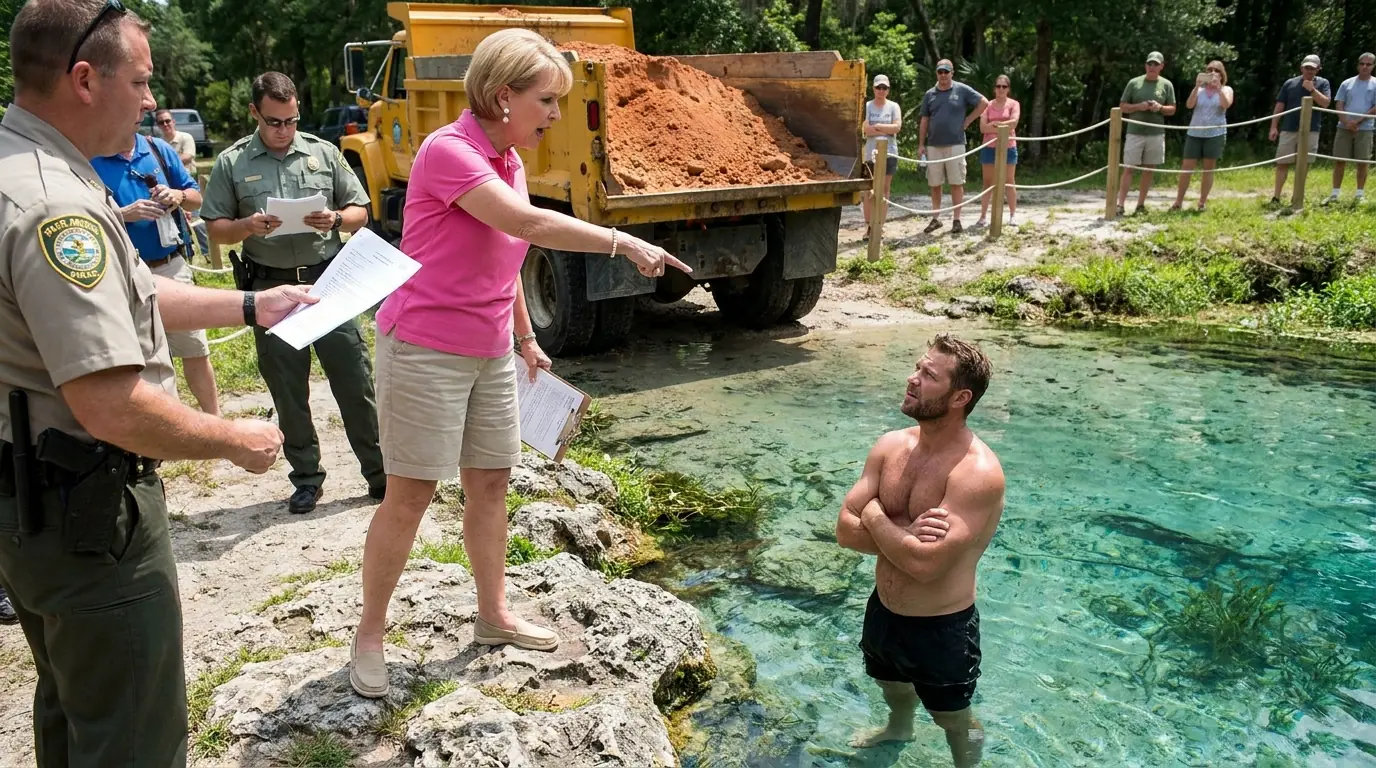
Ryan liked mornings there best.
Before the insects became loud.
Before the trucks started on County Road 326.
Before the neighbors began mowing lawns.
Before Linda Hargrave started finding reasons to call him.
He floated backward.
Above him, live oaks stretched branches over the spring, heavy with Spanish moss. Ferns crowded the limestone edge. Sunlight broke through the canopy and moved across the turquoise water in bright shifting patterns.
For almost three years, this had been the quietest place Ryan knew.
That was one of the reasons he bought the house.
The listing had not called it a swimming pool.
It had said:
PRIVATE RESIDENCE WITH DOCUMENTED NATURAL SPRING AND PROTECTED RIPARIAN FEATURE.
Ryan remembered reading that line twice.
He was forty-one then.
Recently divorced.
Tired of Tampa traffic.
Tired of a downtown engineering job that kept him staring at stormwater plans for subdivisions he would never live in.
He had spent fifteen years working as a civil engineer specializing in drainage and site development before shifting into independent consulting.
Moving outside Ocala had been partly practical.
Lower costs.
More land.
Better access to clients in central Florida.
But mostly, Ryan wanted quiet.
The property offered four acres behind a modest gray house.
One workshop.
Old oaks.
And the spring.
The previous owner, Samuel Bristow, met Ryan there during inspection.
Samuel was seventy-two, thin, deeply tanned, and proud of the place.
“Don’t call it a pond.”
Ryan smiled.
“I wasn’t going to.”
“People call everything water a pond.”
“What should I call it?”
Samuel pointed.
“Spring.”
Ryan looked at the water.
“How deep?”
“About fourteen feet in the center.”
“Flow?”
“Depends on groundwater conditions.”
Samuel nodded toward a narrow outflow channel disappearing beneath vegetation.
“Feeds east after heavy periods. County has records going back decades.”
Ryan looked surprised.
“Protected?”
“Partly.”
Samuel handed him a folder.
Surveys.
Environmental reports.
County maps.
A state water-management district letter.
A conservation easement recorded years earlier over a narrow portion of the property containing the spring and outlet.
Ryan had spent his career reading documents like those.
He understood immediately.
This was not a decorative backyard feature.
It was not something a homeowner could simply deepen, drain, fill, reroute, line with concrete, or redesign because he felt like it.
The spring existed before the house.
Before the road.
Before the subdivision.
Probably long before anyone had given the land a parcel number.
Ryan loved that.
He bought the property.
For nearly two years, nobody cared.
Then Linda Hargrave became HOA president.
The subdivision was called Silver Oaks Preserve, which Ryan always found mildly ironic because half the neighborhood’s oldest trees had been removed during construction.
Silver Oaks consisted of eighty-three homes built in phases.
Most sat on one-quarter- to half-acre lots.
Ryan’s property was different.
His house predated the main subdivision by eleven years and had been incorporated into the HOA through a later annexation agreement when surrounding land was developed.
That legal history made almost everything more complicated.
Some HOA provisions applied fully.
Others applied only to improvements within certain developed portions.
The spring itself was subject to separate recorded environmental restrictions.
Most boards had treated Ryan’s property accordingly.
Linda did not.
She became president after campaigning on what she called:
restoring consistent neighborhood standards.
At first, Ryan paid little attention.
Linda sent newsletters.
Ryan deleted them.
She organized landscaping inspections.
Ryan maintained his property.
No problem.
Then came the letter.
It arrived eleven months after Linda took office.
NOTICE OF UNAPPROVED RECREATIONAL WATER FEATURE
Ryan stared at it.
He thought it had been mailed to the wrong address.
The letter stated:
The Association has observed a substantial open-water feature behind the residence at 417 Cypress Bend Lane. Association records do not show prior architectural approval for installation or maintenance of such feature.
Ryan laughed.
Installation.
He read on.
Unapproved swimming ponds, excavated recreational basins, and similar water hazards are prohibited without architectural review. Owner is directed to provide permit documentation or submit a remediation plan within thirty days.
Ryan took the letter outside.
He stood beside the spring.
Then looked at the house.
Then back at the letter.
“Installation.”
He laughed again.
His neighbor Marcus Dean heard him from across the fence.
“What?”
Ryan held up the paper.
“Apparently I installed a spring.”
Marcus walked over.
“Impressive.”
“I know.”
“When?”
“Geologically? I’m still researching.”
Marcus read the notice.
His expression changed.
“She thinks this is a swimming pond?”
“Apparently.”
“She’s been here.”
“I know.”
“Everybody knows it’s a spring.”
Ryan shrugged.
“Everybody except the person issuing violation notices.”
Ryan replied by email.
Polite.
Short.
He attached the recorded conservation easement, environmental survey, county hydrology map, and original subdivision annexation documents.
He wrote:
The water feature referenced in your notice is a naturally occurring spring documented before construction of Silver Oaks Preserve. It was not installed by the current or previous owners. Please withdraw the violation.
Linda responded three days later.
Thank you for the documentation. The Board maintains concerns regarding the recreational use and appearance of the water feature. Please refrain from swimming until review is complete.
Ryan read that line twice.
Refrain from swimming.
He replied:
Please identify the covenant provision authorizing the HOA to prohibit swimming in a naturally occurring spring located entirely within my parcel and subject to separate environmental restrictions.
Linda did not answer that question.
Instead, two weeks later, Ryan received a second notice.
UNSAFE WATER FEATURE / COMMUNITY LIABILITY CONCERN
This one claimed that the spring posed a hazard because it was unfenced.
Ryan forwarded it to his attorney, Amanda Cross, who had handled the purchase closing years earlier.
Amanda called him.
“Has anything changed at the spring?”
“No.”
“You remove a fence?”
“There was never one.”
“Add a dock?”
“No.”
“Advertise public swimming?”
“No.”
“Allow neighborhood kids?”
“Absolutely not.”
Amanda sighed.
“Then this feels like a woman trying to find a rule after choosing an outcome.”
“That’s my impression.”
“Send her the easement language again.”
“I did.”
“Send the title exception.”
“I did.”
“Send the annexation schedule.”
“I did.”
Amanda paused.
“She may not understand what she’s reading.”
Ryan looked through the window toward the spring.
“I’m starting to think she doesn’t want to.”
That was closer.
Linda disliked ambiguities.
The spring created several.
Was it landscape?
Natural feature?
Recreational feature?
Water body?
Protected resource?
Private amenity?
Depending on the question, it could be several of those things.
Linda preferred categories that ended arguments.
Ryan’s property refused to cooperate.
At the August board meeting, she raised the issue publicly.
Ryan attended because Amanda suggested he should.
Twenty-six residents sat inside the clubhouse.
Linda sat behind a folding table with three other directors.
She wore a pink polo shirt, beige slacks, pearls, and the expression of someone beginning a presentation she expected to win.
“Next item,” she said. “The Mercer water feature.”
Ryan raised one hand.
“Natural spring.”
Linda looked at him.
“The feature behind the Mercer residence.”
“Natural spring.”
“We all understand what we’re discussing.”
Ryan nodded.
“Then use the correct term.”
A few people smiled.
Linda did not.
She continued.
“The association has received concerns about unrestricted recreational use.”
Ryan looked around.
“From whom?”
Linda shuffled papers.
“Residents.”
“How many?”
“That is not relevant.”
“It is if you’re telling everyone there’s a community concern.”
Board treasurer Charles Benton shifted in his seat.
Linda continued.
“The central issue is whether a large exposed body of water should remain without approved safety controls.”
Ryan asked:
“Approved by who?”
“The architectural committee.”
“Over a spring protected by a conservation instrument?”
Linda frowned.
“The HOA governs exterior conditions.”
Ryan placed a document on the table.
Amanda had told him not to overexplain.
One page.
Highlighted clause.
No person or private association shall fill, excavate, substantially alter, obstruct, or modify the protected spring feature without applicable governmental authorization.
Linda glanced at it.
Ryan said:
“That restriction is recorded against the land.”
“We have read it.”