The first thing I saw that morning was a brand-new silver luxury SUV sitting in the middle of a dirt island like somebody had dropped it there from a helicopter.
The second thing I saw was a woman in designer sunglasses standing on the opposite side of a freshly dug drainage trench, screaming my name so loudly she was scaring birds out of the cottonwood trees.
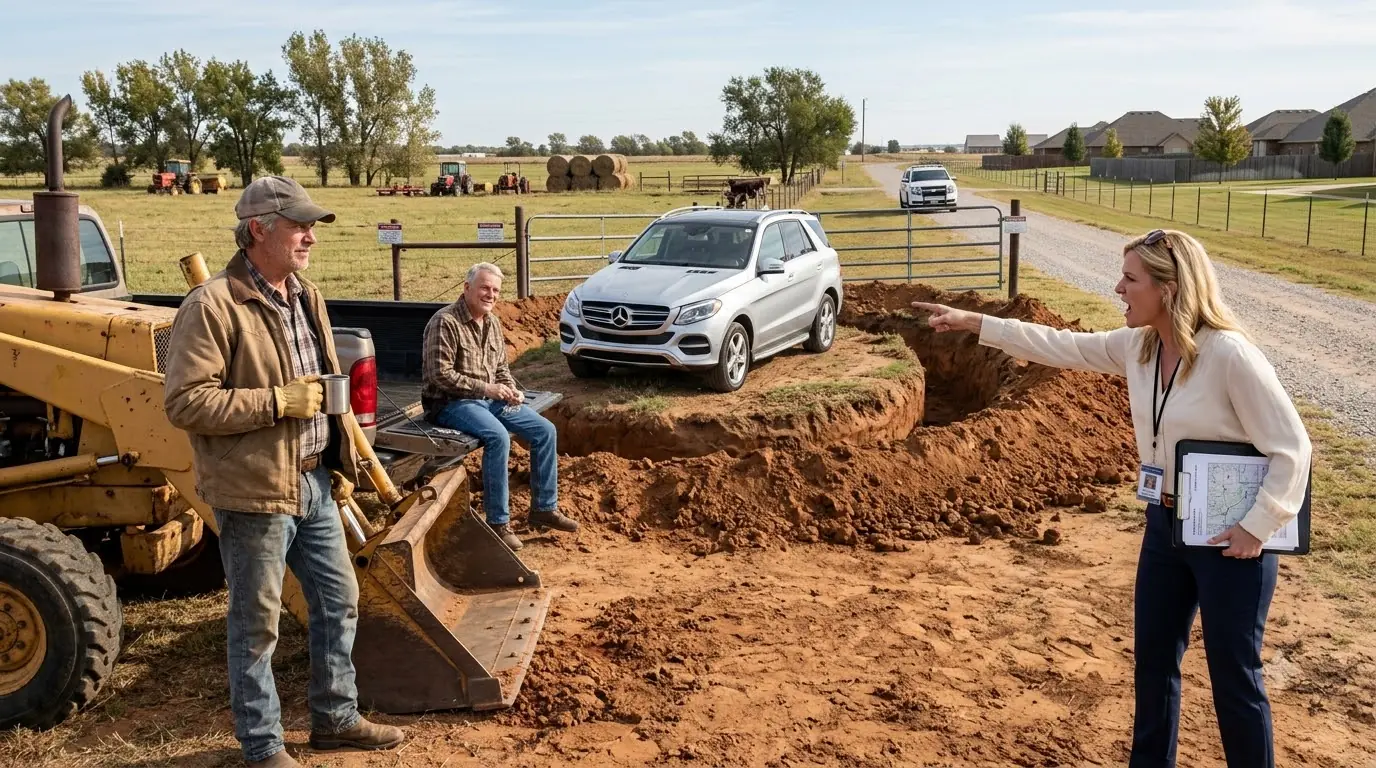
And the third thing I saw was my neighbor Hank sitting beside me on the tailgate of my truck, calmly cracking sunflower seeds and trying so hard not to laugh that his face had turned red.
Now, before I explain how a ninety-thousand-dollar SUV ended up stranded on my land and why a recovery crane eventually had to lift it out, you need to understand something about where I come from.
Because none of this started with a ditch.
It started with people who believed ownership was something you could argue your way around if you carried enough paperwork.
My name is Walter Reed.
I'm sixty years old.
My family has worked the same stretch of western Oklahoma land for almost a century.
My grandfather, Earl Reed, bought the original 160 acres in 1931.
Back then, the road was dirt, electricity had not reached every farmhouse, and people handled most disagreements by walking across a field and talking face-to-face.
Over the years, the Reed place grew.
My father added acreage when a neighboring rancher retired.
I bought another parcel in my thirties.
By the time I inherited the main farm, the property covered a little over three hundred acres of mixed pasture, hay ground, and cattle country.
It was not a grand operation.
Nobody was getting rich.
But it supported my family.
It paid taxes.
It gave my wife Linda and me a home.
And it gave me the one thing I've valued more as I've gotten older.
Space.
I grew up learning two rules that were simple enough for a child to understand.
Respect property that isn't yours.
And if somebody asks you politely to move your truck, move your truck.
For nearly six decades, those rules worked.
Then Silver Creek Estates arrived.
Four years before the SUV incident, developers bought several hundred acres directly east of my farm.
The property had once been open pasture.
Cattle grazed there.
Coyotes crossed it at night.
During spring storms, water moved naturally across shallow draws toward the creek.
Then the machines arrived.
Bulldozers.
Excavators.
Concrete trucks.
Survey crews.
Utility contractors.
One day there was grass.
A few months later, there were streets.
The brochures called the subdivision "Silver Creek Estates, luxury country living with modern convenience."
That phrase always made Hank laugh.
"Luxury country living."
He would say it slowly like he was testing each word for structural weakness.
"They cut down the country part and sold the rest."
Hank Walters lived on the north side of me.
Sixty-four.
Tall.
Lean.
Usually wearing a faded cap from a feed company that had gone out of business twenty years earlier.
He had farmed beside me long enough that we could have entire conversations using head nods.
He was the kind of neighbor you wanted during a storm.
If a calf got through a fence, Hank would be there before you finished calling.
If a tractor broke, he had tools.
If somebody acted foolish, Hank usually noticed before anyone else.
Silver Creek itself was not the problem.
Most of the people who moved there were perfectly decent.
Young families.
Retirees.
A surgeon who grew tomatoes badly but enthusiastically.
A software engineer who bought hay from me because his daughter insisted on keeping two miniature donkeys.
A teacher named Melissa Avery who brought homemade cookies every Christmas.
The problem was not the neighborhood.
The problem was Vanessa Cole.
Vanessa became president of the Silver Creek Homeowners Association before the development was even fully occupied.
Nobody could later explain to me exactly how.
The developer appointed an interim board.
Then homeowners held elections.
Somehow Vanessa went from volunteer architectural committee member to association president with astonishing speed.
She took the position seriously.
Far more seriously than anyone else did.
Vanessa was probably in her late forties.
Perfect blonde bob.
Large designer sunglasses.
Immaculate clothes.
Silver luxury SUV.
And always, always, a black clipboard.
That clipboard became famous.
Trash container visible from the street?
Clipboard.
Fence stain wrong color?
Clipboard.
Basketball hoop two inches too close to a sidewalk?
Clipboard.
Holiday lights still up after some date buried in the covenants?
Clipboard.
The residents joked about it quietly.
Nobody wanted to joke within her hearing.
Every weekday morning around 8:30, Vanessa drove through Silver Creek at about eight miles an hour.
She watched.
Measured.
Photographed.
Wrote.
Duke, my old cattle dog, hated her immediately.
Duke liked almost everybody.
He liked delivery drivers.
He liked veterinarians, even though they had every reason to be unpopular.
He once climbed into Hank's truck and refused to get out because Hank had beef jerky.
But the first time Vanessa walked along my eastern fence, Duke stood beside me and made a sound from deep in his chest.
"Easy."
I put a hand on his back.
Vanessa looked over.
"Is that dog secured?"
I stared at her.
"He's standing beside me."
"He appears aggressive."
Duke yawned.
I should have recognized the warning.
Behind Silver Creek Estates ran a farm access road.
It was not a public street.
It was not association common property.
It was not a county easement.
It sat entirely inside my deeded boundary.
The road ran almost a mile along the eastern side of my farm before turning toward two grazing fields, an equipment shed, and a cattle-working area.
Tractors used it.
Feed trucks used it.
Hay trailers used it.
Veterinary trucks used it.
During planting and cutting seasons, something was moving along that road almost every day.
There were signs.
PRIVATE PROPERTY.
FARM ACCESS ONLY.
NO TRESPASSING.
AUTHORIZED VEHICLES ONLY.
The wording was not subtle.
My first real confrontation with Vanessa happened on a Tuesday.
I was hauling fencing supplies toward the south pasture when I rounded a bend and hit the brakes.
Her silver SUV sat directly across my equipment gate.
Not partly.
Not accidentally.
Dead center.
The engine was off.
Nobody inside.
I waited five minutes.
Then ten.
At twenty minutes, I shut off the truck.
Duke sat in the passenger seat and looked at me.
"I know."
I climbed out.
Eventually I saw Vanessa on the subdivision side of the fence.
Another board member walked behind her carrying folders.
I called:
"Morning."
Vanessa looked over.
"You're blocking my gate."
She glanced at the SUV.
Then back at me.
"I'm conducting association business."
"That's fine."
I pointed.
"But I need through."
"You can wait."
There are certain sentences that become more irritating because the person saying them seems genuinely convinced they are reasonable.
You can wait.
On my land.
At my gate.
Behind a vehicle she had no reason to park there.
Still, I tried politeness.
"Ma'am, this road is private."
Vanessa adjusted her sunglasses.
"We have maintenance access."
"No."
She looked surprised.
"Excuse me?"
"You don't."
"We have access rights along the perimeter infrastructure."
I had no idea what "perimeter infrastructure" meant.
Neither did she, probably.
I said:
"Move your vehicle, please."
Vanessa stared.
For several seconds, I thought she might refuse simply because I had asked.
Finally, she walked back.
She opened the SUV door.
Before getting in, she turned toward me.
"You need to understand that Silver Creek has obligations related to maintaining this boundary."
"And you need to understand the boundary is where your authority ends."
She gave me a look I came to know well.
Not confusion.
Not embarrassment.
Offense.
As though my property line had insulted her personally.
She drove away.
Hank called that evening.
"Heard you met Vanessa."
"News travels fast."
"HOA people saw it."
I sighed.
"She thinks they have access."
"They don't."
"I know."
Hank paused.
"She know?"
"No."