At 7:06 on a bright Saturday morning in Scottsdale, Arizona, Sheriff Daniel Mercer was halfway through his first cup of coffee when his phone vibrated across the kitchen counter.
The message came from his backyard security system.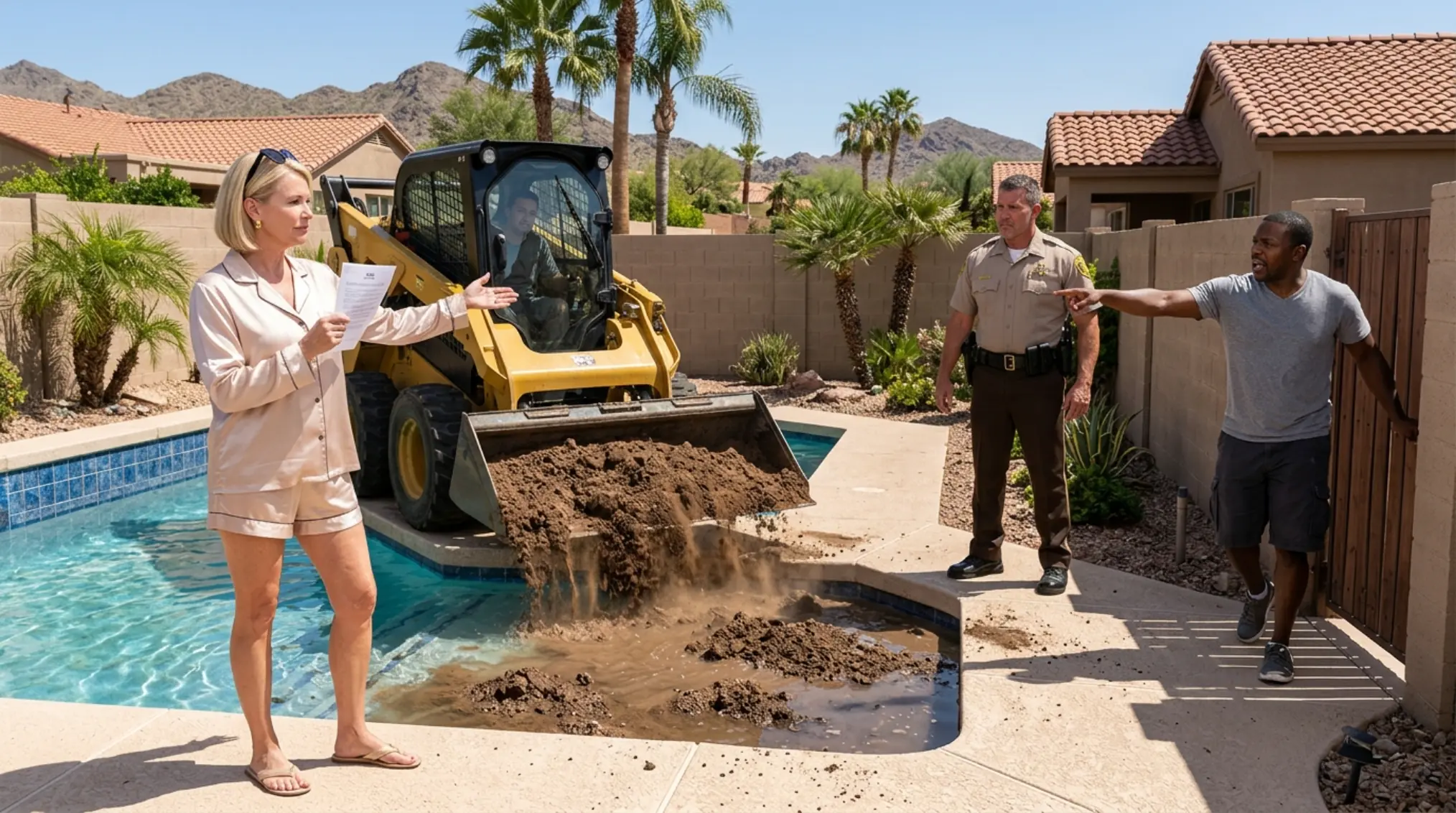
HEAVY VEHICLE DETECTED — REAR PROPERTY ACCESS.
Daniel frowned.
He lived on six quiet acres just beyond the southern boundary of Silver Creek Estates, an expensive master-planned neighborhood filled with sandstone houses, manicured lawns, ornamental palms, and an HOA famous for arguing about everything from mailbox colors to the angle at which basketball hoops could face the street. Daniel’s own property was older than the subdivision and had never been incorporated into Silver Creek. His grandfather had purchased the original parcel in 1978, long before the first stucco wall or decorative entrance sign appeared.
The land had been divided once, decades earlier.
Daniel owned the southern section.
His younger sister owned the western section.
The HOA bordered both.
That boundary had caused problems before.
But never anything like what appeared on his phone that morning.
Daniel tapped the alert.
The camera feed opened.
For several seconds he simply stared.
A large yellow skid-steer loader was driving across his rear lawn.
Its bucket was full of dirt.
The machine turned toward his swimming pool.
Standing beside the water was a blonde woman Daniel recognized immediately.
Pamela Whitaker.
President of the Silver Creek Homeowners Association.
Fifty-five years old.
Sharp blonde bob.
Black sunglasses perched above her forehead.
Small gold earrings.
And, inexplicably, a pale champagne-pink satin pajama set consisting of a loose button-up blouse and matching shorts, as though she had awakened, decided to destroy somebody’s property before breakfast, and never bothered changing clothes.
Pamela stood with one arm folded across her waist while directing the skid-steer operator with the other.
Daniel watched the bucket rise.
He stopped breathing.
The machine tilted forward.
Nearly half a ton of brown soil fell into the blue water.
Mud exploded across the surface.
Daniel set down his coffee.
“Son of a—”
He was through the kitchen door before finishing the sentence.
The distance from the rear of his house to the pool was nearly two hundred yards, and Daniel covered most of it at a run.
He had spent twenty-four years in law enforcement, the last six as county sheriff, but that morning he was not thinking like a sheriff.
He was thinking like a homeowner watching someone bury the swimming pool his late father had helped him build.
The pool sat behind a low sandstone patio near the northern edge of Daniel’s property. It was rectangular, forty feet long, surrounded by pale concrete decking and a row of mature citrus trees. His father, Robert Mercer, had spent an entire summer helping Daniel install drainage around it when Daniel bought the property from the family trust fifteen years earlier.
Robert died three years later.
Daniel still remembered him standing barefoot on the deck, complaining that Daniel had spent too much money on tile and then refusing to leave the water until sunset.
Now dirt covered half the shallow end.
The skid-steer reversed.
Another pile waited nearby.
Daniel shouted from fifty yards away.
“SHUT THAT MACHINE DOWN!”
The operator turned.
Pamela did too.
The loader stopped.
Daniel stormed through the side gate wearing a tan sheriff uniform shirt because he had been scheduled to attend a county emergency-services briefing later that morning. His dark-brown duty pants were already dusty from running across the yard, his black boots struck the concrete hard, and his gold sheriff badge caught the morning sunlight.
Pamela’s expression changed only briefly.
Then arrogance returned.
She raised a sheet of paper.
“You’re interfering with an authorized HOA enforcement action.”
Daniel stopped ten feet from her.
“My property.”
Pamela gave an impatient laugh.
“No, Sheriff. This pool belongs to Lot 118.”
“No.”
“Yes.”
Daniel pointed toward the machine.
“Kill the engine.”
The operator immediately did.
Pamela turned toward him.
“I did not authorize you to stop.”
The contractor looked at Daniel’s badge, then at the muddy pool.
“I’m stopping.”
Pamela’s jaw tightened.
Daniel stepped toward her.
“Who hired him?”
“The association.”
“Who authorized entry onto this parcel?”
“The association.”
“Who authorized you to destroy the pool?”
“It isn’t your pool.”
Daniel looked toward the water.
Then back at her.
“I built it.”
Pamela lifted the violation notice.
“The recorded HOA site map shows this pool inside Lot 118, currently owned by Mr. Nathan Cole. Mr. Cole ignored four architectural violations and refused removal. The association exercised its corrective rights.”
Daniel stared at her.
“Nathan Cole’s house is through that fence.”
“Yes.”
“And his property ends at that wall.”
“That is what he claims.”
“No. That is what the county recorder says.”
Pamela smiled tightly.
“Our records say otherwise.”
Daniel stepped closer.
“Your records are wrong.”
“They were reviewed.”
“By whom?”
“Our property committee.”
“Licensed surveyor?”
Silence.
Daniel asked again.
“Did a licensed surveyor verify this line before you brought heavy equipment onto private property?”
Pamela folded her arms.
“The HOA has maintained that section for years.”
“That wasn’t my question.”
She looked away.
Daniel pointed toward the gate.
“Nobody moves another pound of dirt.”
Pamela’s face hardened.
“You don’t get to use your badge to interfere with association business.”
Daniel’s voice became colder.
“My badge has nothing to do with who owns this land.”
He pointed toward the muddy pool.
“If I were a grocery clerk standing here in boxer shorts, you would still be trespassing.”
The contractor looked increasingly uncomfortable.
Daniel turned toward him.
“What company?”
“Canyon Earthworks.”
“Your name?”
“Eric Lawson.”
“Did you receive a property-access document?”
Eric pointed toward Pamela.
“She gave us a work order.”
Daniel held out his hand.
“May I see it?”
Pamela stepped between them.
“That document belongs to the HOA.”
Eric looked from her to Daniel.
Then he pulled a folded packet from the skid-steer cab.
“I’d rather he see it.”
Pamela’s face reddened.
Daniel opened the packet.
The first page carried the Silver Creek HOA logo.
EMERGENCY ARCHITECTURAL ABATEMENT — LOT 118
Below it:
Remove or render unusable unapproved swimming structure.
Daniel read the sentence again.
“Render unusable?”
Pamela lifted her chin.
“The owner refused removal.”
Daniel looked at Eric.
“You were told to fill a swimming pool?”
“Yes, sir.”
“Did anyone show you a demolition permit?”
Eric paused.
“No.”
“Pool abandonment permit?”
“No.”
“Utility clearance?”
“No.”
Pamela interrupted.
“We are not demolishing it. We are filling it.”
Daniel stared at her.
“That distinction is going to be interesting later.”
He pulled out his phone.
Pamela narrowed her eyes.
“Who are you calling?”
“The county.”
“For what?”
“First, property crimes.”
Her eyes widened.
“You are not seriously treating this like a crime.”
Daniel looked at the mud spreading through his pool.
“You climbed onto land you don’t own and paid somebody to intentionally damage property you don’t own.”
“This was a mistake.”
“You called it authorized thirty seconds ago.”
“I mean the boundary may require clarification.”
Daniel almost smiled.
“That was fast.”
Pamela pointed toward his badge.
“You have a conflict.”
“I agree.”
That answer surprised her.
Daniel called dispatch.
“This is Mercer. Send a patrol supervisor and two deputies to my residence. I’m the complainant, so route the investigation through Captain Hernandez. I don’t want direct involvement beyond providing my statement.”
Pamela stared.
“You’re calling your own deputies?”
“I’m calling law enforcement after discovering intentional property damage.”
“You’re the sheriff.”
“Which is exactly why someone else will run it.”
That was not the response Pamela expected.
She had dealt with Daniel only twice before.
Once at a neighborhood holiday fundraiser.
Once during a storm when Silver Creek’s drainage pond overflowed.
She knew he was sheriff.
She apparently believed that would make him reluctant to turn an HOA dispute into an official matter.
Daniel believed the opposite.
The cleaner the evidence, the less room there should be for favoritism.
He stepped away and opened his security application.
Four cameras covered the rear property.
The first captured Pamela entering through the side gate at 6:31.
The second recorded the skid-steer coming through at 6:44.
The third showed Pamela pointing toward the pool.
The fourth recorded the first load of dirt being dumped.
Audio existed too.
Daniel turned up the volume.
Pamela’s voice came clearly through the speaker.
“Fill the shallow end first. Once the filtration system is buried, he won’t be able to use it even if he tries digging this back out.”
Eric’s face changed.
Daniel looked at him.
“She told you that?”
Eric nodded reluctantly.
“Yes.”
Pamela snapped, “That was taken out of context.”
Daniel looked at the screen.
“What context makes it better?”
She said nothing.
A gate slammed beyond the pool.
A man came running through.
Nathan Cole, forty-one, owner of Lot 118, wore a navy T-shirt, khaki shorts, and sandals. His face was pale with anger.
“What did she do?”
Pamela turned.
“You had your chance.”
Nathan stared at the pool.
Then at Daniel.