“My HOA. My rules. Move the Jeep.”
Bethany Kensington Wright stood in the middle of Marcus Rodriguez’s driveway wearing a blazing orange pantsuit, one hand clutching a thick black HOA folder while the other pointed directly at his chest. Behind her, the cut security chain lay in two pieces beside the front tire of a dark-green federal task-force Jeep.
Marcus folded his arms.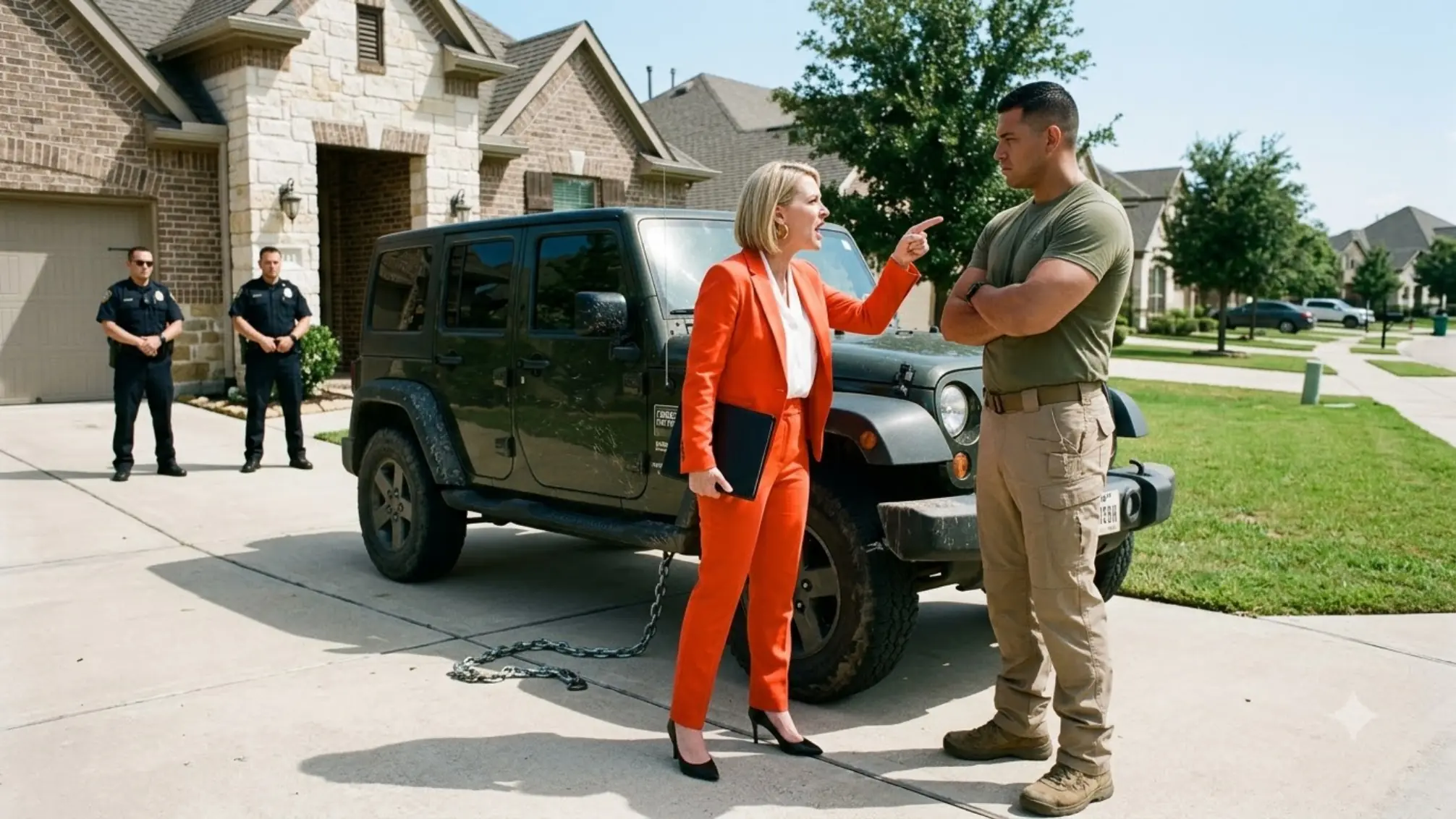
“Touch it again, and you answer to the feds.”
Bethany stepped closer.
“You threatening me?”
Marcus held her stare.
“No. I’m warning you.”
Two uniformed officers standing near the curb stopped talking.
Bethany did not notice.
She was too busy smiling.
For seven years, Bethany had controlled Willowbrook Estates through violation notices, special assessments, committee votes, and the simple fact that most residents found arguing with her more exhausting than paying whatever fine arrived in their mailbox.
She had fined people for leaving garbage cans outside thirty minutes too long.
She had measured lawns with a ruler.
She once sent a retired teacher a written warning because a Christmas wreath remained on her front door until January 9.
But Marcus Rodriguez had become her favorite problem.
The thirty-eight-year-old federal task-force officer had inherited the Willowbrook house from his grandmother, Rosa Rodriguez, six months earlier. Rosa had lived there since 1987, long before Bethany became president and long before Willowbrook developed its obsession with identical mailboxes, identical fences, and approved shades of beige.
Marcus had grown up in that house.
After his parents died when he was twelve, Rosa raised Marcus and his younger sister Maya there.
The kitchen still smelled faintly of cinnamon whenever the afternoon sun warmed the old cabinets.
The scratches Marcus had made while dragging toy trucks across the hallway floor still existed beneath a layer of polish.
On the wall beside the pantry, pencil marks showed Marcus and Maya’s height every birthday until they finished high school.
Marcus could have sold the property.
He refused.
It was the last place where Rosa’s voice still seemed close enough to hear.
When Marcus accepted a position with a regional federal narcotics task force, the house became his permanent residence. He parked his assigned Jeep in the driveway while working locally and occasionally left it there when traveling for training.
That vehicle became Bethany’s excuse.
Her first notice arrived on a Monday.
UNAUTHORIZED COMMERCIAL VEHICLE.
Marcus read it twice.
The Jeep was clearly marked as government property.
He emailed the HOA office.
Government vehicles are exempt under Section 12.4 of the Willowbrook covenants.
Bethany replied seventeen minutes later.
The board interprets that section differently.
Marcus smiled when he read it.
Not because it was funny.
Because Section 12.4 was one sentence.
There was almost nothing to interpret.
Emergency, municipal, state, military, and federal government vehicles are exempt from residential vehicle restrictions.
Marcus sent the sentence back.
Bethany did not answer.
Instead, she issued a fifty-dollar daily fine.
Then another.
Then another.
By the end of the week, Marcus supposedly owed three hundred fifty dollars.
His sister Maya called him from the house.
“She came by again.”
Marcus was temporarily working in Arizona with the task force.
“What did she want?”
“She photographed the Jeep.”
“From the sidewalk?”
Maya hesitated.
“No.”
Marcus sat forward.
“She came onto the property?”
“Yes.”
“How far?”
“Right beside it.”
Marcus became quiet.
The Jeep was not an ordinary personal vehicle.
Its exterior looked simple enough, but it contained encrypted communications equipment, secure mounts, tracking hardware, and agency electronics that were not supposed to be inspected by curious HOA presidents.
“Did she touch anything?”
“No.”
“You sure?”
“I recorded her.”
That was how the file began.
One video.
Then another.
Bethany appeared in Marcus’s driveway seventeen times over the next several days.
Sometimes she photographed the Jeep.
Sometimes she measured the distance between its tires and the sidewalk.
Once she pressed her face against the passenger window.
Maya confronted her.
“What are you doing?”
Bethany barely looked at her.
“Documenting violations.”
“You’re trespassing.”
“I’m the HOA president.”
“That doesn’t make this your property.”
Bethany smiled.
“Your brother should have thought about that before turning this home into some government parking lot.”
Maya crossed her arms.
“He works for the government.”
“Exactly.”
Bethany looked toward the Jeep.
“We don’t need that kind of presence in Willowbrook.”
That sentence stayed with Maya.
She began talking to neighbors.
At first, people were reluctant.
Then Tom Henderson, a seventy-two-year-old Vietnam veteran, showed her a stack of old HOA letters.
His son, an Army helicopter mechanic, had stayed with him temporarily after returning home.
Bethany cited them because his motorcycle was supposedly “inconsistent with neighborhood character.”
Sarah Martinez, whose husband served in the Navy, had received repeated notices because a moving truck remained outside her house for four hours while the family prepared for reassignment.
Another military family had been cited for displaying temporary deployment-support signs.
Maya found a pattern.
Military households were getting attention other residents did not.
Then she found something worse.
Inside Rosa’s old filing cabinet were Willowbrook meeting minutes dating back decades.
One set from 2019 included a letter signed by Bethany.
The letter argued against expanding housing assistance programs for service families because, in Bethany’s words, “transient military populations may not represent the long-term residential stability expected within Willowbrook.”
Maya photographed it and sent it to Marcus.
He stared at his phone.
“This isn’t about my Jeep.”
“No.”
“It never was.”
“No.”
Marcus immediately contacted his supervisor, Captain Sarah Chen.
Chen listened to the story silently.
When Marcus finished, she asked one question.
“Has anyone attempted to enter the vehicle?”
“Not yet.”
“Then keep it that way.”
Marcus nodded.
Chen continued.
“And tell your sister not to engage her alone anymore.”
That became important three days later.
Bethany sent Maya a registered letter.
The HOA claimed it would arrange “emergency vehicle removal” if the Jeep remained after twenty-four hours.
Marcus called Bethany directly.
She answered after one ring.
“Mr. Rodriguez.”
“Do not touch that Jeep.”
“Your threatening tone is being documented.”
“So is your notice.”
Bethany laughed.
“You federal types always think your badges make you special.”
“This has nothing to do with being special.”
“Good. Then follow the rules.”
“The rule you cited does not exist.”
“I decide how our rules are enforced.”
“No.”
Marcus paused.
“You manage an HOA.”
Bethany’s voice sharpened.
“I manage this community.”
“That’s exactly the problem.”
She hung up.
The next morning, Maya found a tow truck slowly circling the block.
The driver stopped once near the house.
Then continued.
Marcus contacted Captain Chen again.
She requested the vehicle’s remote security logs.
The Jeep’s proximity sensors showed repeated activity.
One night at 1:43 a.m., a camera captured Bethany approaching with two private security guards.
She pointed through the windows.
One guard took photographs.
Bethany tried the driver-side handle.
Locked.
She tried again.
That changed the situation.
Captain Chen stopped treating it as neighborhood harassment.
“You’ve got government equipment inside?”
“Yes.”
“Secure communications?”
“Yes.”
“Tell Maya not to touch the Jeep. We’re preserving everything.”
The next morning, Bethany lost the private security company she had hired.
Its management received a formal notice informing them that employees had been photographed examining restricted government equipment on private property.
The guards disappeared from Willowbrook immediately.
Bethany became furious.
Without the security company, she escalated.
Violation notices began arriving almost daily.
Landscaping.
Fence color.
Mailbox placement.
Trash collection.
One claimed Rosa’s old porch light was “architecturally inconsistent.”
Another accused Maya of running an unauthorized business from the house because she graded school papers at the kitchen table.
That one almost made Marcus laugh.
Almost.
Then Maya called him crying.
“Bethany contacted my school.”
Marcus stood up from his temporary office.
“What?”
“She told someone on the parent committee that having your government vehicle here creates a security concern.”
Marcus’s voice changed.
“What exactly did she say?”
“That military and federal families bring instability into residential communities.”
Marcus closed his eyes.
Maya continued.
“She implied my connection to you could make parents uncomfortable.”
That ended Marcus’s patience.
He had spent weeks trying to keep the situation procedural.
Now Bethany had taken a parking dispute and turned it into an attack on his sister’s livelihood.
He called Captain Chen.
“I’m filing everything.”
“Already started.”
“What?”
Chen sounded almost amused.
“Marcus, your sister has sent us more documentation than some investigators produce in a month.”
Maya had indeed become relentless.
She created folders.
Dates.
Photographs.
Violation notices.
Copies of the real HOA bylaws.
Statements from residents.
Videos of Bethany entering properties.
Then Maya made a discovery no one expected.
She was examining old community records when she noticed repeated payments from the HOA to a company called Kensington Urban Consulting.
The name was suspiciously familiar.
Bethany’s husband, Carl Wright, served on the city council and owned several development businesses.
Kensington Urban Consulting used the same mailing address as one of Carl’s companies.
Over three years, Willowbrook had paid more than $180,000 for “planning consultation,” “neighborhood enhancement strategy,” and “future development analysis.”
Maya could find almost no evidence the services existed.
She called Marcus.
“You need to see this.”
“Send it.”
“No.”
Her voice was different.
“This is bigger.”
Marcus returned home two weeks later.
When he entered Rosa’s kitchen, the dining table was covered with paperwork.
Maya stood beside it.
“This woman is not just crazy.”
Marcus dropped his bag.
“What did you find?”
Maya handed him a contract.
The first page contained the name Eastbrook Development Corporation.
The agreement described future acquisition opportunities involving Willowbrook properties.
Marcus read faster.
Then stopped.
His grandmother’s address appeared in an appendix.
So did Henderson’s house.
The Martinez home.
Several elderly homeowners.
Military families.
People who had repeatedly fought HOA fines.
“What is this?”
Maya pointed toward the heading.
Acquisition Facilitation Targets.
Marcus stared at her.
“They planned to force people out?”
“I think they planned to make living here miserable enough that people would sell.”
Marcus turned another page.
Potential redevelopment.
Luxury townhomes.
Higher-density residential units.
Estimated future profit.
His grandmother’s home was listed as a target almost eleven months before she died.
Marcus sat down.
Suddenly, old memories became different.
Rosa complaining about HOA letters during hospice care.
Rosa asking whether Marcus would keep the house.
Rosa saying quietly one evening:
“Don’t let them take our home, mijo.”
Marcus had believed she was frightened because illness made everything uncertain.
Maybe she had understood more than anyone realized.
Maya placed another folder on the table.
“I found notices they sent Grandma during her last six weeks.”
Marcus opened it.
Grass height.
Exterior maintenance.
Driveway discoloration.
Late assessment fees.
Threats involving liens.
His hands tightened around the papers.
Maya touched his shoulder.
“Tank.”
He looked at her.
“Grandma was dying.”
“I know.”
“And they were sending this?”
“I know.”
Marcus closed the folder carefully.
Rosa’s voice returned to him.
Stand up to bullies, mijo. But do it the right way.
He stood.
“Call the residents.”
“What are we doing?”
“The right way.”
Within forty-eight hours, Willowbrook stopped being a frightened neighborhood.
Residents held an emergency meeting.
Maya presented the real bylaws.
Tom Henderson presented military-family complaints.
Other homeowners brought their own records.
One elderly couple had been fined thousands for landscaping violations.
Another family had paid repeated penalties for parking despite photographs showing their vehicles were compliant.
The community discovered something Bethany had depended on for years.
Nobody had compared stories.
Once they did, her power weakened immediately.
A recall petition circulated.
Sixty-seven percent of homeowners signed.
Bethany responded with fury.
She called the petition illegal.
She threatened lawsuits.
She sent emails warning that removing her leadership would “destroy property values.”
Then, at 6:47 on a Tuesday morning, she made the mistake that ended everything.
Maya woke to metal striking metal.
Clang.
Then again.
Clang.
She ran to the front window.
Bethany stood in Marcus’s driveway wearing an orange jacket over casual clothes, gripping a large set of bolt cutters.
The Jeep’s security chain was already damaged.
A tow truck waited at the curb.
Maya grabbed her phone and started recording.
“Bethany!”
Bethany looked up.
“This vehicle is being removed.”
“You cannot touch that!”
“I absolutely can.”
The tow driver stepped out.
Then he saw the markings on the Jeep.
He stopped.
“Ma’am.”
Bethany ignored him.
She cut through the final section of chain.
It fell onto the concrete.
Marcus happened to be inside the house.
He had returned late the previous night.
He stepped through the front door wearing an olive T-shirt and tan pants.
He saw the chain.
Then Bethany.
Then the tow truck.
He walked down the driveway.
“My HOA. My rules. Move the Jeep,” Bethany snapped.
Marcus folded his arms.
“Touch it again, and you answer to the feds.”
“You threatening me?”
“No.”
Marcus’s voice dropped.
“I’m warning you.”
The tow driver raised both hands.
“I’m out.”
Bethany spun toward him.
“I paid you.”
“That thing says federal.”
“It’s still parked in my HOA.”
The driver actually laughed.
“Lady, your HOA doesn’t beat the United States government.”
He climbed back into his truck.
Bethany stepped in front of it.
“You leave and I’ll have your license reviewed.”
The driver stared at her.
“You do that.”
Then he drove away.
Bethany turned toward Marcus.
“You think this proves something?”
Marcus pointed toward the broken chain.
“You just damaged government security equipment.”
“It was attached to a community violation.”
“No.”
He stepped closer.
“It was attached to a federal vehicle.”
Two police cruisers turned onto the street.
Bethany smiled.
“Perfect.”
She believed they were coming for Marcus.
They were not.
Captain Chen had already notified local law enforcement after the Jeep’s tamper alarm activated automatically.
The officers exited their vehicles.
Bethany immediately pointed toward Marcus.
“He’s refusing lawful HOA enforcement.”
One officer looked at the Jeep.
Then the chain.
Then Marcus.
“Sir, are you Rodriguez?”
“Yes.”
“We were told federal personnel are en route.”
Bethany stopped.
“What?”
The officer nodded toward the Jeep.
“Tampering alert went out.”
Bethany laughed nervously.
“That’s ridiculous.”
Marcus looked at her.
“You wanted attention.”
He glanced down the street.
“Now you have it.”
A dark government SUV arrived several minutes later.
Then another.
Bethany’s confidence disappeared.
Federal investigators photographed the lock, the chain, the Jeep, and the security footage.
Nobody arrested her theatrically in the driveway.
That would have been simpler than what actually happened.
They asked questions.
Preserved records.
Collected videos.
Requested HOA documents.
And once federal investigators began looking at Bethany’s actions toward the Jeep, they found Maya’s financial records.
That opened another door.
Then another.
The development contracts.
The fabricated consulting invoices.
The unusual payments.
The targeted properties.
Carl Wright’s involvement.
Investigators discovered that Eastbrook Development had discussed purchasing groups of Willowbrook homes years before most residents considered selling.
Several properties on the target list belonged to people later subjected to unusually heavy HOA enforcement.
The pattern could no longer be dismissed as aggressive neighborhood management.
Financial investigators traced money.
Emails were preserved.
Account records were subpoenaed.
One message from Carl to Bethany read:
Need progress on Henderson, Martinez, Rodriguez block before Phase Two closes.
Another:
Increase compliance pressure. Eastbrook will not wait forever.
Marcus read the messages months later in a prosecutor’s office.
His jaw tightened.
“They called Grandma’s home a block.”
Maya sat beside him.
“They didn’t see homes.”
“No.”
“They saw inventory.”
The criminal cases took time.
Much longer than viral stories would later make it seem.
There was no instant courtroom.
No twenty-minute collapse.
Attorneys argued over records.
Investigators interviewed residents.
Forensic accountants reconstructed payments.
Some accusations could not be proven.
Others could.
Bethany and Carl eventually faced charges involving fraud, conspiracy, misuse of association funds, obstruction, and conduct connected to attempts to manipulate property sales.
The Jeep incident became only one part of the case.
But it was the mistake that exposed everything.
Meanwhile, Willowbrook held its recall election.
Bethany lost overwhelmingly.
Maya was asked to serve temporarily as HOA president.
She refused at first.
“I teach middle school.”
Tom Henderson grinned.
“Exactly. You already manage worse behavior than an HOA board.”
She eventually agreed.
Her first action was simple.
Every homeowner received a complete digital copy of the actual bylaws.
Her second action required every violation notice to cite the exact section allegedly violated.
Her third opened HOA financial records to residents.
Suddenly, Willowbrook became boring.
Marcus loved it.
No secret inspections.
No invented rules.
No rulers measuring lawns.
No targeted harassment.
People argued about pool maintenance and landscaping budgets instead of whether Bethany could control their lives.
That was what community governance was supposed to look like.
Boring.
Transparent.
Accountable.
A year after the confrontation, Marcus stood beside the Jeep in his grandmother’s driveway.
Maya came outside carrying coffee.
“You ever going to remove that old security hook?”
Marcus looked at the replacement chain.
“Probably.”
“You said that six months ago.”
He smiled.
Maya handed him a cup.
Across the street, Tom Henderson was helping a new military family unload boxes from a rental truck.
Nobody had sent them a violation notice.
Nobody had photographed their vehicle.
Nobody had questioned whether they belonged.
Marcus watched them for a while.
“You know what bothers me?”
Maya leaned against the Jeep.
“Only one thing?”
He laughed.
Then became serious.
“Bethany thought her biggest mistake was touching a federal vehicle.”
“Wasn’t it?”
“No.”
Marcus looked toward Rosa’s house.
“The Jeep just made people pay attention.”
He nodded toward the neighborhood.
“Her biggest mistake was thinking everyone here would stay scared forever.”
Maya smiled.
“That sounds like Grandma.”
“Yeah.”
They stood in silence.
The house behind them still had the same old porch.
The same kitchen.
The same pencil marks beside the pantry.
The same memories Bethany and Carl had once reduced to a line in a development spreadsheet.
Marcus had spent years investigating criminal organizations that looked powerful because people believed resistance was impossible.
Willowbrook taught him that power worked similarly even on quiet suburban streets.
Sometimes it wore expensive suits instead of gang colors.
Sometimes it arrived as certified mail instead of threats.
Sometimes it hid behind committees, bylaws, and official-looking letterhead.
But the weakness was often the same.
Bullies depended on isolation.
One homeowner thought they were alone.
Then another.
Then another.
Until someone finally compared the paperwork.
Marcus looked down at the cut chain Maya had insisted on keeping.
She had mounted one broken link inside a small frame.
Beneath it was a handwritten sentence from Rosa:
Stand up to bullies, but do it the right way.
Marcus touched the frame.
Bethany had believed bolt cutters would prove who controlled Willowbrook.
Instead, the sound of that chain breaking became the moment the neighborhood finally stopped obeying her.
Not because Marcus was a federal officer.
Not because agents arrived.
Not because the Jeep carried government equipment.
Those things only forced outsiders to look.
Willowbrook saved itself when ordinary residents finally decided fear was no longer a community rule.
And Bethany Kensington Wright learned the lesson too late.
She had spent years believing every driveway, every mailbox, every lawn, and every resident answered to her.
Then she cut one lock—
and discovered the entire neighborhood had finally started keeping receipts.