The bucket struck Daniel Mercer before he heard anyone enter the backyard.
A freezing wave of black, foul-smelling liquid crashed across his head and shoulders, soaking through his gray T-shirt and splattering over the tomato plants beside him. Daniel dropped his hand trowel and staggered away from the flower bed as the sludge burned against a small cut on his forearm.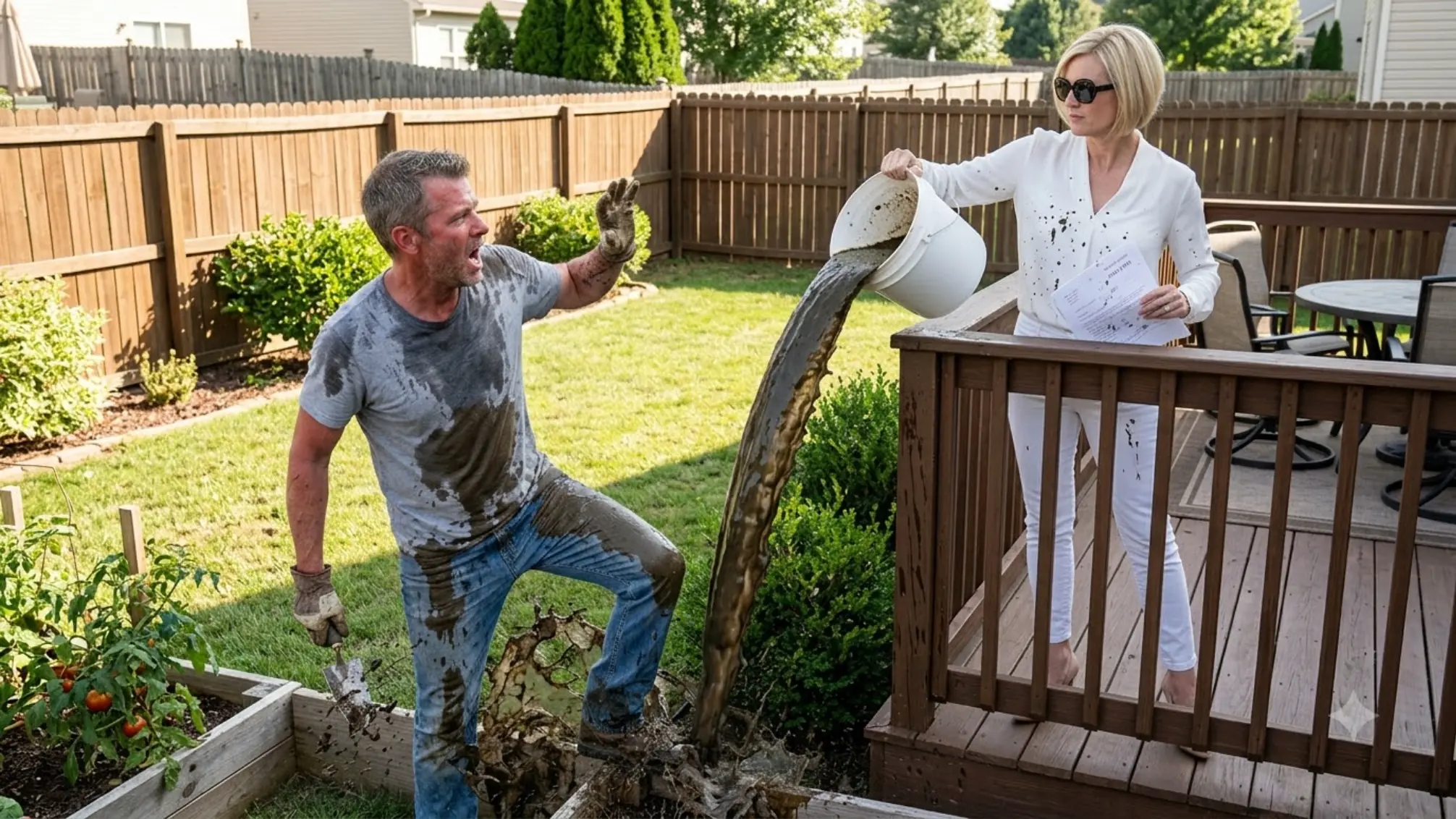
He wiped his eyes and looked toward the wooden deck.
Sharon Whitmore, president of the Westbrook Hills Homeowners Association, stood above him holding the empty white bucket. Her short blonde hair was styled into a perfect bob, oversized round sunglasses covered half her face, and her elegant white blouse and matching pants remained spotless.
“What the hell is wrong with you?” Daniel shouted. “You just dumped that on me!”
Sharon tilted her chin. “You wanted to ignore my warnings, so I handled your disgusting mess myself.”
Daniel stepped toward the deck, dark liquid dripping from his hair and beard. His fingers closed around the muddy trowel at his side, not because he intended to use it, but because rage needed somewhere to go.
“That’s assault, lady,” he said. “And that paper under your arm says you filed the complaint before you even touched my yard.”
Sharon tightened her grip on the bucket.
“Say one more word,” she replied, “and I’ll show you how fast this neighborhood can bury you.”
Daniel stared at the beige complaint form beneath her arm.
A printed timestamp appeared in the upper-right corner.
Complaint submitted: 1:42 p.m.
He glanced at the digital clock mounted beside the patio doors.
2:11 p.m.
The complaint had been filed twenty-nine minutes before Sharon entered his property and created the mess she was accusing him of causing.
Daniel slowly lowered the trowel.
Sharon mistook the movement for surrender.
She stepped down from the deck and held up the document. “The association received a report that you were dumping prohibited chemicals into the drainage soil. I came to document the violation.”
“You came carrying the chemical.”
“This bucket came from your yard.”
“No, it didn’t.”
“I found it behind your shed.”
Daniel looked at the white plastic container. A blue hardware-store label remained attached near its base.
He had never purchased anything from that store.
“Put it down,” he said.
“You don’t give me orders.”
“You entered my locked yard and dumped an unknown substance over me.”
“The association has inspection authority.”
“Not without notice.”
“Emergency conditions do not require notice.”
Daniel pointed toward the complaint. “You reported the emergency before it existed.”
For the first time, Sharon’s mouth tightened.
She had expected shouting. She had prepared for insults, threats, and perhaps a physical reaction she could describe as intimidation.
She had not expected him to notice the timestamp.
Daniel pulled his phone from his pocket. The screen was wet but still working.
Sharon moved closer.
“Who are you calling?”
“Emergency services.”
“You’re being dramatic.”
“My skin is burning.”
“It’s organic treatment.”
“Then pour the rest over yourself.”
Her confidence flickered.
Daniel pressed the call button.
Sharon reached toward his phone, but he stepped away.
“Touch me again,” he warned, “and the camera above that door will record a second assault.”
Her head snapped toward the patio roof.
A small black security camera pointed across the backyard.
Sharon stared at it.
Daniel saw the exact instant she realized she had missed it.
He spoke calmly to the dispatcher, explaining that an intruder had entered his property and poured an unknown chemical over his body while he gardened. He provided the address and requested medical assistance.
Sharon picked up the bucket.
“You’re wasting everyone’s time.”
“You’re leaving the evidence.”
“It belongs to the HOA.”
Daniel positioned himself between her and the gate without touching her.
“The police can decide who owns it.”
“You cannot hold me here.”
“I’m not holding you. The gate is behind you.”
Sharon looked toward the side fence.
To reach it, she would have to pass beneath another camera mounted near the garage.
Daniel understood why she hesitated.
“Go ahead,” he said. “Take the bucket with you. Make the evidence-disposal part easy to prove.”
She placed it down.
The smell rising from Daniel’s shirt was heavy and metallic, mixed with something resembling rotten vegetation. His arms had begun itching, and the skin beneath the sludge was turning red.
He removed his shirt carefully and dropped it beside the garden bed.
Sharon folded her arms. “You always exaggerate.”
Daniel looked at her.
“You’ve known me for eight months.”
“I know your kind.”
The words hung between them.
Daniel was a forty-six-year-old white American man, born less than thirty miles from Westbrook Hills. He had worked as a civil engineer for the county before opening his own drainage-design company. Nothing about his race or background separated him from most residents in the neighborhood.
But Sharon’s meaning was not racial.
To her, his “kind” meant homeowners who questioned her.
People who requested records.
People who read bylaws before paying fines.
People who did not accept her authority as unquestionable.
Daniel had become her problem three months after moving into Westbrook Hills.
It began with a rain garden.
His property sat near the lowest point of the neighborhood. During strong storms, water traveled across three neighboring yards and collected beside his foundation. The previous owner handled the flooding with an electric pump that pushed water toward the street.
Daniel designed a better solution.
He reshaped one section of the backyard, planted native grasses and flowers, and created a shallow rain garden capable of capturing runoff before releasing it slowly into the soil.
The garden reduced standing water.
It also attracted butterflies, bees, and birds.
Most neighbors liked it.
Sharon did not.
She sent Daniel a violation notice claiming that his native plants exceeded the association’s height limit. He responded with the landscaping provision, which specifically exempted approved stormwater gardens.
She fined him anyway.
Daniel appealed and won.
A month later, Sharon cited him for installing an “unauthorized drainage structure.” Daniel provided the county permit and engineering plans.
The board dismissed that violation too.
Afterward, the complaints became personal.
His shed was allegedly the wrong shade of brown.
His mailbox numbers were half an inch too tall.
His recycling container remained visible from the street for twenty-seven minutes after the collection deadline.
Daniel began requesting copies of every complaint and enforcement record.
That was when he discovered something troubling.
Many violation reports carried Sharon’s name as both the complainant and the reviewing officer. Some were approved minutes after submission. Others contained photographs taken from inside private yards.
At the next board meeting, Daniel asked whether the HOA president was entering properties without permission.
Sharon accused him of attacking volunteers.
He asked for an answer.
She ended the meeting.
Two weeks later, Daniel received a final warning about the rain garden. The letter claimed neighbors had reported chemical smells and contaminated runoff entering the common drainage channel.
Daniel hired an independent environmental testing company.
The soil was clean.
The plants were healthy.
No prohibited products were detected.
He sent the results to the HOA.
Sharon replied that the matter remained under investigation.
Now she stood beside the same garden after dumping toxic sludge across Daniel and the plants.
The distant sound of sirens grew louder.
Sharon removed her sunglasses.
Her blue eyes were sharp but no longer confident.
“You can still stop this nonsense,” she said.
Daniel almost laughed.
“You attacked me.”
“I attempted to collect a sample.”
“With a bucket over my head?”
“You moved unexpectedly.”
“I was kneeling with my back to you.”
“You became aggressive.”
“After you poured it.”
She stepped closer and lowered her voice.
“Think carefully. I am president of this association. I know every board member, every contractor, and every attorney involved in this community.”
Daniel looked at the complaint form again.
“And yet you still forgot what time you filed your lie.”
Paramedics entered through the gate first.
A police officer followed them.
Sharon immediately changed her posture.
Her shoulders lowered, her expression softened, and her voice became controlled.
“Thank goodness you’re here,” she said. “This homeowner became threatening while I was performing an emergency HOA inspection.”
Daniel did not respond.
One paramedic examined the redness spreading across his neck and arms. Another collected a sample from the sludge on his discarded shirt.
The officer looked at Sharon.
“Did you pour this substance on him?”
“I was attempting to remove a contaminated bucket from his property.”
“That was not my question.”
“The contents spilled during the confrontation.”
Daniel pointed toward the camera.
“It recorded everything.”
The officer turned toward him. “You have surveillance footage?”
“Three angles.”
Sharon’s face became still.
The paramedics led Daniel toward the kitchen sink and instructed him to rinse his skin while they prepared clean water and protective materials. The substance’s exact composition remained unknown, so they treated the exposure cautiously.
The officer remained outside with Sharon.
When Daniel returned wearing a clean shirt, another patrol car had arrived. Sharon stood beside the deck speaking to two officers at once.
“She was manufacturing evidence,” Daniel said.
Sharon pointed at him. “That is a ridiculous accusation.”
He held out the complaint form.
One officer read the timestamp.
“What time did you enter the property, ma’am?”
“I don’t remember.”
Daniel opened the security application on his phone.
The side-gate camera showed Sharon arriving at 2:06 p.m. She wore the same white outfit and carried the bucket from her car toward the fence.
She placed a narrow metal hook over the gate and lifted the interior latch.
At 2:08, she entered.
The next camera showed her walking toward Daniel while he worked with his back turned.
She paused beside the rain garden, removed the lid, and poured the bucket over him.
There was no accidental spill.
No struggle.
No attempt to collect a sample.
Sharon raised the bucket deliberately with both hands and emptied it across his head.
The officers watched without speaking.
Daniel then showed them the HOA complaint portal.
The report had been filed from Sharon’s account at 1:42 p.m. It claimed Daniel had poured “a bucket of black chemical waste” into his rain garden at approximately 2:10 p.m.
The report described an event that had not yet happened.
Sharon had predicted the time because she intended to create it.
One officer looked at her.
“You filed a complaint at 1:42 describing something you claimed occurred at 2:10.”
“The portal time must be wrong.”
Daniel shook his head. “The server synchronizes automatically.”
“You don’t know that.”
“I designed part of the county system it connects through.”
The officer asked Sharon to place her hands where he could see them.
Her voice rose.
“You cannot be serious.”
“We are investigating a possible assault and unlawful entry.”
“I am the HOA president.”
“That does not change the video.”
Sharon looked toward Daniel with open hatred.
“This man has harassed me for months.”
“By appealing fines?” Daniel asked.
“Be quiet.”
The officer moved between them.
“Ma’am, do not address him.”
Sharon’s breathing became shallow.
“I need to call the association attorney.”
“You may contact counsel after we complete the immediate investigation.”
The paramedics recommended that Daniel be transported for further evaluation. His skin irritation was worsening, and the substance might contain industrial chemicals.
Before leaving, he handed the officers digital copies of the footage and screenshots of the timestamped complaint.
He also gave them the original environmental report proving the garden was uncontaminated before Sharon arrived.
At the hospital, doctors flushed his eyes and treated chemical burns across his shoulders and forearms. The injuries were painful but not permanent.
Laboratory testing identified the sludge later that evening.
It contained concentrated herbicide, used motor oil, contaminated pond sediment, and an alkaline industrial cleaner. The mixture was not a recognized gardening or drainage product.
Someone had combined it intentionally.
The herbicide explained why Sharon targeted the rain garden. Even if Daniel had avoided injury, the substance could have killed the native plants and contaminated the soil.
Then she could point to the damage as evidence supporting her complaint.
Daniel called his attorney, Rebecca Sloan, from the hospital.
She listened without interrupting.
When he finished, she asked one question.
“Do you still have every HOA email?”
“All of them.”
“Good. Do not contact Sharon, the board, or any neighbor tonight.”
“Why?”
“Because this was not an emotional outburst. She filed the complaint before she entered your yard.”
Daniel looked at the bandages around his arms.
“You think the board knew?”
“I think we should find out.”
The following morning, Westbrook Hills residents received an email from Sharon.
It stated that the HOA president had been “injured and verbally threatened” while responding to an environmental emergency at a homeowner’s property. The message warned residents against spreading rumors or interfering with association investigations.
Daniel forwarded it to Rebecca.
“She sent this after the police watched the video,” he said.
“She is building a second version of events.”
“Can she get away with it?”
“Not if we move faster.”
Rebecca sent a preservation notice to the HOA, requiring it to retain emails, portal logs, camera footage, complaints, financial records, and board communications involving Daniel’s property.
Within hours, the association’s insurance company appointed outside counsel.
The full board held an emergency meeting that evening.
Daniel attended remotely from home.
Sharon appeared at the clubhouse table wearing another white suit and the same oversized sunglasses, though the meeting was indoors.
She attempted to call the session to order.
Vice President Harold Mason interrupted.
“Sharon, the board voted before this meeting to appoint independent counsel.”
“You had no authority to meet without me.”
“We did not conduct official business. We requested advice.”
“I am the president.”
Harold placed a document on the table.
“You are temporarily suspended pending investigation.”
Sharon’s face changed.
“You cannot suspend me over accusations from one hostile homeowner.”
“The police provided the association with a preservation request.”
“That proves nothing.”
“Daniel’s cameras recorded you entering his property and dumping the bucket.”
“The footage is misleading.”
“You raised it over his head.”
“He threatened me.”
“After or before you poured it?”
Sharon looked around the table.
No director defended her.
Daniel appeared on the large screen behind them.
Rebecca sat beside him.
She shared the HOA complaint form.
The timestamp was enlarged until it filled the screen.
“Mrs. Whitmore,” Rebecca said, “your report states that at approximately 2:10 p.m., Mr. Mercer deposited toxic sludge into his garden.”
“That is what I observed.”
“The report was submitted twenty-eight minutes earlier.”
“The computer clock was incorrect.”
Rebecca displayed the portal’s technical records.
“The system clock matched every other submission that day. It also recorded your location when you filed.”
A map appeared.
Sharon had submitted the complaint from the parking lot of a hardware store four miles away.
The same store whose label appeared on the bucket.
Harold turned toward her.
“You bought it there?”
“I bought an empty container.”
“Why?”
Sharon said nothing.
Rebecca presented a receipt obtained through police investigators. It showed that Sharon purchased the bucket, industrial cleaner, and herbicide shortly before filing the complaint.
The used oil and pond sediment came from an HOA maintenance shed.
Access logs recorded Sharon’s entry the previous evening.
The entire act had been planned.
One board member covered her mouth.
Another whispered, “My God.”
Daniel leaned toward the camera.
“You wanted my garden destroyed before the county inspector arrived.”
Sharon removed her sunglasses.
“You think this is about flowers?”
“What is it about?”
She stared at him but did not answer.
Rebecca answered for her.
The attorney displayed a property map.
A developer called Highcrest Residential had submitted a private proposal to purchase six homes along the neighborhood’s western drainage corridor. Daniel’s property occupied the center lot.
His rain garden complicated the project because it had been constructed under a county stormwater permit. Removing it would require environmental review and public notice.
Daniel had also rejected Highcrest’s purchase offer.
Rebecca produced an email from Sharon to the developer.
Once Mercer’s drainage feature is declared contaminated, the county will force removal. He will either sell or face costs he cannot justify.
A second email discussed a consulting payment Sharon would receive if the sale proceeded.
The room erupted.
Board members spoke over one another. Residents watching the livestream flooded the comment section.
Sharon stood.
“This meeting is illegal.”
Harold remained seated.
“No. Your conduct was illegal.”
She pointed toward Daniel’s image.
“He obstructed a neighborhood improvement project that would raise every home value.”
“You tried to poison my land,” Daniel said.
“I tried to remove an obstacle.”
“You dumped it on me.”
“You were not supposed to turn around.”
Silence struck the meeting.
Sharon seemed to realize what she had admitted.
Rebecca’s voice became very quiet.
“Thank you, Mrs. Whitmore.”
The board removed Sharon as president by unanimous vote.
The police arrested her the following morning.
Charges included assault, unlawful entry, evidence fabrication, environmental contamination, filing a false report, and attempted fraud. Investigators later added conspiracy charges after uncovering communications between Sharon and a Highcrest representative.
The developer denied authorizing the attack, but its project manager had discussed using HOA enforcement to pressure Daniel into selling.
Highcrest abandoned the project.
The company paid a substantial settlement rather than allow the case to reach trial.
Sharon refused every plea offer at first. She insisted the HOA had given her broad authority and claimed Daniel injured himself for sympathy.
Then prosecutors played the backyard footage during a preliminary hearing.
They showed the timestamp.
They presented the receipt.
They read her email promising to create a contamination event.
Faced with overwhelming evidence, Sharon accepted a plea agreement. She received prison time, probation after release, mandatory restitution, and a permanent ban from serving on residential boards or holding property-management positions.
The HOA’s insurer compensated Daniel for medical expenses, soil removal, damaged landscaping, security repairs, and emotional distress.
Daniel used only part of the settlement to rebuild the garden.
The rest funded an independent legal-assistance program for homeowners facing abusive association enforcement.
Six months after the attack, volunteers gathered in Daniel’s backyard to replant the contaminated section.
Native grasses returned first.
Then coneflowers, milkweed, and blue flag iris.
Children from neighboring homes placed small stones along the garden’s edge. Each stone carried one word painted across it.
Truth.
Home.
Courage.
Accountability.
Harold Mason, now interim HOA president, approached Daniel while volunteers worked.
“I owe you an apology.”
“You did not dump the bucket.”
“We gave Sharon too much control.”
“You stopped asking for proof.”
Harold nodded. “That will not happen again.”
The association adopted new rules requiring two-person review of complaints, electronic access logs, public enforcement reports, and homeowner consent before any private-property inspection.
No president could act as complainant, investigator, and judge in the same case.
The beige complaint form remained in Daniel’s attorney’s evidence file.
Its timestamp had seemed like a small administrative detail, one line of numbers printed above a manufactured accusation.
But it revealed intent.
Sharon filed the future before creating it.
She believed her title allowed her to write a lie, enter a private yard, manufacture the evidence, and force reality to match her complaint.
She forgot that time does not flatter power.
It records what happened first.
A year after the attack, Daniel stood in the same flower bed beneath a warm afternoon sun. The rain garden had grown fuller than before, alive with bees and butterflies.
A new security camera watched the gate.
His scars had faded, though pale marks remained across one forearm.
Daniel did not hide them.
They reminded him how close Sharon came to turning authority into unquestioned truth.
A neighbor leaned over the fence.
“Garden looks good.”
Daniel smiled. “Better than before.”
“You ever think about moving?”
He looked across the native flowers, the rebuilt deck, and the house he had refused to surrender.
“No.”
The neighbor nodded toward the garden.
“Why not?”
Daniel placed his trowel into the soil.
“Because she wanted me gone.”
He returned to his work as water moved quietly through the shallow channel, exactly as he had designed it.
Sharon tried to bury him beneath complaints, fines, sludge, and fear.
Instead, one timestamp buried her story.
And the garden she tried to destroy became the strongest proof that she had failed.