Marcus Reed had been sitting beside his backyard pool for less than twenty minutes when Patricia Caldwell pushed open the locked side gate and marched onto his property. The summer sun hung over Plano, Texas, reflecting from the clear blue water and the glass patio table beside his chair. Marcus wore a white tank top, bright blue swim trunks, and dark sunglasses, looking more like a man enjoying a quiet Saturday than someone expecting another confrontation with his homeowners association. A smartphone mounted on a small tripod faced the patio, broadcasting the peaceful scene to what Patricia assumed was an ordinary social media audience.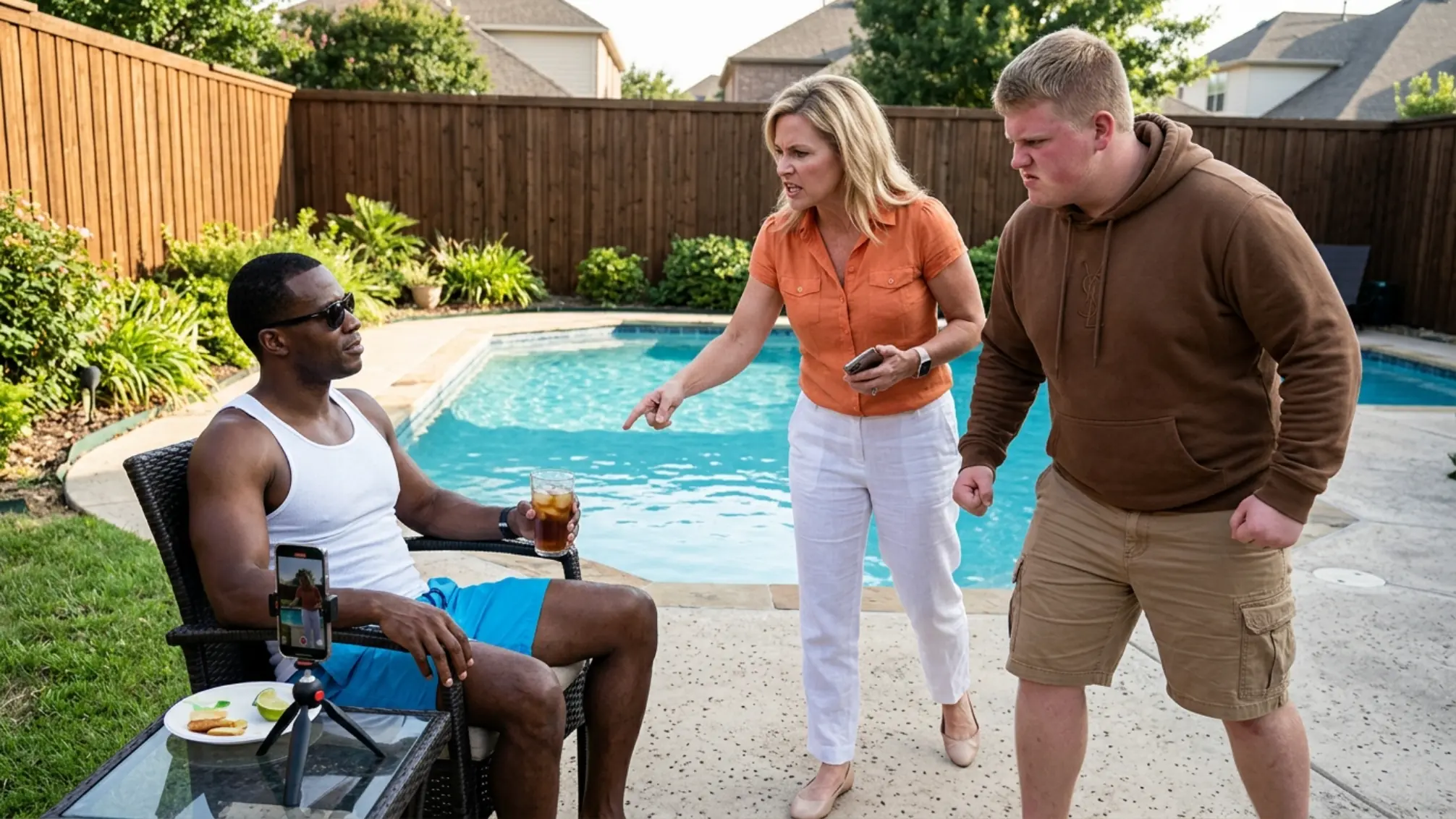
She was wrong.
Patricia crossed the stone patio in an orange blouse, white pants, and nude flats that were completely unsuited for grass wet from the sprinkler system. Her forty-seven-year-old face was flushed with fury, and her shoulder-length blonde hair moved wildly around her cheeks as she raised one hand toward Marcus. In the other, she gripped her phone so tightly that her knuckles had turned white.
Her seventeen-year-old son, Dylan, followed closely behind. He wore a brown designer hoodie covered with a recognizable luxury pattern, tan shorts, and expensive sneakers he had already stained by cutting through the flower bed beside Marcus’s gate. He was large for his age, with a heavy build, short blond hair, and the confident aggression of someone who had rarely faced consequences.
Patricia stopped several feet from Marcus.
“Delete that video before I destroy you here!”
Marcus lifted his drink but did not rise. “The HOA board is already watching.”
Dylan leaned over the glass table with his fists clenched. “I’ll smash the phone myself.”
Marcus turned his head toward him. “Touch it—your mother’s removal vote starts now.”
For a brief moment, neither Patricia nor Dylan understood what he meant. The swimming pool filter hummed behind them, water moved gently against the tiled edge, and a lawn mower operated somewhere beyond the tall privacy hedge. Marcus’s expression remained completely calm.
Patricia recovered first. “What removal vote?”
Marcus gestured toward the phone. “The one scheduled for four o’clock.”
She looked at the screen but could not read the small names appearing beside the video. “You’re lying.”
“Would you like me to introduce everyone?”
Marcus reached toward the tripod without touching it. “Board members, you can see Patricia Caldwell and her son standing beside my pool after entering through a locked private gate. The time is 3:58 p.m.”
A woman’s voice came through the phone’s speaker. “We can see them clearly, Marcus.”
Patricia froze.
The voice belonged to Vice President Elaine Foster, Patricia’s closest ally on the HOA board—or at least the woman Patricia believed remained loyal to her. Another voice followed, this one belonging to the association’s attorney, Nathan Price.
“Mrs. Caldwell,” he said, “do not touch the recording device, the homeowner, or any property inside the yard.”
Patricia’s anger changed into disbelief. She stepped closer to the phone as though proximity might allow her to control the people speaking through it.
“Nathan, this homeowner has been harassing me for weeks.”
Marcus took a slow drink.
The attorney replied, “The board is reviewing allegations against you, Mrs. Caldwell. You were instructed in writing not to contact Mr. Reed directly before today’s hearing.”
“I came here because he recorded me without permission.”
“You were standing outside his gate on a public sidewalk.”
“He edited the footage.”
“The board has the original file.”
Patricia turned toward Marcus. “You gave them that?”
“You gave it to them yourself,” he said. “You were speaking in front of the neighborhood security camera.”
The conflict had begun four months earlier, shortly after Marcus purchased the largest home on Willow Creek Drive. The property sat at the end of a quiet cul-de-sac and included a private pool, a detached studio, and an eight-foot wooden fence surrounding the backyard. Marcus had bought the house after selling a cybersecurity company he founded with two college friends.
He did not discuss his wealth with neighbors. He worked from home, drove a seven-year-old SUV, and spent most evenings cooking outside or swimming after sunset. To Patricia, his privacy looked suspicious.
She had served as HOA president for six years and controlled the neighborhood through a combination of selective enforcement and public embarrassment. Residents who supported her received warnings before violations were filed. Residents who questioned her found notices attached to their doors for trash cans, lawn height, guest parking, holiday decorations, or paint colors that differed slightly from approved samples.
Patricia called it maintaining standards.
The neighborhood called it surviving Patricia.
Her first notice to Marcus arrived six days after he moved in. It claimed his pool equipment produced excessive noise after nine in the evening. Marcus checked the timer and discovered the system shut off automatically at eight.
The second notice accused him of operating an unauthorized business from the property because delivery vehicles appeared several times during the week. The deliveries contained furniture and computer equipment for his home office.
The third violation concerned his bright blue pool cover, which could not be seen from the street or any neighboring property. Patricia claimed the color failed to match the community’s approved exterior palette.
Marcus responded to each notice calmly. He requested the specific covenant allegedly violated, attached photographs and equipment records, and asked the board to confirm whether Patricia had personally entered his property to inspect the backyard.
The fines disappeared without explanation.
Patricia did not.
She began driving slowly past Marcus’s house several times a day. She photographed visitors’ license plates and questioned contractors at the curb. When Marcus hosted a small birthday barbecue for his younger sister, Patricia appeared outside the gate and demanded a guest list.
“You don’t have authority to ask for that,” Marcus told her.
“I’m responsible for neighborhood security.”
“You’re responsible for common-area landscaping and covenant enforcement.”
Patricia smiled tightly. “People who cooperate usually find living here much easier.”
Marcus closed the gate.
Three weeks later, he found muddy footprints near the pool equipment. His backyard security camera showed Patricia opening the side gate with a maintenance key provided by the landscaping company. She walked around the pool, photographed the patio, opened a storage cabinet, and looked through the window of his detached studio.
Marcus contacted the police but chose not to pursue charges after Patricia claimed she believed the gate led to a shared utility area. He sent a written cease-and-desist notice to the HOA and requested that every master key be collected.
Patricia treated his restraint as weakness.
At the next community meeting, she announced that a resident had become hostile toward volunteers attempting to preserve safety standards. She never named Marcus directly, but her description made the target obvious. Several neighbors looked toward him while Patricia suggested that certain new homeowners purchased expensive properties without understanding how respectable communities operated.
Marcus recorded the meeting.
Afterward, seventy-two-year-old Mrs. Alvarez approached him in the parking lot. She had lived in Willow Creek for eighteen years and knew the history behind Patricia’s leadership.
“She doesn’t stop when people stay quiet,” Mrs. Alvarez warned.
Marcus asked how many residents had similar experiences.
Mrs. Alvarez laughed without humor. “How much time do you have?”
Over the following month, neighbors quietly shared documentation. Patricia had fined a single mother for leaving children’s bicycles near the garage while ignoring identical bicycles outside a board member’s home. She pressured an elderly couple to replace a roof that still had ten years of useful life, then recommended a company owned by her brother.
A young Indian family received repeated noise complaints whenever their relatives visited, even though security footage showed the gatherings ended before nine. Patricia told them the neighborhood was “not designed for large family compounds.”
The pattern was broader than personal conflict. Marcus organized the records by date, covenant, resident, and board decision. His former company specialized in identifying hidden patterns inside enormous sets of digital information. Patricia Caldwell had created a much simpler trail.
Marcus found that residents who opposed her faced nearly four times as many violation notices as those who supported her. More than sixty percent of disputed fines were later withdrawn, suggesting that the notices were issued without sufficient evidence. Payments to Patricia’s brother’s roofing company had increased every year she held office.
He sent the findings to the full HOA board.
At first, no one responded.
Then Elaine Foster called him privately.
“I always believed Patricia was strict,” Elaine said. “I didn’t know she was using board access to target people.”
“You approved many of the fines.”
“She presented photographs and written reports.”
“Did you verify them?”
“No.”
Marcus did not soften the question. “Why not?”
Elaine remained silent.
Patricia’s authority depended not only on her aggression but on board members who found it easier to approve her decisions than examine them. Marcus understood that exposing one woman without addressing that silence would change nothing.
He asked the board to hire independent counsel and audit the previous five years of enforcement actions. Nathan Price, an attorney specializing in community associations, reviewed the evidence and recommended an emergency removal hearing.
The bylaws allowed the board to remove an officer by majority vote for misconduct, unauthorized entry, financial conflicts, or actions exposing the association to legal liability. The hearing was scheduled for Saturday at four and conducted online so elderly residents and homeowners traveling outside the state could attend.
Patricia received formal notice.
She responded by visiting Marcus’s gate that morning.
Her first confrontation was captured by both his doorbell camera and the neighborhood security system. She accused him of creating false evidence, threatened to place a lien against his house, and warned that no one challenged her without regretting it.
Marcus said only one sentence.
“You should save your explanation for the board.”
Patricia noticed his phone recording and demanded that he erase the video. When he refused, she left while shouting that she would return with someone capable of making him cooperate.
That person was apparently Dylan.
At 3:56, Marcus’s side gate alarm sent a notification to his phone. He activated the livestream for the board members already waiting in the online hearing room. Two minutes later, Patricia and her son walked into view.
Now they stood beside his pool while the entire board watched.
Patricia pointed toward the phone. “Turn this off immediately.”
Nathan replied through the speaker. “The emergency hearing has begun.”
“I am not participating under these conditions.”
“You are present, and the board can hear you.”
“I demand legal representation.”
“You received notice ten days ago advising you of that right.”
Dylan looked between his mother and the phone. “Mom, let’s go.”
Patricia ignored him. “Marcus trapped us.”
Marcus remained seated. “My gate was locked.”
“You knew we were coming.”
“You announced it this morning.”
“That does not give you permission to record private conversations.”
“You are in my backyard during a board hearing about your unauthorized entries.”
Patricia’s face became redder. She had built her authority through public confidence, always speaking as though any disagreement had already been settled in her favor. The livestream deprived her of the ability to reinterpret events later. Board members were watching her decisions unfold in real time.
Elaine spoke next. “Patricia, did you enter using a key?”
“The gate was open.”
Marcus raised his remote and pressed one button. The electronic lock clicked loudly behind them.
“The system log shows the gate was forced at 3:56,” he said.
Dylan glanced toward the entrance. “I only pushed it.”
Patricia turned on him. “Don’t say anything.”
Nathan’s voice remained professional. “Dylan, did you damage the lock?”
“No. I mean, it opened.”
“After you pushed it?”
Patricia stepped in front of her son. “He is a minor. You will not question him.”
Marcus looked toward the phone. “The camera above the gate recorded the entry.”
Patricia’s confidence weakened further.
The attorney began presenting the allegations. He described unauthorized access to Marcus’s property, selective enforcement, intimidation of residents, misuse of confidential homeowner information, and financial conflicts involving companies connected to Patricia’s family.
Each allegation had supporting documents displayed inside the online meeting. Marcus watched Patricia recognize files she believed no one else possessed—private messages, contractor invoices, altered photographs, and fine schedules showing clear differences between favored and targeted residents.
“You accessed private board communications,” she accused him.
Elaine answered. “I provided the communications to counsel.”
Patricia stared toward the phone. “You betrayed me.”
“I corrected my own failure,” Elaine said. “I approved decisions without verifying what you told us.”
The president laughed sharply. “You all needed me. This neighborhood was falling apart before I took over.”
Mrs. Alvarez’s voice entered the call. “The neighborhood was peaceful before you took over.”
Patricia turned toward Marcus. “You filled their heads with lies.”
“I organized their records.”
“You manipulated statistics.”
“The original notices are included.”
She stepped closer to his chair. “You think because you have money and cameras, you can humiliate me?”
Marcus removed his sunglasses and placed them on the table. His dark eyes remained steady.
“You entered my property to force me to destroy evidence.”
“I came to defend myself.”
“You brought your son to threaten me.”
“I never told him to threaten anyone.”
Dylan clenched his fists again. “He’s sitting there acting like he owns everybody.”
Marcus looked around the yard. “I own this property.”
“Don’t get smart with me.”
“Dylan,” Patricia warned.
But her son had absorbed years of watching her win through intimidation. He believed aggression was the family language of authority. The camera on the tripod had become the object he blamed for their loss of control.
He stepped toward the table.
Nathan’s voice came sharply through the speaker. “Do not touch the device.”
Dylan reached anyway.
Marcus stood.
The movement was not violent, but it changed the balance of the scene instantly. At six feet two with a muscular build, Marcus towered over the teenager when standing. He placed one hand beside the tripod without grabbing Dylan.
“You threatened to destroy my property,” Marcus said. “Step back.”
Dylan’s face tightened. “Or what?”
“Or the officers already outside come through the gate.”
Patricia turned toward the fence.
A police radio sounded beyond the hedge.
Marcus had called the non-emergency line when the gate alarm activated. He requested officers remain outside unless the trespassers became destructive or refused to leave. The entire interaction had been designed to protect evidence, not provoke a fight.
Dylan finally moved backward.
Patricia stared at Marcus. “You called the police on my child?”
“I called them after two people forced entry onto my property.”
“He is seventeen.”
“Then he is old enough to understand a locked gate.”
A knock sounded from the front side entrance. Marcus gave permission for officers to enter. Two uniformed patrol officers walked onto the patio with their body cameras active.
The female officer addressed everyone calmly. “We received a report of possible trespassing and property threats.”
Patricia lifted her phone. “I’m the president of the HOA.”
“That does not authorize entry into a private backyard.”
“This man is harassing my family.”
The officer looked toward the phone broadcasting the hearing. “Is the interaction recorded?”
“From multiple angles,” Marcus said.
Patricia’s shoulders lowered slightly.
Nathan asked the officers to allow the board hearing to conclude before taking statements, provided Marcus felt safe. He agreed. The officers positioned themselves near the gate, visible but not interfering.
The attorney asked Patricia whether she wished to respond to the financial allegations. She claimed every contractor had been selected for quality and denied receiving personal benefits. Nathan displayed a bank transfer from her brother labeled HOA referral share.
Patricia stared at the screen.
“That was a family loan repayment.”
“Then why does it match five percent of the roofing contract?”
No answer came.
Board treasurer William Hart described payments Patricia approved without competitive bids. Three companies used the same mailing address as her brother’s business. The association had paid nearly eighty thousand dollars more than independent estimates suggested the work should have cost.
Patricia accused William of incompetence for signing the checks.
“I trusted the president’s certifications,” he admitted.
“That is your fault.”
“It was,” William said. “That is why I am voting to remove you.”
The words struck Patricia harder than the arrival of police.
The board had seven voting members. Patricia could not vote on her own removal, leaving six eligible members. Four votes were required.
Nathan called each name.
Elaine Foster voted yes.
William Hart voted yes.
Secretary Melissa Green voted yes.
Patricia looked toward the phone as though she could identify which board member might still rescue her. She had spent years collecting favors and private information, convincing everyone that opposition would cost more than cooperation.
The fourth member, Robert Ellis, had remained silent throughout the hearing. Patricia had supported his application to build an oversized workshop and repeatedly reminded him of that favor.
“Robert,” she said, “remember who stood with you when the neighborhood attacked your family.”
Robert’s voice came slowly through the speaker. “You approved my workshop because I promised to support you.”
“That is not true.”
“I saved the messages.”
A screenshot appeared on the board’s shared display.
Patricia’s own words filled the screen:
I can make the variance happen. I only need to know you’ll stay loyal when certain residents start causing trouble.
Robert exhaled.
“I vote yes.”
The removal became official at 4:27 p.m.
Patricia Caldwell was no longer president of the Willow Creek Homeowners Association.
Nathan informed her that she was also suspended from all board access pending the financial audit. Elaine would serve as acting president until a community election could be held. Every disputed fine issued under Patricia’s leadership would be independently reviewed.
Patricia looked around Marcus’s backyard. The pool water remained calm, the sun still shone across the patio, and the man she came to frighten had never raised his voice. Her power had not ended with a dramatic physical confrontation.
It ended through records, witnesses, and a vote she could not threaten into changing.
“This isn’t finished,” she said.
Marcus put his sunglasses back on. “For today, it is.”
The officers escorted Patricia and Dylan toward the gate. Before leaving, Dylan looked back at the tripod.
“You ruined my mother.”
Marcus shook his head. “Your mother brought you into a private yard and encouraged you to treat threats like loyalty.”
“She did everything for this neighborhood.”
“She did everything to control it.”
Dylan opened his mouth, but the officer guided him through the gate before he could respond.
Marcus chose not to pursue criminal charges against the teenager after Dylan agreed to pay for the damaged lock and complete a community accountability program. Patricia received a formal trespass warning and faced separate civil claims connected to the HOA’s financial losses.
The independent audit lasted three months.
It found that Patricia had directed more than two hundred thousand dollars in association work toward companies connected to relatives and friends. Some work had been completed properly but at inflated prices. Other invoices described repairs no one could prove had occurred.
The board referred the findings to county investigators.
Nearly one hundred seventy violation notices were reviewed. Ninety-two were withdrawn, and homeowners received refunds for unsupported fines. Families who had been pressured into unnecessary repairs were allowed to submit claims against the association’s insurance policy.
Mrs. Alvarez received back the money she paid after Patricia claimed her front steps violated an accessibility rule. The supposed violation had never existed. Patricia wanted the steps replaced because she disliked their color.
The Indian family received a written apology for selective noise enforcement. The single mother had every bicycle fine removed. Several residents who had considered selling their homes decided to stay.
Marcus refused invitations to become HOA president.
“I didn’t expose one person to replace her,” he told Elaine. “You need a system that does not depend on anyone being unusually good.”
He helped the board create transparent enforcement procedures. No violation could be issued without dated evidence and review by two unrelated board members. Homeowners gained access to meeting records, contractor bids, and appeal decisions through a secure online portal.
Board members had to disclose family or financial connections to vendors. Private-property access required written homeowner permission except during genuine emergencies. Livestreamed meetings became standard so residents could watch decisions without leaving their homes.
Elaine won the community election six weeks later. Her first act as elected president was to apologize publicly for remaining silent during Patricia’s leadership.
“I told myself I was preventing conflict,” she said. “In reality, I allowed the conflict to fall entirely on the people she targeted.”
The neighborhood did not forgive instantly, but residents respected the admission because it came before anyone forced her to make it.
Patricia sold her home the following spring. She blamed Marcus, the board, ungrateful neighbors, and online harassment. She never publicly accepted responsibility for entering his yard or misusing association authority.
Dylan’s attitude changed more slowly.
As part of the accountability program, he spent Saturday mornings assisting at a community legal clinic that helped tenants and homeowners challenge improper fines. At first, he sat with crossed arms and answered every instruction with resentment.
Then he met an elderly veteran facing the loss of his house because a neighborhood association had added thousands of dollars in penalties to a minor landscaping dispute. Dylan watched the man’s hands shake while explaining that he did not understand the letters sent to him.
For the first time, the teenager saw HOA authority from the other side.
Months later, he mailed Marcus a short handwritten note.
I should not have threatened you or touched your property. I thought protecting my mom meant doing whatever she wanted. I understand now that I was helping her hurt people.
Marcus did not become Dylan’s mentor or pretend one apology erased the confrontation. He sent back a single response.
Protecting someone also means stopping them before they destroy themselves. Keep learning.
One year after the livestream, Marcus sat beside the same pool wearing blue swim trunks and holding a cold drink. The side gate had been repaired, the tripod remained on the table, and neighbors gathered in the yard for a summer barbecue.
Mrs. Alvarez brought homemade food. The Indian family’s children played near the shallow end. Elaine discussed new landscaping bids with residents openly instead of behind closed doors.
Nothing about the gathering felt like a victory ceremony. It felt like an ordinary neighborhood finally learning how ordinary life should work.
The livestream that removed Patricia Caldwell became famous inside Willow Creek, but Marcus rarely discussed it. People remembered the dramatic line about the removal vote beginning in sixty seconds. He remembered something quieter.
Patricia had not lost power because Marcus was stronger, wealthier, or more intimidating than she expected. She lost it because the neighbors she divided finally compared their experiences and realized none of them had been alone.
Her son’s threat revealed the family’s belief that authority belonged to whoever frightened everyone else first.
The board’s vote established a different rule.
Real community power belonged to the people willing to document the truth, correct their silence, and refuse to let one loud voice speak for everyone.