The hiss of spray paint stopped the moment Marcus Hale stepped off his porch.
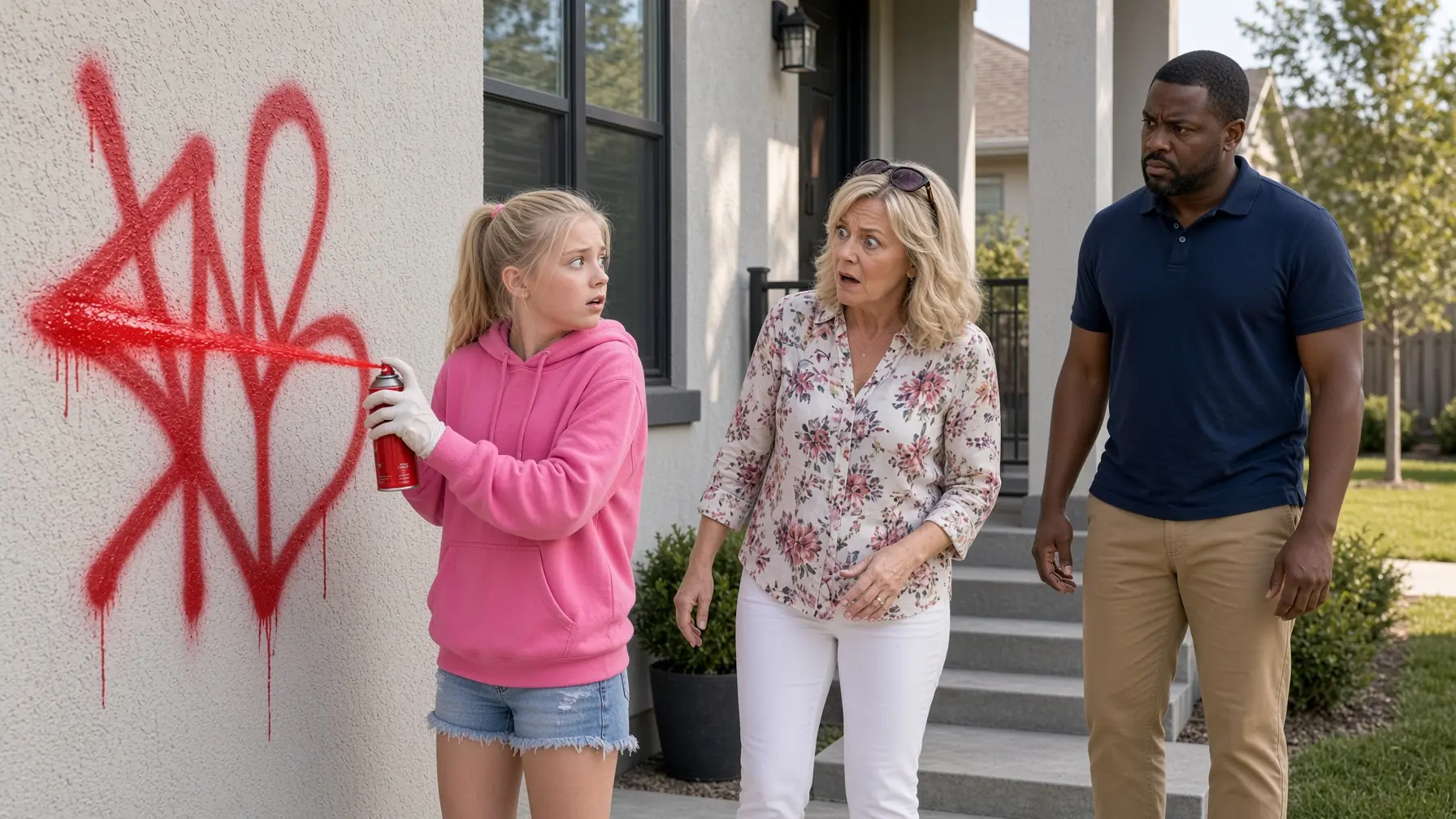
Lily Whitaker froze.
The thirteen-year-old still had the red can raised in one gloved hand.
A wet streak of paint ran diagonally across the pale stone wall beside Marcus’s garage.
Three larger marks were already there.
Bright.
Fresh.
Still dripping.
Marcus stopped on the walkway.
His jaw tightened.
“Put the can down.”
Lily’s blue eyes widened.
A few feet behind her, Brenda Whitaker did not look frightened at all.
The forty-five-year-old HOA president stood at the edge of Marcus’s lawn wearing a bright floral blouse, fitted white pants, wedge sandals, and oversized sunglasses pushed on top of carefully styled blonde hair.
Designer handbag on one shoulder.
Arms folded.
Amused little smile.
As if she had brought her daughter over to draw with sidewalk chalk.
“Oh, relax.”
Brenda laughed.
“She’s just a kid.”
Marcus looked at the wall.
Red paint slid toward the foundation.
Then at Lily.
Then Brenda.
“On my house.”
Brenda rolled her eyes.
“She was having fun.”
“Stop making this into something.”
Marcus took one slow step forward.
Lily lowered the spray can.
“Mom…”
Brenda’s expression shifted slightly.
“Lily, it’s fine.”
The girl looked from Marcus to her mother.
Then said:
“You said he wouldn’t be home until six.”
Brenda’s smile vanished.
Marcus stopped.
The afternoon went very quiet.
Brenda snapped her head toward Lily.
“What?”
Lily’s grip tightened around the can.
“You said he wouldn’t be home until six.”
“Lily.”
Marcus’s eyes moved slowly back to Brenda.
His voice changed.
Not louder.
Colder.
“How did you know I wouldn’t be home?”
Brenda’s mouth opened.
Nothing came out.
For the first time since Marcus had met her, the president of Cedar Ridge Estates had no answer ready.
Marcus had lived at 417 Willow Crest for eight months.
Long enough to understand that Brenda Whitaker did not consider the HOA a volunteer organization.
She considered it a government.
And herself the government.
The first letter arrived six days after Marcus moved in.
TRASH BIN VISIBILITY VIOLATION
His bins had remained beside the garage for forty-three minutes after pickup.
The second notice came because his lawn was allegedly one inch too high.
The third concerned a small basketball hoop his nephew had used during a weekend visit.
Marcus checked the covenants each time.
Trash bins had until 8 p.m. to be stored.
His lawn height complied.
Portable sports equipment was permitted during daytime hours.
Each time he responded politely.
Each time the violation quietly disappeared.
That should have ended things.
Instead, Brenda seemed to take his insistence on reading the rules personally.
At the next HOA meeting she smiled across the table and said:
“Some new residents struggle with community expectations.”
Marcus had looked directly at her.
“Then written rules should make those expectations pretty easy to understand.”
Three people had looked down at their papers.
Brenda’s smile became thinner.
After that, Marcus noticed the pattern.
His car photographed from the street.
A message about “unapproved exterior lighting” after he replaced one porch bulb.
A warning about guests when his sister stayed for two nights.
A landscaping complaint after he replaced dying shrubs with a species already approved two houses away.
Nothing major.
Nothing dramatic.
Just constant.
Small.
Exhausting.
Always framed as procedure.
Marcus never shouted.
Never threatened.
He documented.
Dates.
Emails.
Letters.
Photographs.
He kept everything in a folder on his laptop labeled:
CEDAR RIDGE HOA
He hoped eventually he would never need it.
Then Brenda brought spray paint to his house.
Marcus looked at Lily.
“Did your mother give you that can?”
Lily glanced at Brenda.
Brenda stepped forward immediately.
“Do not interrogate my daughter.”
Marcus did not move.
“I asked one question.”
“She doesn't have to answer you.”
“Then you can.”
He pointed toward the wall.
“Why is your child spray-painting my house?”
Brenda gave a theatrical sigh.
“It was washable.”
Marcus looked at the label on the can.
Exterior enamel.
Permanent.
He looked back at her.
“No, it isn't.”
Brenda’s mouth tightened.
“You always have to be difficult.”
Marcus stared at her.
“You are standing in my yard while your daughter vandalizes my wall.”
“Vandalizes?”
Brenda laughed sharply.
“Oh my God.”
“Listen to yourself.”
“She made a few marks.”
Marcus took out his phone.
Brenda’s face changed immediately.
“What are you doing?”
“Photographing my property.”
“You're not photographing my child.”
Marcus angled the phone only toward the wall and spray can.
“I don't need to.”
Brenda reached toward his hand.
Marcus stepped back.
“Do not touch me.”
She stopped.
Lily looked increasingly uncomfortable.
“Mom, can we just go?”
Brenda ignored her.
Marcus photographed the wall.
The can.
Disposable gloves.
Paint droplets on the grass.
Then the soles of Lily’s white sneakers, where red overspray had collected.
Brenda stared.
“This is unbelievable.”
Marcus lowered the phone.
“What is?”
“You.”
“You've been looking for an excuse to come after me since you moved in.”
Marcus almost laughed.
“You came to my house.”
Brenda stepped closer.
“I am HOA president.”
“And?”
“I have authority to inspect exterior conditions.”
“From the street.”
Her face changed.
Marcus continued.
“Section 8.4.”
“Board representatives may visually inspect visible exterior conditions from common areas or public rights-of-way.”
“You do not have the right to enter my property without notice except for an emergency.”
Brenda’s cheeks reddened.
Lily looked at her mother.
“You said the HOA owned the front yards.”
Marcus looked at Lily.
Then Brenda.
Brenda snapped:
“Lily, stop talking.”
Marcus went still.
“What did you tell her?”
Brenda folded her arms.
“I don't have to explain myself to you.”
“No.”
Marcus nodded toward the dripping wall.
“But eventually you may have to explain this to someone else.”
That finally made Brenda hesitate.
The first independent witness arrived thirty seconds later.
Marcus’s next-door neighbor, seventy-one-year-old Helen Parker, opened her front door.
“Marcus?”
She walked toward the property line.
Then saw the wall.
“Oh my Lord.”
Brenda immediately said:
“It’s being handled.”
Helen looked at her.
“By who?”
Brenda frowned.
“The HOA.”
Helen stared at the spray paint.
“Did the HOA paint his house?”
Lily looked down.
Marcus almost smiled.
Brenda did not.
“This is a private matter.”
Helen pointed toward the wall.
“It’s on the outside.”
Then she looked at Marcus.
“I saw them come over.”
Marcus’s expression sharpened.
“When?”
“Maybe ten minutes ago.”
“Did you see what happened?”
“I saw Brenda give Lily something from the trunk.”
Brenda spun around.
“You need to mind your own business.”
Helen’s eyes widened.
“My kitchen window faces his driveway.”
Brenda stepped toward her.
Marcus moved slightly between them.
“Brenda.”
She stopped.
Marcus asked Helen:
“Do you have a doorbell camera?”
Helen nodded.
“Yes.”
“Please don’t delete anything from today.”
Brenda’s face tightened.
“Why are you turning this into some criminal investigation?”
Marcus looked at the paint.
“You brought gloves.”
Brenda stared.
He continued.
“Your daughter is thirteen.”
“She arrived with disposable gloves already on.”
“You brought exterior spray paint.”
“You waited until you thought I was gone.”
“And apparently you knew exactly when you believed I would return.”
Marcus let the sequence hang.
“That doesn't look spontaneous.”
Brenda’s voice became sharp.
“You are accusing me of something you cannot prove.”
Lily whispered:
“Mom…”
“Not now.”
Marcus noticed the girl’s expression.
Fear.
Not fear of him.
Fear of Brenda.
That changed how he handled the next moment.
He looked at Lily.
“You’re not in trouble with me.”
Brenda scoffed.
“How generous.”
Marcus ignored her.
“Put the spray can on the ground.”
Lily did.
Immediately.
Brenda stared at her daughter as though she had betrayed her.
Marcus then stepped backward.
“I’m not touching it.”
He took another photograph.
Brenda laughed bitterly.
“You really think police are going to come because of paint?”
Marcus looked at her.
“I haven't called anyone.”
Brenda paused.
That answer unsettled her.
Because Marcus was not reacting emotionally.
He was preserving the scene.
Then Lily said something else.
Very quietly.
“Mom said it was payback.”
Brenda went white.
Marcus looked at Lily.
Brenda snapped:
“That is enough!”
Lily flinched.
Helen heard it too.
Marcus’s voice stayed calm.
“Payback for what?”
Brenda grabbed Lily by the wrist.
“We’re leaving.”
Lily pulled slightly.
“Ow.”
Marcus immediately said:
“Let go of her arm.”
Brenda released her.
Then pointed at Marcus.
“You stay away from my daughter.”
Marcus did not move.
“You brought her here.”
Brenda grabbed her handbag.
“You’ll hear from the board.”
Marcus looked at the wall.
“I’m sure I will.”
Brenda marched toward the sidewalk.
Lily followed two steps behind.
At the edge of the lawn, Lily turned around.
For one second her eyes met Marcus’s.
She looked ashamed.
Marcus did not glare.
Did not shake his head.
He simply said:
“Go home.”
She did.
Marcus did not wash the paint off.
That was his first instinct.
Instead he called a restoration company and asked for an estimate.
Then a nonemergency police line.
Officer Daniel Ruiz arrived forty minutes later.
No sirens.
No dramatic confrontation.
Marcus preferred that.
Ruiz photographed the wall.
Asked about the can.
Interviewed Marcus.
Then Helen separately.
He did not interview Lily immediately because she was a minor and not present.
Marcus handed him nothing beyond what was asked.
No speech about Brenda’s history.
No demand for arrest.
Ruiz looked at the wall.
“Any idea why they did this?”
Marcus hesitated.
Then:
“I have an HOA dispute with Brenda.”
“What kind?”
“Mostly enforcement disagreements.”
“Recent?”
“Yes.”
“Threats?”
“Nothing explicit.”
Marcus opened his phone.
“Emails if you want them.”
Ruiz nodded.
“Send copies.”
Then:
“You said the daughter said her mother knew you'd be gone?”
“Yes.”
“Exact wording?”
Marcus repeated it.
Ruiz wrote:
Mom... you said he wouldn’t be home until six.
Then:
“How was your schedule today?”
Marcus frowned.
“What do you mean?”
“Were you normally supposed to be gone until six?”
Marcus thought.
“Yes.”
“Work?”
“Usually.”
“Why were you home?”
“Client meeting canceled.”
“Did Brenda know your work schedule?”
“Not from me.”
Ruiz looked toward Brenda’s house three doors down.
“That part is worth figuring out.”
Marcus agreed.
Helen’s doorbell footage answered the easy question.
At 2:17 p.m., Brenda’s white SUV stopped beside Marcus’s curb.
Brenda and Lily got out.
Brenda opened the rear cargo area.
Removed a shopping bag.
Handed something to Lily.
They walked directly onto Marcus’s property.
No knock.
No attempt to see if anyone was home.
Lily put on gloves.
Brenda stood near the walkway.
Then Lily began painting.
The camera did not capture perfect audio.
But one sentence came through clearly.
Brenda’s voice.
“Do the side wall too. He’ll see it the second he pulls in.”
Officer Ruiz replayed it.
Once.
Then again.
Marcus said nothing.
Helen covered her mouth.
That removed any believable version where Lily had acted alone.
But it still did not explain the schedule.
Why six?
The answer came from the HOA itself.
Two days later, Marcus received an email from board treasurer Samuel Price.
Subject:
Please Call Me
Marcus did.
Samuel sounded nervous.
“Marcus, I need to ask you something.”
“Okay.”
“Did police contact the association?”
“Yes.”
Silence.
Then:
“I think I know how Brenda knew you weren’t supposed to be home.”
Marcus sat up.
“How?”
Samuel exhaled.
“The security committee has a spreadsheet.”
Marcus did not speak.
Samuel continued.
“It started for vacation watches.”
Residents could voluntarily tell the HOA if they’d be away for several days.”
“That makes sense.”
“Yes.”
“But Brenda expanded it.”
Marcus’s expression hardened.
“Expanded how?”
“She started adding what she called routine occupancy notes.”
Marcus went still.
“What is a routine occupancy note?”
“Work schedules.”
“School pickup times.”
“When homes usually looked empty.”
Marcus thought he had misheard.
“Based on what?”
“Neighborhood cameras.”
“Guard reports.”
“Things she observed.”
“She said it helped identify unusual activity.”
Marcus stood.
“Am I on that sheet?”
Another pause.
“Yes.”
“What does mine say?”
Samuel did not answer immediately.
“Marcus?”
Samuel finally said:
Hale — normally departs approx. 7:30 a.m. weekdays, returns 5:45–6:15 p.m.
Marcus felt cold.
Not angry.
Cold.
“Who can access that?”
“Board officers.”
“Security committee.”
“Brenda.”
“Did I authorize you to track that?”
“No.”
“Did any resident?”
“Not for routine schedules.”
Marcus looked out the window.
Toward Brenda’s house.
“That spreadsheet still exists?”
“Yes.”
“Do not alter it.”
Samuel understood immediately.
“Okay.”
“Don't delete anything.”
“I won't.”
“Don't warn Brenda.”
Samuel hesitated.
“She’s the president.”
Marcus’s voice stayed level.
“I know.”
That evening, the situation stopped being a paint dispute.
Marcus forwarded Samuel’s information to Officer Ruiz.
Ruiz contacted the HOA’s attorney.
The attorney requested preservation of records before anyone else could touch them.
Board emails.
Security logs.
Committee spreadsheets.
Cloud storage history.
Access records.
The spreadsheet existed.
So did older versions.
Marcus was not the only person on it.
Dozens of residents were listed.
Work schedules.
Regular gym times.
School drop-offs.
Church mornings.
Which homes had dogs.
Who traveled often.
Whose elderly parents lived alone.
Which teenagers came home before parents.
Some information came from voluntary vacation forms.
Much did not.
One note beside a divorced woman’s address said:
Usually alone Tues/Thurs evenings.
Another:
Husband travels every third week.
Another:
Teen home alone approx. 3:15–5:30 weekdays.
When Samuel saw the full spreadsheet printed on paper, his face changed.
“This looks terrible.”
The HOA attorney answered:
“It is terrible.”
Brenda defended it immediately.
“Neighborhood safety requires patterns.”
The attorney asked:
“Patterns of criminal activity?”
“Occupancy.”
“Why?”
“So we know if someone is somewhere they shouldn't be.”
The attorney stared.
“Such as?”
Brenda folded her arms.
“If Marcus Hale’s car is normally gone until six and someone is walking around his house at three, that’s suspicious.”
Samuel said:
“Unless the someone is Marcus.”
Brenda glared at him.
Then investigators checked the edit history.
Brenda had opened the spreadsheet at 1:48 p.m. on the day of the vandalism.
Twenty-nine minutes before Helen’s camera showed her SUV arriving outside Marcus’s house.
She viewed Marcus’s entry.
Then closed the file.
At 1:59, she texted Lily.
The message was later recovered voluntarily from the family’s device records during the juvenile investigation.
Put on old shoes. We’re going to teach Mr. Perfect a lesson.
Lily responded:
Why?
Brenda:
Because some people need to learn what happens when they make enemies with the HOA.
That was worse than the paint.
Marcus read the message only once when his attorney showed it to him.
Then put the paper down.
“Don’t show me the rest unless I need it.”
“Why?”
“Because she’s thirteen.”
His attorney nodded.
Marcus continued:
“I don't need every embarrassing thing that kid said to her mother.”
“What matters is what Brenda told her to do.”
The motive was not difficult to find.
Three weeks earlier, Marcus had challenged a proposed HOA fine.
Brenda wanted to charge him $650 for “unauthorized exterior modifications.”
The modification:
A new mailbox light.
Marcus had submitted the exact fixture months earlier.
It was listed as pre-approved in the association’s own architectural catalog.
At the hearing, Marcus brought printed copies.
Page numbers.
Approval table.
Email confirmation.
Brenda still insisted the fine should stand.
Marcus asked:
“Can you show me the violated provision?”
She could not.
The board voted 4–1 to cancel the fine.
Brenda was the only opposing vote.
Afterward she followed Marcus into the parking lot.
“You enjoy embarrassing people.”
Marcus had turned.
“No.”
“You could have handled that privately.”
“I tried.”
“You made me look incompetent.”
Marcus stared.
“The paperwork did that.”
Brenda’s face hardened.
“You should be careful how you speak to people who decide what happens in this neighborhood.”
Marcus replied:
“No board member decides what happens here alone.”
Then left.
Brenda remembered every word.
Apparently, she had also remembered his work schedule.
Lily’s interview changed the emotional center of the case.
She was interviewed with a guardian ad litem present because Brenda had become a potential subject of the same investigation.
The girl cried before the first ten minutes ended.
She admitted spraying the wall.
Admitted wearing gloves because Brenda told her paint would stain her hands.
Admitted Brenda bought the cans.
Admitted they practiced one letter on cardboard in the garage.
The investigator asked:
“Did you want to damage Mr. Hale’s home?”
Lily wiped her face.
“I thought it was a joke.”
“Why?”
“Mom said he deserved to be embarrassed.”
“Did she tell you it was legal?”
“Yes.”
“What exactly did she say?”
Lily swallowed.
“She said because she was HOA president, she could approve exterior changes.”
The investigator paused.
“She said painting someone else’s house counted as an exterior change?”
Lily nodded.
“She said Mr. Hale kept telling her to follow the rules, so she was going to show him what rules could do.”
That sentence eventually appeared in the report.
Marcus hated reading it.
Not because of Brenda.
Because it showed how completely Lily had trusted her mother.
Marcus declined every interview request.
The story leaked anyway.
Not the girl’s name at first.
Just:
HOA PRESIDENT INVESTIGATED AFTER HOME VANDALISM
Then:
PRIVATE RESIDENT-SCHEDULE DATABASE DISCOVERED
Local television stations called.
Marcus declined.
Neighbors began messaging him.
Some apologized.
Some asked whether they were on the spreadsheet.
Many were.
Cedar Ridge exploded.
One resident who traveled for work called the board furious.
A single mother demanded to know why her daughter’s after-school schedule appeared in an HOA file.
An elderly couple discovered Brenda had noted when their home-health nurse usually arrived.
The issue stopped being Marcus versus Brenda.
It became:
Why had a neighborhood organization been quietly recording when homes were likely empty?
An emergency HOA meeting was scheduled.
Every chair was filled.
People stood along the back wall.
Brenda arrived wearing a navy blazer and carrying a thick binder.
No sunglasses.
No floral blouse.
This time she dressed like she expected court.
Marcus sat three rows back.
Not beside his attorney.
Not at a special table.
Just another homeowner.
Brenda took the microphone first.
“I want everyone to understand that the so-called schedule database has been grotesquely misrepresented.”
Someone shouted:
“Why does it say when my kid is home alone?”
The room erupted.
HOA counsel banged the table.
“Please.”
Brenda continued.
“It was a security tool.”
A man in the second row stood.
“Security for who?”
“For all residents.”
“You wrote when my wife goes to church.”
“Observational data.”
“You tracked her.”
“I documented normal neighborhood patterns.”
A woman shouted:
“That is tracking!”
More voices.
Brenda raised hers.
“This is exactly why volunteers stop helping communities!”
Marcus remained seated.
Silent.
Brenda noticed him.
Her eyes locked on his.
Then she made the mistake of addressing him.
“This entire hysteria started because one homeowner decided a childish prank was worth destroying people’s reputations.”
The room quieted.
Marcus slowly stood.
Not angrily.
He did not approach the microphone until invited.
The board secretary handed it to him.
Marcus looked at Brenda.
“Your daughter is not the reason you’re sitting there.”
Brenda scoffed.
“She painted the wall.”
“Yes.”
Marcus nodded.
“She is thirteen.”
“She will deal with that appropriately.”
Then:
“You are forty-five.”
The room went completely still.
“You bought the paint.”
“You brought the gloves.”
“You checked a database to see when I would be gone.”
“You drove her to my house.”
“You stood there while she damaged it.”
“And when I came home, you told me to relax.”
Brenda’s face reddened.
Marcus continued:
“This is not a story about a bad kid.”
“It’s about an adult using a child to carry out an adult grudge.”
No one spoke.
Brenda opened her mouth.
Marcus held up one hand.
“And the spreadsheet?”
He looked around the room.
“That is bigger than my wall.”
Several residents nodded.
Marcus continued:
“I can repaint a wall.”
“What I cannot repaint is trust after a board records when families are likely to be home or away without their permission.”
Brenda shook her head.
“You are twisting everything.”
Marcus looked directly at her.
“Then explain one thing.”
She stared.
“How did you know I wouldn’t be home until six?”
No answer.
The same question from the front yard.
Only now the entire neighborhood was listening.
The board voted that night.
Brenda was removed as HOA president.
Not fined by Marcus.
Not expelled from the neighborhood.
Not publicly dragged out.
Removed from office by the board and residents under the association’s bylaws.
The security committee was dissolved pending review.
The occupancy spreadsheet was secured as evidence, then scheduled for deletion after legal preservation requirements ended.
A new policy prohibited collection of resident schedules unless voluntarily submitted for a specific temporary service such as vacation watch.
Every such entry required:
Written consent.
Purpose.
Start date.
End date.
Automatic deletion.
No more permanent “routine patterns.”
No more surveillance disguised as neighborliness.
The board also required that architectural and compliance actions be approved by more than one person.
No president could turn a personal dispute into unilateral enforcement.
The vandalism case ended quietly.
Lily entered a juvenile diversion program.
Community service.
Restitution jointly handled through her family.
A written apology.
No permanent criminal record if she completed the program.
Marcus supported that outcome.
Some neighbors were surprised.
One asked him:
“After what she did to your house?”
Marcus replied:
“She is thirteen.”
“Her mother brought her.”
“That matters.”
Brenda faced separate consequences related to directing the vandalism and misuse of HOA records.
Marcus did not control those decisions.
He gave evidence.
Then stepped away.
He wanted accountability.
Not ownership of punishment.
The apology arrived three months later.
Handwritten.
Lily.
Marcus almost left it unopened.
Then he sat at his kitchen table.
The first sentence read:
I’m sorry I painted your house.
The second mattered more.
I’m sorry I believed being mad at someone made it okay to damage their things.
Then:
You didn’t yell at me even when you caught me.
Marcus stopped reading for a moment.
Continued.
I thought you were going to hate me.
My counselor said adults are supposed to help kids tell the difference between a joke and hurting someone, and I think I understand that now.
At the end:
I hope the wall looks normal again.
Marcus folded the letter.
The wall did look normal.
The restoration company had matched the paint almost perfectly.
Only Marcus could still identify the repaired section when afternoon sunlight hit it at a particular angle.
He decided not to send a lecture back.
He wrote one sentence.
Thank you for taking responsibility. I hope you keep learning from it.
Then mailed it.
Brenda did not apologize.
Not to Marcus.
Not to the neighborhood.
She appealed her removal.
Lost.
She claimed the board had overreacted.
She claimed Marcus had turned residents against her.
She claimed Samuel had betrayed confidential operations.
She claimed the spreadsheet was misunderstood.
She claimed the spray painting was “juvenile expression.”
Everything had an explanation.
Nothing was her responsibility.
Eventually people stopped arguing with her.
That hurt her influence more than public confrontation ever had.
Cedar Ridge changed slowly.
Not magically.
New board.
New processes.
Complaints required photographs and a specific bylaw section.
Residents accused of violations received evidence.
Appeals were reviewed by members who had not initiated the complaint.
Informal “watch lists” were banned.
Neighborhood security shifted back to observable events.
Broken window.
Open garage at 2 a.m.
Unknown person trying door handles.
Actual things.
Not:
This person is usually at work right now.
Marcus noticed the difference when his sister visited one Saturday.
Her car remained parked overnight.
No email.
No photograph.
No anonymous question in the community group.
Nothing.
Exactly as it should have been.
One year after the incident, Marcus was repainting the trim around his garage when Helen Parker walked over.
“You missed a spot.”
Marcus looked.
“Where?”
She pointed at the repaired wall.
He laughed.
“That’s not trim.”
“I know.”
“You’re annoying.”
“I’m retired.”
“Same thing?”
“Basically.”
Helen looked at the wall.
“Hard to believe what happened.”
Marcus kept painting.
“Not really.”
Helen frowned.
“What do you mean?”
Marcus thought about Brenda.
The letters.
The inspections.
The spreadsheet.
The spray can.
“It didn't start with paint.”
“No.”
“It started when somebody became convinced that being in charge meant she didn't have to hear no.”
Helen nodded.
Then:
“You know what part I remember?”
“What?”
“That little girl saying her mother knew you'd be gone.”
Marcus stopped brushing.
“So do I.”
One sentence.
That was all.
A child’s accidental honesty had transformed an argument about vandalism into a question no one could ignore.
How did Brenda know?
And behind that question had been a spreadsheet.
Behind the spreadsheet, years of unchecked authority.
Behind that, an HOA board that found it easier to tolerate Brenda than challenge her.
The graffiti had been ugly.
But visible.
The quiet system behind it had been much worse.
Two years later, Lily returned to Marcus’s house.
Marcus was outside changing a porch light.
She was fifteen now.
Taller.
Hair shorter.
No bright pink hoodie.
No paint.
She stopped at the sidewalk.
“Mr. Hale?”
Marcus looked down from the ladder.
“Lily.”
“Can I talk to you?”
He climbed down.
“Sure.”
She looked toward the side wall.
Then:
“I wanted to see if you could still tell.”
“Tell what?”
“Where I painted.”
Marcus pointed.
“There.”
She squinted.
“I can't see it.”
“I can.”
Her face fell.
Marcus smiled slightly.
“Because I know where to look.”
She nodded.
Then:
“I'm sorry again.”
“You already apologized.”
“I know.”
She looked uncomfortable.
“My mom still says you ruined everything.”
Marcus did not respond.
Lily continued:
“But I don't think that anymore.”
Marcus leaned against the ladder.
“What do you think?”
She looked toward the wall.
“I think she was mad and made me feel like it was my job to be mad too.”
Marcus considered that.
Then nodded.
“That happens.”
Lily looked surprised by the lack of condemnation.
“She says the HOA was against her.”
Marcus replied:
“Your mother can tell her story.”
“You can decide what you believe from what you saw.”
Lily looked down.
“I saw a lot.”
Marcus did not ask for details.
She smiled weakly.
“Okay.”
Then started walking away.
Marcus called:
“Lily.”
She turned.
“You don't have to keep being the worst thing you did when you were thirteen.”
Her face changed.
For the first time in the conversation, she looked close to tears.
She nodded once.
Then walked home.
Marcus returned to the porch light.
Years later, the photo of the vandalized wall still circulated in local HOA training.
Not Lily’s face.
Never Lily’s face.
Just the property.
Red paint.
Gloves on the grass.
The spray can.
Beside the photo was one question:
WHAT HAPPENS WHEN ENFORCEMENT POWER BECOMES PERSONAL POWER?
Board volunteers discussed conflicts of interest.
Privacy.
Documentation.
Retaliatory enforcement.
Resident consent.
Data minimization.
Most had no idea the policy came from one thirteen-year-old girl accidentally telling the truth in a driveway.
Marcus preferred it that way.
The lesson was bigger than Brenda.
People who heard the simplified story always focused on the same moment.
The paint.
Marcus walking outside.
Brenda saying:
She’s just a kid.
Then Lily:
Mom... you said he wouldn’t be home until six.
It was a perfect twist.
A daughter exposing her mother without meaning to.
But Marcus eventually understood that the important question was not why Brenda knew his schedule.
The important question was why nobody had stopped her from believing she had a right to know it.
The spreadsheet.
The surveillance.
The selective complaints.
The private notes.
None of those appeared overnight.
They accumulated because every individual intrusion looked small enough to tolerate.
A photo here.
A schedule note there.
A “friendly reminder.”
A compliance check.
A neighbor saying:
That’s just Brenda.
Until one afternoon “that’s just Brenda” arrived with exterior spray paint and a thirteen-year-old child.
Marcus kept one photograph from the incident.
Not the graffiti.
Not Brenda.
Not even the spray can.
It was a close-up of the repaired wall taken six months later.
Clean.
Normal.
Almost impossible to distinguish from the untouched section.
He used it once when the new HOA president asked him to speak at an annual governance workshop.
Marcus put the photo on the screen.
Then said:
“Damage is easy to see when it’s red paint on a beige wall.”
He changed slides.
The old occupancy spreadsheet appeared.
Names blacked out.
Schedules removed.
Only the column headings remained.
DEPARTURE.
RETURN.
REGULAR ABSENCE.
CHILD SCHEDULE.
TRAVEL PATTERN.
Marcus looked at the room.
“This was the damage that took longer to notice.”
No one spoke.
Then he changed slides again.
One sentence.
The same question he had asked Brenda that afternoon.
HOW DID YOU KNOW I WOULDN’T BE HOME?
Marcus let it remain on the screen.
Because that had always been the real story.
Not a teenage girl with a spray can.
Not even an HOA Karen caught retaliating against a homeowner.
It was what happened when someone with a little authority stopped asking:
Am I allowed to do this?
And started assuming:
Who is going to stop me?
Brenda had believed the answer was nobody.
Until her own daughter lowered the spray can, looked at her mother, and said the one thing Brenda had never expected anyone to ask about.
Why she knew the house would be empty.
Tighten the middle and ending sections